Project-1: Powertrain for aircraft in runways
Objective: To answer the following questions appropriately,
- Search and list out the total weight of various types of aircraft.
- Is there any difference between ground speed and airspeed?
- Why is it not recommended to use aircraft engine power to move it on the ground at the Airport?
- How an aircraft is pushed to the runway when it's ready to take off?
- Learn about take-off power, tyre design, rolling resistance, tyre pressure, brake forces when landing.
- With necessary assumptions, calculate the force and power required to push/pull an aircraft by a towing vehicle.
- Design an electric powertrain with the type of motor,
STUDY 1:
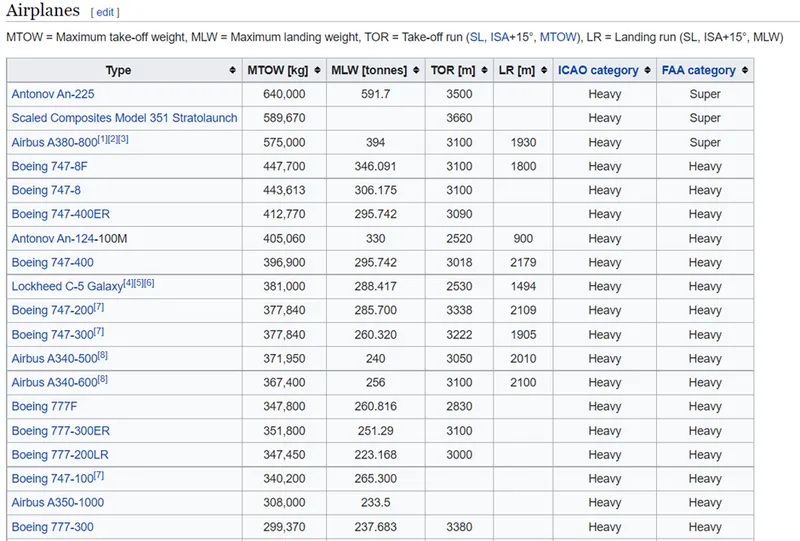
List out the total weight of various types of aircrafts.
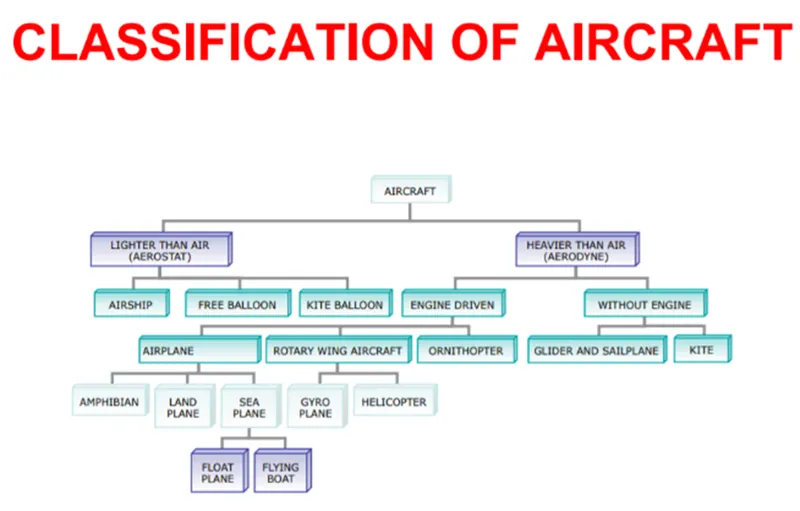
The different terms represent different weights or masses. For each flight, the weights are taken into account for several reasons.
A brief description about these is below:
Manufacturer's empty weight (MEW)
Also called Manufacturer's Weight Empty (MWE) or Licensed Empty Weight
It is the weight of the aircraft "as built" and includes the weight of the structure, power plant, furnishings, installations, systems and other equipment that are considered an integral part of an aircraft.
This excludes any baggage, passengers, or usable fuel2.
Zero-fuel weight (ZFW)
This is the total weight of the airplane and all its contents (including unusable fuel), but excluding the total weight of the usable fuel on board.
As a flight progresses and fuel is consumed, the total weight of the airplane reduces, but the ZFW remains constant.
Maximum zero fuel weight (MZFW) is the maximum weight allowed before usable fuel and other specified usable agents (engine injection fluid, and other consumable propulsion agents) are loaded.
Operating empty weight (OEW) (Roughly equivalent to basic empty weight on light aircraft)
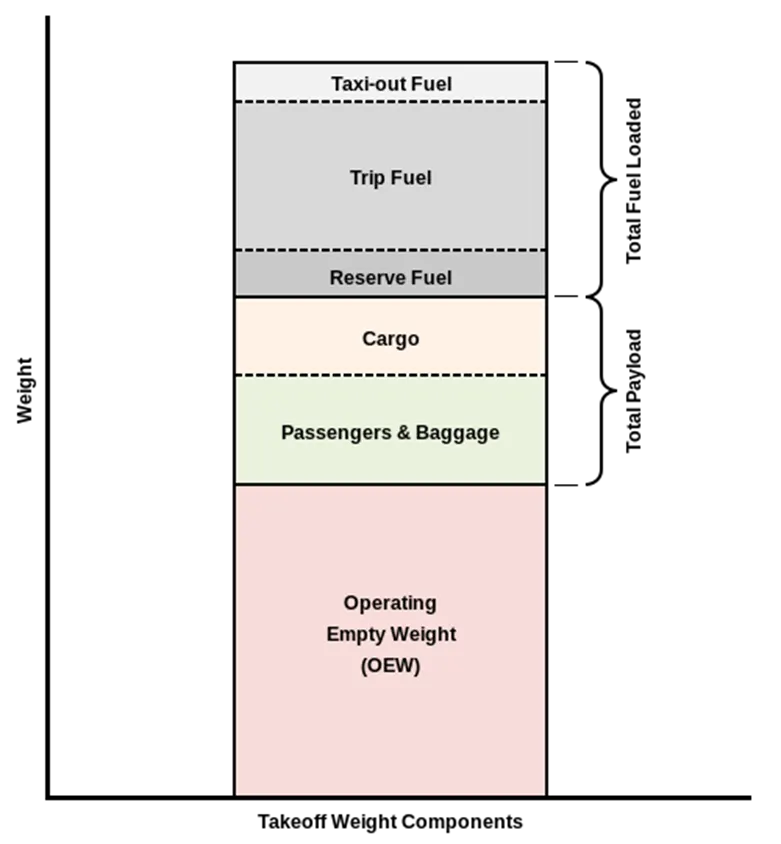
It is the basic weight of an aircraft including the crew, all fluids necessary for operation such as engine oil, engine coolant, water, unusable fuel and all operator items and equipment required for flight but excluding usable fuel and the payload.
It is the carrying capacity of an aircraft. It includes cargo, people, extra fuel. In the case of a commercial airliner, it may refer only to revenue-generating cargo or paying passengers.
Maximum takeoff weight (MTOW)
This is the maximum weight at which the pilot of the aircraft is allowed to attempt to take off.
Regulated takeoff weight (RTOW)
Depending on different factors (e.g. flap setting, altitude, air temperature, length of runway), RTOW or maximum permissible takeoff weight varies for each takeoff. It can never be higher than MTOW. More information is on this answer.
Maximum landing weight (MLW)
This maximum weight at which an aircraft is permitted to land.
The following image depicts takeoff weight components.
Maximum ramp weight (MRW)
also called maximum taxi weight (MTW)
It is the maximum weight authorized for maneuvering (taxiing or towing) an aircraft on the ground.
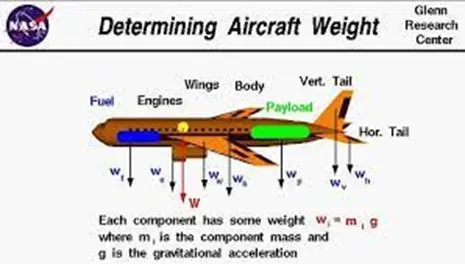
It is the total aircraft weight at any moment during the flight or ground operation. This decreases during flight due to fuel and oil consumption
Weight is a major factor in airplane construction and operation, and it demands respect from all pilots and particular diligence by all maintenance personnel. Excessive weight reduces the efficiency of an aircraft and the available safety margin if an emergency condition should arise. The total weight is the maximum take-off weight. It is the maximum mass at which the aircraft is certified for take-off due to structural or other limits.
2.Difference between ground speed and air speed
The importance of the relative velocity explains why, even today, airplanes take off and land on different runways on different days. Airplanes always try to take off and land into the wind. This requires a lower ground speed, which means the plane can take off or land in the shortest distance travelled along the ground.
Since runways have a fixed length, you want to get airborne as fast as possible on take-off and stopped as soon as possible on landing. In the old days, a large "wind sock" was hung near the runway for pilots to see which way the wind was blowing to adjust their take-off and landing directions.
Now mechanical or electronic devices provide the information that is radioed to the cockpit. It is important to understand the relationships of wind speed to ground speed and airspeed.
wind speed is a vector quantity and has both magnitude and direction. The wind blowing against the motion of aircraft is called Head wind.
We have defined a positive velocity to be in direction of the aircraft motion, head wind a negative velocity. When the wind blows in the same direction of aircraft motion it is called Tail wind. The sign of wind is now positive.
Ground Speed: The speed on which the aircraft moves relative to the point on the ground. Ground speed is a vecte quantity.
Air Speed: The relative velocity between the object and the air is called air speed. Airspeed cannot be directly measured from a ground position, but must be computed from the ground speed and the wind speed. Airspeed is the vector difference between the ground speed and the wind speed.
AIR SPEED GROUND SPEED
Speed relative to air. • Measured quantity. Using Pitot
Speed relative to ground. • Calculated quantity. (Air speed + tube. Wind velocity)
Study -3:
Why is it not recommended to use aircraft engine power to move it on the ground at Airport?
Aircraft can move using their own engine power all the time on the airport apron and taxiways under their own power to go towards runways and after landing taxi to their assigned gate. But the thrust produced resulting jet blast might cause damage to the terminal building or equipment.Engines close to the ground may also blow sand and debris forward and then suck them into the engine, causing damage to the engine. A pushback is therefore the preferred method to move the aircraft away from the gate. And also it can reduce the cost for fuel. Taxing can save money.
STUDY 4:
How an aircraft is pushed to runway when it's ready to take off?
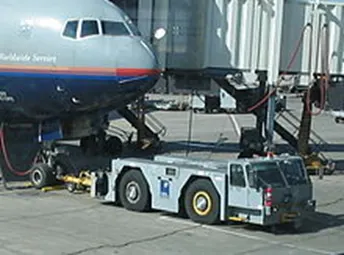
Pushback is when an aircraft is pushed backwards away from the airport gate by vehicles called tugs or tractors. Closer to departure, an alcraft tug will park right in front of the nose wheel. The tug might be directly attached to the plane's nose gear with a tow bar, or could be a "wheel-lift" tug. These tugs cradle the nose gear, then lift it up before moving the plane.
That gives the tug driver control over the plane's direction during pushback. New taxi technologies are appearing, like pilot-controlled tugs, and electric motors mounted to the plane's landing gear. Both promise to save fuel, and reduce airport noise...
A normal take-off is one in which the airplane is headed into the wind, or the wind is very light. Also, the take-off surface is firm and of sufficient length to permit the airplane to gradually accelerate to normal lift-off and climb-out speed, and there are no obstructions along the take-off path.
Study 5
Learn about take-off power, tyre design, rolling resistance, tyre pressure, brake forces when landing.
Takeoff power:
The amount of power that an engine is allowed to produce for a limited period of time for takeoff.The use of takeoff power is usuallylimited to5minfor reciprocating engines and up to 2½ min for gas turbine engines. This may not always be the case. Specifically, with respect to reciprocating engines, it is the brake horsepower developed under standard, sealevel conditions and under the maximum conditions of the crankshaft rotational speed and the engine manifold pressure approved for the normal takeoff.
It is limited in continuous use to the period of time shown in the approved enginespecifications.With respect to gas turbine engines,it is the thrust developed under staticconditions at a specified altitude and atmospheric conditions of the rotor shaft rotational speed and gas temperature approved for the normal takeoff. It is limited in continuous use to the period of time shown in the approved engine specifications.
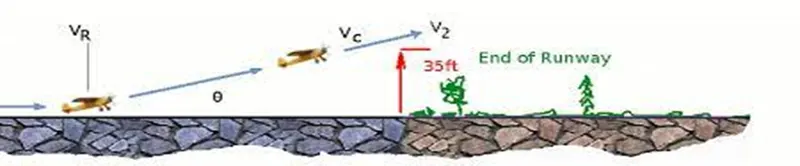
Take off power can be predicted using a simple measure of the acceleration of the aircraft along the runway based
on force equilibrium. The forces involved will be.
T is Thrust of propulsion system pushing aircraft along the runway.
D is Aerodynamic Drag of vehicle resisting the aircraft motion.
F is Rolling resistance friction due to the contact of wheels or skids on the ground.
During the take-off run, the imbalance in these forces will produce an acceleration along the runway.
m*(dv/dt)-T-D-F
where, dv/dt is the acceleration along the runway and m is the mass of the vehicle.
Many aviation technicians are not aware of the critical design factors of aircraft tyre in use today. I will discuss step by step, but first, I would like to ask the importance of tyre in aircraft.
Why are tyres important in Aircraft?
When it comes to safety, tyres are one of the most important components of aircraft. They help to absorb the shock of landing and provide cushioning. It also provides the necessary traction for braking and stopping of an aircraft.
An aircraft tyre is designed to withstand extremely heavy loads while landing, take off, taxing, and parking. The number of wheels required for aircraft increases with the weight of the aircraft, as the weight of the aeroplane needs to be distributed more evenly.
A Boeing 737NG & 737MAX uses 6 wheels, Boeing 787 uses 10 wheels, Boeing 777 uses 14 wheels and Airbus A380 uses 22 wheels. Aircraft tyres work under extreme conditions, carrying up to 340 tons and accelerating at over 250 km/hour at takeoff, in addition to enduring varied environmental stress when in flight and taxiing.
Design and Construction of Aircraft tyre
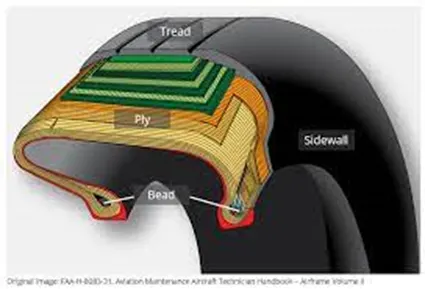
Carcass plies are used to form the tire. They are sometimes called casing plies. An aircraft tyre is constructed for the purpose it serves.
- They support the weight of an aircraft while it is on the ground.
- It also provides the necessary traction for braking and stopping of an aeroplane.
- Tyre also helps to absorb the shock of landing and provide cushioning the roughness of takeoff, roll-out, and taxi operations.
-
Unlike an automobile or truck tyre, it does not have to carry a load for a long period of continuous operation. However, an aircraft tyre absorbs the high impact loads of landing, and also it’s operating at high speeds for a short time when required.
Retreading – Retreading is methods of restoring a worn tyre by renewing the tread area or by renewing the tread area plus one or both sidewalls. Repairs are included in the tyre retreading process.
Load Rating – Load rating is the maximum permissible load at a specified inflation pressure.
Ply Rating – Ply Rating is used to identify the maximum recommended load rating and inflation pressure for a specified tyre. It is an index of tyre strength.
Speed Rating – The speed rating is the maximum takeoff speed to which the tyre has been tested.
Skid Depth – Skid depth is the distance between the tread surface and the deepest groove as measured in the mould.
Aircraft tyres must have an approved speed and load rating and have sufficient clearance when retracted through landing gear to allow for tyre growth. Tyre growth is the increase in the size of the tyre due to centrifugal forces at high speed.
Aircraft tyres may be Tube-type or Tubeless
Tubeless tyres are more advantageous over tube-type. There is no longer the use of tube-type tyre in recent aviation. Nowadays all airliners are using tubeless tyres. Tubeless that are meant to be used without a tube has the word TUBELESS on the sidewall of the tyre.
Aircraft tyres may be Radial or Bias
Almost all airliners are using Radial tyre. Bias is an older design, and it’s mainly used for road vehicles. Radial tyres have the word RADIAL on the sidewall. Radial tires are more expensive than bias-ply tyres. Radial tires are in demand because of their lower life cycle cost and long term value.
Are aviation tyres are conductive?
Yes, Today’s tyres are conductive. Aircraft tyres are manufactured with tread rubber with conducting compounds to permit earthing of static charges.
In early days when tyres were not sufficiently conductive, aircraft used to have a conductive strip hanging down from the axle of the landing gear. Upon landing, this strip would be the first part of the aircraft to touch the earth. This discharges any static electricity accumulated on the outer surfaces of the aircraft. No
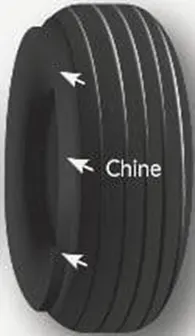
What is the purpose of Chines in aviation tyre
-
Chines are also called deflectors. Chine tyre used on the nose wheel of aircraft, specially fuselage-mounted jet engines. It diverts runway water away from the engine inlets.
Chines are circumferential protrusions that are moulded into the sidewall of nose tyres that deflect water sideways to help reduce excess water ingestion into the engines. Tyres may have chines on one or both sides, depending on the number of nose tyres on the aircraft.
Aircraft Tyre Standards
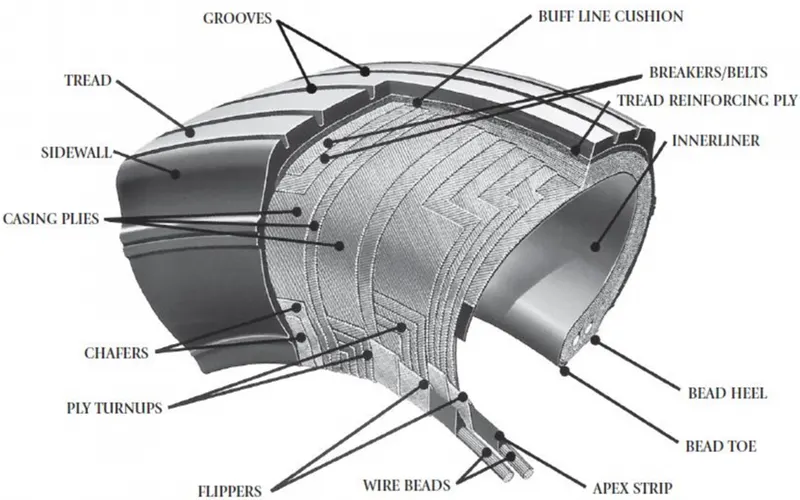
Each tyre manufacturer produces their own designs of the tyre with different tread patterns, wear patterns, wear limits etc, and in some cases, different names for the same part of the tyre. But all tyres must meet the approved standards before being accepted by the FAA or CAA.
All commercial aircraft tyres approved under FAA Requirement Technical Standard Order (TSO) C62. A TSO is a minimum performance standard for specified materials, parts, and appliances used on civil aircraft.
The tyre is inflated according to the aircraft manufacturer's maintenance manual. The tyre is not inflated directly according to the sidewall information or how the tyre appears. The tyre pressure in unloaded condition and loaded condition can vary as much as 4%.Under-inflated tyre can flex beyond the design limits of tyre. This can weaken the carcass construction and cause internal damage that is invisible externally.
Tyre pressure:
Tyre pressure changes ccording to the ambient temperature. For every 5 degree Fahrenheit change in the temperature, the tyre pressure changes by 1%. If the airplane is flying to colder ambient temperature, then the tyre might be in under-inflated condition. This problem is overcome by over inflating tyres at hotter ambient temperature departure regions. But this infition is made sure to be in design limits.
The aircraft tyre pressure is checked 3 hours after landing so that it cools to ambient temperature. The manufacturer of tyre provides table of appropriate pressure at different ambient temperature.
Under-inflation of tyre causes uneven wear of tread and premature replacement of tyre. It causes the sidewall to be pinched between wheel rim and runway. It causes the slip of beads on the rim Over-inflation causes tread wear at the center of tyre periphery and the tyre is not completely in touch with ground. Under-inflation causes tread wear at shoulders of tyre.
-
Rolling Resistance:
Rolling resistance is the force resisting the motion when apody (such as ball, tyre or wheel) rolls on a surface. Rolling resistance can be seen in the aircraft when the aircraft takes-off from the runway & while landing at the runway with the help of their wheels.
Rolling resistance can be expressed as From
Where resistance can be seen in the aircraft when the aircraft takes-off from the runway & while landing at the runway with the help of their wheels.
Rolling resistance can be expressed as F=mg (N).
Where Fis the Rolli resistance(N)
H is coefficient of rolling resistance,
m is mass (kg)
g is acceleration due to gravity = 9.81m/s^2
Brake Force
Stopping a heavy aircraft landing at high speed requires a lot of braking force. To do this, the aircraft has one brake unit on each of the eight wheels on the main gear assembly. On other aircraft types, the brake units are powered by the hydraulics system. An electrical signal is sent from the flight deck to hydraulic actuators near the main landing gear.
Here, hydraulic fluid at 3,000 pounds per square inch is used to force the brake unit against the wheel, thus slowing it down. This system works fine, but the pipes and actuators that form this part of the hydraulic system come at a considerable weight cost. Extra weight means more fuel burn, which in turn increases. costs and carbon emissions.
The different brakes used in this case are electric brake, anti-skid protection, auto brake, parking brake. For the purpose of braking spoilers and reverse thrust are also used
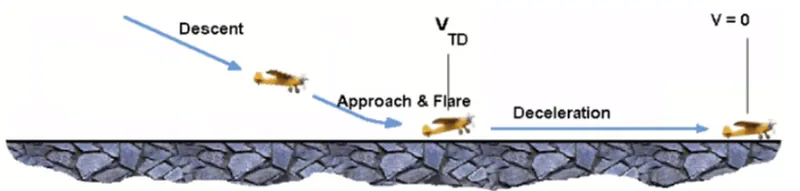
- The touch-down velocity should be approximately the stall speed of the aircraft in the landing configuration. This will 82be achieved by a pitch man ever during the flare portion of the approach which increases drag and) decelerates the aircraft to minimum flying speed.
The deceleration on the landing roll from Vip to Vo will be accomplished by braking and reverse thrust. This can be solved by the average acceleration approach that was used to estimate the take-off roll
study 6
- With necessary assumptions, calculate the force and power required to push/pull an aircraft by a towing vehicle.
Total mass of their aircraft(including payload)for air bus a 380 =575,000 kg.
Mass of the push back :1000kg (assumed)
Rolling resistance (Frr):
Coefficient of rolling resistance (Crr)=0.002 (on tarmac)
Rolling resistance force is given by Frr =Crr.m.g
For the air craft Frr =0.002.575000.9.81
Frr=12181.5N=11.2815 KN
For the towing vehicle :Frrt=0.002*1000*9.81=19.62 N
As the towing vehicle resistance is so less compared to the air craft because this is a heavy air craft these can be neglected
Aerodynamic resistance (Far)
Drag coefficient (Cd)=0.025
Air Density(p)= 1.125 kg/m^3
Front area (A) :150 m^2
Velocity (v) =14.5kmph or 4m/s
Far=1/2*Cd*p*A*v^2
Far=1/2*0.025*1.125*150*4^2
= 33.75N
As the vehicle and plane is moving at very low speed aero dynamic resistance can be neglected
Hill climbing Resistance :
Runways are constructed flat so gradient resistance /hill climb force is neglected
Total resistance :
Ft=11.2815KN
Power required :
P=Ft.v=11.285*4=45.26 kw
The main power required by the the vehicle is 45.26 kw to taxi a heavy air craft at 4m/s.
The simulation and block diagram of rolling resistance and aero dynamic force and total power and total force :
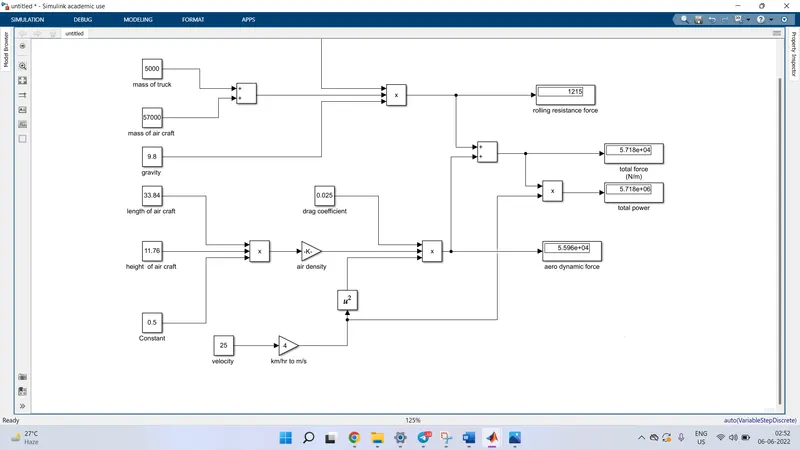
write the progarm for vartion of traction force with ma and rolling resistance coefficient and excuite the programs and we plot the results are below:
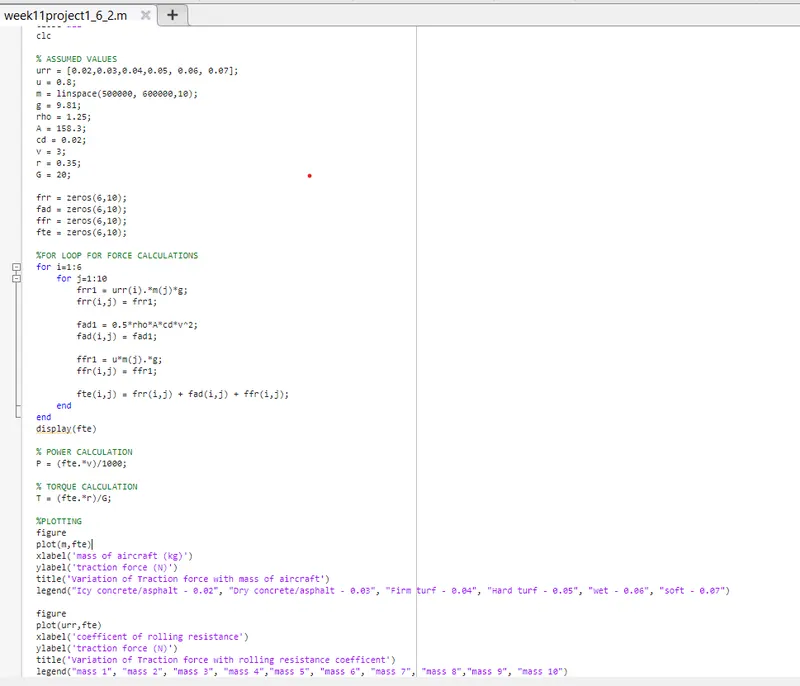
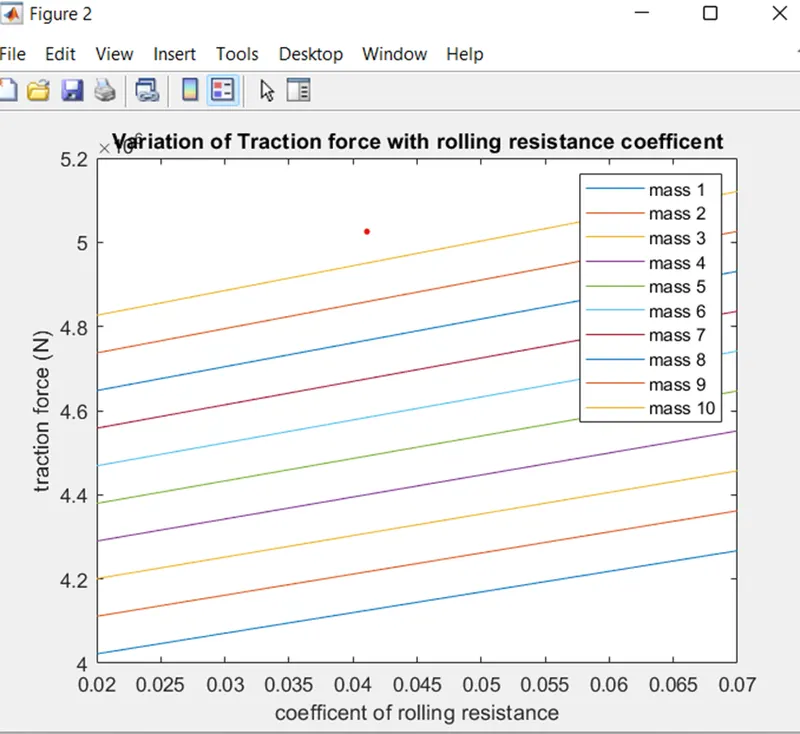
by the sumlation of the above progarm and we got some foces at difeerent points.
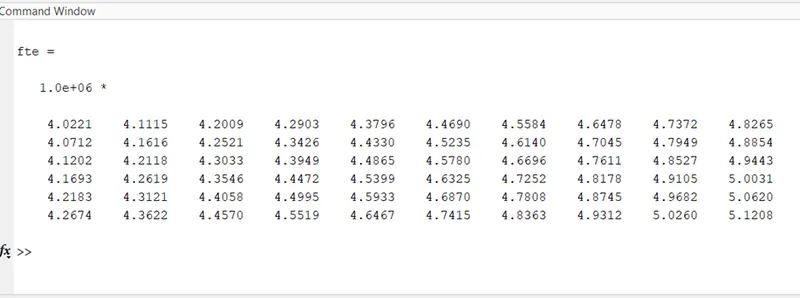
The plot shows the varation of tarction force with ma by using traction force and mass of the aircraft.
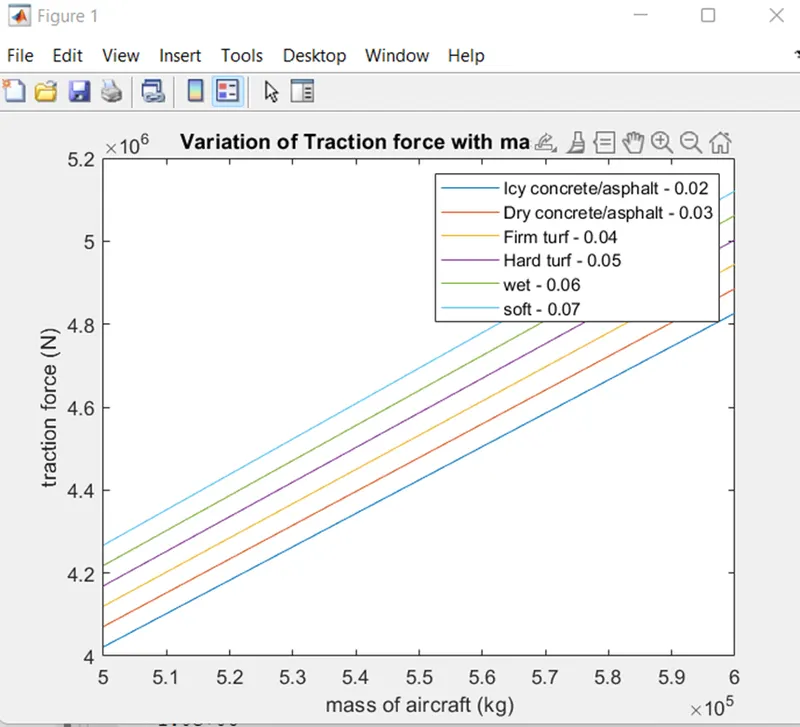
The traction force vs rolling resistance co efficient is gives varation of traction force with rolling resistance coefficient shown below.
- Design an electric powertrain with the type of motor, it's power rating, and energy requirement to fulfill aircraft towing application. Estimate the duty cycle range to control the aircraft speed from zero to highest. Make all required assumptions. Prepare a table of assumed parameters. Draw a block diagram of the powertrain.
A)Estimation of Duty Cycle:
Based on the calculation done in study 6
The Power Required for towing of the aircraft is 45.26kW.
Motor Considred for the drive train is REB 90
Considering 60kW as continuous power, so the voltage will be 400V
Battery power is considred to be 550v .
Duty cycle is given by Vo/Vb
where Vo is motor required voltage
Vb is battery voltage.
d= 400 550 ⇒ 0.7272
As there will be losses due to the resistance of FET and Inductance.
Correction factor is considred to be 90% As there is 10% loss, the voltafge demanded by the motor should be 10% more than required d 0.7272 (1+0.1) 0.799≈ 0.8
so the voltage demand should be around 440V from the battery.
Assumed parameters
Mass of aircraft 575000 kg
Mass of the push back track 1000 kg
coefficient of rolling resistance 0.002
Drag coefficient 0.025
Air density 1.125 kg/m^3
Frontal Area 150 m^2
Velocity 4 m/s
uphill gradient 0 deg
Battery voltage 550 v
correction Factor 0.8
Based on the calculations done in 6A.
Force required to push/pull the aircraft =19.508 KN
Power required =135.478 kw
Let us assume,
The Radius of the Tyre for the Tug - 25inches =0.635m
Gear ratio=8
Transmission Effeciency (nt) =87%
Motor Efficiency (nm)=95%
then,Torque required for the wheels (Tw)=Total Force *Radius in meters
=19.508 *0.635
=12.387KNm
Motor Torque-Wheel= torque/(Gear ratio'nt)
=12.387/(8 0.87)
=1.778KNm
For nm =95%. The required motor Torque (Tm)= 1.778/0.95 1.871 kNm
Similarly. The total power required by the motor considering all the efficiencies (Pt) =135.478/(0.87 0.95)=163.917Kw
Let us assume the towing operation was done for a 15 minutes (0.25Hrs) duration.
Then, Total Energy consumed = 163.917* 0.25 =40.98 KWh
If we consider the battery capacity=220 kw is used by the towing vehicle then. The duty cycle range to control the speed from O to max speed (3m/s) is given as
Duty Cycle (d)= (Required Power)/ (Rated power) = 163.917/220=0.75
Therefore the controller will be able to provide a duty cycle ranging from 0 to 75% in order to control the towing speed.
Block diagram of electric power train :
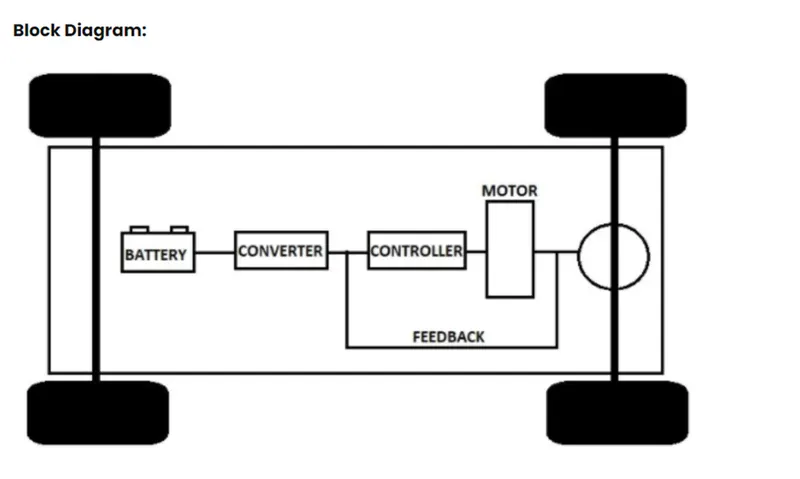
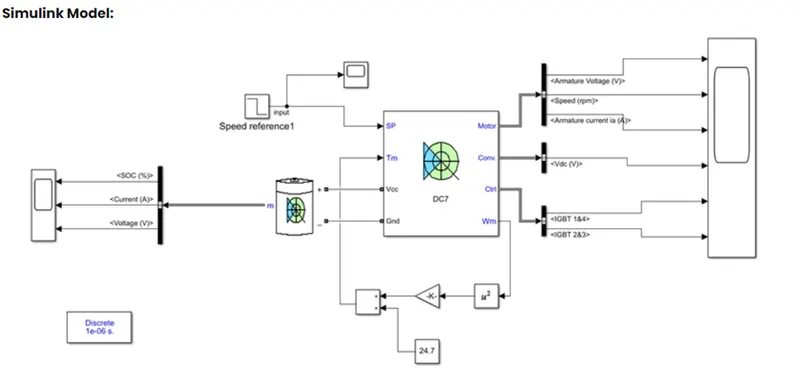
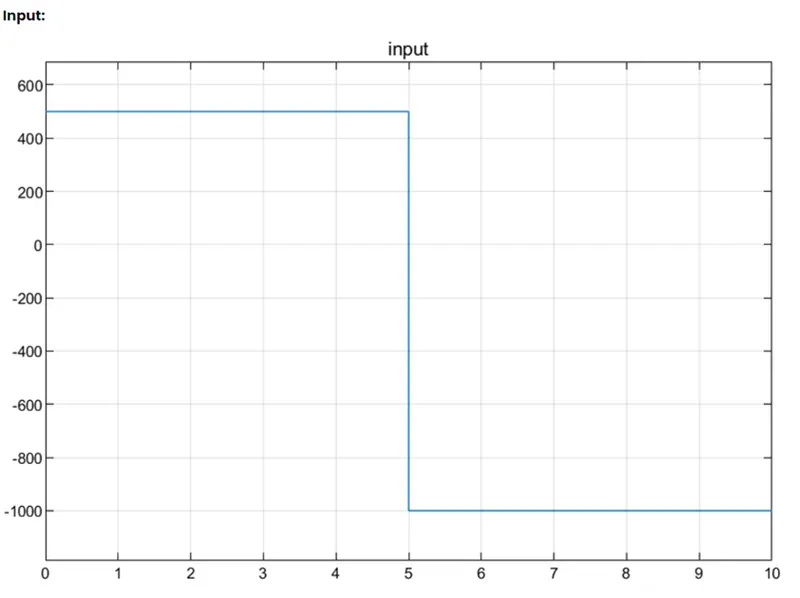
for the iinput singnal we are using step bolck and its input vale is 500 and and having 0.77 dyty cylce ratio. as shown below.
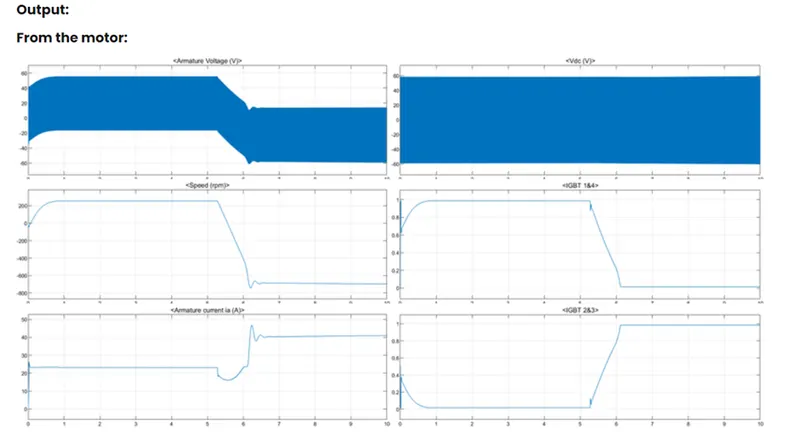
from the above module is simluated and motor output parameters of armature voltage and speed and armature current are shown below.
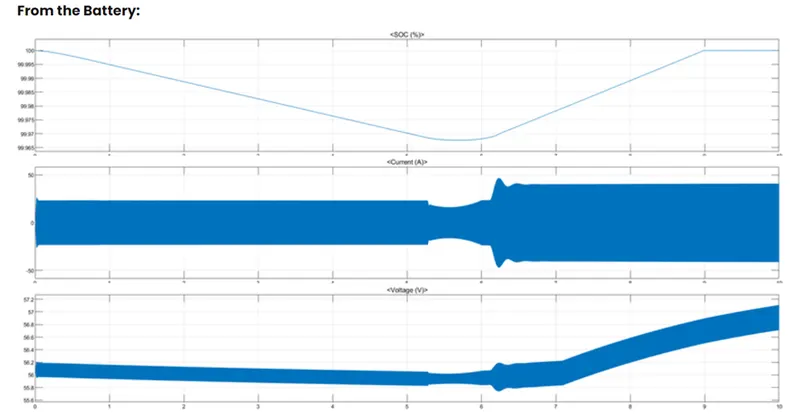
from this garph we are plots results of battery peromance parmeters are soc(safe operation condition)and battry current and baterry volatge charerstics are shown below
7 B. Design the parameters in excel sheet.
The excle sheet is attached below
conclusion:
With necessary assumptions, calculated the force and power required to push / pull an aircraft by a towing vehicle.
Develop the model for the calculated force and power using Simulink.
Designed an electric powertrain with type of motor, it’s power rating, and energy requirement to fulfill aircraft towing application in Simulink.
Estimated the duty cycle range to control the aircraft speed from zero to highest. plotted necessory required graphs.