Project-1: Powertrain for aircraft in runways
PART A
1. In an aeroplane, there are several weights.
1.empty weight of the manufacturer (MEW)
This weight includes the aircarft construction, power plant, furniture, installation, system, and equipment.
2. Zero fuel weight (ZFW)
This is the total weight of the aeroplane, including all of its contents, minus the total weight of usable fuel on board. Before usable fuel and other specified usable agents (engine injection fluid, and other consumable propulsion agents) are loaded, the maximum zero fuel weight (MZFW) is allowed.
3. Operating empty weight (OEW)
The basic weight of an aircraft includes the crew, all necessary operating fluids such as engine oil, engine coolant, water, unusable fuel, and all operator items and equipment, but not useable fuel or the payload.
4.Payload
It is an aircraft's carrying capacity. It contains goods, passengers, and more fuel. It may only relate to revenue-generating cargo or paying passengers on a commercial airliner.
5.Maximum takeoff Weight(MTOW)
This is the maximum weight at which the aircraft's pilot is permitted to attempt takeoff.
6.Regulated takeoff weight(RTOW)
The RTOW, or maximum allowed takeoff weight, fluctuates for each takeoff depending on several circumstances (e.g. flap setting, altitude, air temperature, runway length). It cannot be greater than MTOW.
7.Maximum landing weight(MLW)
This maximum weight at which an aircraft is permitted to land.
8.Maximum ramp weight(MRW)
It is the maximum weight authorized for maneuvering (taxiing or towing) an aircraft on the ground.
9 .Aircraft gross weight
It is the entire weight of the aircraft at any one time during flight or land operations. Due to fuel and oil consumption, this lowers during flight.
------------------------------------------------------------------------------------------------------------
2. There are two different types of speed when talking about airplanes – ground speed and airspeed.
While ground speed is the airplane’s speed relative to the surface of the Earth, airspeed – at least true airspeed – is its speed relative to the air it is flying in.
true airspeed is simply the speed at which an aircraft is moving relative to the air it is flying in. As such, it’s also the speed at which the air is flowing around the aircraft’s wings.
Ground speed, on the other hand, is the aircraft’s speed relative to the ground. One thing that should be noted here is that it’s its horizontal rather than vertical speed – an aircraft climbing completely vertically would have a ground speed of zero.
In other words, while airspeed is what determines whether there is enough airflow around an aircraft to make it fly, ground speed is what determines how fast an aircraft will get to its destination. Pilots commonly use three different types of airspeed: indicated airspeed, calibrated airspeed, and true airspeed.
Indicated airspeed is an airspeed that is calculated directly off an aircraft’s pitot-static system. It’s the calculated off the aircraft’s dynamic pressure – the difference between its total pressure and static pressure.The dynamic pressure depends not only on the aircraft’s speed, but also on the density of the air it is flying in. As such, the higher the aircraft flies – and the lower the air density as a result – the bigger the difference between indicated and true airspeed is.
Calibrated airspeed is indicated airspeed adjusted for a variety of errors.Just as an example, one of the things it’s adjusted for is the flap position. The reason for that is that at different flap positions, air flows differently around the pitot-static system and affects the indicated airspeed readings.
True airspeed is, as has been mentioned numerous times in this article, the actual speed at which an aircraft is moving relative to the air it is traveling in. It’s calibrated airspeed adjusted for the the exact conditions (altitude, air temperature, etc.) that the aircraft is flying in.
------------------------------------------------------------------------------------------------------------
3. Because aircraft lack reverse gear, it is not suggested to employ aircraft engine power. As a result, a pushback vehicle is required to connect the runway to the airport gates.
When planes employ reverse thrust, they will consume a lot of fuel, make a lot of noise, and be dangerous to those working nearby. When thrust is applied, a blast is created behind each engine. The jet explosion can harm or damage anything else in the way.Aircraft consume far too much fuel and contribute significantly to pollution. Because gasoline is expensive, engine power is not used to conserve money. The pilot in the cockpit of a moving aircraft has his eye level set at a distance that creates a blind spot. As a result, planes do not use engine power to move on the ground and instead rely on towing crews.
------------------------------------------------------------------------------------------------------------
4. The aeroplane moves on wheels when it is on the ground. It taxis from one location on the airport to another using taxiways.Engines provide taxiing's power. Propellers on aircrafts produce thrust and pull the aircraft forward. If it has a jet engine, it will exhaust air and generate forward force.The plane picks up enough speed as it begins to roll. Pilots return to using the rudder pedals to maintain the centre line once enough air has passed over the rudders.When the plane is loaded with passengers and luggage, the airport protocol is to use external power to push the plane backwards from the gate.
To avoid colliding, it moves on the ground following yellow lines. Taxiing has a speed limit, and the pilot slows the speed before a turn to avoid tyre skids.Pushbacks are performed by low-profile vehicles known as pushback tractors or tugs.
------------------------------------------------------------------------------------------------------------
5.
1.Take off power
The amount of power that an engine is allowed to produce for a limited period for take-off.
Take off powere with respect to reciprocating engines which means the brake horsepower that is developed under standard sea level conditions.Take off is the phase of flight in which an aerospace vehicle leaves the grund and becomes airborne.Take off speed varies with air density, aircraft gross weight and aircraft configuration. the power from the engine of the aircraft used to achieve the flight is called take off power.
2.tyre Design
The aircraft tires are designed to withstand extremely heavy loads while landing, takeoff, taxing and parking.When weight of aeroplane increased number of tires are evenly distribute the weight.Tires from by carcass piles. sometimes they called as casing piles.They support the weight of an aircraftwhile it is on the ground. It also provides the necessary traction for braking and to stop aeroplane.Tyre absorb the shock of landing and provide cushioning the roughness of take-off, roll-out and taxii operations.
3. Rolling resistance
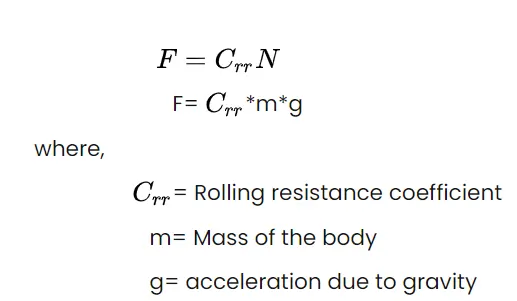
Rolling resistance is a forcethat resists the motion of a body when it rolls on a surface.
it is caused by non elastic effects. Not all energy needed for defromation of the wheel is recovered when the pressure is removed.
Frr =murr*mg
4.Tyre pressure
Aircraft tires usually operate at high pressure up to 200psi for airlineres, when
it is high for jets, the main landing gear on the concorde was inflated while its tail bumper gear tires were inflated at high pressure.Air craft tires are usually inflated at high pressure to sustain the heavy loadds during take -off, landing and taxing. They are typically made of nylon and more recently a variety known as aramid.
5. Brake force when loading
When aircraft is landing at over 150mph speed is a difficulty take. Aircraft rely on braking system fro safe landing n runways.Most aircrafts use their wing spoilers to assist braking while landing. the spilers are extendable flaps at the ends of wings. Pilots raise the spoilers to decelearate upon reaching the runway and kept raise till the plan comes to halt. The raised sopiler increases drag that slows down the plan.
------------------------------------------------------------------------------------------------------------
PART -B
6.
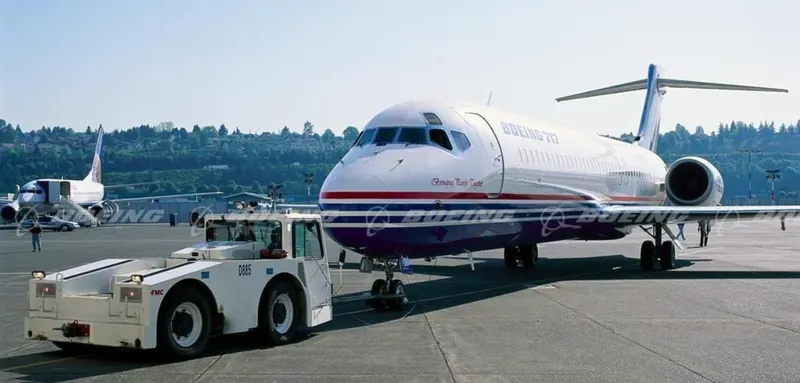
The forces required to push/ pull an aircraft by a towing are rolling resistance force and areodynamic drag force.
1)Rolling resistance force:- As we have discussed in part-A 5c. It is the force resisting the motion when a body (such as a ball, tire, or wheel) rolls on a surface. Its governing equation is given as
2)Aerodynamic Drag Force :-
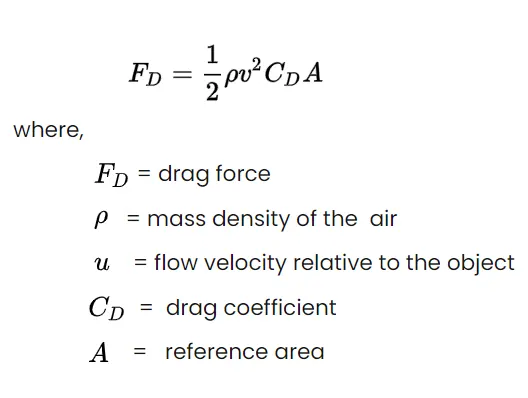
It is the force opposing the motion of the body. The drag coefficient is a common measure in automotive design as it
pertains to aerodynamics. Drag is a force that acts parallel to and in the same direction as the airflow. The drag coefficient of an automobile measures the way the automobile passes through the surrounding air. When automobile companies design a new vehicle, they take into consideration the automobile drag coefficient in addition to the other performance characteristics. Aerodynamic drag increases with the square of speed; therefore, it becomes critically important at higher speeds. Reducing the drag coefficient in an automobile improves the performance of the vehicle as it pertains to speed and fuel efficiency. The governing equation of these force is given as following:
Calculation:-
let us assume that,
Mass of Towing Vehicle= 45,000kg
Mass of aircraft = 155,000kg
Total mass (m)= 45,000+155,000 =200,000kg
Frontal Area of the aircraft (A) =18 m2
Speed of the vehicle ( u ) =25kmph
converting it into m/sec
u = 25*(1000/3600) =6.9445m/sec
Drag coefficient (cd) =0.75
Air density ( p ) =1.225kg/m3
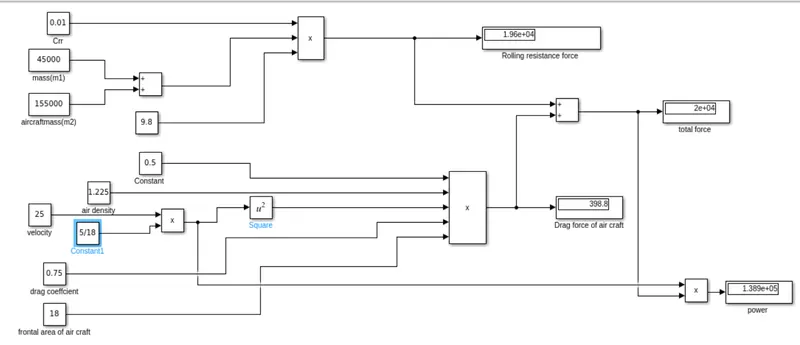
Calculating Rolling resistance Force (Frr) = Cry*m*g
= 0.01*200,000*9.8
= 19,600N
Calculating Aerodynamic Drag Force (Fd)=0.5*p * Cd*A* v/2
=0.5*1.225*18*0.75*(6.9445)2
=398.769N
Therefore the total Force required to push/pull the aircrcraft by the towing vehicle (F) = Frr+ Fd
= 19,600+ 398.769
= 19,998.769 N
Calculating the power (p) = Force*Velocity
= 19998.769* 6.9445
=138.881kW
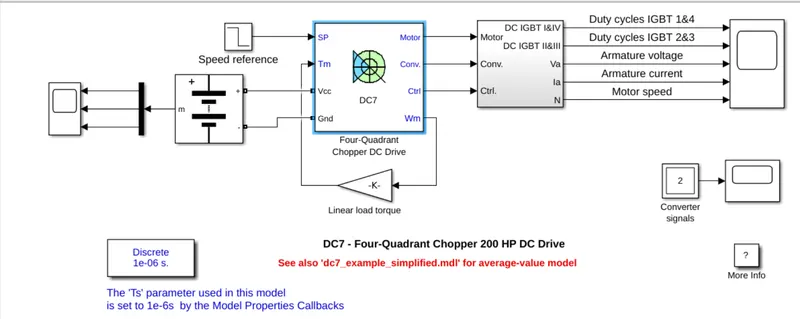
b. SIMULINK MODEL OF CALCULATED MODEL
------------------------------------------------------------------------------------------------------------
7.
Block diagram of a power train
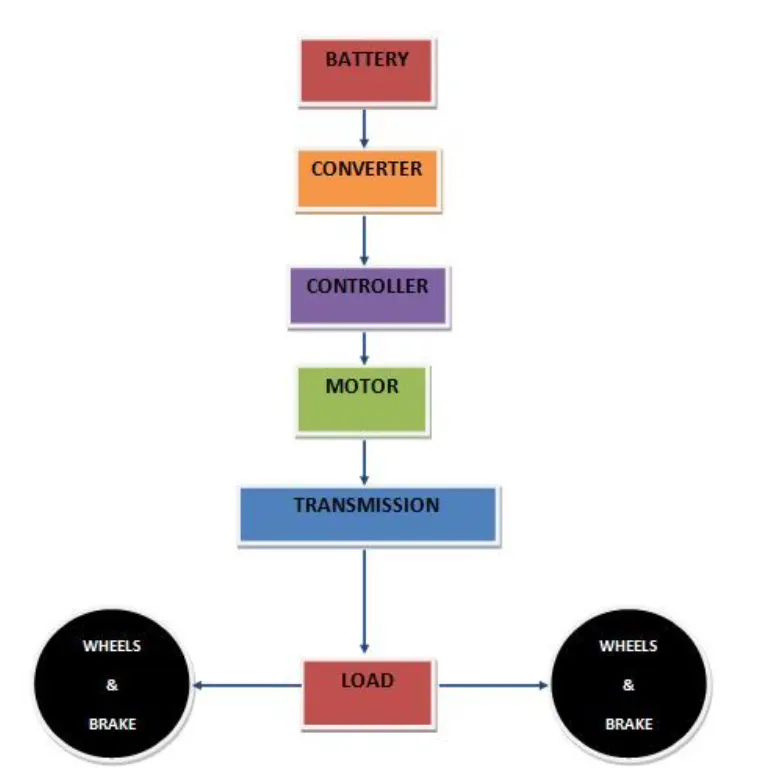
Based on the calculations done in 6A.
Force required to push/pull the aircraft =37.65KN
Power required =261.6KW
Let us assume,
The Radius of the Tyre for the Tug - 25inches =0.635m
Gear ratio=8
Transmission Effeciency (nt) =87%
Motor Efficiency (nm)=95%
then,
Torque required for the wheels (Tw)=Total Force *Radius in meters =37.65*0.635 =23.907KNm
Motor Torque-Wheel torque/(Gear ratio*nt) =23.907/(8*0.87) =3.434KNm
For nm =95%. The required motor Torque (Tm)= 3.434/0.95 =3.615KNm
Similarly. The total power required by the motor considering all the efficiencies (Pt) = 261.6/(0.87*0.95)=316.515Kw
Let us assume the towing operation was done for a 15 minutes (0.25Hrs) duration.
Then, Total Energy consumed = 316.515* 0.25=79.12 KWh
If we consider the battery capacity=420 kw is used by the towing vehicle then. The duty cycle range to control the speed
from 0 to
max speed (3m/s) is given as
Duty Cycle (d)= (Required Power)/ (Rated power)= 316.51/420 =0.75
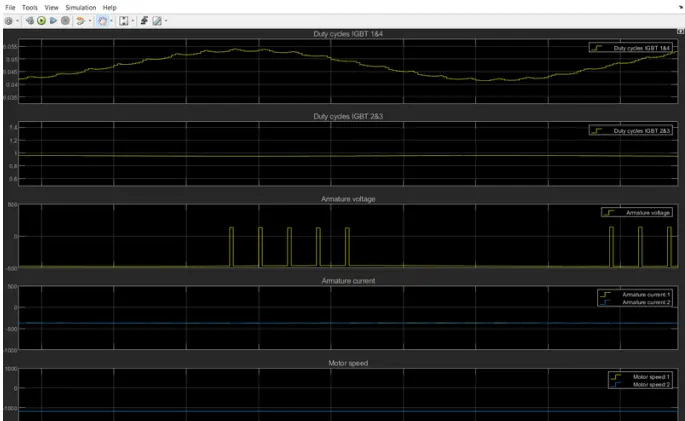
Therefore the controller will be able to provide a duty cycle ranging from 0 to 75% in order to control the towing speed
Simulation of the required model
Simulation results
Excel :
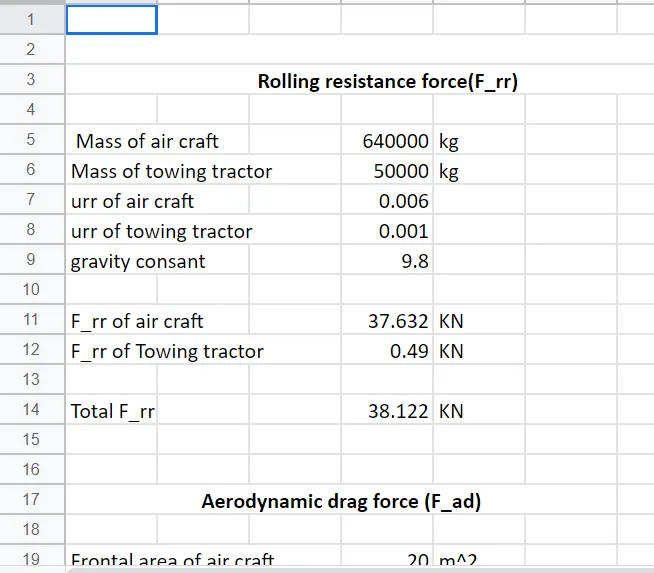
https://docs.google.com/spreadsheets/d/1bQmTJeLyaEeCTFGQWSMxEb45ZaOmm0K_/edit?usp=sharing&ouid=104582857145168293489&rtpof=true&sd=true