Project-1: Powertrain for aircraft in runways
STUDENT OF ONLINE EV BATCH 16
PART-A
ANS 1 :
(1) Search and list out the total weight of various types of aircrafts.
| Aircraft | Empty Weight | Max Fuel Weight | Max Cargo Weight | Max Gross Takeoff Weight |
|---|---|---|---|---|
| Antanov AN-225 | 628,000 lbs 285,000 kg |
661,400 lbs 300,000 kg |
417,000 lbs 190,000 kg |
1,411,000 lbs 640,000 kg |
| Airbus A380-800 | 611,000 lbs 277,000 kg |
560,000 lbs 254,000 kg |
185,000 lbs 84,000 kg |
1,268,000 lbs 575,000 kg |
| Boeing 747-800 | 485,300 lbs 220,100 kg |
427,400 lbs 194,000 kg |
295,000 lbs 134,000 kg |
987,000 lbs 447,700 kg |
|
Airbus A340-500 |
370,000 lbs 168,000 kg |
386,300 lbs 175,000 kg |
119,000 lbs 54,000 kg |
820,000 lbs 372,000 kg |
| Boeing 777-300ER | 370,000 lbs 168,000 kg | 320,800 lbs 145,500 kg | 148,000 lbs 67,100 kg |
776,000 lbs 352,000 kg |
| Boeing 787-10 | 299,000 lbs 135,500 kg | 223,500 lbs 101,500 kg |
126,300 lbs 57,300 kg | 560,000 lbs 254,000 kg |
|
Boeing 737-900 |
98,500 lbs 44,700 kg |
53,100 lbs 24,000 kg |
44,600 lbs 20,200 kg |
187,000 lbs 85,000 kg |
| Airbus A320-100 | 93,900 lbs 42,600 kg |
48,700 lbs 22,100 kg |
44,000 lbs 20,000 kg |
150,000 lbs 68,000 kg |
| Embraer 190 | 63,500 lbs 28,800 kg |
28,600 lbs 13,000 kg |
28,800 lbs 13,100 kg |
106,000 lbs 48,000 kg |
| Gulfstream G650 | 54,000 lbs 24,500 kg | 48,200 lbs 21,900 kg | 6,500 lbs 3,000 kg |
100,000 lbs 45,200 kg |
| Bombardier CRJ900 | 48,160 lbs 21,850 kg | 19,600 lbs 8,900 kg | 6,075 lbs 2,760 kg | 80,500 lbs 36,500 kg |
| Bombardier Q400 | 39,300 lbs 17,800 kg |
11,700 lbs 5,300 kg |
18,700 lbs 8,500 kg |
62,000 lbs 28,000 kg |
| Learjet 75 | 13,900 lbs 6,300 kg | 6,060 lbs 2,750 kg |
2,900 lbs 1,300 kg |
21,500 lbs 9,700 kg |
| Cessna Citation CJ4 | 10,300 lbs 4,700 kg | 5,800 lbs 2,650 kg |
2,200 lbs 1,000 kg | 17,200 lbs 7,800 kg |
| Beechcraft King Air B100 | 7,100 lbs 3,200 kg | 3,200 lbs 1,450 kg |
4,150 lbs 1,900 kg |
12,000 lbs 5,400 kg |
| Diamond DA50 RG | 3,200 lbs 1,450 kg |
340 lbs 155 lbs |
1,250 lbs 560 kg |
4,400 lbs 2,000 kg |
| Beechcraft Bonanza G36 | 2,500 lbs 1,150 kg | 450 lbs 200 kg |
850 lbs 385 kg |
3,660 lbs 1,660 kg |
| Cessna 206H | 2,200 lbs 990 kg |
520 lbs 235 kg |
1,150 lbs 520 kg |
3,600 lbs 1,630 kg |
| Sirrus SR22 | 2,250 lbs 1,000 kg | 485 lbs 220 kg |
950 lbs 430 kg |
3,600 lbs 1,630 kg |
| Cessna 172R | 1,700 lbs 770 kg |
380 lbs 170 kg |
560 lbs 255 kg |
2,425 lbs 1,100 kg |
ANS 2 :
(2) Is there any difference between ground speed and air speed?
- Two kinds of speed in air plane as:
- Air speed.
- Ground speed.
|
Ground Speed |
Air Speed |
|
1. Speed relative to ground. |
1. Speed relative to air/wind. |
|
2. It is measured quanity. |
2. It is a calculated quanity. |
|
3. In Tail wind condition : GS=True air speed + Wind component |
3. On a perfectly still day, the airspeed is equal to the ground speed. |
|
4. In Head wind Condition : GS= True air speed - Wind component. |
4. If the wind is blowing in the same direction that the aircraft is moving, the airspeed will be less than the ground speed. |
|
5. It is a vector quanity. |
5. Airspeed, in contrast, is how fast an airplane is really flying strictly under its own power, which is calculated by subtracting the wind speed from the ground speed. |
ANS 3 :
(3) Why is it not recommended to use aircraft engine power to move it on the ground at Airport?
- High engine thrust during maintenance activity can cause considerable damage to airplanes and other elements in the airport environment.
- An example of this problem occurred after an airplane arrived at its final destination with a log entry indicating the flight crew had experienced anomalous engine operation.
ANS 4 :
(4) How an aircraft is pushed to runway when its ready to take off?
- A so-called pushback truck reverses the aircraft into taxiing position, pushing it with a towbar attached to the nose-wheel strut. Or, in the most modern versions, by actually lifting the wheel.
- That speeds up coupling and decoupling. The aircraft taxis to the runway to depart at the agreed time.
ANS 5 :
(5) Learn about take off power, tyre design, rolling resistance, tyre pressure, brake forces when landing.
TAKE OFF POWER :
- The amount of power that an engine is allowed to produce for a limited period of time for takeoff.
- The use of takeoff power is usually limited to 5 min for reciprocating engines and up to 2½ min for gas turbine engines.
- Specifically, with respect to reciprocating engines, it is the brake horsepower developed under standard,sealevel conditions and under the maximum conditions of the crankshaft rotational speed and the engine manifold pressure approved for the normal takeoff.
- It is limited in continuous use to the period of time shown in the approved engine specifications. With respect to gas turbine engines, it is the thrust developed under static conditions at a specified altitude and atmospheric conditions of the rotor shaft rotational speed and gas temperature approved for the normal takeoff.
TYRE DESIGN :
Carcass plies are used to form the tire. They are sometimes called casing plies. An aircraft tyre is constructed for the purpose it serves.
- They support the weight of an aircraft while it is on the ground.
- It also provides the necessary traction for braking and stopping of an aeroplane.
- Tyre also helps to absorb the shock of landing and provide cushioning the roughness of takeoff, roll-out, and taxi operations.
Unlike an automobile or truck tyre, it does not have to carry a load for a long period of continuous operation. However, an aircraft tyre absorbs the high impact loads of landing, and also it’s operating at high speeds for a short time when required.
- Let’s go through some technical aspects of the tyre.
RETREADING :
- Retreading is methods of restoring a worn tyre by renewing the tread area or by renewing the tread area plus one or both sidewalls. Repairs are included in the tyre retreading process.
LOAD RATING :
- Load rating is the maximum permissible load at a specified inflation pressure.
PLY RATING :
- Ply Rating is used to identify the maximum recommended load rating and inflation pressure for a specified tyre. It is an index of tyre strength.
SPEED RATING :
- The speed rating is the maximum takeoff speed to which the tyre has been tested.
SKID DEPTH :
- Skid depth is the distance between the tread surface and the deepest groove as measured in the mould.
- Aircraft tyres must have an approved speed and load rating and have sufficient clearance when retracted through landing gear to allow for tyre growth.
- Tyre growth is the increase in the size of the tyre due to centrifugal forces at high speed.
AIRCRAFT TYRES MAY BE TUBE-TYPE OR TUBELESS :
- Tubeless tyres are more advantageous over tube-type.
- There is no longer the use of tube-type tyre in recent aviation.
- Nowadays all airliners are using tubeless tyres.
- Tubeless that are meant to be used without a tube has the word TUBELESS on the sidewall of the tyre.
AIRCRAFT TYRES MAY BE RADIAL OR BIAS :
- Almost all airliners are using Radial tyre.
- Bias is an older design, and it’s mainly used for road vehicles.
- Radial tyres have the word RADIAL on the sidewall. Radial tires are more expensive than bias-ply tyres.
- Radial tires are in demand because of their lower life cycle cost and long term value.
ROLLING RESISTANCE :
- In the broad sense, specific "rolling resistance" (for vehicles) is the force per unit vehicle weight required to move the vehicle on level ground at a constant slow speed where aerodynamic drag (air resistance) is insignificant and also where there are no traction (motor) forces or brakes applied.
TYRE PRESSURE :
- The high-flying rubber is typically inflated to 200 psi, roughly six times what you put in an automobile tire, and the tires on an F-16 fighter are pumped to 320 psi.
- “It's really pressurized air that's so strong,”
BRAKE FORCE :
- The brake units are powered by the hydraulics system.
- An electrical signal is sent from the flight deck to hydraulic actuators near the main landing gear.
- Here, hydraulic fluid at 3,000 pound per square inch is used to force the brake unit against the wheel, thus slowing it down.
PART-B
ANS 6 :
(A ) With necessary assumptions, calculate the force and power required to push / pull an aircraft by a towing vehicle.
- To push or pull an aircaft by a towing vehicle, there are two forces acting on that :
1. Rolling Resistance Force.
2. Aerodynamic Drag Force.
Data has been copied for calculation.
Calculation :
Let's consider,
Towing Vehicle Mass = 50,000 kg
Aircraft mass = 183700 kg
Total mass of the vehicle= (50000+183700) = 233700 kg
Speed of the vehicle (V) = 10 km/hr = 2.77m/s
Now, Rolling Resistance Force is :
Since, Frr=urr*m*g;
= 0.013 *233700*9.8;
= 29773.38 N
Now, Calculating Aerodynamic Drag force as :
Since, Fad= 0.5*p*(v)^2*A*(Cdt+Cda);
= 0.5 *1.225*(2.778)^2*20*(.5+0.045);
= 51.514 N
So, Total Traction Force is :
Ftr=Frr+Fad;
= (29773.38+51.514);
= 29824.894 N
Now, Total power can be calculated as :
T= Ftr*v;
= 29824.894*2.77:
= 8282375 W;
i.e = 82.823 KW
(B) Develop the model for the calculated force and power using Simulink.
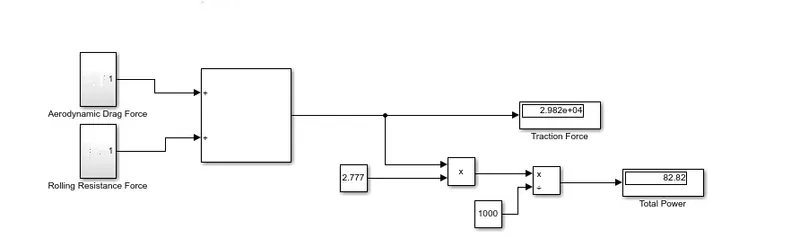
To create this model Rolling Resistance Force and Aerodynamic Force has been calculated separetly than the subsytem was created and connected with the add block . Later on two scope , one Divide block, product block, and Two constant block have been used and proper system was created then simulate for 1 sec results are as under :
ANS 7 :
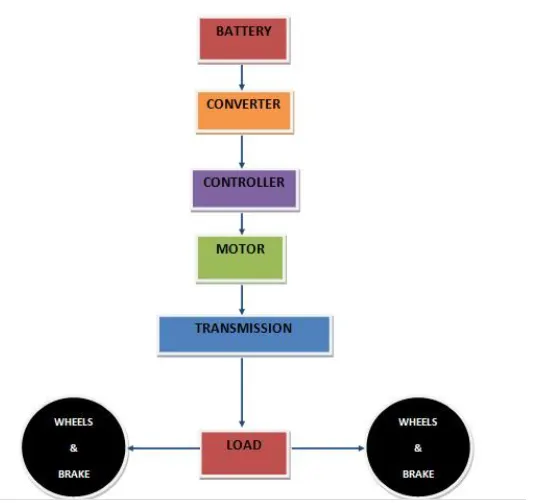
(A) Design an electric powertrain with type of motor, it’s power rating, and energy requirement to fulfill aircraft towing application in Simulink. Estimate the duty cycle range to control the aircraft speed from zero to highest. Make all required assumptions. Prepare a table of assumed parameters. Draw a block diagram of powertrain. (Hint :DC7 Block)
BLOCK DIAGRAM OF ELECTRIC POWER TRAIN :
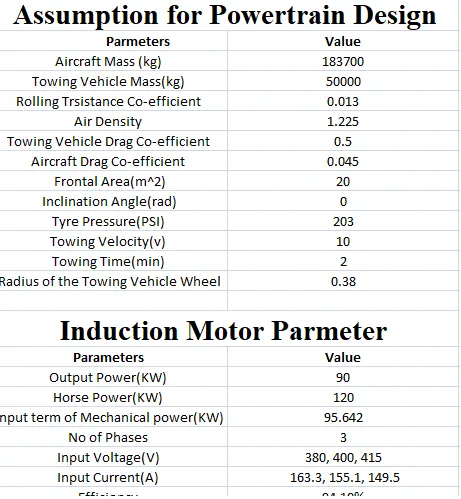
Assumption for Powertrain Design
| Parameter |
Value |
| Aircraft Mass |
183700 kg |
| Towing Vehicle Mass | 50000 kg |
| Rolling Trsistance Co-efficient | 0.013 |
| Air Density | 1.225 Kg/m^3 |
| Towing Vehicle Drag Co-efficient | 0.5 |
| Aircraft Drag Co-efficient | 0.045 |
| Frontal Area | 20 m^2 |
| Inclination Angle | 0 rad/s |
| Tyre Pressure | 203 PSI/14 bar |
| Towing Velocity(v) | 10 Km/hr = 2.778 m/s |
| Towing Time(t) | 2 min |
| Radius of the Towing Vehicle Wheel | 0.38 m |
By using these values, we had calculated the traction force as:
F = 29824.8927 N;
Power = Force*Velocity;
= 29824.8927*2.778;
P = 82.84 KW;
Now, Calculating the torque Vale as :
T= F*r;
= 29824.8927*0.38;
= 11333.45 N-m;
Now, Required energy can be calculated as :
E = P*t;
= 82.82*(120/3600);
= 2.760 KWh;
For electric power train an induction motor or BLDC motor can be used as :
| Parameter | Rating |
| Input Power | 90 KW |
| Horse Power | 120 HP |
| Input term of Mechanical power | 95.642 KW |
| No of Phases | 3 |
| Input Voltage | 380V, 400V, 415V |
| Input Current | 163.3A, 155.1A, 149.5A |
| Efficiency | 94.10 % |
We know that duty cycle can be defiend as the ratio of output power to Input power and can be calculated as below :
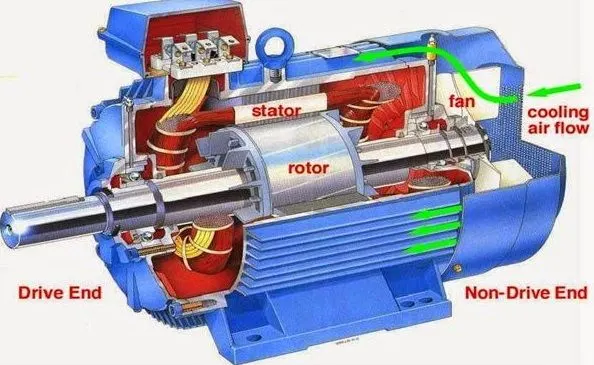
Duty Cycle = Output Power/Input Power;
= (82.82/90)*100;
= 92%
Simulink Model :
In this model AC source is replaced by DC source.
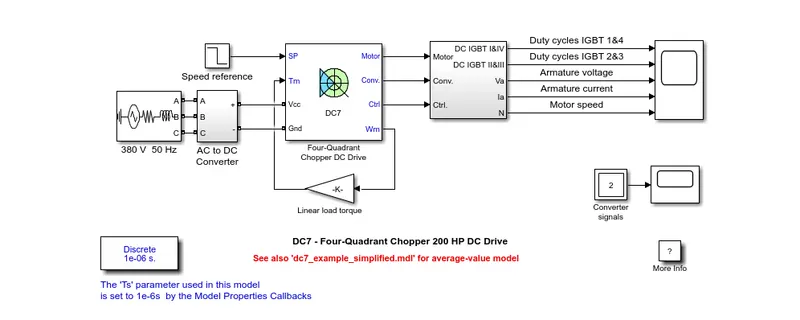
SIMULINK RESULTS :
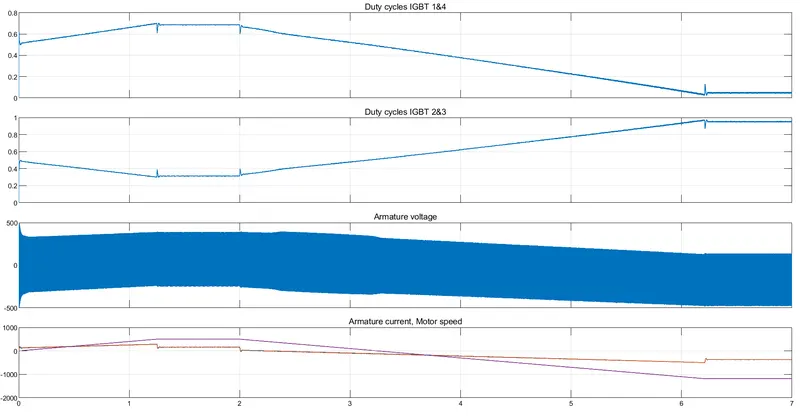
B. Also, Design the parameters in excel sheet.
Parmeters has been taken for calculation purpose only.
Reference :
Wikipedia