Project-1: Powertrain for aircraft in runways
Aim
To Powertrain for aircraft in runways
object:-
Part A:
1. Search and list out the total weight of various types of aircraft.
2. Is there any difference between ground speed and airspeed?
3. Why is it not recommended to use aircraft engine power to move it on the ground at the Airport?
4. How an aircraft is pushed to the runway when it's ready to take off?
5. Learn about taking off the power, tire design, rolling resistance, tire pressure, and brake forces when landing.
Part B:
6. A. With necessary assumptions, calculate the force and power required to push/pull an aircraft by a towing vehicle.
B. Develop the model for the calculated force and power using Simulink.
7. A. Design an electric powertrain with the type of motor, its power rating, and energy required to fulfill aircraft towing application in Simulink. Estimate the duty cycle range to control the aircraft speed from zero to highest. Make all required assumptions. Prepare a table of assumed parameters. Draw a block diagram of the powertrain.
B. Also, Design the parameters in an excel sheet.
Q.
1. Search and list out the total weight of various types of aircraft.
Ans:-
list out the total weight of various types of aircraft.
Weight is a major factor in airplane construction and operation, and it demands respect from all pilots and particular diligence by all maintenance personnel. Excessive weight reduces the efficiency of an aircraft and the available safety margin if an emergency condition should arise. the total weight is the maximum take-off weight .it is the maximum mass at which the aircraft is certified for take-off due to structural or other limits.
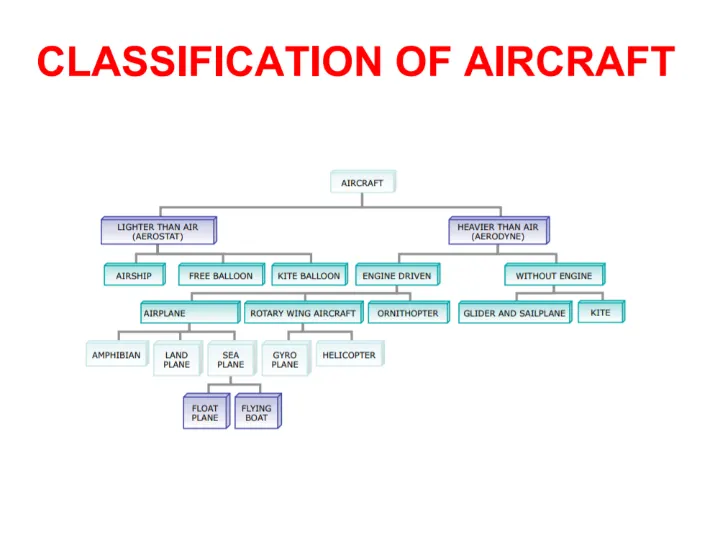
Aircraft Total weight (Take-off weight)
- Average sized airplane
Eg: Boeing 737-800 80000kg
- fighter jet
Eg: Boeing F-18 hornet 113646kg
2. Q
Is there any difference between ground speed and airspeed?
Ans:-
- On a perfectly still day, the airspeed is equal to the ground speed. But if the wind is blowing in the same direction that the aircraft is moving, the airspeed will be less than the ground speed.
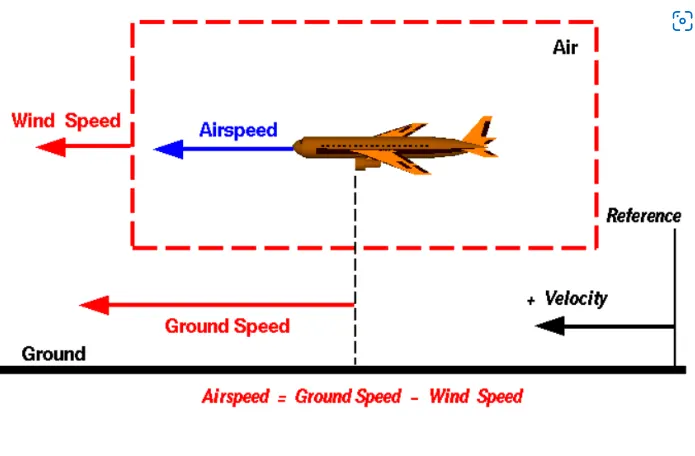
For pilots, both airspeed and ground speed is very important. While the first one helps them make sure they are flying fast enough to take off, not stall, and so on, the second one helps them figure out how long it will take them to get from one place to another.
On the other hand, if you are a passenger, you will only need to be concerned about the ground speed as that will tell you how fast are you flying from your origin to your destination – how fast you will be able to get to your meeting, meet your relatives, or do whatever else the reason for your travel might be.
Airspeed
- speed relative to air
- Measured quantity .using pitot tube.
Ground speed
- Speed relative to the ground
- Calculated quantity. (Air speed+ wind velocity)
3. Q
3. Why is it not recommended to use aircraft engine power to move it on the ground at the Airport?
Ans;-
Aircraft are designed to fly. When they’re going to spend more than 15 hours in the air, they need to perform as efficiently as possible. From getting the most power out of the engines to maximizing the lift from the wings, the main part of the design process is focused on the airborne aspect. However, it’s no good creating the perfect flying machine if you can’t get it to and from the terminal building. So, how do you get 200 tons of aircraft from the runway to the gate?
Q
4. 4. How an aircraft is pushed to the runway when it's ready to take off?
Ans:-
- The pilot parks the aircraft in exactly the right place. Usually with the help of an automatic system, but occasionally guided by a marshaller waving two paddles or wands. Dozens of handling personnel are already standing by to perform a whole range of tasks simultaneously.
- As soon as the aircraft is stationary and the engines are switched off, the priority is to disembark the passengers as quickly as possible. The apron handler places chocks in front of the wheels and connects the ground power. Meanwhile, the passenger bridge maneuvers up to the door, and a belt loader rolls up to the cargo hold. Luggage is unloaded and transferred to the terminal on baggage carts.
- Refuelling begins, usually from a hydrant at the stand. A hose is attached to this from a special vehicle called a dispenser, with the other side connected to the fuel tank in the wing. Read more about refueling here.
- Now it is time to service the aircraft. The caterer loads new meals and takes away the food waste and used cutlery and crockery. Other activities include draining the lavatories, replacing the headrest covers, removing rubbish, and distributing fresh blankets and in-flight magazines.
- A specialist team – or sometimes the crew themselves – cleans the cabin so that the new passengers board a pristine aircraft.
- Meanwhile, specialists from the airline conduct a technical check to make sure that the engines, wings, control surfaces, landing gear, instruments, doors, and other equipment are in full working order.
- The aircraft is now ready for baggage to be loaded for the next flight. This is a quick process, on average taking only 10-15 minutes. A little later the passengers start boarding. As soon as they are all in their seats, the door is closed and the pilot informs air-traffic control that the flight is ready for departure.
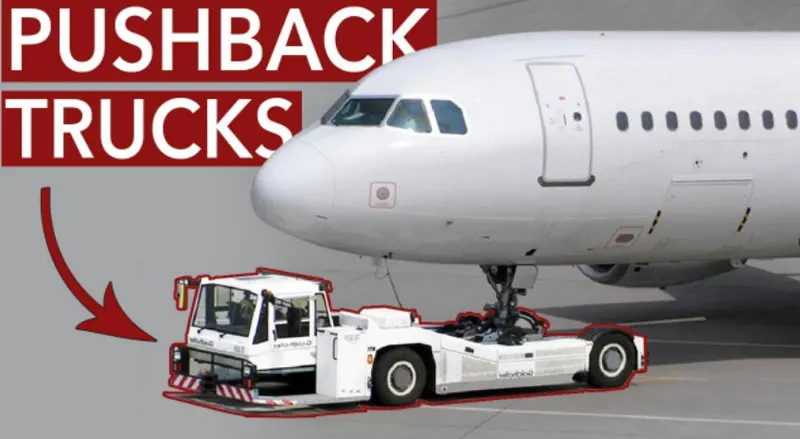
- The apron handler removes the chocks. A so-called pushback truck reverses the aircraft into taxiing position, pushing it with a towbar attached to the nose-wheel strut. Or, in the most modern versions, by actually lifting the wheel. That speeds up coupling and decoupling.
- The aircraft taxis to the runway to depart at the agreed time.
- The pilot waits for permission to take off from air-traffic control. This is possible once the departure route is clear. As soon as the go-ahead is received, the plane takes to the air at full power.
Q.5
5. Learn about take-off power, tire design, rolling resistance, tire pressure, and brake forces when landing.
Ans:-
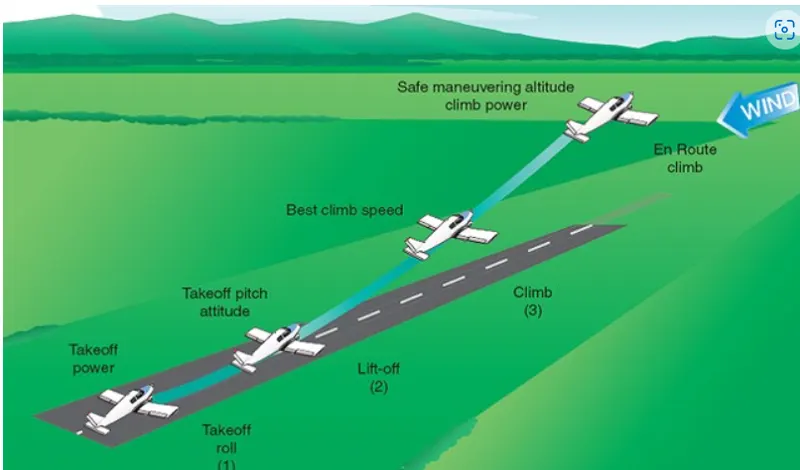
A normal take-off is one in which the airplane is headed into the wind, or the wind is very light .also the take-off surface is firm and of sufficient length to permit the airplane to gradually accelerate to normal lift-off and climb -uot speed, and there are no obstructions along the take-off path.
four forces help the aircraft the take-off
Wings keep an airplane up in the air, but the four forces are what make this happen. They push a plane up, down forward, or slow it down
Trust:-
T=pshsft.n/V
Drag:-
D=Cd.05.p.V^2.s
Weight:-
W=mg
Therefore Take-off power=total force *velocity
The following parameter of component design and model
i)
Design and Construction of Aircraft tire
Carcass plies are used to form the tire. They are sometimes called casing plies. An aircraft tire is constructed for the purpose it serves.
- They support the weight of an aircraft while it is on the ground.
- It also provides the necessary traction for braking and stopping an airplane.
- Tyre also helps to absorb the shock of landing and provides cushioning for the roughness of takeoff, roll-out, and taxi operations.
Unlike an automobile or truck tire, it does not have to carry a load for a long period of continuous operation. However, an aircraft tire absorbs the high impact loads of landing, and also it’s operating at high speeds for a short time when required.
Let’s go through some technical aspects of the tire.
Retreading – Retreading is a method of restoring a worn tire by renewing the tread area or by renewing the tread area plus one or both sidewalls. Repairs are included in the tire retreading process.
Ply Rating – Ply Rating is used to identify the maximum recommended load rating and inflation pressure for a specified tire. It is an index of tire strength.
Speed Rating – The speed rating is the maximum takeoff speed to which the tire has been tested.
Skid Depth – Skid depth is the distance between the tread surface and the deepest groove as measured in the mold.
Aircraft tires must have an approved speed and load rating and have sufficient clearance when retracted through landing gear to allow for tire growth. Tire growth is the increase in the size of the tire due to centrifugal forces at high speed.
Aircraft tires may be Tube-type or Tubeless
Tubeless tires are more advantageous over tube-type. There is no longer the use of tube-type tires in recent aviation. Nowadays all airliners are using tubeless tires. Tubeless that are meant to be used without a tube has the word TUBELESS on the sidewall of the tire.
Aircraft tires may be Radial or Bias
Almost all airliners are using Radial tires. Bias is an older design, and it’s mainly used for road vehicles. Radial tires have the word RADIAL on the sidewall. Radial tires are more expensive than bias-ply tires. Radial tires are in demand because of their lower life cycle cost and long-term value.
Further Read:
Are aviation tires are conductive?
Yes, Today’s tires are conductive. Aircraft tires are manufactured with tread rubber with conducting compounds to permit earthing of static charges.
In the early days when tires were not sufficiently conductive, aircraft used to have a conductive strip hanging down from the axle of the landing gear. Upon landing, this strip would be the first part of the aircraft to touch the earth. This discharges any static electricity accumulated on the outer surfaces of the aircraft. Now you don’t see them anymore.
What is the purpose of Chines in aviation tires?
Chines are also called deflectors. Chine tires are used on the nose wheel of aircraft, specially fuselage-mounted jet engines. It diverts runway water away from the engine inlets.
Chines are circumferential protrusions that are molded into the sidewall of nose tires that deflect water sideways to help reduce excess water ingestion into the engines. Tires may have chines on one or both sides, depending on the number of nose tires on the aircraft.
Aircraft Tyre Standards
Each tire manufacturer produces their designs of the tire with different tread patterns, wear patterns, wear limits, etc, and in some cases, different names for the same part of the tire. But all tires must meet the approved standards before being accepted by the FAA or CAA.
All commercial aircraft tires are approved under FAA Requirement Technical Standard Order (TSO) C62. A TSO is a minimum performance standard for specified materials, parts, and appliances used on civil aircraft.
Rolling Resistance
Rolling friction and rolling resistance.
The force that resists the motion of a body rolling on a surface is called the rolling resistance or the rolling friction.
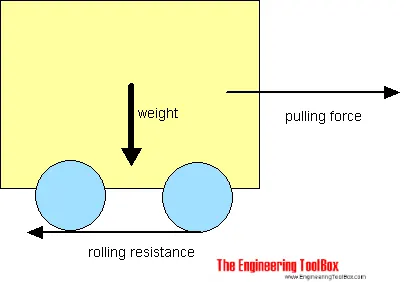
The rolling resistance can be expressed by the generic equation
Fr = c W (1)
where
Fr = rolling resistance or rolling friction (N, lbf)
c = rolling resistance coefficient - dimensionless (coefficient of rolling friction - CRF)
W = m ag
= normal force - or weight - of the body (N, lbf)
m = mass of body (kg, lb)
ag = acceleration of gravity (9.81 m/s2, 32.174 ft/s2)
Note that the rolling resistance coefficient - c - is influenced by different variables like wheel design, rolling surface, wheel dimensions, and more.
The rolling resistance can alternatively be expressed as
Fr = cl W / r (2)
where
cl = rolling resistance coefficient - dimension length (coefficient of rolling friction) (mm, in)
r = radius of wheel (mm, in)
Rolling Friction Coefficients
Some typical rolling coefficients:
| Rolling Resistance Coefficient | ||
|---|---|---|
| c | cl (mm) | |
| 0.001 - 0.002 | 0.5 | railroad steel wheels on steel rails |
| 0.001 | bicycle tire on wooden track | |
| 0.002 - 0.005 | low resistance tubeless tires | |
| 0.002 | bicycle tire on concrete | |
| 0.004 | bicycle tire on asphalt road | |
| 0.005 | dirty tram rails | |
| 0.006 - 0.01 | truck tire on asphalt | |
| 0.008 | bicycle tire on roughly paved road | |
| 0.01 - 0.015 | ordinary car tires on concrete, new asphalt, cobbles small new | |
| 0.02 | car tires on tar or asphalt | |
| 0.02 | car tires on gravel - rolled new | |
| 0.03 | car tires on cobbles - large worn | |
| 0.04 - 0.08 | car tire on solid sand, gravel loose worn, soil medium hard | |
| 0.2 - 0.4 | car tire on loose sand | |
tire pressure
Every aviator has their soapbox issues, and when it comes to maintenance, my top two are constant-speed propellers and aircraft tires. I may touch on the former in a future article, but for now, let’s focus on the latter.
Tires are one of the most vitally important — yet frequently ignored — parts of an aircraft. It’s easy to see why: they’re relatively simple elements that work day in and day out without a problem, and as such are taken for granted. In addition, some of the typical pilot’s attitude toward tires is transferred from the way they treat their automotive counterparts. To be honest, how often do you inspect your car’s tires? When was the last time you checked the pressure on all four wheels? I’m about as anal as a person gets when it comes to car maintenance and upkeep, and I might check the tires once every couple of months at best.
In a light GA aircraft, tire failure on the takeoff or landing roll can lead to loss of directional control, runway excursion, and/or a ground loop. These things are unlikely to be fatal but are frequently embarrassing and inconvenient as they’ll shut down the runway for a while. I’ve had several of those in my career. Ironically, it always seems to happen during a student’s softest, smoothest 3-point landing in the Decathlon. Well, almost always.
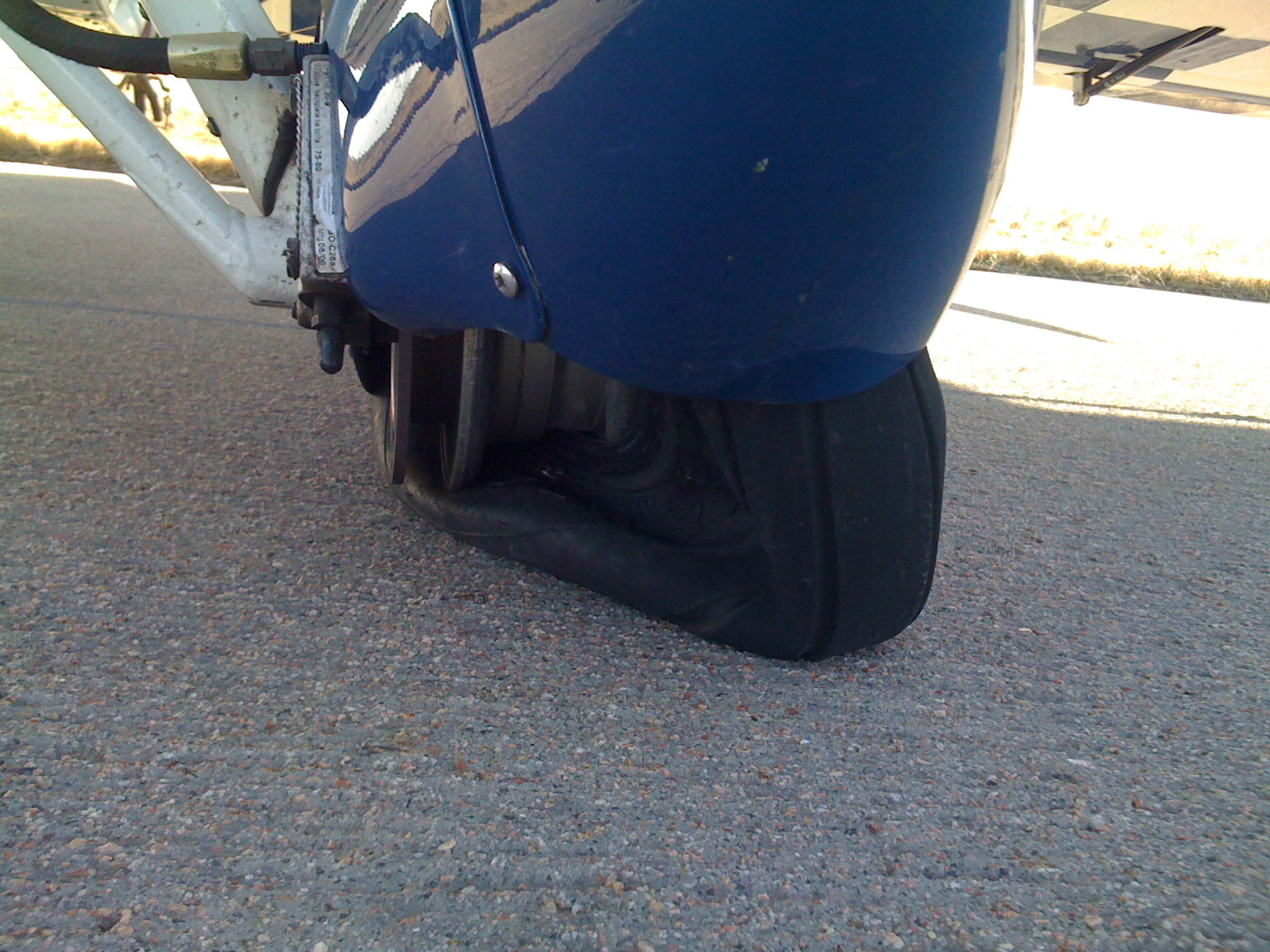 Not what you want to see on a deserted runway in the middle of nowhere as the sun is going down. " />
I once lost a tire while taxiing a Pitts S-2C. I had stopped for cheap fuel in Limon, Colorado, a paved but little-used strip on the edge of a small town near the Nebraska border. After a great landing in a 25-knot crosswind, I refueled and started to back-taxi on the runway when the left main tire slowly deflated. I shut down and opened the canopy, but as soon as my feet came off the brakes, the airplane weathervane into the wind, taking the tire right off the rim as it pivoted. Now I couldn’t even move the plane.
Oh, and did I mention the sun was setting soon and the runway had lights? Suddenly the flat tire was less important than ensuring some wayward pilot didn’t attempt a night landing with my disabled, unlighted biplane sitting on the runway.
Light aircraft flats are more often caused by the failure of the tube than the tire itself. The Pitts incident taught me the value not only of proper tire inflation but also of alighting at airports with maintenance services when flying cross-country. Making that trip today, I’d at least carry a spare tube.
Of course, that won’t always save the day. I once had to rescue a friend from Death Valley when his underinflated aircraft tires melted into the tarmac on a 120+ degree day. Tire condition can be difficult to judge on fixed-gear aircraft on account of the fairings which often hide 90% of the rubber from view.
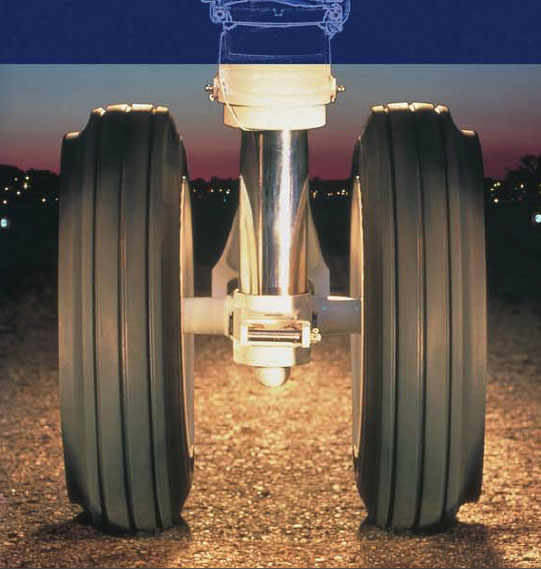 Jet aircraft nose gear " />
In turbine aircraft, improperly inflated tires are more likely to lead to expensive damage, if not outright catastrophic consequences, due to the higher speeds and heavier weights of those aircraft. There’s simply a lot more kinetic energy for the tires to absorb. This is why turbine aircraft tires are stronger and more advanced than those found in their lighter brethren. It also explains why those tires are filled with nitrogen instead of air. Nitrogen doesn’t expand at altitude the way air does. It has a low moisture content so it doesn’t freeze, and it will not support combustion.
The FAA recently issued Safety Alert for Operators (SAFO) bulletin 11001, “The Importance of Properly Inflated Aircraft Tires”, which notes:
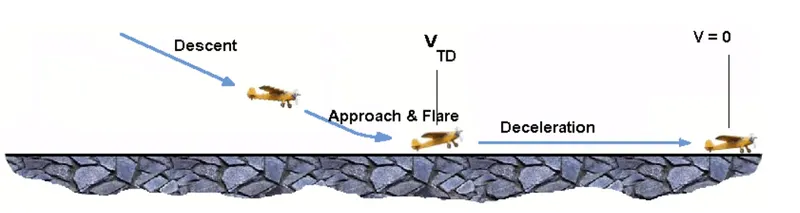
An aircraft is one of the most advanced inventions. Today, aircraft manufacturers are more capable than ever of producing safer and more reliable aircraft. However, there is one part of flying, which is often said to be the toughest; the landing. Although modern-day aircraft are capable of handling landings very well, there is almost some kind of uncertainty to it.
From the time the aircraft turns around and taxis to the active runway, everything seems normal. The consequent power-up of strong modern engines makes the aircraft capable of taking off, nowadays rather easily. The remaining part of the flight is comparatively challenging.
The possibility of experiencing bad weather, an engine failure, or strong winds is unpredictable. However, every aircraft has to somehow and somewhere touch down safely. The main question remains: How does an aircraft stop after landing?
A modern-aircraft braking system
On any given modern aircraft, there are mainly three types of braking sources; ground spoilers, disc brakes, and thrust reversers. The three combined can provide the most potent braking effect post-landing. Although spoilers and wheel brakes are an integral part of any aircraft, thrust reversers are usually more common in airliners.
Ground spoilers
One of the most effective and logical ways of bringing an aircraft to rest is by first cutting off its supply of lift—spoilers on the top of a wing act as a hindrance to the streamlined flow of air. However, spoilers can have varied applications. They can be used to some extent to lower aircraft speeds at the time of descent and approach. This stage is called the 'partial deployment' of spoilers.
After touching down, the spoilers take a fully vertical shape by standing straight and out of the wings. In many cases, an additional ground spoiler, which is closer to the fuselage, is used as well. However, there is only a bit that the spoilers can do. The main application of an aircraft spoiler is to cut the lift and provide some sort of a drag. The rest is done by disc brakes and reverse thrusters.
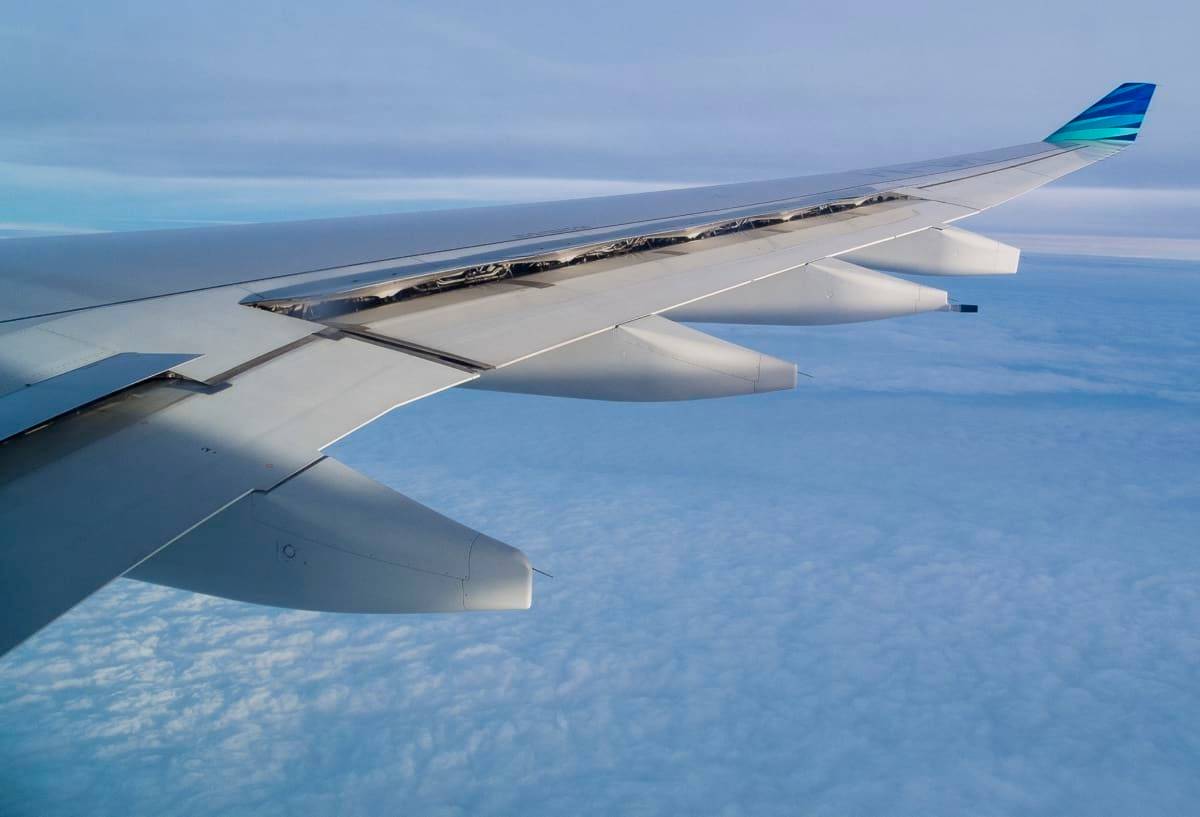
Wheel brakes
The wheel braking system is the most common form of braking on any given vehicle in the world. Unsurprisingly an aircraft has it too. Nevertheless, the braking system on any given aircraft is highly-engineered and sophisticated. The complexity of a disc-braking system is such that it is hard to explain it in a few words.
Simply put, the disc braking system of a wheel is a part that is fixed and doesn't rotate with the other part of the wheel. Just like a pad on any modern vehicle, these stationary discs act as friction to the rotating part and cause it to either gradually stop or reduce its rotation speed.
Most modern aircraft are nowadays equipped with autobraking systems controlled by the autopilot. Depending on the various aspects of landing, the level of the auto brake can be changed to get the desired effect. A lot depends on the length and the state of the runway. For example, it will take some tough braking to stop a B747 from touching down on a wet runway at the speed of 290 km/hr.

Runway length is an essential factor too. Airports like Kai Tak, which had a really tough approach and a high possibility of crosswinds, required an aircraft to apply strong brakes to stop on its short runway. For this reason, most pilots nowadays have to prepare the autobraking system before landing. After the aircraft has slowed down to an extent, the pilots switch to manual braking.
Reverse thrust
Thrust reversers are a very common part of modern aircraft engines. The application of thrust reversers is more important in heavier aircraft. Some smaller aircraft like the BAE 146 still don't find any use for thrust reversers. This might have to do with a combination of a strong braking system and effective spoilers. However, on a heavy passenger aircraft like an A330, thrust reversers are very crucial.
The working of a thrust reverser is easy to understand and very practical. It is the process of amending an already working engine. In modern high-bypass turbofan engines, more than 90% of air is sucked in and thrown out of the engines. After touch-down, all thrust reversers have to do is just change the direction of the air.

Instead of being pushed towards the back, the reversers pave a sideward opening to allow for the air to push forward. This creates an 'opposite thrust', and this helps the aircraft in stopping. Unlike the process of wheel braking, thrust reversers are mostly manual and applied after the aircraft has safely touched down.
****************************************************************************
part-B
Q
6. A. With necessary assumptions, calculate the force and power required to push/pull an aircraft by a towing vehicle.
Ans:-Calculate the force and power required to push /pull an aircraft by towing a vehicle.
The force to move an airplane on an absolute flat runway with no wind at constant low speed is the resistance between the plane and the tarmac.
The rolling resistance for the airplane can be calculated as
Fr=C.Mr.ag
Where is
Fr= rolling resisstence
C= rolling resistance coefficient
Mr= rolling mass
ag=acceleration fo gravity(9.8 m/S2)
If the mass of the plane is 40000kg and the rolling coefficient between the aircraft wheel and trauma is 0.02
Therefor calculation
Fr=0.02*(40000)*9.81
=7848 N
This force can be delivered by a pulling truck. Enough weight of the truck is required to create friction Tarmac that
The friction force for the puller can be calculation
Ff=uW
= u.mf.ag--------------(2)
where
Ff=frication force
u=frication co-enfficient
W=weight
mf= frication mass
mf=7848/(0.9*9.81)
= 889kg
power required for pulling a truck with a velocity of 5 m/s
p=F*V
where is
F=total force acting a truck
V=velocity of truck
p=7848*5
=39.24 kw
*************************************************************************************************
7. Q
A. Design an electric powertrain with the type of motor, its power rating, and energy required to fulfill aircraft towing application in Simulink. Estimate the duty cycle range to control the aircraft speed from zero to highest. Make all required assumptions. Prepare a table of assumed parameters. Draw a block diagram of the powertrain.
ans;-
according to study 6 towing an aircraft of 40000 kg needed 39.24 kW of power
so,
we are selecting a motor which can take this much power.
vehicle Drive:58.3 HP/45.5 kW,80vDc traction motor mated with Auburn /Dana 44 different
Auburn is a high-performance series different which delivers more tractive and faster engagement for controlled
power transfer and lightning-fast reaction to changing load
Power out =45.5kw
Batteries: two 40 VDC industrial,595 AMP-HR battery (6 hr rate) ,wired in series
power input=V*i
=80*595
=47.6kw
Effficiency of motor =power output / power input
=45.5/47.6
= 95.58 %
Enrgy required for towing aircraft =Required power *Time
Assue rtaxing time =15 min
therefor
Energy required =39.24*0.25
=9.81 kwh
assume highest speed =25 kmph
Duty cycle =Average power /peak power
=39.24/45.5
=86%
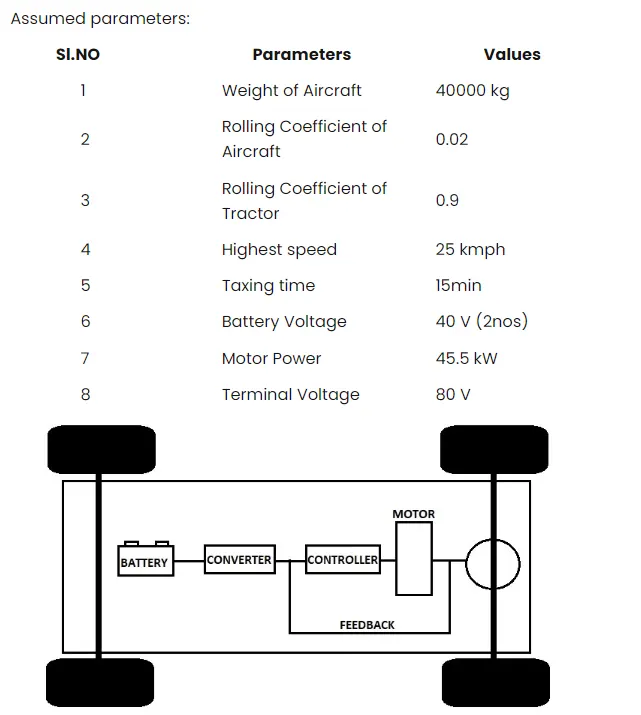
B. Also, Design the parameters in an excel sheet.

Result:-
i) The total weight of various aircraft was mentioned in the above section
ii) the difference between difference between ground speed and airspeed?
iii) Is it not recommended to use aircraft engine power to move it on the ground at the Airport?
iv) the aircraft is pushed to the runway when it's ready to take off?
v)Learn about taking off the power, tire design, rolling resistance, tire pressure, and brake forces when landing.
vi) With necessary assumptions, calculate the force and power required to push/pull an aircraft by a towing vehicle.
vii) Design an electric powertrain with the type of motor, its power rating, and energy requirement to fulfill aircraft towing applications in Simulink. Estimate the duty cycle range to control the aircraft speed from zero to highest. Make all required assumptions. Prepare a table of assumed parameters. Draw a block diagram of the powertrain.