1. list out the total weight of various types of aircrafts.
|
Type
|
MAXIMUM TAKE-OFF WEIGHT [kg]
|
MAXIMUM LANDING WEIGHT[tonnes]
|
|
Airbus A220-100
|
59,000
|
50.80
|
|
Airbus A400M
|
141,000
|
122
|
|
Antonov An-124-100M
|
405,060
|
330
|
|
Boeing 787-8[10]
|
228,000
|
172.365
|
|
Embraer ERJ 145
|
22,000
|
19.3
|
|
McDonnell-Douglas MD-83
|
73,000
|
63.28
|
|
Pilatus PC-24[24]
|
8,300
|
7.665
|
|
Saab 340
|
13,150
|
12.930
|
|
Saab 2000
|
22,800
|
21.5
|
|
Tupolev Tu-154M
|
104,000
|
80
|
|
Tupolev Tu-204SM
|
104,000
|
87.5
|
|
Vickers VC10
|
152,000
|
151.9
|
|
Vickers Viscount 800
|
30,400
|
|
ref:https://en.wikipedia.org/wiki/List_of_airliners_by_maximum_takeoff_weight
2.
There is a difference betwn ground speed and air speed
Wind Speed
The air moves relative to the reference point at the wind speed that the wind speed and is a vector quantity and has both a magnitude and a direction The wind has components in all three paimary directions (north-south, east-west, and up-down), we are considering only velocities along the common path. A positive velocity is defined to be in the direction of the aircraft's motion. We neglect the cross windwhich occur perpendicular to the flight path but parallel to the ground, and updrafts and downdrafts, social perpendicular to the ground.
Ground Speed
The aircraft moves relative to the reference point at the ground speed Ground speed is the vector quantity so as the comparison of the ground speed to the wind speed must be done according to rules for vector comparisons only.
Airspeed
The imp.quantity in the generation of lift is the relative velocity between the object and air, which is airspeed Airspeed must be computed from the ground speed and the wind speed. Airspeed is the vector difference between the ground speed and the wind speed.
Airspeed= Ground Speed - Wind Speed
3.it is not recommended to use aircraft engine power to move it on the ground at Airport as the risks which may arise from engine to ground running relate to loss of control of the aircraft by pilots. Unwanted consequences from such static running are mainly related to those arising from the movement of the aircraft during engine running effectively a loss of control - especially during high power engine running. Damage to the aircraft itself, In addition, there is a risk of injury to ground support personnel who may be in relatively close to the aircraft.
4. An aircraft is pushed to runway when its ready to take off , pushback is an airport procedure during which an aircraftis pushed backwards away from an airport gate . It is done by special, low-profile vehicles called pushback tractor or tugs.
Although many aircraft are capable of moving themselves backwards on the ground using reverese thrust , the resulting jetblast might cause damage to the terminal building or equipment Engines close to the ground may also blow sand and debris and then suck them into the engine, damaging the engine. A pushback is therefore the preferred to move the aircraft away from the gate. As the pilots cannot see what is behind the aircraft, steering is done by the pushback tractor driver and not by the pilots. Depending on the aircraft type and airline procedure, a bypass pin will be temporarily installed into the nose gear to disconnect it from the aircraft's normal steering mechanism
Once the pushback is completed, the tow-bar is disconnected and The pushback is complete.
5.
Take-Off Power:
For light aircraft full power is used during takeoff, airliner aircraft may use a reduced power for takeoff, where less than full power is applied in order to prolong engine life, reduce maintenance costs and reduce noise emissions but In emergency cases, the power used can then be increased to increase the aircraft's performance.
The nose is raised to a nominal 5°-15° nose up pitch attitude to increase lift from the wings and effect lift-off. most of the aircraft the attempt of a takeoff without a pitch-up would require cruise speeds while still on the runway.
Tyre design:
Tyres are one of the most important components of aircraft. They help to absorb the shock of landing and provide cushioning and also provides the necessary traction for braking and stopping of an aircraft.
Carcass plies are used to form the tire also called casing plies.
- They support the weight of an aircraft while it is on the ground.
- It also provides the necessary traction for braking and stopping of an aeroplane.
- Tyre also helps to absorb the shock of landing and provide cushioning the roughness of takeoff, roll-out, and taxi operations.
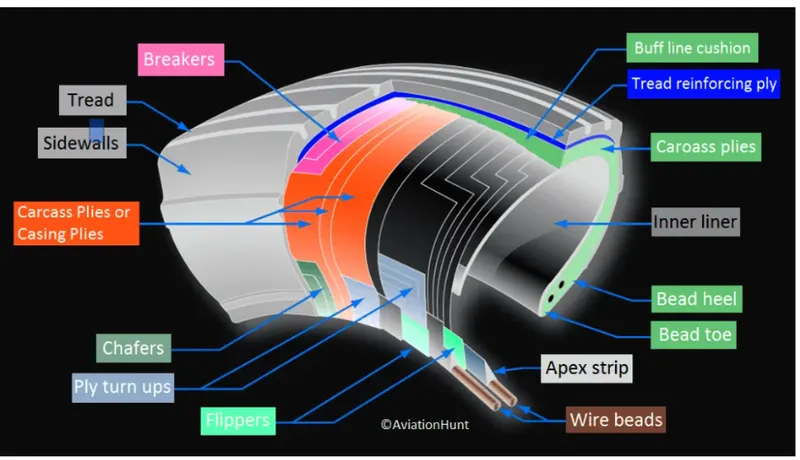
Aircraft tyres may be Tube-type or Tubeless
Aircraft tyres may be Radial or Bias
Aviation tyres are conductive
Each tyre manufacturer produces their designs of the tyre with different tread patterns, wear patterns, wear limits etc, and in some cases, different names for the same and all tyres must meet the approved standards by the FAA or CAA.
Rolling Resistance:
The resistance offered by the tyres on motion of vehicle/aircraft is called as rolling resistance, the rolling resistance happens during take off/landing in the runway.
Tyre Pressure:
Aircraft tires are usually inflated with nitrogen to minimize expansion and contraction from extreme changes in ambient temperature and pressure experienced during flight Dry nitrogen expands at the same rate as other dry atmospheric gases , but common compressed air sources may contain moisture, which increases the expansion rate with temperature.
Tests of airliner aircraft tires have shown that they are able to sustain pressures of
maximum 800 psi (55 bar; 5,500 kPa) before bursting During the tests the tires have
to be filled with water, to prevent the test room being blown apart by the energy that
would be released by a gas when the tire bursts
Tyre Pressure:
Aircraft tires are usually inflated with nitrogen to minimize expansion and contraction from extreme changes in ambient temp. and pressure experienced during flight Dry nitrogen expands at the same rate as other dry atmospheric gases (normal air is about 80% nitrogen), but common compressed air sources may contain moisture, which inc. the expansion rate with temp.
Brakes Forces When Landing:
While the wheels touch the ground, a set of spoilers raise up quickly, which kills the litt provided by the wings ,ground spoilers that only deploy on landing,while the spoilers provide some drag their primary purpose is to stop the plane from actually flying, putting all the weight on the landing gear and in turn making the brakes that much more effective.
Aircraft have highly-engineered, multi-disc brakes made of a carbon-steel material and also Honeywell and Goodrich, part of Collins Aerospace. the brakes are composed of discs that rotate with the wheel and separate discs that are fixed.
Auto Brakes:
Wheel brakes are usually made to engage automatically after landing. The crew will decide which is the most appropriate to use for every landing depending upon factors like the length of runway or if it is wet or dry and want to exit the runway at a particular point.
6.1DATA:
Mass of the truck = 50000 Kg
Mass of the aircraft = 2457000 Kg
Length of the aircraft = 33.84 m
Velocity of the truck = 25kmph
Height of the aircraft = 11.76 m
Air density (p) 1.225 Kg/m^3
Drag coefficient (Cd) = 0.6
Rolling resistance coefficient (ur) = 0.03
Gravitational constant (g) = 9.8 Nm
for Rolling Ressistance (Frr)
Frr= urr*m*g
For aircraft=0.03*247000*9.81
Frr=72692.1N
For truck=0.03*50000*9.81
Frr=14715N
for Total Rolling Ressistance (Frr)
Frr=72692.1+14715
Frr = 87407N
Aerodynamic Drag force:
Fad = 0.5p x A x v² x (Cd(Aircraft) + Cd (Towing))
Fad = 0.5 *1.225*335*(5.556)^ 2 *(0.6+0.15)
Fad =4750.47N
Total Force of the Towing Vehicle,
F=Fad +Frr
F = 4750.47 + 87407.1
F = 92157.6N
Power Required,
P=F*v
P = 92157.6 * 5.556
P = 512.028KW
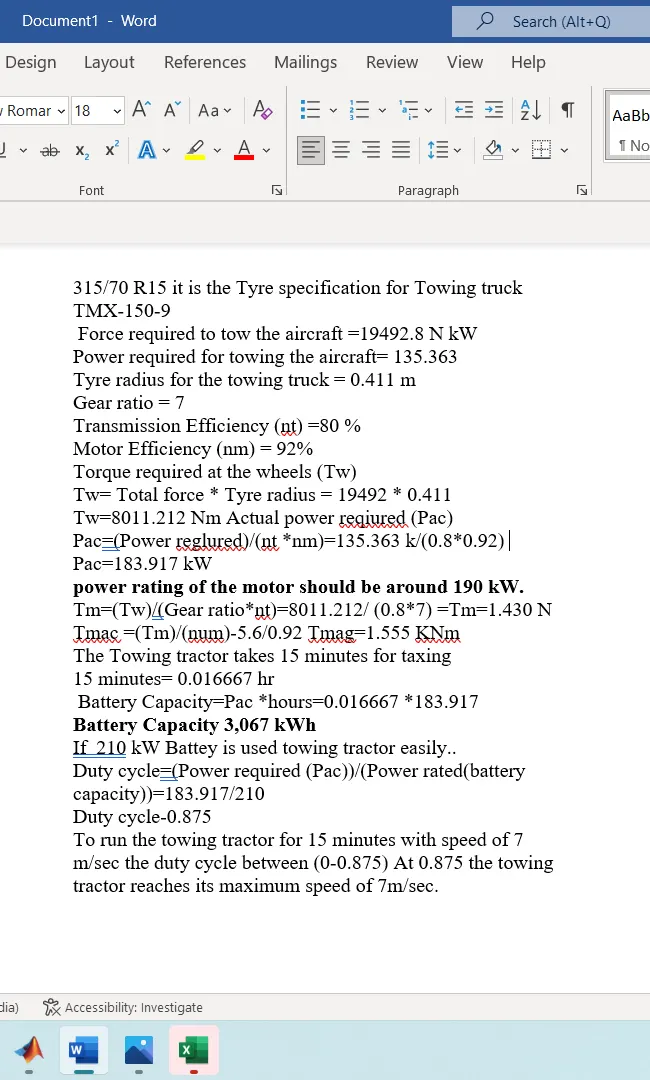
The Force = 92.156KN and Power of the Towing vehicle carrying the Aircraft is 512.028 KN.With necessary assumptions, calculated the force and power required to push / pull an aircraft by a towing vehicle.
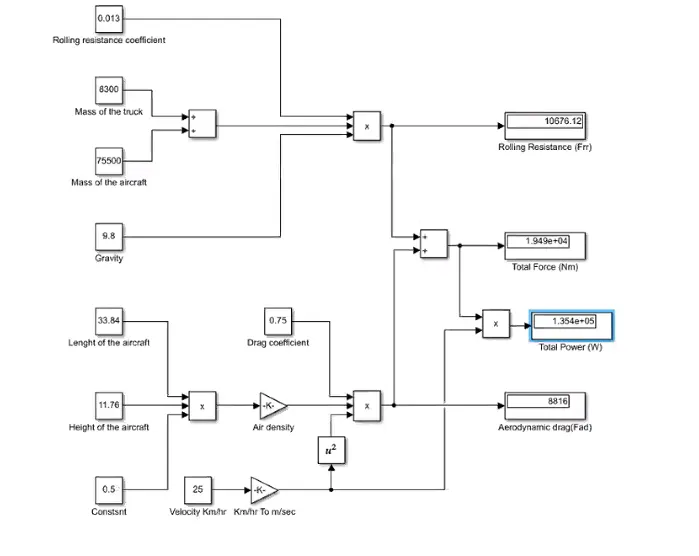
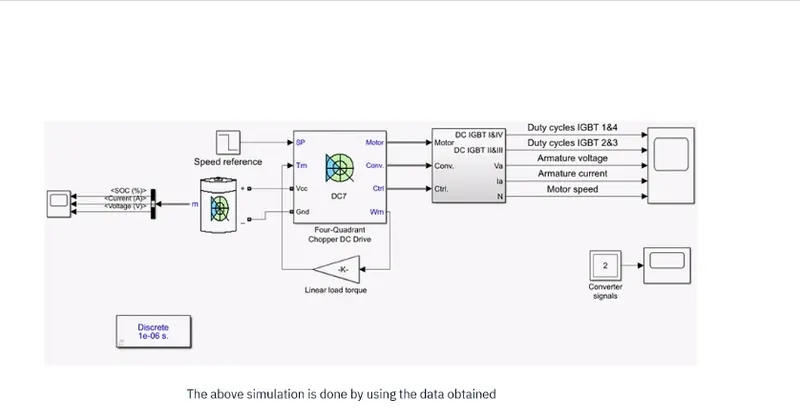
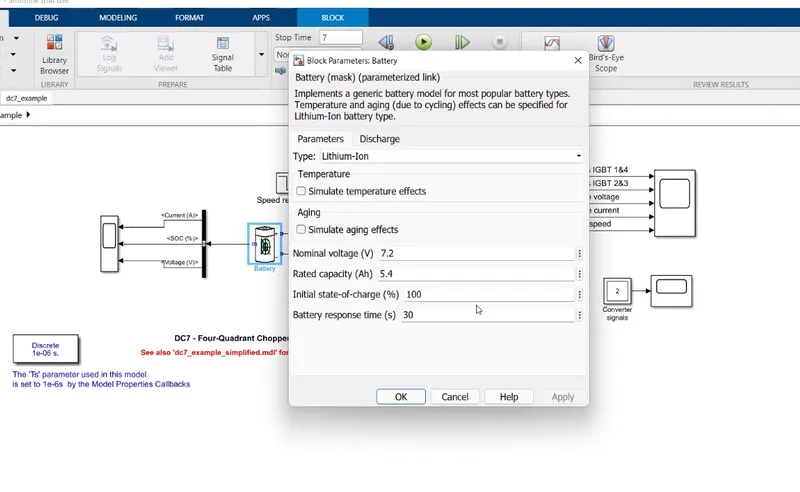
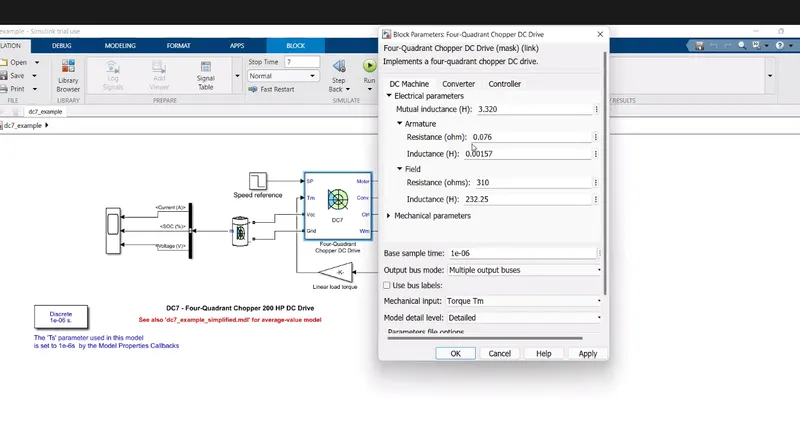
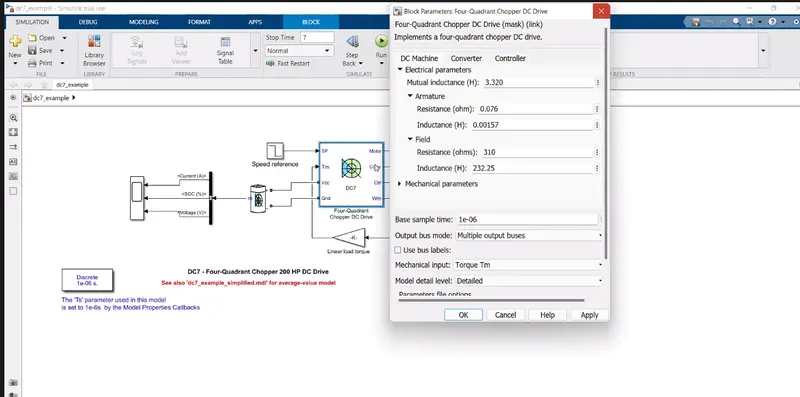
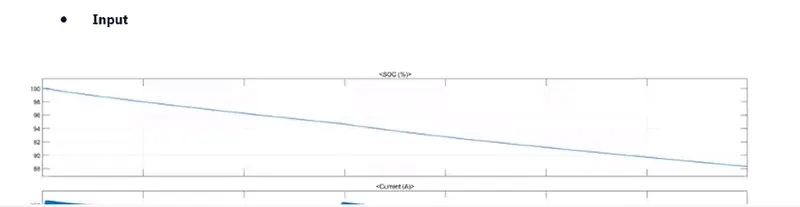
. Developed the model for the calculated force and power using Simulink.
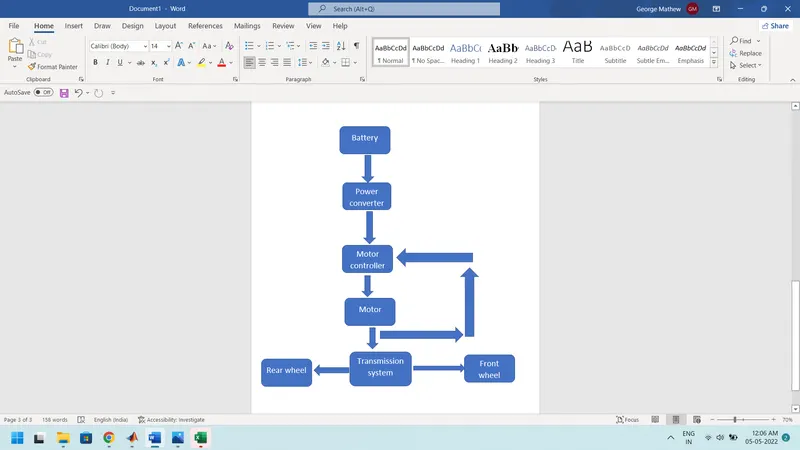
Design an electric powertrain with type of motor, it’s power rating, and energy requirement to fulfill aircraft towing application in Simulink.
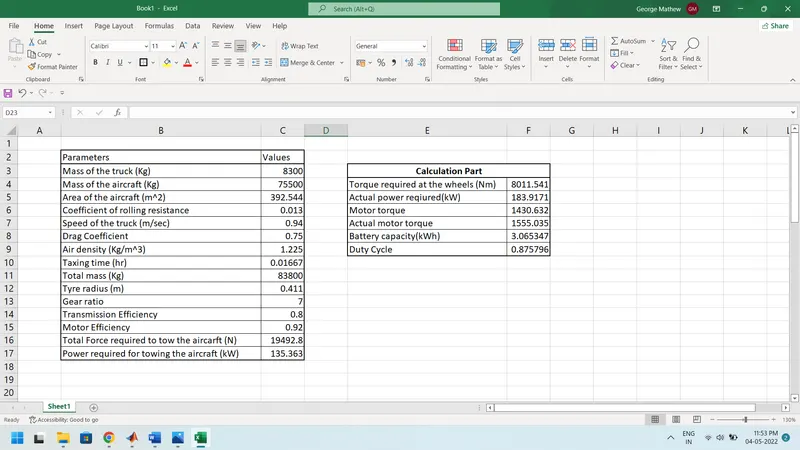
Prepare a table of assumed parameters.
a block diagram of powertrain
hence Designed the parameters in excel sheet.