Project-1: Powertrain for aircraft in runways
PART - A :-
1.
Total weight of various types of aircrafts :-
The aircraft gross weight is the total weight at during in flight and grounding position . Its weight decreases during flight because of fuel consumption . Its weight value may vary during a flight due to payload dropping and inflight fueling . During flight the total weight is equal to the enroute weight or in flight weight .
Its weight also dependes upon the struture of it .
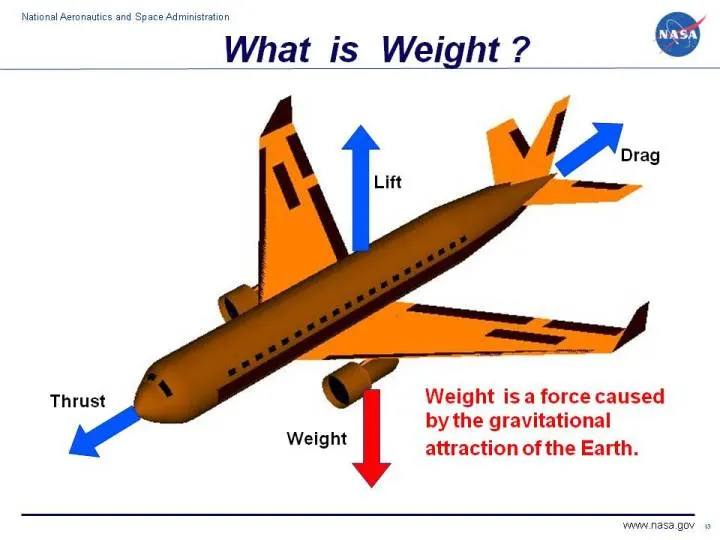
Empty weight :- Aircraft weight with leftover fuel in tank + engine oil + other operating fuel .
Payload weight :- Fuel weight + passenger weight + luggage weight
Maximum Takeoff weight :- It is the maximum weight when its breaks are released and starts take off .
Maximum landing weight :- It is the weight at landing case but it can't be exceed the take off weight .
Some aircrafts and its takeoff and landing weight :-
AIRCRAFT TAKEOFF WEIGHT (Kg) LANDING WEIGHT (Ton)
ATR 42-500 18,600 18.3
saab 340 13,150 12.93
Learjet 9,752 8.70
Fooker 100 46,000 39.95
Hence, these are some weights acting on the aircraft in different positions of it like in flight , in landing , in take off etc .
2.
Difference between ground speed and air speed :-
Ground speed :-
1.Speed of aircraft with respect to the ground reference.
2.This can shows how fast the aircraft can reach the destination .
3.It is the addition of air speed and wind speed.
Air speed :-
1.It is the speed required to lift the aircraft .
2.It can't be calculated from a ground position .
3.On a still day the air speed is equal to the ground speed but when its moving in the same direction of wind then the air speed is less than the ground speed .
4.There are three types of air speed
>Indicated air speed
>True air speed
>Calibrated air speed
Hence ,for pilot both the ground and air speed are necessery while one of them helps to know that they are moving in enough speed to take off and other to minimum time to reach the destination and for the passengers only one that is ground speed is needed.
3.
It is not recommended to use aircraft engine power to move it on the ground at Airport because of the following reasons :-
1.It saves fuel for the aircraft .
2.Applying thrust can cause blast in the aircraft .
3.Blasting of these can make the personalities present over their harmful .
4.It produce large amount of noise in the airport .
5.Tow cars used in the airport for movement of aircraft .
6.Their in no much space available to look every side of the craft for its movement so these avehicles are used .
7.To avoid extreme caution it is not used in airports .
8.Truck driver knows better about airport than the pilots .
Hence, these are some points for which no engine power are used in the ground of airport .
4.
An aircraft is pushed to runway when its ready to take off because pushback is an airport procedure during which an aircraft pushed away from airport gate by some external power .These are carried out by some low profile vehicles.
Many aircrafts are capable of moving themselves backward on the ground in reverse direction which might resulting some damage in the engine . This may blast as it very near to the surface the person present over their for its movement may gets hurt , so pushing aircraft is a usable method in air ports . It is the ground control clearance method where its clear the ground while pushing it . Both of them were connected by some type of communication for better positioning. These vehicles are made in such a way that it can pull or push very heavy vehicles like plane .
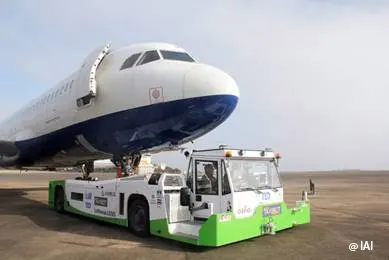
Since the pilots can not see what is behind the aircraft , steering is done by this vehicles and not by the pilot . Depending on the aircraft type and airline procedure , a bypass pin is used for movement of it and once it is completed this pin is disconnected and the ground handler will inform the pilot about its position and then pilot starts its engine to follow the run way and finally it takes off . It also have many safety reasons .
5.
Take off power :-
Mainly the take off power depends upon the kinetic and potential energy of the aircraft .
where as it is determined by the total energy
E = 1/2 *M*V^2 + MGH
M= mass of the aircraft
V = velocity
G= gravitational force
H = height
Tyre design :-
Its design should be that type which can resist more pressure and easy for movable and the prototype of it should be tested well that much that its failure percentage should be less .
Rolling resistance :-
It is the opposite force acting on the aircraft .
It can be calculated by -
Frr = Cr * m * g
here Cr = coefficient of rolling resistance
m = mass of the craft
g = gravitational force
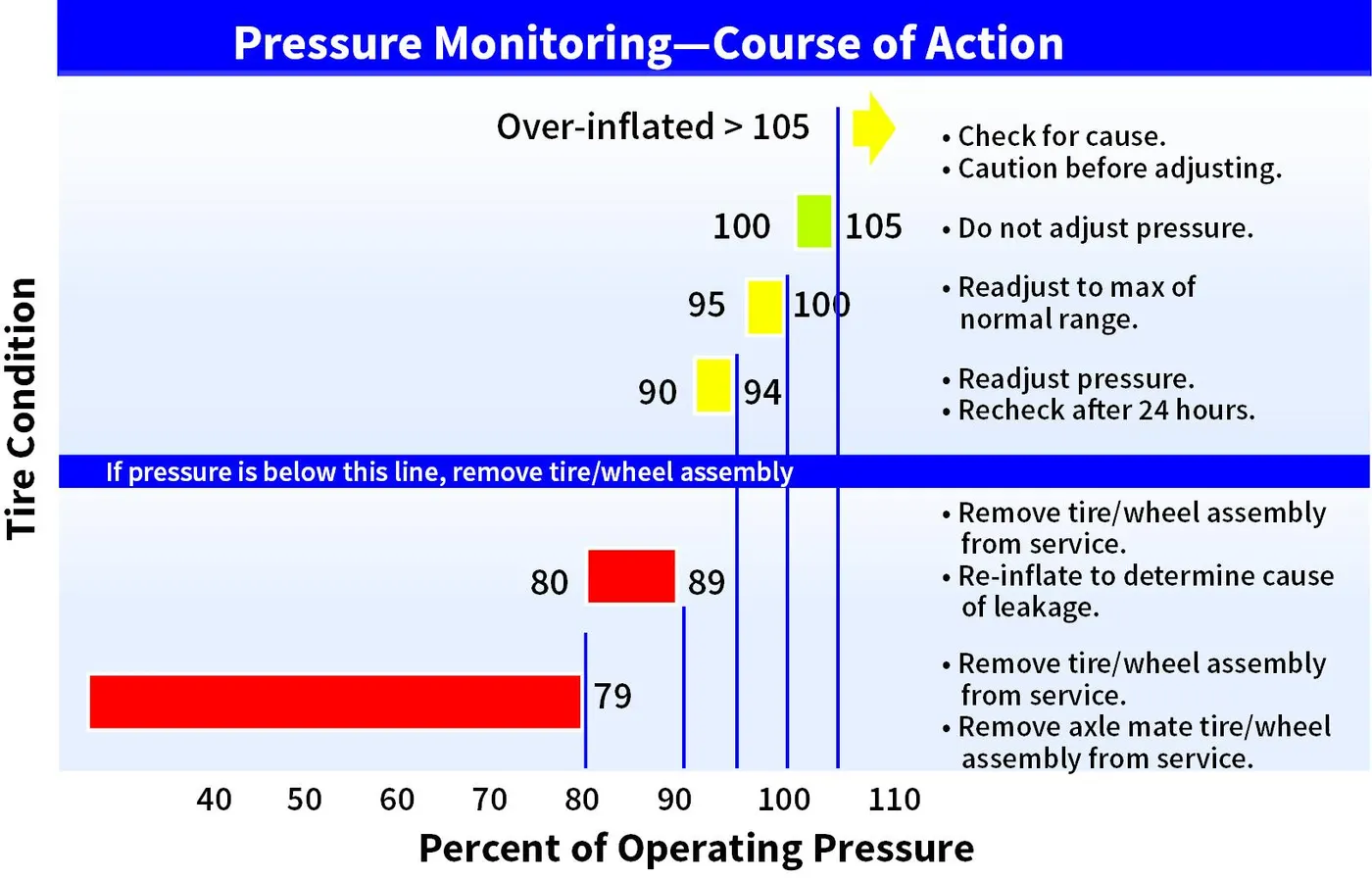
Tyre pressure :-
Brake forces when landing :-
There are different types of breaking available in aircraft like Engine breaking , hydraulic breaking and mechanical spoiler.
In engine breaking it stops the forward acceleration of the aircraft and the hydarulic breaking are applied when it touches the ground level and the spoiler helps in deaccelerate the aircraft wih the help of its wings.
PART -B :-
6.
A.
The force and power required to push / pull an aircraft by a towing vehicle :-
By assuming some values we can calculate the force applied and the power acted upon the craft
force acting on the craft are rolling resistance force and aerodynamic force and these are calculated by
Rolling resistance force :-
Frr = Cr * m * g
here Cr = coefficient of rolling resistance = 0.002
m = mass of the craft
g = gravitational force
Lets take the gross weight of the aircraft = 50,000 kg
so Frr = 0.002 * 50000 * 10
= 1000 N
Aerodynamic force :-
Fad = 1/2 *Cd * ro *A * v^2
lets assume that the Cd = drag coefficient =0.025
ro = air density =1.125
Area = A = 150 m^2
velocity = 4 m/s
so overall force Fad = 1/2 * 0.025 * 1.125 * 150 * 4^2
= 33.75 N
As here it is moving with a very low speed here aerodynamic force is neglected so,
the total force acting on it = 1000 N
Power = force * velocity
= 1000 * 4 = 4000 watt
Hence ,the overall force acted upon and the power requird to push or pull the aircraft is calculated .
B.
Simulink model for calculating the force and power acted upon the aircraft :-
Here we by using some block we created the model for calculating force and power and it is uploade below and outputs are shown.
OUTPUT :-
In output display results are shown .
7.
A.
By assuming some values of parameter like :-
Forec required to push or pull the aircraft = 15K N
Power required = 130K W
Radius of the tyre = 0.5 m
Gear ratio = 8
Transmission efficiency = 85%
Motor efficiency = 95%
So,
the torque required for the wheels = force * radius of the tyre
= 15 * 0.5
=7.5K Nm
Motor torque = wheel torque / gear ratio * efficiency
= 7.5 /8*0.85
=1.10K Nm
For motor efficiency = 95% ,
The required motor torque = 1.10 / 0.95
=1.15K Nm
Similarly the total power required by the motor cosidering all the efficiency = 130 / 0.85*0.95
= 162.5 K w
Lets by taking the operation time = 20 min =0.334 hr
So , the total energy consumed = 162.5 * 0.334
= 54.275 K Wh
If we consider the battery capacity = 220K W
Then the duty cycle = required power / rated power
= 162.5/220
=0.73
Hence , the controller will be able to provide a duty cycle of 73% in order to control the speed .
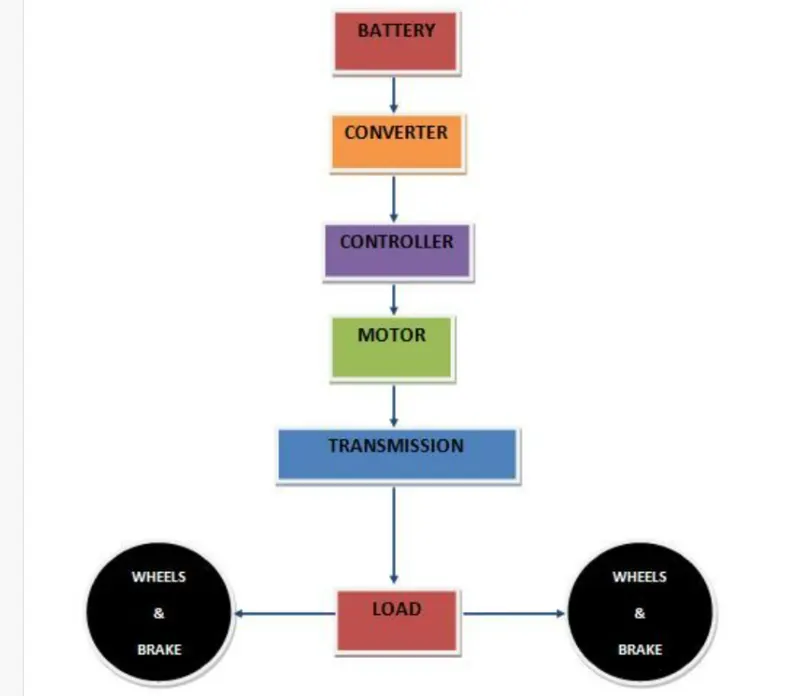
BLOCK DIAGRAM :-
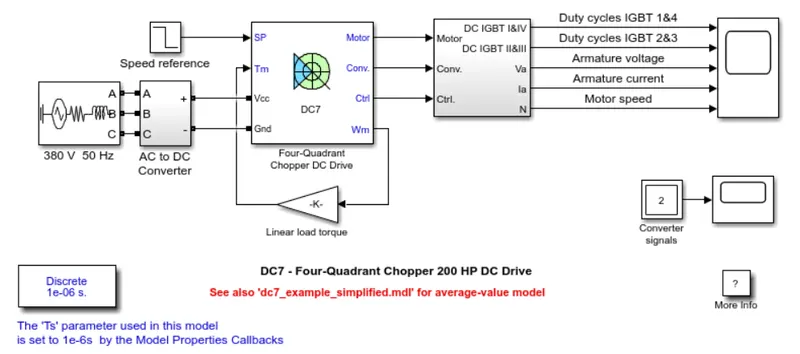
SIMULINK MODEL :-
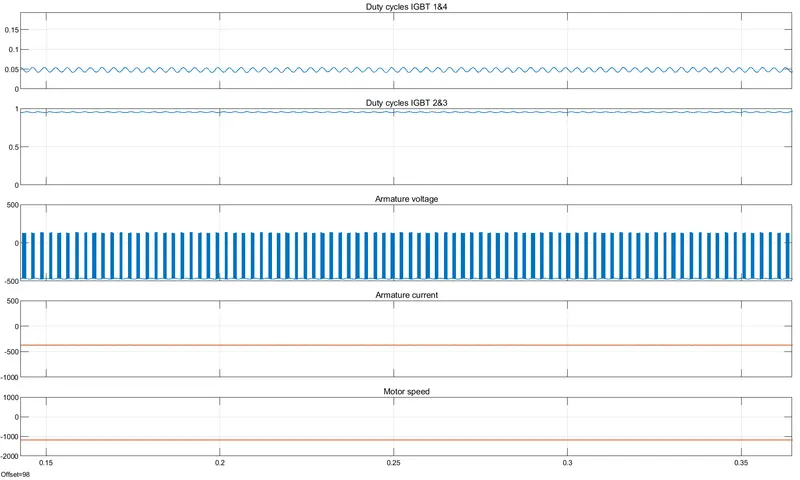
OUTPUT :-
B.
Excel sheet with parameters and its respective values is mentioned below :-
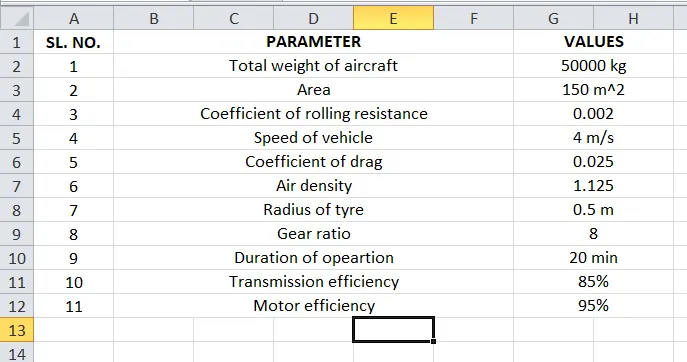
Hence, here we by assuming some data we calculated the duty cycle of the system ans simulation is performed and results are shown .