The powertrain for aircraft in runways
Aim:
- To Search and list out the total weight of various types of aircraft.
- To differentiate between ground speed and airspeed.
- To find out why it is not recommended to use aircraft engine power to move it on the ground at Airport.
- To find out how an aircraft is pushed to the runway when it's ready to take off.
- To learn about take-off power, tire design, rolling resistance, tire pressure, and brake forces when landing.
- To calculate the force and power required to push/pull an aircraft by a towing vehicle and to develop the model for the calculated force and power using Simulink.
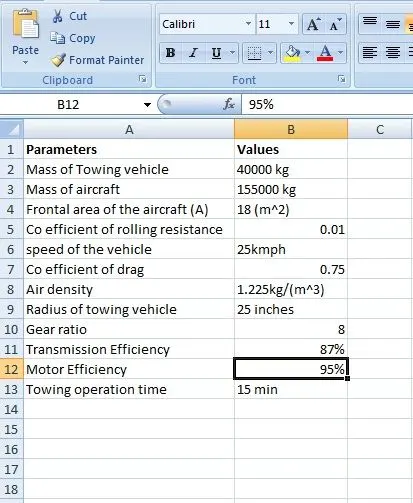
- To design an electric powertrain with a requirement to fulfill aircraft towing application in Simulink and prepare a table of assumed parameters and draw a block diagram of the powertrain and design the parameters in an excel sheet.
Explanation:
1. Types of aircraft and their weight
An aircraft is a vehicle that is able to fly by gaining support from the air. It counters the force of gravity by using either static lift or by using the dynamic lift of an airfoil, or in a few cases the downward thrust from jet engines.
There are many factors that lead to the efficient and safe operation of aircraft. Among these vital factors are proper weight and balance control. The maximum allowable weight for an aircraft is determined by design considerations. The manufacturer provides the aircraft operator with the empty weight of the aircraft and the location of its empty weight center of gravity (EWCG) at the time the certified aircraft leaves the factory.
However, the maximum operational weight may be less than the maximum allowable weight due to such considerations as high-density altitude or high-drag field conditions caused by wet grass or water on the runway. The maximum operational weight may also be limited by the departure or arrival airport's runway length.
Types Of Aircraft:
There are a number of ways to identify aircraft and there are two types of classifications for aircraft.
They are:
- One is lighter than aircraft, known as aerostats.
- Another one is heavier than air aircraft, called aerodynes.
Lighter-than-air:
Aircraft such as ballons, nonrigid airships, and dirigibles are designed to contain within their structure a sufficient volume that, when filled with a gas lighter than air (heated air, hydrogen, or helium), displaces the surrounding ambient air and floats, just as a cork does on the water.
Balloons are not steerable and drift with the wind and Non-rigid airships, which have enjoyed a rebirth of use and interest, do not have a rigid structure but have a defined aerodynamic shape, which contains cells filled with the lifting agent. They have a source of propulsion and can be controlled in all three axes of flight. Dirigibles are no longer in use, but they were lighter-than-air craft with a rigid internal structure, which was usually very large, and they were capable of relatively high speeds. It proved impossible to construct dirigibles of sufficient strength to withstand routine operation under all weather conditions, and most suffered disaster, either breaking up in a storm, as with the U.S. craft Shenandoah, Akron, and Macon or through ignition of the hydrogen, as with the German Hindenburg in 1937.

Balloon - 400kg
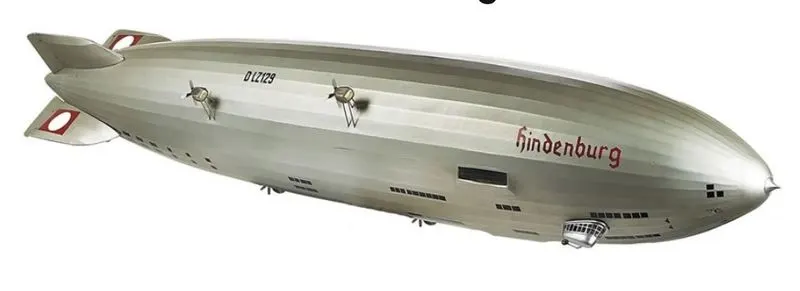
Airship - 2,60,000kg at Full load & 1,30,000kg at No-load
Heavier-than-air:
This type of aircraft must have a power source to provide the thrust necessary to obtain lift. Simple heavier-than-air craft include kites. These are usually flat-surfaced structures, often with a stabilizing “tail,” attached by a bridle to a string that is held in place on the ground. Lift is provided by the reaction of the string-restrained surface to the wind.
Another type of unmanned aircraft is the unmanned aerial vehicle (UAV), commonly called drones or sometimes remotely piloted vehicles (RPVs). These aircraft are radio-controlled from the air or the ground and are used for scientific and military purposes.
Unpowered manned heavier-than-air vehicles must be launched to obtain lift. These include some of the heavier aircraft are:
Hanging Glider:
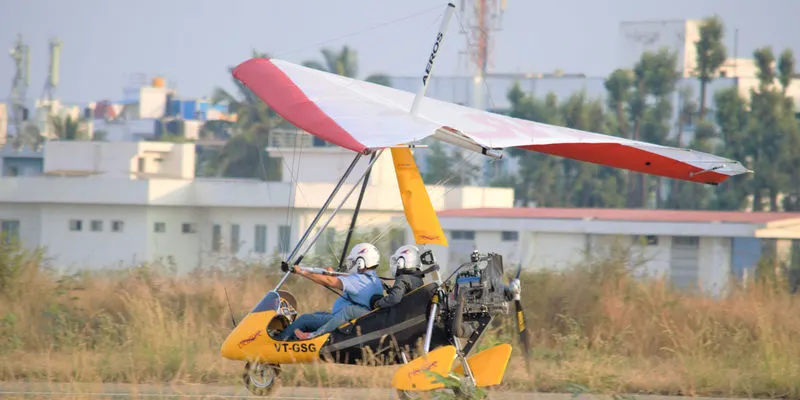
Hang Glider - typically weighs more than 50 pounds
Hang gliders are aircraft of various configurations in which the pilot is suspended beneath the (usually fabric) wing to provide stability and control. They are normally launched from a high point. In the hands of an experienced pilot, hang gliders are capable of soaring (using rising air columns to obtain upward gliding movement) and paragliders typically weigh less than 50 pounds.
Glider:
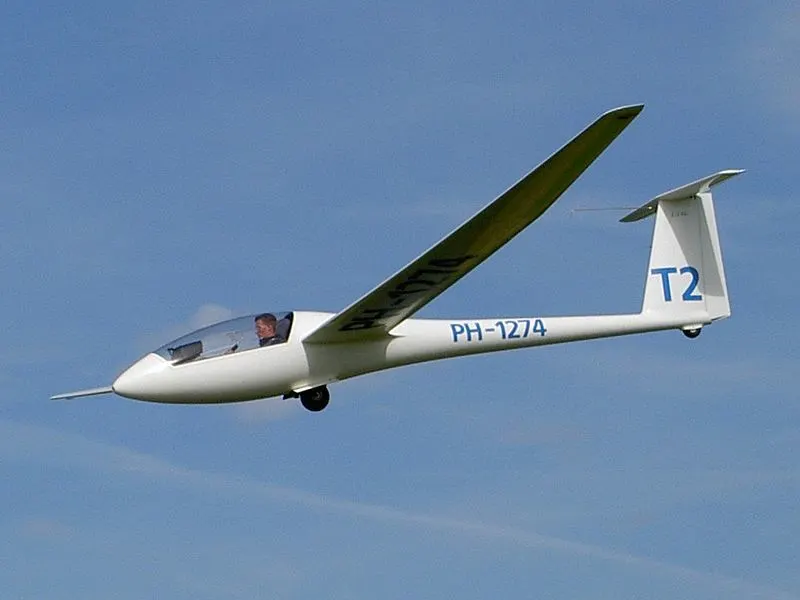
Glider - 110kg
Gliders are usually used for flight training and have the capability to fly reasonable distances when they are catapulted or towed into the air, but they lack the dynamic sophistication of sailplanes. These sophisticated unpowered crafts have wings of unusually high aspect ratio. Most sailplanes are towed to launch altitude, although some employ small, retractable auxiliary engines. They are able to use thermals (currents more buoyant than the surrounding air, usually caused by higher temperature) and orographic lift to climb to higher altitudes and glide for great distances. Orographic lift results from the mechanical effect of wind blowing against a terrain feature such as a cliff. The force of the wind is deflected upward by the face of the terrain, resulting in a rising current of air.
Some of the weights of the other aircraft are mentioned below:
- MQ-1 Predator - 1125kg
- RQ-4 Global Hawk - 13325kg
- RQ-7 Shadow - 150kg
- Wasp Aerovironment - 200g
- Istar allied Aerospace - 2.5kg
- Mavic Pro 2 - 907g
2. Difference between Ground speed and Air speed:
| Ground Speed |
Air Speed |
| Ground speed is the aircraft’s speed relative to the ground. |
Air speed is simply the speed at which an aircraft is moving relative to the air it is flying in. |
| Ground speed is a vector quantity, a comparison of the ground speed to the wind speed must be done based on the rules of vector comparison. |
Air speed is a vector difference between the ground speed and wind speed.
Air speed = Ground speed - Wind speed
|
| Ground Speed is the actual speed of the aircraft over the ground and is the result of the wind’s effect on the aircraft. |
Air Speed is the actual speed of the aircraft over the air related to the moving of the flight. |
| “Stall Speed” is an Indicated Airspeed reference. |
Ground Speed is used to help determine the aircraft's “Estimated Time Enroute" |
| If the wind blows in the same direction as the moving aircraft, the airspeed will be less. |
If the wind blows in the same direction of the moving aircraft, the ground speed will be higher. |
3. Aircraft engine power to move it on the ground
For movement on the ground, the aircraft uses its own engine power, which is called taxiing. Although many aircraft are capable of moving in backward using reverse thrust, as a result, the jet blast or prop wash might cause damage to the terminal building or equipment. Engine close to the ground may also blow sand and debris forward and then suck them into the engine, causing damage to the engine. Therefore there are pushback trucks in the airport. A pushback truck lifts the front wheel of the aircraft, their role in most airports is to move the aircraft away from the parking spot onto the taxiways, which is called towing.
Unwanted consequences mainly arise from the unintended movement of the aircraft during engine running.
- Effectively a loss of control can happen, especially during high power engine running. Damage can occur to the aircraft itself, other aircraft nearby, or to airside structures.
- There is a risk of injury to ground support personnel who may be in relatively close proximity to the aircraft.
- It is easier for the truck drivers to see the surroundings better than the pilot sitting in the cockpit with a limited window. The pushback driver knows the airport better than the pilot.
- It also saves fuel. virgin Atlantic had proposed a new system in which pushback trucks will move the aircraft all the way to the runway to save fuel and reduce the impact on the environment.
- The plane engines are very loud. When more than one plane will add up its sound then it will not be pleasant for passengers and others near the airport.
4. Aircraft is pushed to the runway when its ready to take off
A so-called pushback truck reverses the aircraft into taxiing position, pushing it with a towbar attached to the nose-wheel strut
Taxiing:
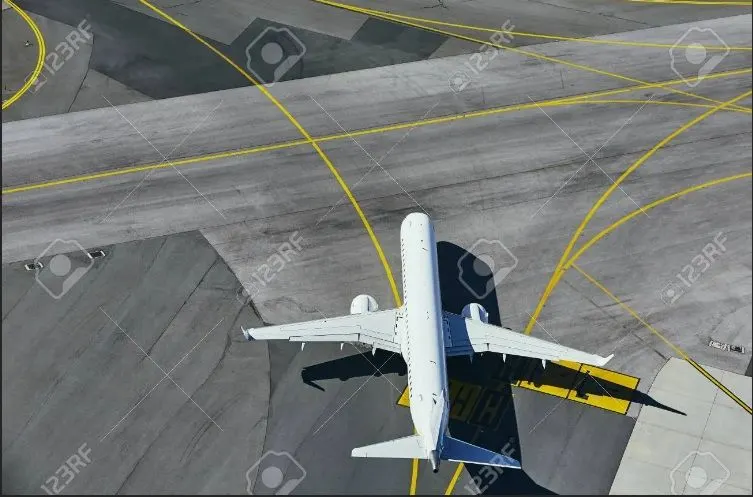
Taxiing is the movement of an aircraft on the ground, under its own power, in contrast to towing or pushback where the aircraft is moved by a tug. The aircraft usually moves on wheels, but the term also includes aircraft with skis or floats (for water-based travel).
It occurs after an airplane has landed, and it occurs before an airplane takes off. Airplanes don't actually fly while on the ground. As a result, the process by which they move on the runway isn't known as flying.
Towing:
The forward movement of an aircraft, usually with engines off, uses the power of a specialized ground vehicle attached to or supporting the nose landing gear. It may occur for the movement of both in service and out of service aircraft. This will affect the promulgation of procedures and the required qualification for those occupying the flight crew seats on the aircraft during the maneuver.
As part of an out-of-service repositioning of aircraft supervised by maintenance personnel, it may follow the pushback from a nose-in gate of an empty aircraft with engines off.
The movement of most aircraft around the airport and hangars is usually accomplished by towing with a towing vehicle or 'tug'. The aircraft is attached to the tow vehicle by the use of a towbar or other specialized methods that connect to or raise the nose or landing gear off the ground.
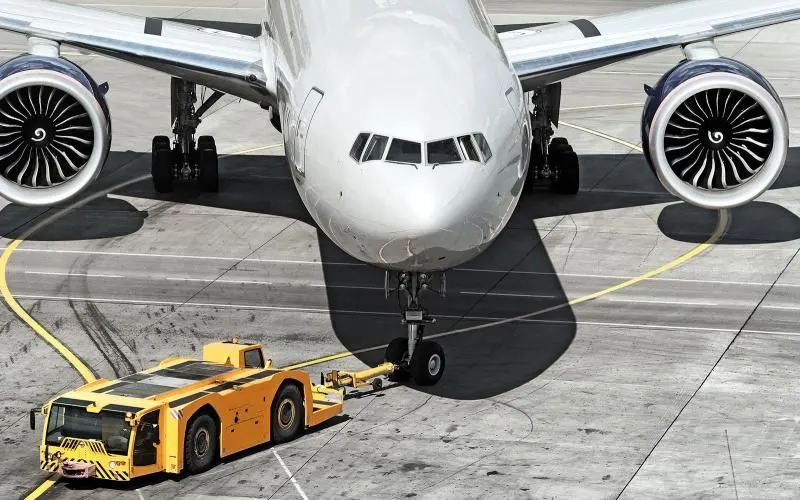
When towing the aircraft, the towing vehicle speed must be reasonable, and all persons involved in the operation must be alert. When the aircraft is stopped, do not rely upon the brakes of the towing vehicle alone to stop the aircraft. The person in the flight deck must coordinate the use of the aircraft brakes with those of the towing vehicle.
Aircraft equipped with tail wheels are generally towed forward by attaching the tow bar to the main landing gear. In most cases, it is permissible to tow the aircraft in reverse by attaching the tow bar to the tail wheel axle. Any time an aircraft equipped with a tail wheel is towed, the tail wheel must be unlocked or the tailwheel locking mechanism may damage or break. Aircraft equipped with tricycle landing gear are generally towed forward by attaching a tow bar to the axle of the nosewheel. They may also be towed forward or backward by attaching a towing bridle or specially designed towing bar to the towing lugs on the main landing gear. When an aircraft is towed in this manner, a steering bar is attached to the nosewheel to steer the aircraft.
5. Learn about the following
Take off:
Takeoff is the phase of flight in which an aircraft goes through a transition from moving along the ground (taxiing) to flying in the air, usually starting on a runway. For balloons, helicopters, and some specialized fixed-wing aircraft (VTOL aircraft such as the Harrier), no runway is needed. Takeoff is the phase of flight in which an aerospace vehicle leaves the ground and becomes airborne.
For aircraft that take off horizontally, this usually involves starting with a transition from moving along the ground on a runway. For balloons, helicopters, and some specialized fixed-wing aircraft (VTOL aircraft such as the Harrier), no runway is needed. Takeoff is the opposite of landing.
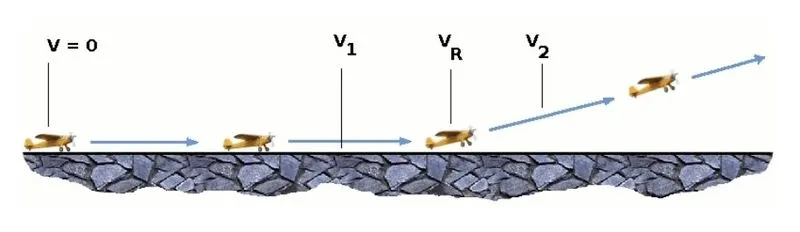
Take-off performance can be predicted using a simple measure of the acceleration of the aircraft along the runway based on force equilibrium. The forces involved will be,
T - Thrust of propulsion system pushing aircraft along the runway.
D - Aerodynamic Drag of vehicle resisting the aircraft motion.
F-Rolling resistance friction due to the contact of wheels or skids on the ground.
During the take-off run, the imbalance in these forces will produce an acceleration along the runway.
dv/dt = (T-D-F)/m
where dv/dt is the acceleration along the runway and m is the mass of the vehicle.
The procedure for take-off will be that the vehicle will accelerate until it reaches a safe initial flying speed. The pilot can then rotate the vehicle to an attitude to produce a climb lift and it will ascend from the ground. The determination of this safe flying speed or rotation speed, VR, is a critical factor in determining take-off performance.
Take-off rules vary slightly depending on the aircraft category. Small commuter aircraft should be considered as meeting FAR 23 rules, transport category aircraft should comply with FAR 25 rules.
Rolling Resistance:
The friction between the aircraft and the runway will be proportional to the normal force exerted by the aircraft on the runway.
F = μ(W-L)
The normal force will be the difference between the Weight of the aircraft and the Lift, the friction coefficient will be typically of a magnitude of 0.02 for a standard tarmac runway.
The rate of change of velocity can be predicted at any point on the take-off roll by substituting results for T, D, and F into the initial equation for dv/dt. The subsequent velocity at any point can be found by integrating this resulting equation and the distance traveled is found by then integrating the velocity.
Typically acceleration will be dominated by the drag component as thrust, weight, and friction are relatively constant during this period. This leads to the result shown where acceleration is inversely proportional to velocity squared.
Due to the quadratic nature of acceleration change, an average value,
(dV/dt)_avg = a
This average acceleration can be found at the point where,
V = VR/√2
This average acceleration can be used to simplify calculations and the take-off run can be calculated as an equivalent constant acceleration over the complete period of time (tr) taken to get from 0 to VR. For a constant acceleration take-off calculation.
VR = a.t
and distance travelled,
S =(1/2)*at²
Rearranging leads to a relatively simple calculation to predict the distance to the rotation point.
S1 = (1/2)*((VR^2)/a)
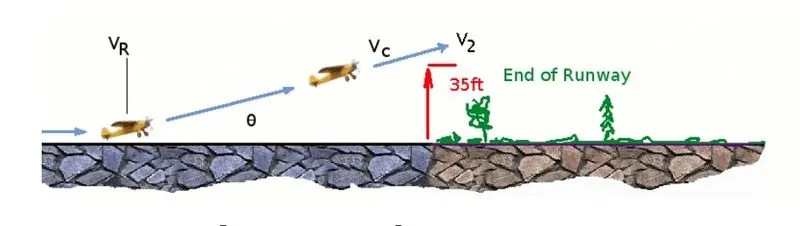
From the rotation point, the end of the runway can be defined by the requirement to clear a 35ft obstacle at the end. During rotation, it can be assumed that any residual excess thrust is absorbed in overcoming the lift-induced drag as the aircraft begins to climb. Acceleration reduces and a constant flight speed during this climbing phase can be assumed. The distance along the ground from rotation point to obstacle clearance point with thus be,
S2=35/tanθ
Landing:
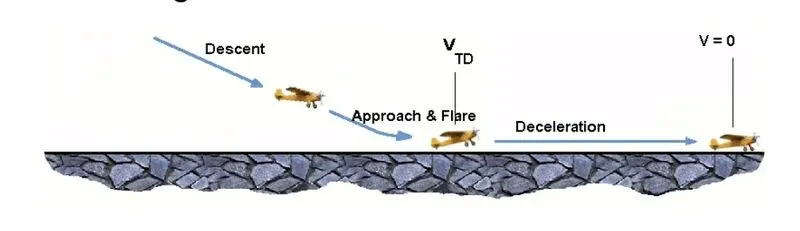
The landing run can be calculated in a similar fashion to the take-off distance. The aim is again to minimize the distance.
The touch-down velocity should be approximately the stall speed of the aircraft in landing configuration. This will be achieved by a pitch maneuver during the flare portion of the approach which increases drag and decelerates the aircraft to minimum flying speed.
The deceleration on the landing roll from VTD to Vo will be accomplished by braking and reverse thrust. This can be solved by the average acceleration approach that was used to estimate the take-off roll.
The negative acceleration or deceleration value will be based on the friction coefficient for maximum braking and the value of reverse thrust (if available).
Braking force:
Stopping an aircraft landing at 180-200 mph requires a lot of braking force. To do this, the aircraft has a brake unit on each of the wheels on the main gear assembly. On landing, pilots should use aerodynamic braking by applying extra back pressure on the stick or yoke. Extreme caution should be used when applying brakes at any sign cant speed, and only when the end of the runway is quickly approaching. Never step on the brakes to make a runway exit. Applying the brakes at too high a speed could burn the tires, wear out the brakes, or result in a ground loop or swerve.
Aircraft Disc Brake:
In the landing gear, it is used to brake the wheels while touching the ground. These brakes are operated hydraulically. In most modern aircraft they are activated by the top section of the rudder pedals ("toe brakes"). In some older aircraft, the bottom section is used instead ("heel brakes"). Levers are used in a few aircraft. Most aircraft are capable of differential braking.
Tyre Design of aircraft:
When it comes to safety, tires are one of the most important components of aircraft. They help to absorb the shock of landing and provide cushioning. It also provides the necessary traction for braking and stopping an aircraft.
An aircraft tire is designed to withstand extremely heavy loads while landing, taking off, taxing and parking. The number of wheels required for aircraft increases with the weight of the aircraft, as the weight of the airplane needs to be distributed more evenly.
Carcass plies are used to form the tire. They are sometimes called casing plies. An aircraft tire is constructed for the purpose it serves.
Unlike an automobile or truck tire, it does not have to carry a load for a long period of continuous operation. However, an aircraft tire absorbs the high impact loads of landing, and also it's operating at high speeds for a short time when required.
(1)Retreading:
Retreading is a method of restoring a worn tire by renewing the tread area or by renewing the tread area plus one or both sidewalls. Repairs are included in the tire retreading process.
(2)Load Rating:
The load rating is the maximum permissible load at a specified inflation pressure.
(3)Ply Rating:
Ply Rating is used to identify the maximum recommended load rating and inflation pressure for a specified tire. It is an index of tire strength.
(4)Speed Rating :
The speed rating is the maximum takeoff speed to which the tire has been tested.
(5)Skid Depth:
Skid depth is the distance between the tread surface and the deepest groove as measured in the mold.
Aircraft tires must have an approved speed and load rating and have sufficient clearance when retracted through landing gear to allow for tire growth. Tire growth is the increase in the size of the tire due to centrifugal forces at high speed.
6. calculate the force and power required to push/pull an aircraft by a towing vehicle.
The force required to push/pull an aircraft by a towing are:
- Rolling Resistance Force
- Aerodynamic Drag Force
Rolling Resistance Force:
As we have discussed earlier. It is the force resisting the motion when a body (such as a ball, tire, or wheel) rolls on a surface. Its governing equation is given as
F = Crr*N
F= Crr *m*g
where,
Crr - Rolling resistance coefficient
m - Mass of the body
g - acceleration due to gravity
Calculation:
let us assume that,
Mass of Towing Vehicle= 40,000kg
Mass of aircraft = 155,000kg
Total mass (m)= 40,000+155,000 =195,000kg
Frontal Area of the aircraft (A) =18 m²
Speed of the vehicle (u) =25kmph or 6.9445m/sec
Drag coefficient (Cd) =0.75
Air density (P) =1.225kg/m³
Calculating Rolling resistance Force (Frr):
Frr=Crr *m*g
=0.01*195,000*9.8
Frr= 19,110N
2) Aerodynamic Drag Force:
It is the force opposing the motion of the body. The drag coefficient is a common measure in automotive design as it pertains to aerodynamics. Drag is a force that acts parallel to and in the same direction as the airflow. The drag coefficient of an automobile measures the way the automobile passes through the surrounding air. When automobile companies design a new vehicle, they take into consideration the automobile drag coefficient in addition to the other performance characteristics. Aerodynamic drag increases with the square of speed; therefore, it becomes critically important at higher speeds. Reducing the drag coefficient in an automobile improves the performance of the vehicle as it pertains to speed and fuel efficiency. The governing equation of these forces is given as follows:
FD = (1/2)*ρv²*CDA
where,
FD - a drag force
ρ - mass density of the air
v - flow velocity relative to the object
CD - drag coefficient
A - reference area
Calculation:
let us assume that,
Mass of Towing Vehicle= 40,000kg
Mass of aircraft = 155,000kg
Total mass (m)= 40,000+155,000 =195,000kg
Frontal Area of the aircraft (A) =18 m²
Speed of the vehicle (u) =25kmph or 6.9445m/sec
Drag coefficient (Cd) =0.75
Air density (P) =1.225kg/m³
Calculating Aerodynamic Drag Force (Fd):
Fd = 0.5*p* Cd*A* v^2
= 0.5*1.225*18*0.75*(6.9445)²
Fd = 398.769N
Therefore the total Force required to push/pull the aircraft by the towing vehicle (F) = Frr+ Fd
= 19,110+398.769
F = 19,508.769 N
Calculating the power (p) = Force*Velocity
= 19508.769* 6.9445
Power =135.478kW
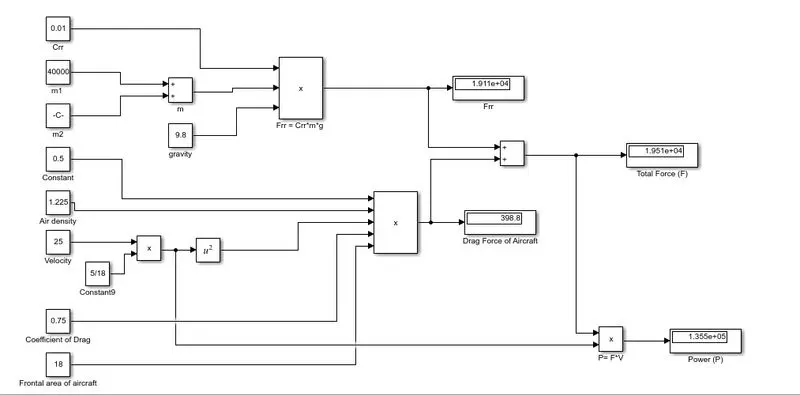
6.B. Simulink Model
Explanation:
- The above Simulink model has the input as calculated in the above calculation.
- To find the value of rolling resistance (Frr) we used the product to multiply the values Crr, Total mass(m) & gravity (g) which are to be entered in the 'Constant' block.
- For calculating the Total Force(F) we have added both Frr & Fd by using the 'Sum' block.
- For calculating Drag force(fd) we have to multiply the velocity in m/sec, Drag coefficient, Air density, Frontal area of aircraft (A), and a constant value of 0.5 which are to be entered in the 'constant' block.
- In order to convert velocity in Kmph to m/sec, we have multiplied by 5/18. and the values are squared.
- For calculating power, we have to multiply both total forces (F) and velocity in m/sec for this we have used the 'product' block (P=F*V).
- Then the output values of rolling resistance, Total Force, Air drag force and power are displayed through display.
7. Electric Powertrain
An EV's powertrain is responsible for taking energy stored in the vehicle's battery system and supplying it to the motors. The amount of power that it takes to move a fully-loaded vehicle is enormous, and delivery needs to be instantaneous and predictable.
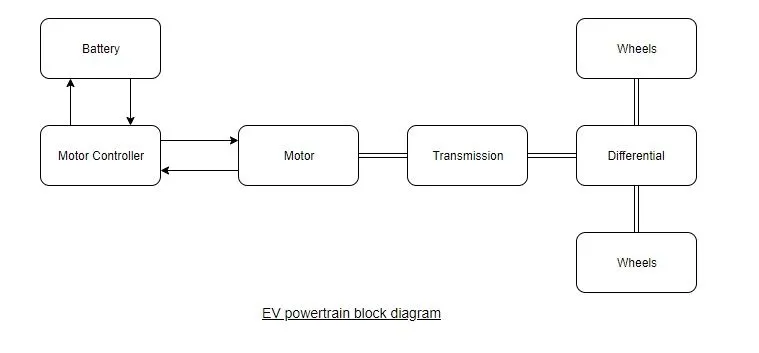
Based on the above calculations,
The force required to push/pull the aircraft = 19.508 KN
Power required =135.478 kw
Let us assume,
The Radius of the Tyre for the Tug = 25inches =0.635m
Gear ratio = 8
Transmission Efficiency (ηt) =87%
Motor Efficiency (ηm)=95%
then,
The torque required for the wheels (Tw)=Total Force *Radius in meters
= 19.508*0.635
Tw=12.387KNm
Motor Torque = Wheel torque/(Gear ratio*ηt)
= 12.387 / (8*0.87)
= 1.778KNm
For ηm=95%,
The required motor Torque (Tm)= 1.778/0.95
Tm=1.871 kNm
Similarly,
The total power required by the motor considering all the efficiencies (Pt) = 135.478/(0.87*0.95)
Pt=163.917Kw
Let us assume the towing operation was done for a 15 minutes (0.25Hrs) duration.
Then,
Total Energy consumed = pt*t
=163.917*0.25
= 40.98 KWh
If we consider the battery capacity = 220 kW is used by the towing vehicle then, The duty cycle range to control the speed from 0 to max speed (3m/s) is given as
Duty Cycle (d) = (Required Power)/ (Rated power)
= 163.917/220
Duty Cycle (d) = 0.75
Therefore the controller will be able to provide a duty cycle ranging from 0 to 75% in order to control the towing speed.
Inputs:
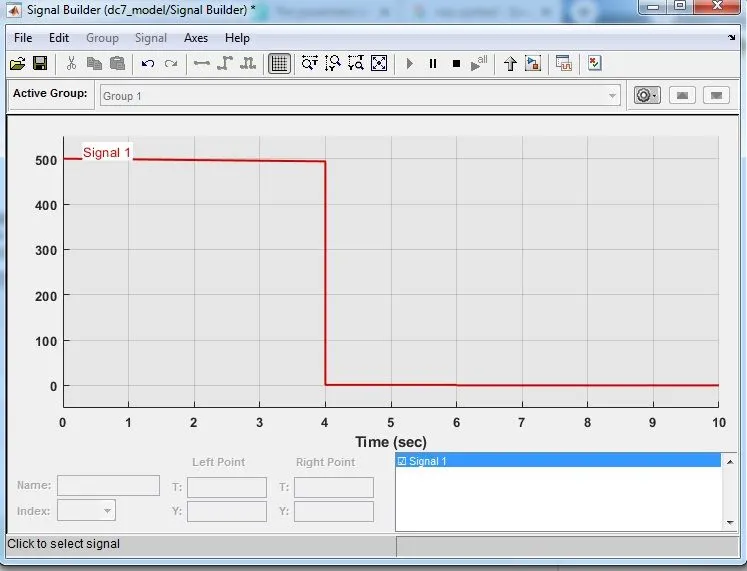
1.Signal Builder:
In the signal builder block we are assigning the values for,
y limits = 500 for T limits = 0 to 4
y limits = 0 for T limits = 4 to 10
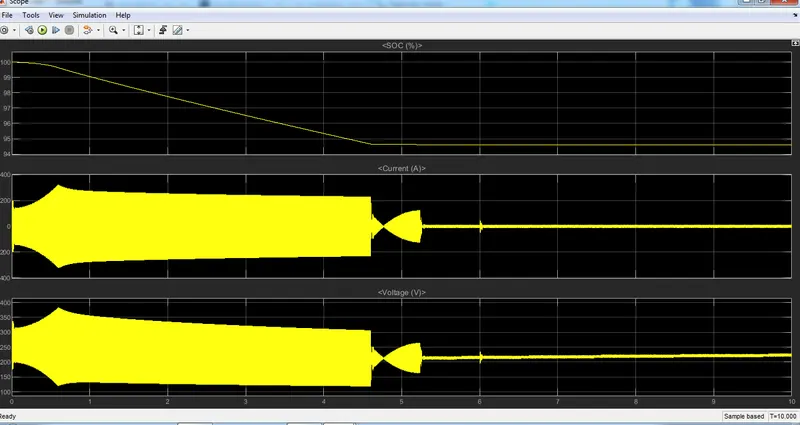
2. Battery:
In the battery, we have given an input voltage of 220V and the other parameter values are expressed through the above graphical representation.
Output results:
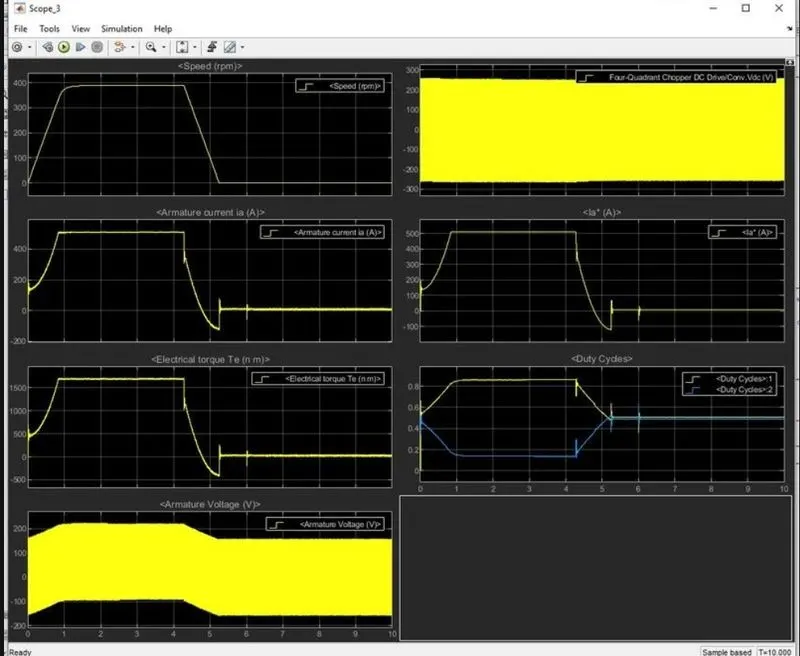
DC Drive Output:
7.B. Parameters in excel sheet
Conclusion:
Various types of aircraft weights has been searched and listed.
Difference of ground speed and air speed has explained well.
why the aircraft engine power is not recommended for the ground has explained.
How aircraft is pushed to runway has showned.
clearly learned about the given things and explained.
The power and force of a towing vehicle has simulated and calculated.
Electric powertrain has designed as a simulink model and also designed in the excel sheet.