Project-1: Powertrain for aircraft in runways
Part A:
1.Search and list out the total weight of various types of aircrafts.
Answer:-
Introduction:-
An aircraft is a vehicle or machine that is able to fly by gaining support from the air. It counters the force of gravity by using either static lift or by using the dynamic lift of an airfoil or in a few cases the downward thrust from jet engines. Common examples of aircraft include airplanes, helocopters, airships (including blimps), gliders, paramotors, and hot air ballons.
Aircraft Authorized Gross Weight Limits (also referred to as certified weight limits) are laid down in the (AFM) or Associated Certificate of Airworthiness. The Authorized weight limits that can legally be used by an operator or airline are those listed in AFM and the weight and balance manual. The Authorized weight limits are chosen by the customer/ airline and they are referred to as “purchased weight”. The operator may purchase certified weight below the max. design weight because many of the operating fees are based on the aircraft AFM maximum allowable weight values. An aircraft purchase is typically a function of the certified weight purchased. Maximum weights established for each aircraft, by design & certification must not be exceeded during aircraft operation (ramp or taxying, take-off, en-route flight, approach & landing) & during aircraft loading (zero fuel conditions, center of gravity positions, weight distribution) weights could be restricted on some type of aircraft depending on the aircraft handling requirements, e.g. Aerobatic Flight Aircraft, where certain Aerobatic Manoeuvres can only be executed with a limited gross weight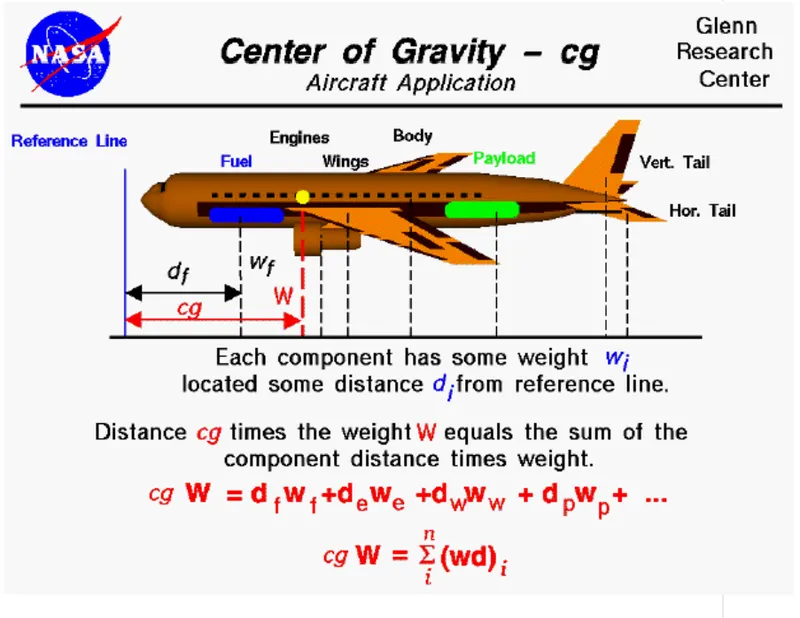
Also, the authorized maximum weight limits may be less as limited by the center of gravity, fuel density, and fuel loading limits. The different terms represent different weights or masses. For each flight, the weights are taken into account for several reasons like design, authorization, suitable condition, etc. A brief description of these is below:
1)Manufacturer's Empty Weight(MEW):
Also called Manufacturer's Weight Empty (MWE) or Licensed Empty Weight. It is the weight of the aircraft "as-built" and includes the weight of the structure, power plant, furnishings, installations, systems, and other equipment that are considered an integral part of an aircraft. This excludes any baggage, passengers, or usable fuel.
2)Zero-fuel weight(ZFW):
This is the total weight of the airplane and all its contents (including unusable fuel), but excluding the total weight of the usable fuel on board.
As a flight progresses and fuel is consumed, the total weight of the airplane reduces, but the ZFW remains constant. Maximum zero fuel weight (MZFW) is the maximum weight allowed before usable fuel and other specified usable agents (engine injection fluid, and other consumable propulsion agents) are loaded.
3)Operating empty weight(OEW): (Roughly equivalent to basic empty weight on light aircraft)
It is the basic weight of an aircraft including the crew, all fluids necessary for operation such as engine oil, engine coolant, water, unusable fuel, and all operator items and equipment required for flight but excluding usable fuel and the payload.Now, it is important to mention that the carrying capacity of an aircraft is known as the Payload. It includes cargo, people, extra fuel.In the case of a commercial airliner, it may refer only to revenue-generating cargo or paying passengers.
4)Maximum takeoff weight(MTOW):
This is the maximum weight at which the pilot of the aircraft is allowed to attempt to take off.
5)Regulated takeoff weight(RTOW):
Depending on different factors (e.g. flap setting, altitude, air temperature, length of runway), RTOW or maximum permissible takeoff weight varies for each takeoff. It can never be higher than MTOW.
The following image depicts takeoff weight components for a better idea:-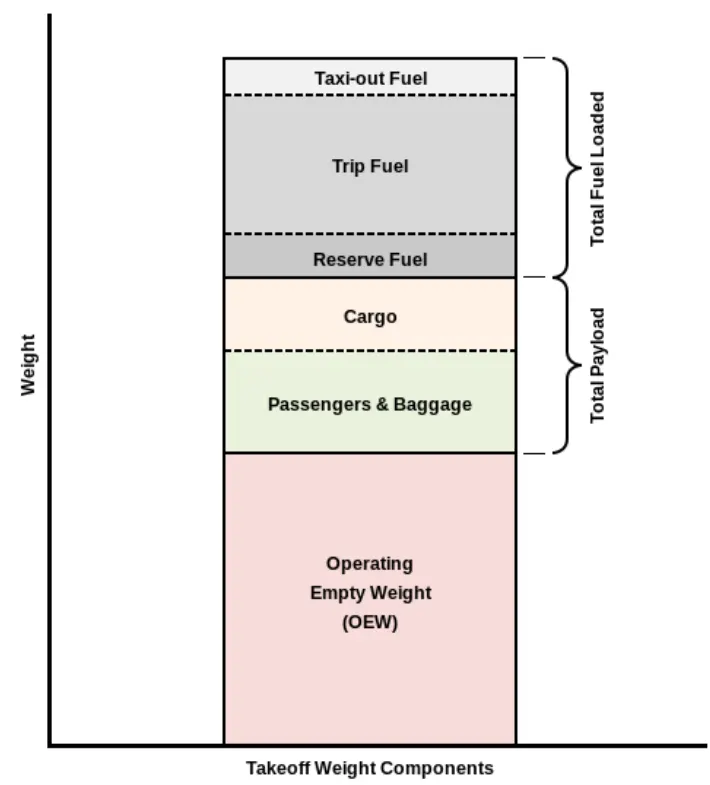
6)Maximum landing weight(MLW):
This maximum weight at which an aircraft is permitted to land. The maximum certificated design weight at which the aircraft meets the appropriate landing certification requirements. It generally depends on the landing gear strength or the landing impact loads on certain parts of the wing structure. The MLW must not exceed the MTOW.
The maximum landing weight is typically designed for 10 feet per second (600 feet per minute) sink rate at touch down with no structural damage.
7)Maximum ramp weight(MRW):
Also called maximum taxi weight (MTW). It is the maximum weight authorized for maneuvering (taxiing or towing) an aircraft on the ground.
8)Aircraft gross weight(AGW):
It is the total aircraft weight at any moment during the flight or ground operation. This decreases during the flight due to fuel and oil consumption.
To have a practical idea a complete listing of the "Aircraft's maximum takeoff weight(MTOW)" is given below with all the needed details:
Airplanes:
MTOW = Maximum take-off weight, MLW = Maximum landing weight, TOR = Take-off run (SL, ISA+15°, MTOW), LR = Landing run (SL, ISA+15°, MLW)
| Type | MTOW [kg] | MLW [tonnes] | TOR [m] | LR [m] | ICAO category | FAA category |
|---|---|---|---|---|---|---|
| Antonov An-225 | 640,000 | 591.7 | 3500 | Heavy | Super | |
| Scaled Composites Model 351 Stratolaunch | 589,670 | 3660 | Heavy | Super | ||
| Airbus A380-800[1][2][3] | 575,000 | 394 | 3100 | 1930 | Heavy | Super |
| Boeing 747-8F | 447,700 | 346.091 | 3100 | 1800 | Heavy | Heavy |
| Boeing 747-8 | 443,613 | 306.175 | 3100 | Heavy | Heavy | |
| Boeing 747-400ER | 412,770 | 295.742 | 3090 | Heavy | Heavy | |
| Antonov An-124-100M | 405,060 | 330 | 2520 | 900 | Heavy | Heavy |
| Boeing 747-400 | 396,900 | 295.742 | 3018 | 2179 | Heavy | Heavy |
| Lockheed C-5 Galaxy[4][5][6] | 381,000 | 288.417 | 2530 | 1494 | Heavy | Heavy |
| Boeing 747-200[7] | 377,840 | 285.700 | 3338 | 2109 | Heavy | Heavy |
| Boeing 747-300[7] | 377,840 | 260.320 | 3222 | 1905 | Heavy | Heavy |
| Airbus A340-500[8] | 371,950 | 240 | 3050 | 2010 | Heavy | Heavy |
| Airbus A340-600[8] | 367,400 | 256 | 3100 | 2100 | Heavy | Heavy |
| Boeing 777F | 347,800 | 260.816 | 2830 | Heavy | Heavy | |
| Boeing 777-300ER | 351,800 | 251.29 | 3100 | Heavy | Heavy | |
| Boeing 777-200LR | 347,450 | 223.168 | 3000 | Heavy | Heavy | |
| Boeing 747-100[7] | 340,200 | 265.300 | Heavy | Heavy | ||
| Airbus A350-1000 | 308,000 | 233.5 | Heavy | Heavy | ||
| Boeing 777-300 | 299,370 | 237.683 | 3380 | Heavy | Heavy | |
| Boeing 777-200ER | 297,550 | 213.00 | 3380 | 1550 | Heavy | Heavy |
| Airbus A340-300[8][9] | 276,700 | 190 | 3000 | 1926 | Heavy | Heavy |
| McDonnell Douglas MD-11 | 273,300 | 185 | 2990 | 1890 | Heavy | Heavy |
| Airbus A350-900 | 270,000 | 175 | 2670 | 1860 | Heavy | Heavy |
| Ilyushin Il-96M | 270,000 | 195.04 | 3115 | 2118 | Heavy | Heavy |
| McDonnell Douglas DC-10 | 256,280 | 183 | 2990 | 1890 | Heavy | Heavy |
| Boeing 787-9[10] | 254,000 | 192.777 | 2900 | Heavy | Heavy | |
| Boeing 787-10[10] | 254,000 | 201.849 | Heavy | Heavy | ||
| Airbus A340-200[8][11] | 253,500 | 181 | 2990 | Heavy | Heavy | |
| Airbus A330-900 | 251,000 | 191 | 3100 | Heavy | Heavy | |
| Ilyushin IL-96-300 | 250,000 | 175 | 2600 | 1980 | Heavy | Heavy |
| Airbus A330-300[12][13] | 242,000 | 185 | 2500 | 1750 | Heavy | Heavy |
| Airbus A330-200[12][13] | 242,000 | 180 | 2220 | 1750 | Heavy | Heavy |
| Lockheed L-1011-500 | 231,300 | 166.92 | 2636 | Heavy | Heavy | |
| Boeing 787-8[10] | 228,000 | 172.365 | 3300 | 1695 | Heavy | Heavy |
| Lockheed L-1011-200 | 211,400 | Heavy | Heavy | |||
| Ilyushin IL-86 | 208,000 | 175 | Heavy | Heavy | ||
| Boeing 767-400ER | 204,000 | 158.758 | 3414 | Heavy | Heavy | |
| Airbus A300-600R[14] | 192,000 | 140 | 2385 | 1555 | Heavy | Heavy |
| Boeing 767-300ER | 187,000 | 136.08 | 2713 | 1676 | Heavy | Heavy |
| Concorde | 185,000 | 111.1 | 3440 | 2220 | Heavy | Heavy |
| Airbus A300-600[14] | 163,000 | 138 | 2324 | 1536 | Heavy | Heavy |
| Boeing 767-300 | 159,000 | 136.078 | 2713 | 1676 | Heavy | Heavy |
| Airbus A310-300[14] | 157,000 | 124 | 2290 | 1490 | Heavy | Heavy |
| Vickers VC10 | 152,000 | 151.9 | Heavy | Heavy | ||
| Boeing 707-320B[15] | 151,000 | 97.5 | Heavy | Heavy | ||
| Boeing 707-320C[15] | 151,000 | 112.1 | Heavy | Heavy | ||
| Douglas DC-8-61 | 147,000 | Heavy | Heavy | |||
| Airbus A310-200[14] | 142,000 | 123 | 1860 | 1480 | Heavy | Heavy |
| Airbus A400M | 141,000 | 122 | 980 | 770 | Heavy | Heavy |
| Douglas DC-8-32 | 140,000 | Heavy | Heavy | |||
| Douglas DC-8-51 | 125,000 | Medium | Large | |||
| Boeing 757-300 | 124,000 | 101.6 | 2550 | 1750 | Medium | Large |
| Boeing 707-120B[15] | 117,000 | 86.3 | Medium | Large | ||
| Boeing 757-200 | 116,000 | 89.9 | 2347 | 1555 | Medium | Large |
| Boeing 720B[16] | 106,000 | 79.5 | Medium | Large | ||
| Boeing 720[16] | 104,000 | 79.5 | Medium | Large | ||
| Tupolev Tu-154M | 104,000 | 80 | Medium | Large | ||
| Tupolev Tu-204SM | 104,000 | 87.5 | 2250 | Medium | Large | |
| Convair 880 | 87,500 | Medium | Large | |||
| Boeing 737-900 | 85,000 | 66.36 | 2500 | 1704 | Medium | Large |
| Boeing 737-900ER | 85,000 | 71.35 | 2804 | 1829 | Medium | Large |
| Boeing 727-200 Advanced[17] | 84,000 | 70.1 | Medium | Large | ||
| Airbus A321-100[18] | 83,000 | 77.8 | 2200 | 1540 | Medium | Large |
| Boeing 737-800 | 79,000 | 65.32 | 2308 | 1634 | Medium | Large |
| Boeing 727-200[17] | 78,000 | 68.1 | Medium | Large | ||
| McDonnell-Douglas MD-83 | 73,000 | 63.28 | Medium | Large | ||
| Boeing 727-100[17] | 72,500 | 62.4 | Medium | Large | ||
| Boeing 727-100C[17] | 72,500 | 62.4 | Medium | Large | ||
| McDonnell-Douglas MD-90-30 | 71,000 | 64.41 | 2165 | 1520 | Medium | Large |
| de Havilland Comet 4 | 70,700 | Medium | Large | |||
| Boeing 737-700 | 70,000 | 58.06 | 1921 | 1415 | Medium | Large |
| Airbus A320-100[18] | 68,000 | 66 | 1955 | 1490 | Medium | Large |
| Boeing 737-400 | 68,000 | 54.9 | 2540 | 1540 | Medium | Large |
| de Havilland Comet 3 | 68,000 | Medium | Large | |||
| Boeing 377 | 67,000 | Medium | Large | |||
| Boeing 737-600 | 66,000 | 54.66 | 1796 | 1340 | Medium | Large |
| Airbus A220-300 | 65,000 | 57.61 | 1890 | 1494 | Medium | Large |
| Hawker Siddeley Trident 2E | 65,000 | Medium | Large | |||
| Airbus A319[18] | 64,000 | 62.5 | 1850 | 1470 | Medium | Large |
| Boeing 737-300 | 63,000 | 51.7 | 1939 | 1396 | Medium | Large |
| Boeing 737-500 | 60,000 | 49.9 | 1832 | 1360 | Medium | Large |
| Airbus A220-100 | 59,000 | 50.80 | 1463 | 1356 | Medium | Large |
| Airbus A318[18] | 59,000 | 57.5 | 1375 | 1340 | Medium | Large |
| Boeing 717-200HGW | 55,000 | 47.174 | 1950 | Medium | Large | |
| Douglas DC-7 | 55,000 | Medium | Large | |||
| de Havilland Comet 2 | 54,000 | Medium | Large | |||
| Boeing 717-200BGW | 50,000 | 46.265 | 1950 | Medium | Large | |
| de Havilland Comet 1 | 50,000 | Medium | Large | |||
| Douglas DC-6A | 48,600 | Medium | Large | |||
| Douglas DC-6B | 48,500 | Medium | Large | |||
| Embraer 190[19] | 48,000 | 43 | 2056 | 1323 | Medium | Large |
| Caravelle III | 46,000 | Medium | Large | |||
| Fokker 100 | 46,000 | 39.95 | 1621 | 1350 | Medium | Large |
| Douglas DC-6 | 44,000 | Medium | Large | |||
| Avro RJ-85 | 42,000 | 36.74 | Medium | Large | ||
| Handley Page Hermes | 39,000 | Medium | Large | |||
| Embraer 175[20] | 37,500 | 32.8 | 2244 | 1304 | Medium | Large |
| Bombardier CRJ900[21] | 36,500 | 33.345 | 1778 | 1596 | Medium | Large |
| Embraer 170[22] | 36,000 | 32.8 | 1644 | 1274 | Medium | Large |
| Bombardier CRJ700 | 33,000 | 30.39 | 1564 | 1478 | Medium | Large |
| Douglas DC-4 | 33,000 | Medium | Large | |||
| Vickers Viscount 800 | 30,400 | Medium | Large | |||
| Bombardier Q400 | 28,000 | 28.01 | 1219 | 1295 | Medium | Large |
| Bombardier CRJ200 | 23,000 | 21.319 | 1918 | 1479 | Medium | Large |
| ATR 72-600 | 22,800 | 22.35 | 1333 | 914 | Medium | Large |
| Saab 2000 | 22,800 | 21.5 | 1300 | Medium | Large | |
| Embraer ERJ 145 | 22,000 | 19.3 | 2270 | 1380 | Medium | Large |
| ATR 42-500 | 18,600 | 18.3 | 1165 | 1126 | Medium | Small |
| Saab 340 | 13,150 | 12.930 | 1300 | 1030 | Medium | Small |
| Embraer 120 Brasilia | 11,500 | 11.25 | 1560 | 1380 | Medium | Small |
| BAe Jetstream 41 | 10,890 | 10.570 | 1493 | 826 | Medium | Small |
| Learjet 75[23] | 9,752 | 8.709 | 1353 | 811 | Medium | Small |
| Pilatus PC-24[24] | 8,300 | 7.665 | 893 | 724 | Medium | Small |
| Embraer Phenom 300[25] | 8,150 | 7.65 | 956 | 677 | Medium | Small |
| Beechcraft 1900D | 7,765 | 7.605 | 1036 | 853 | Medium | Small |
| Cessna Citation CJ4[26] | 7,761 | 7.103 | 1039 | 896 | Medium | Small |
| de Havilland Hercules | 7,000 | Medium | Small | |||
| Embraer Phenom 100 | 4,800 | 4.43 | 975 | 741 | Light | Small |
Reference Link:-
1)https://en.wikipedia.org/wiki/Aircraft_gross_weight
2)https://en.wikipedia.org/wiki/List_of_airliners_by_maximum_takeoff_weight
3)https://aviation.stackexchange.com/questions/12956/what-are-different-types-of-weights-of-an-aircraft
----------------------------------------------------------------------------------------------------
2. Is there any difference between ground speed and air speed?
Answer:-
Air-speed & Ground-speed of an Aircraft:
As mentioned above, true airspeed is simply the speed at which an aircraft is moving relative to the air it is flying in. As such, it’s also the speed at which the air is flowing around the aircraft’s wings.`Ground speed, on the other hand, is the aircraft’s speed relative to the ground. One thing that should be noted here is that it is horizontal rather than vertical speed – an aircraft climbing completely vertically would have a ground speed of zero. In other words, while airspeed is what determines whether there is enough airflow around an aircraft to make it fly, ground speed is what determines how fast an aircraft will get to its destination.
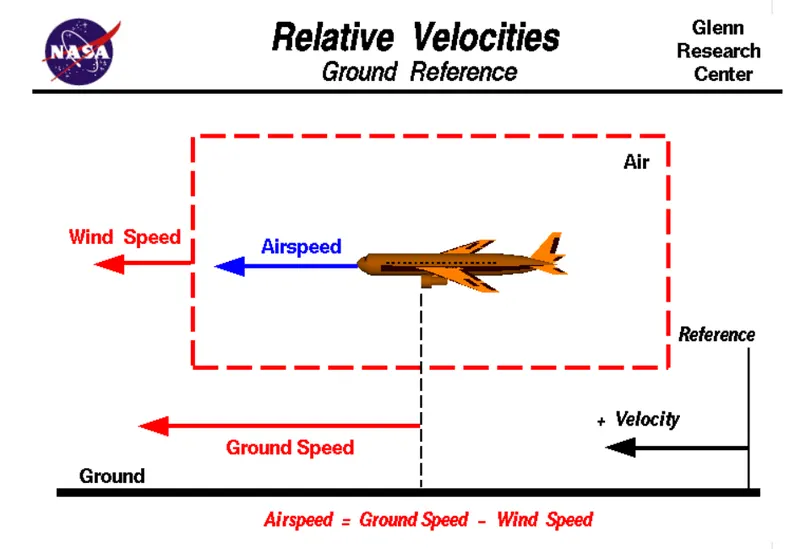
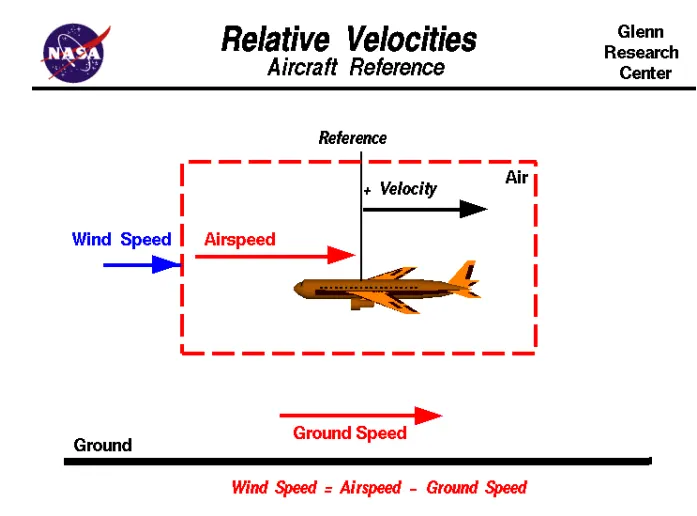
- The aircraft usually operates on land as well as in air and so we need to study their speed differences in-ground and in air
- The ground speed and the airspeed usually change based on the wind component.
- If we consider that there is no wind component then, ground speed = airspeed
- If the wind is blowing in the tail direction of the aircraft then, (airspeed > ground speed) so, airspeed = ground speed + wind component.
- If the wind is blowing in the head direction of the aircraft then, (airspeed < ground speed)so, airspeed = ground speed – wind component.
- Also, gravity plays a major role in increasing the aircraft's speed while it is descending.
- Here wind speed is the vector difference between ground and airspeed. On a particular day, the wind speed may be zero and it is equal to the ground speed.
- If the measured airspeed is greater than the observed ground speed the wind speed becomes positive.
---------------------------------------------------------------------------------------------------
3. Why is it not recommended to use aircraft engine power to move it on the ground at Airport?
Answer:-
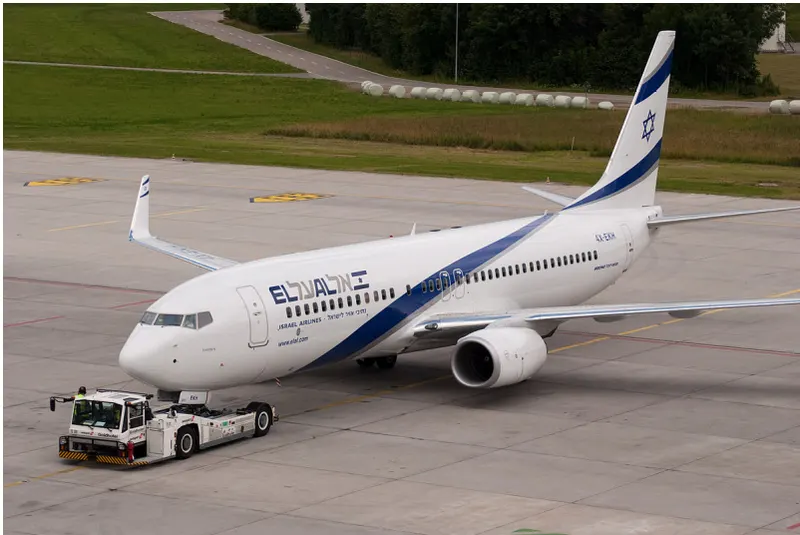
The aircraft can be move using their own engine power all the time on the airport apron and taxiways under their own powere to go towards runways and after landing taxi to thier assignbed gate. But the thrust produced resulting jet blast might cause damage to terminal building or equipment. Engine close to the ground may also blow sand and debris forward and then suck them into the engine causing damage to the engine. A pushback is therefore are preferred method to move the aircraft away from the gate. and also it can reduce the cost of fuel, Taxing can save money.
Thrust reverse:-
It is known in the majority as reverse thrust, is projected in the opposite way and is used after landing, in the case of rejected departures or, in some cases, in flight, to decelerate the aircraft. Pushback is used by aircraft to move backward on the ground using the power of their engines along with the reverse thrust of the aircraft.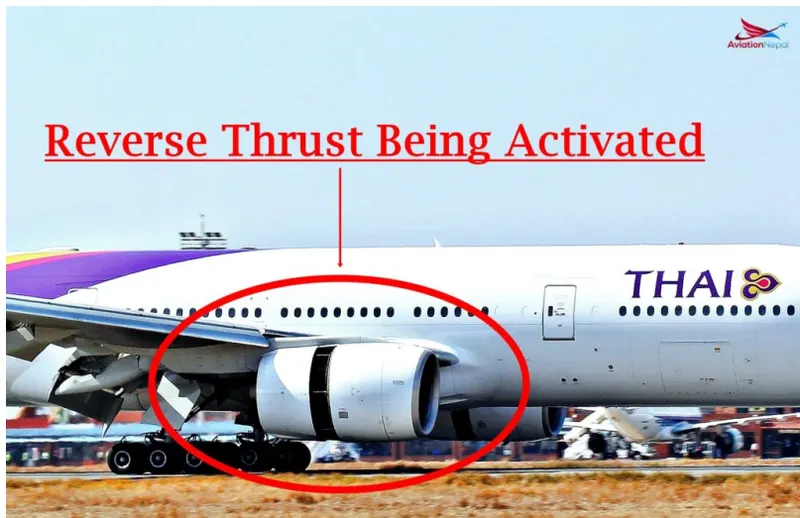
Disadvantages for thrust back process:-
- Need To maintain the fuel:-
Using reverse thrust for pushback, it consumes a lot of fuel. Aviation fuels are very expensive. It will therefore become more expensive for the airline itself. Airlines therefore discontinued this practice in order to reduce costs and conserve fuel. - Causes more wear and tear:-
Since the engines were used for pushback, other than normal operation, they would cause more wear and tear in the engine parts, thus reducing the operating life of the engine. - More maintenace cost:-
Generally, the engine that will operate more will require more maintenance to check the wear and tear of the engine parts. This will add to the maintenance cost of the operating airline. This practice has therefore been discontinued. - No back view:-
Unlike our cars, aircraft don’t have rear-view mirrors to look backwards while using the Reverse Thrust (a procedure referred to as a powerback) pushback method. This is causing serious accidents. - Injuries to the ground staff:-
The powerful jet blast created during the reverse thrust can throw the ground personnel at his feet. In order to avoid such events, the reverse thrust (a procedure referred to as a powerback) procedure has been discontinued. - Damage to the engine of the aircarft:-
The powerful jet blast can throw ground equipment and debris into the engine intake. This will cause serious engine damage and ultimately lead to engine failure. - Damage to the terminal at the airport:-
The jet blast from the engine’s thrust reversers can throw anything away and hurl it toward the terminal. Thus, the terminal of the airport can be damaged.
Reference Link:- https://www.aviationnepal.com/how-pushback-is-performed-why-do-civil-aircraft-do-not-use-apower-back-pushback/
--------------------------------------------------------------------------------------------------
4. How an aircraft is pushed to runway when its ready to take off?
Answer:-
4.1 Phases of A Flight:-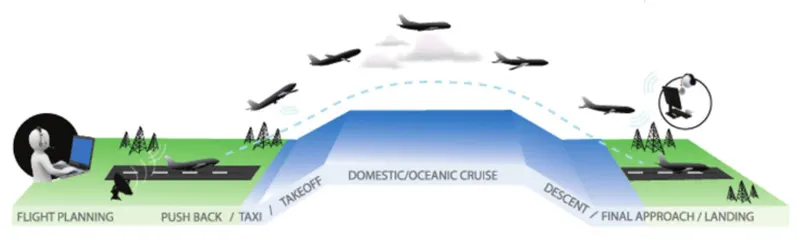
Image courtesy of Federal Aviation Administration (FAA) 4.1 Taxi
a. Taxiing refers to the movement of an aircraft on the ground, under its own power. The aircraft moves on wheels. An aeroplane uses taxiways to taxi from one place on an airport to another; for example, when moving from a terminal to the runway.
b. The aircraft always move on the ground following the yellow lines, to avoid any collision with the surrounding buildings, vehicles or other aircraft. The taxiing motion has a speed limit. Before making a turn, the pilot reduces the speed further to prevent tire skids. Just like cars, there is a certain list of priorities during taxiing. The aircraft that are landing or taking off have higher priority.The other aircraft have to wait for these aircraft before they start or continue taxiing.
c. The thrust to propel the aircraft forward comes from its propellers or jet engines. Steering is achieved by turning a nose wheel or tail wheel/rudder; the pilot controlling the direction travelled with their feet. The use of engine thrust near terminals is restricted due to the possibility of jet blast damage. This is why the aircraft is pushed back from the buildings by a vehicle before they can start their own engines for taxiing.
4.2 Take-Off:-
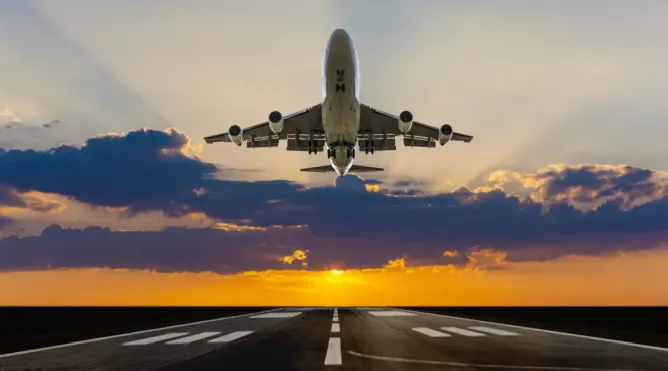
- Takeoff is the phase of flight in which an aircraft goes through a transition from moving along the ground (taxiing) to flying in the air, usually starting on a runway. Usually, the engines are run at full power during takeoff. Following the taxi motion, the aircraft stops at the starting line of the runway. Before takeoff, the engines, particularly piston engines, are routinely run up at high power to check for engine-related problems. This makes considerable noise. When the pilot releases the brakes, the aircraft starts accelerating rapidly until the necessary speed for take-off is achieved.
- The takeoff speed required varies with air density, aircraft weight, and aircraft configuration (flap and/or slat position, as applicable). Air density is affected by factors such as field elevation and air temperature.
- Operations with transport category aircraft employ the concept of the takeoff V-Speeds, V1 and V2. These speeds are determined not only by the above factors affecting takeoff performance but also by the length and slope of the runway. Below V1, in case of critical failures, the takeoff should be aborted; above V1 the pilot continues the takeoff and returns for landing. After the co-pilot calls V1, Then, V2 (the safe takeoff speed) is called. This speed must be maintained after an engine failure to meet per- performance targets for rate of climb and angle of climb.
- The speeds needed for takeoff are relative to the motion of the air (indicated airspeed). A headwind will reduce the ground speed needed for takeoff, as there is a greater flow of air over the wings. This is why the aircraft always take off against the wind. Sidewind is not preferred as it would disturb the stability of the aircraft. Typical takeoff air speeds for jetliners are in the 130–155 knot range (150–180 mph, 240–285 km/h). For a given aircraft, the takeoff speed is usually directly proportional to the aircraft weight; the heavier the weight, the greater the speed needed. Some aircraft have difficulty generating enough lift at the low speeds encountered during takeoff. These are therefore fitted with high-lift devices, often including slats and usually flaps,which increase the camber of the wing, making it more effective at low speed, thus creating more lift. These have to be deployed from the wing before performing any manoeuvre.
- At the beginning of the climb phase, the wheels are retracted into the aircraft and the undercarriage doors are closed. This operation is audible by the passengers as a niose coming from below the floor.
4.3 Climb:-
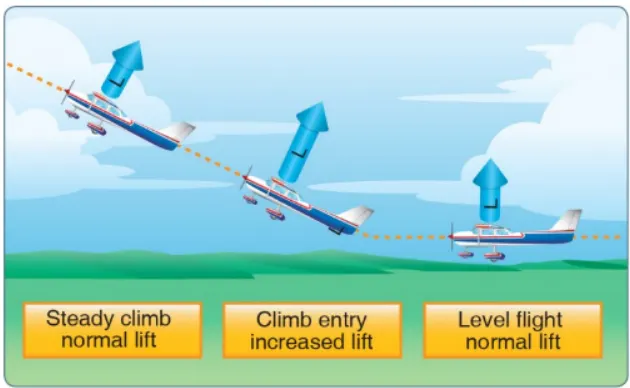
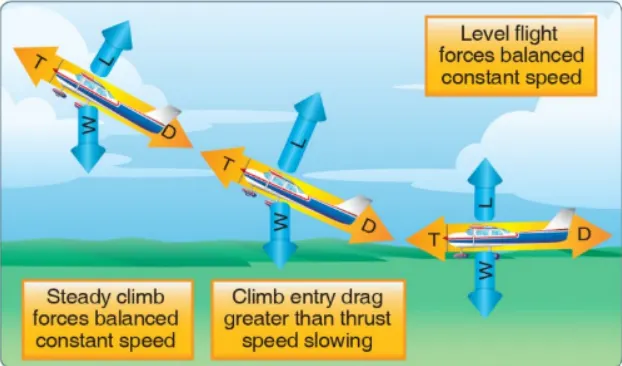
- Following take-off, the aircraft has to climb to a certain altitude (typically 30,000 ft or 10 km) before it can cruise at this altitude safely and economically. A climb is carried out by increasing the lift of wings supporting the aircraft until their lifting force exceeds the weight of the aircraft. Once this occurs, the aircraft will climb to a higher altitude until the lifting force and weight are again in balance. The increase in lift may be accomplished by increasing the angle of attack of the wings, by increasing the thrust of the engines to increase speed (thereby increasing lift), by increasing the surface area or shape of the wing to produce greater lift, or by some combination of these techniques. In most cases, engine thrust and angle of attack are simultaneously increased to produce a climb.
- Because lift diminishes with decreasing air density, a climb, once initiated, will end by itself when the diminishing lift with increasing altitude drops to a point that equals the weight of the aircraft. At that point, the aircraft will return to level flight at a constant altitude. During the climb phase, it is normal that the engine noise diminishes. This is because the engines are operated at a lower power level after the take-off. It is also possible to hear a whirring noise or a change in the tone of the noise during a climb. This is the sound of the flaps that are retracting. A wing with a retracted flap produces less noise.
Referece Link:- https://www.flightliteracy.com/aerodynamic-forces-in-flight-maneuvers-part-two/
--------------------------------------------------------------------------------------------------
5. Learn about take off power, tyre design, rolling resistance, tyre pressure, brake forces when landing.
Answer:-
1] Take Off Power:-
Takeoff is the phase of flight in which an aerospace vehicle leaves the ground and becomes airborne. For aircraft that take off horizontally, this usually involves starting with a transition from moving along the ground on a runway.
Although the takeoff is one continuous maneuver it will be divided into three separate steps for purposes of explanation:
1. takeoff roll, 2. lift-off, and 3. initial climb after becoming airborne.
Takeoff roll (ground roll) is the portion of the takeoff procedure during which the airplane is accelerated from a standstill to an airspeed that provides sufficient lift for it to become airborne.
Lift-off is when the wings are lifting the weight of the airplane off the surface. In most airplanes, this is the result of the pilot rotating the nose up to increase the angle of attack (AOA).
The initial climb begins when the airplane leaves the surface and a climb pitch attitude has been established. Normally, it is considered complete when the airplane has reached a safe maneuvering altitude or an en route climb has been established.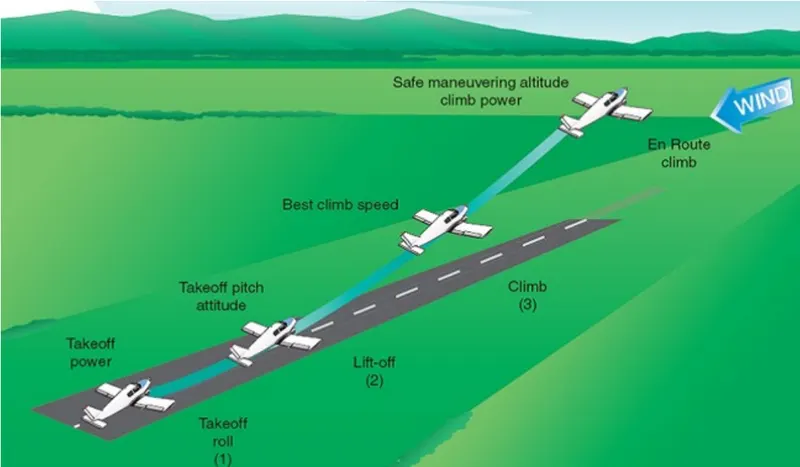
Cross winding Take off:-
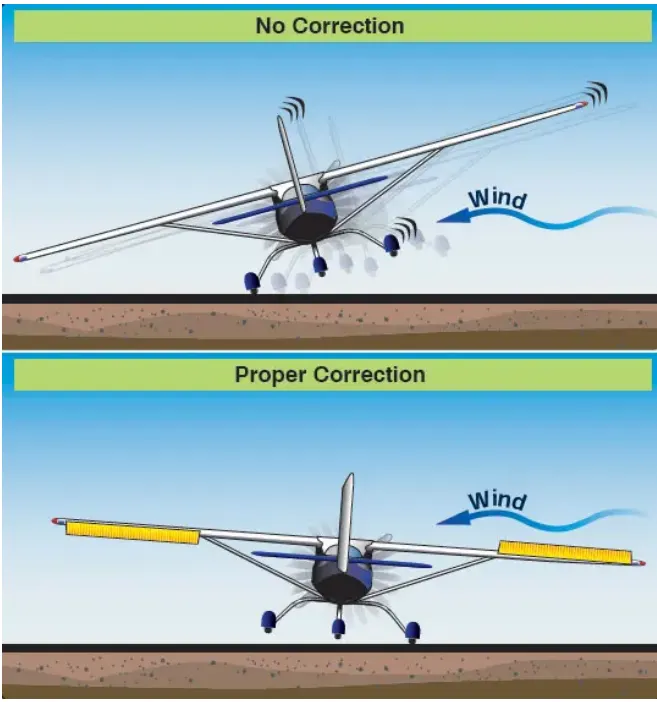
Take off performance can be predicted using a simple measure of the acceleration of the aircraft along the runway based on force equilibrium. The forces will be involved by,
T – Thrust of propulsion system pushing aircraft along runway.
D – Aerodynamic Drag of vehicle resisting the aircraft motion.
F – Rolling resistance friction due to the contact of wheels or skids on the ground.
During take-off run the imbalance in these forces will produce an acceleration along the runway.
`m.(dv)/dt=T-D-F`
where (dV/dt) is the acceleration along the runway and (m) is the mass of the vehicle.
The procedure for take-off will be that the vehicle will accelerate until it reaches a safe initial flying speed. The pilot can then rotate the vehicle to an attitude to produce climb lift and it will ascend from the ground. The determination of this safe flying speed or rotation speed, (V , is a critical factor in determining take-off performance. Take-off rules vary slightly depending on the aircraft category.
Small commuter aircraft,
`V=1.1.V stall or`
`V=1.05.V control,`
`V stall=sqrt(W/(0.5.CLmax.rho.S))`
wheer S =runway length
Take OFF power = Force*Displacement,
`(m.(dv)/dt).2.S=(T-D-F).S`
Reference Link:- 1) http://www.aerodynamics4students.com/aircraft-performance/take-off-and-landing.php
2] Tyre Design:-
Aircraft Radial vs Bias Tyre - AviationHunt
When it comes to safety, tyres are one of the most important components of aircraft. They help to absorb the shock of landing and provide cushioning. It also provides the necessary traction for braking and stopping of an aircraft.
An aircraft tyre is designed to withstand extremely heavy loads while landing, take off, taxing, and parking. The number of wheels required for aircraft increases with the weight of the aircraft, as the weight of the aeroplane needs to be distributed more evenly.
Constuction of Tyres:-
Radial type Tyre:-
It has the fibre strands of the ply fabric oriented with and at 90° to the direction of rotation and the tyre sidewall. This restricts flexibility bidirectionally and the flexibility of the sidewall while it strengthens the tyre to carry heavy loads.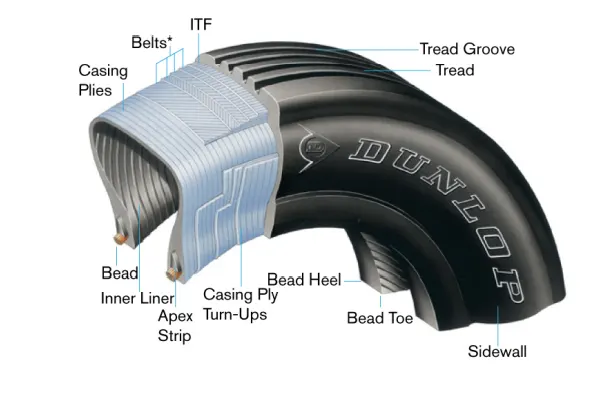
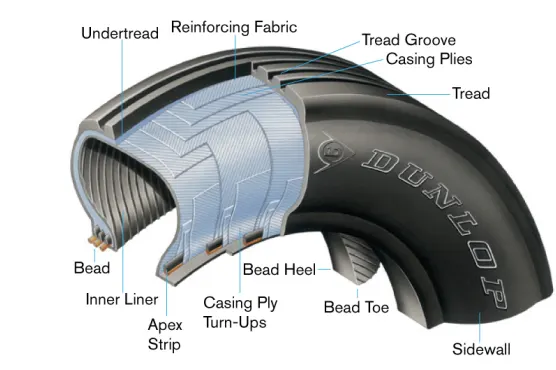
Bias-ply type Tyre:-
It has the fabric bias oriented with and across the direction of rotation and the sidewall. Since fabric can stretch on the bias, the tyre is flexible and can absorb loads. Tyre strength is obtained by adding plies.
3] Rolling Resistance:-
It is the resistance to rolling that occurs when a round object, such as a ball, wheel, or cylinder rolls on a surface. It is caused primarily by deformation of the object, deformation of the surface, or both.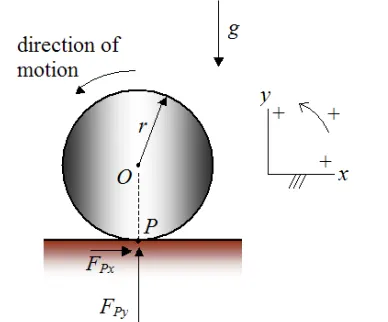
It can be seen in the aircraft when the aircraft Takes Off from the runway and while landing at the runway with the help of their wheels.
It is expressed as `Frr=murr.m.g`
Wheere,
Frr = rolling resistavnce (N)
urr = Coefficient of rolling resistance
m = mass (kg)
g = acceleration due to gravity = 9.81 m/s^2.
Referencelink:- https://www.real-world-physics-problems.com/rolling-resistance.html
4] Tyre pressure:-
Aircraft tires generally operate at high pressures, up to 200 psi (14 bar; 1,400 kpa) for airliners, /and even higher for business jets. The main landing gear on the concorde was typically inflated to 232 psi (16.0 bar), whilst its tail bumper gear tires were as high as 294 psi (20.3 bar). Tests of airliner aircraft tires have shown that they are able to sustain pressures of maximum 800 psi (55 bar; 5,500 kPa) before bursting. During the tests the tires have to be filled with water, to prevent the test room being blown apart by the energy that would be released by a gas when the tire bursts. Aircraft tires are usually inflated with nitrogen to minimize expansion and contraction from extreme changes in ambient temperature and pressure experienced during flight. Dry nitrogen expands at the same rate as other dry atmospheric gases (normal air is about 80% nitrogen), but common compressed air sources may contain moisture, which increases the expansion rate with temperature.
The requirement that an inert gas, such as nitrogen, be used instead of air for inflation of tires on certain transport category airplanes was prompted by at least three cases in which the oxygen in air-filled tires had combined with volatile gases given off by a severely overheated tire and exploded upon reaching autoignition temperature. The use of an inert gas for tire inflation eliminates the possibility of tire explosion.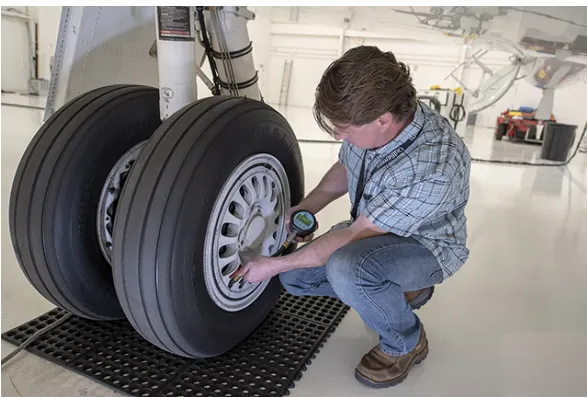
Reference Link:- https://en.wikipedia.org/wiki/Aircraft_tire
5] Brake forces when landing:-
In general, when the wheels touch the ground, a set of spoilers raise up quickly, which kills the lift provided by the wings. (There are two sets seen in the image below: ground spoilers that only deploy on landing, and spoilers that are used in flight as speed brakes as well as on landing.) While the spoilers provide some drag, their primary purpose is to stop the plane from actually flying, putting all of the weight on the landing gear and in turn making the brakes that much more effective.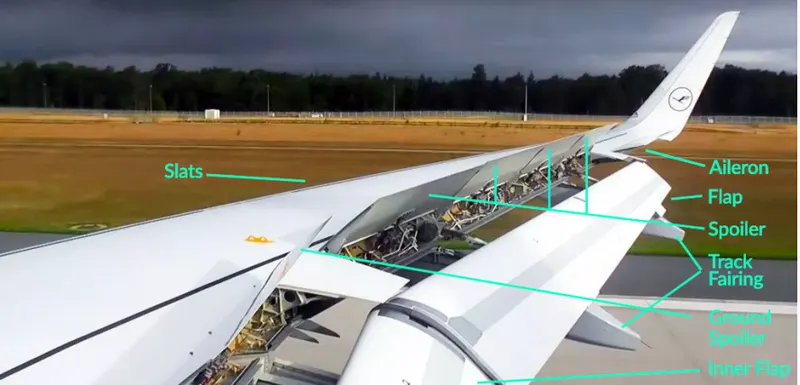
Before landing, when the landing gear is lowered, the pilots arm the ground spoilers to deploy automatically on touchdown.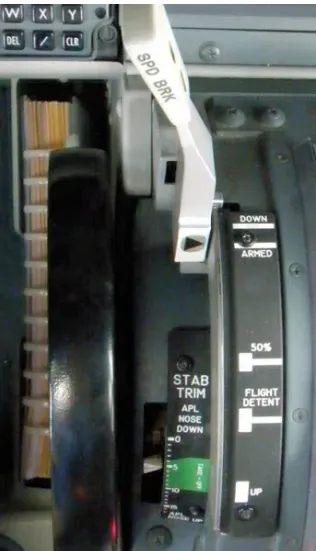
This lever controls the speed brakes, or ground spoilers. Here, it is shown in the armed position, prior to landing.
Hit the Brakes:-
Aircraft have highly-engineered, multi-disc brakes made of a carbon-steel material. Manufacturers include Honeywell and Goodrich, part of Collins Aerospace. In general, the brakes are composed of discs that rotate with the wheel and separate discs that are fixed. When pressure is applied—and below you see pressure applied from the right fixed disc on all of the discs—the entire assembly compresses to create the braking action. Carbon brakes are standard today; they cool faster than steel brakes (their predecessor) and can weigh up to 700 pounds less. That represents a significant weight saving for airlines.
Autobrakes:-
Wheel brakes are usually selected to engage automatically after landing, Brady explained. These are called “autobrakes”. Brady says that all airliners have several levels of autobrake “severity”. The crew will decide which is the most appropriate to use for every landing depending upon factors like the length of runway, if it is wet or dry, or if the pilots want to exit the runway at a particular point. “For a short wet runway you might select autobrake 3, or MED on the Airbus. For a long dry runway you might select autobrake 1 or LOW on the Airbus,”.
------------------------------------------------------------------------------------------------
Part B:
6. A. With necessary assumptions, calculate the force and power required to push / pull an aircraft by a towing vehicle.
B. Develop the model for the calculated force and power using Simulink.
Answer:-Let us Assume :
Weight of the Aircraft = 500000kg
Rolling Resistance Coefficient of an aircraft tire = 0.005
Wight of the Towing Tractor = 50000kg
Rolling Resistance Coefficient of Towing Vehicle = 0.002
The Velocity of the Aircraft while Towing = 18KMPH = 5m/s
Density of Air medium = 1.225 kg/m^3
The Frontal area of the Aircraft = 20 'm^2'
The Coefficient of Drag of the Aircraft = 0.26
Towing Tractor Gear ratio(G- for high torque output) = 11
Towing Tractor tyre radius(r) = 0.5 m
The forces that are acting on the aircraft are
1. i) Rolling Resistance
2. ii) Drag Force
i) Rolling Resistance for the Aircraft
Now, Here the Rolling resistance be
`Fr=c.mr.ag`
Let,
- F = Rolling resistance
- c = coefficient of rolling resistance
- mr = rolling mass
- a = Acceleration of gravity
Now Substituting the values in the above formula gives us the Rolling resistance of the Aircraft
F = 0.005(500000 kg)(9.81 m/s^2)
Therefore the Rolling resistance of the aircraft F = 24.525 KN.
Rolling Resistance for the Towing Vehicle
Now let us calculate the rolling resistance for the Towing Vehicle
F = c. mr. a
F = 0.002(50000 kg)(9.81 m/s^2)
Therefore the Rolling resistance of the Towing vehicle F = 0.981 KN.
ii) Drag Force
`D=1/2.Crho.A.V^2`
Where,
D = Drag force
C = Drag Coefficient
V = Velocity of Towing Vehicle
A = Frontal area
Now Substituting the assumed values in the above formula gives us the Drag force of the Towing vehicle
Drag Force = 0.5 * (0.26*1.225*20*5*5)
= 0.079 KN
Therefore the Drag force is = 0.079625 KN
Now to get the total force to push the aircraft by the towing vehicle
we add the Rolling resistance of the Aircraft + Rolling resistance of Towing Vehicle + Drag Force
= 24.525 KN + 0.981 KN + 0.079625 KN
Therefore the Total force required for a towing vehicle to push the aircraft is = 25.585625 KN = 25585.625 N
Power required to the towing vehicle to pull the aircraft
In this case, Power = force * velocity
= 25.585625 * 5.0
= 127.928125 KW
Therefore the power required for the towing vehicle to pull the aircraft = 127.928125 KW = 127928.125 W
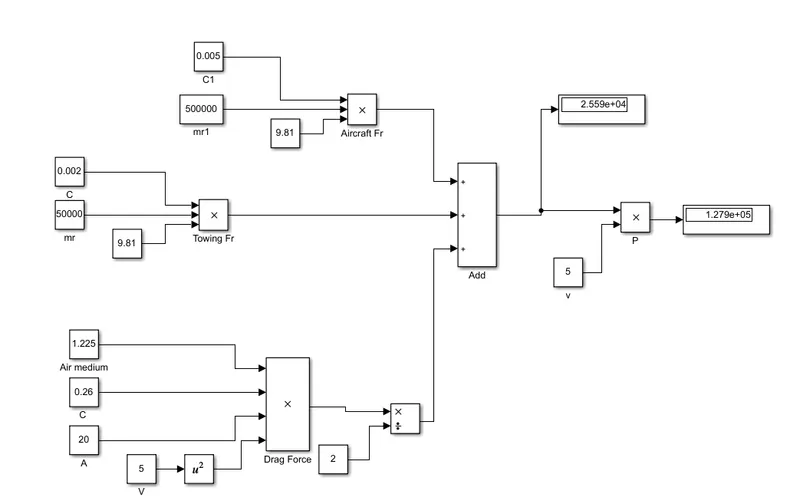
Simulink model for the calculation of the force and power
------------------------------------------------------------------------------------------------
7. A. Design an electric powertrain with type of motor, it’s power rating, and energy requirement to fulfill aircraft towing application in Simulink. Estimate the duty cycle range to control the aircraft speed from zero to highest. Make all required assumptions. Prepare a table of assumed parameters. Draw a block diagram of powertrain.
(Hint :DC7 Block)
B. Also, Design the parameters in excel sheet.
Answer:-
Estimating the data
Based on the calculations done in 6a.
Force required to push/pull the aircraft = 23.56 KN
Power required = 132.85KW
let us assume
Radius of tyre for the tug = 30 inches = 0.762m
Gear ratio = 8
Transmission efficiency (`etat`) = 87%
motor efficiency(`etam`) = 95%
Torque required for the wheels (Tw) = Total force*Radius of wheel
= 23.56*0.762
= 17.95KNm
Motor torque = wheel torque/(gear ratio*transmission efficiency)
= 17.95/(8*0.87)
= 2.57KNm
Required motor torque (Tm) = motor torque/motor efficiency
= 2.57/0.95
= 2.70KNm
Similarly, The total power required by the motor considering all efficiencies (Pt) = Total required power/(transmission eff*motor eff)
= 132.85/(0.87*0.95)
= 160.73KW
let us assume the towing operation was done in 15 min (0.25hrs) duration
then total energy consumed = Pt*duration
= 160.73*0.25
= 40.18KWh
If we consider the battery capacity 220KW is used by the towing vehicle then the duty cycle range to control the speed,
Duty cycle (d) = (required power)/(rated power)
= 160.73/220
= 0.73
Therefore the controller will be able to provide duty cycle ranging from 0 to 73% in order to control the towing speed.
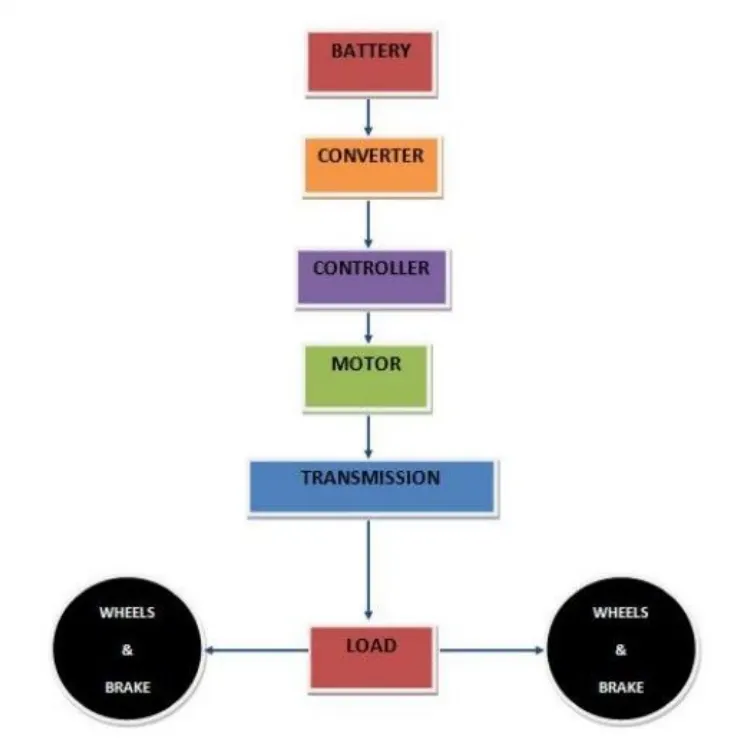
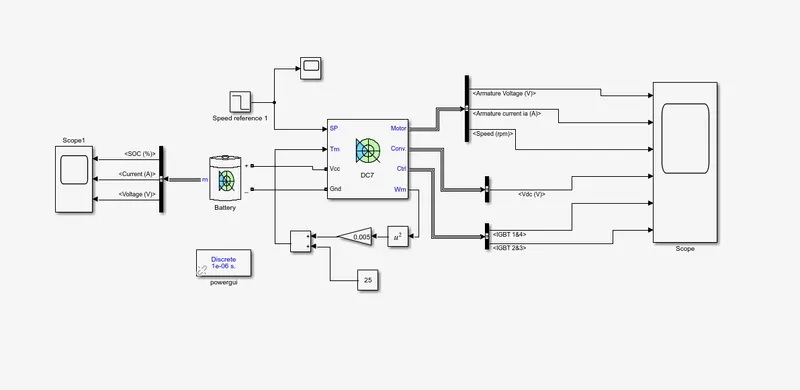
Block Diagram of power train:-
Simulink Model of powertarin:-
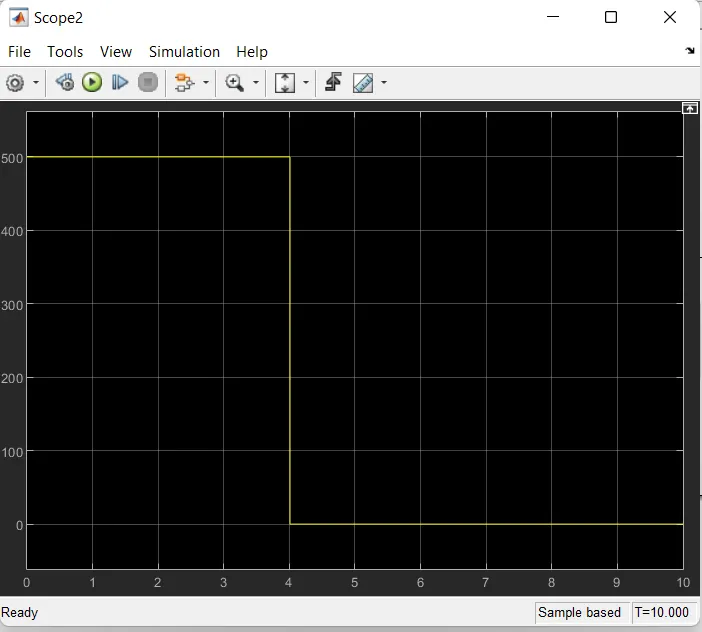
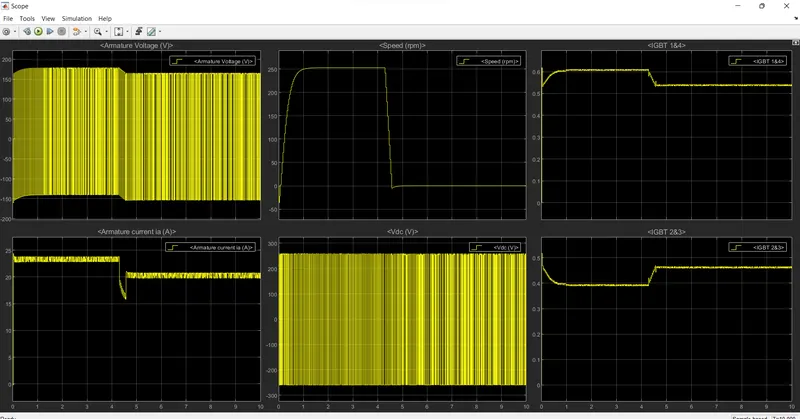
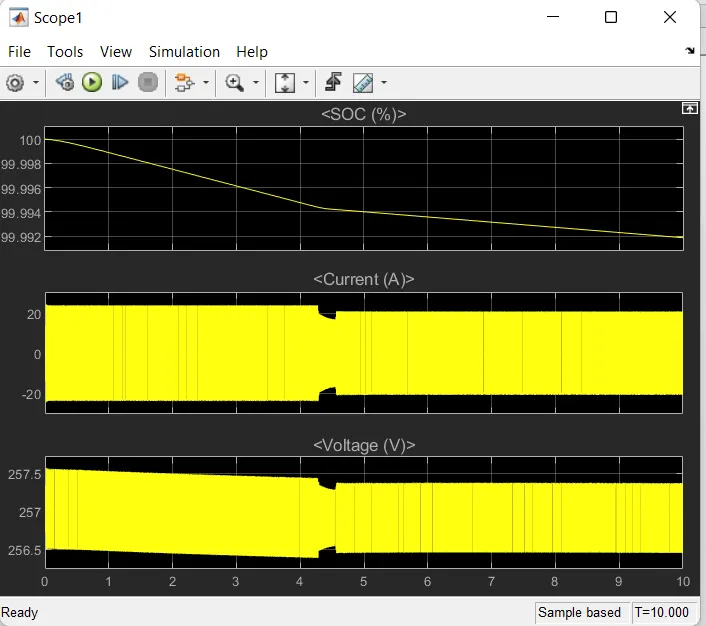
Result:-
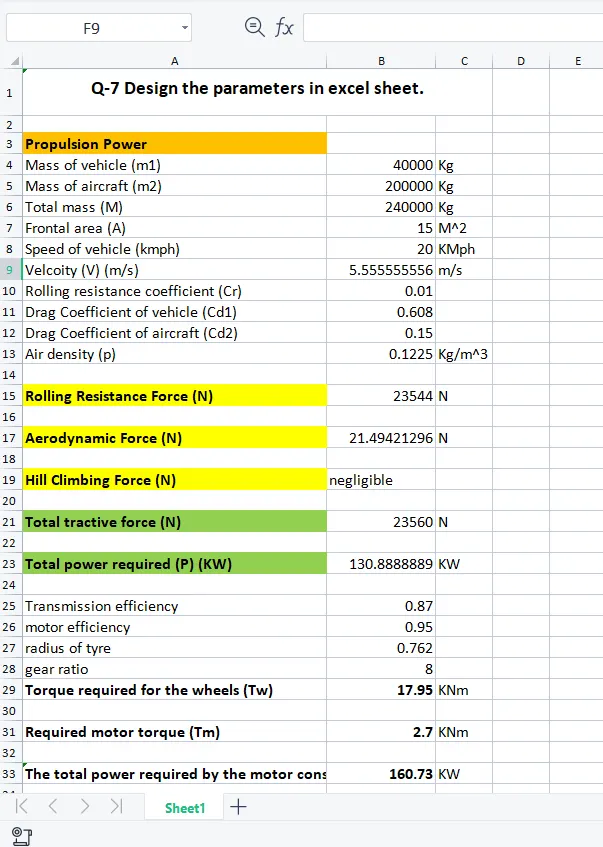
B. Also, Design the parameters in excel sheet.
Propulsion Power
| Mass of vehicle (m1) | 40000 | Kg |
| Mass of aircraft (m2) | 200000 | Kg |
| Total mass (M) | 240000 | Kg |
| Frontal area (A) | 15 | M^2 |
| Speed of vehicle (kmph) | 20 | KMph |
| Velcoity (V) (m/s) | 5.555555556 | m/s |
| Rolling resistance coefficient (Cr) | 0.01 | |
| Drag Coefficient of vehicle (Cd1) | 0.608 | |
| Drag Coefficient of aircraft (Cd2) | 0.15 | |
| Air density (p) | 0.1225 | Kg/m^3 |
| Rolling Resistance Force (N) | 23544 | N |
| Aerodynamic Force (N) | 21.49421296 | N |
| Hill Climbing Force (N) | negligible | |
| Total tractive force (N) | 23560 | N |
| Total power required (P) (KW) | 130.8888889 | KW |
| Transmission efficiency | 0.87 | |
| motor efficiency | 0.95 | |
| radius of tyre | 0.762 | |
| gear ratio | 8 | |
| Torque required for the wheels (Tw) | 17.95 | KNm |
| Required motor torque (Tm) | 2.7 | KNm |
| The total power required by the motor considering all efficiencies (Pt) |
160.73 | KW |
| total energy consumed | 40.18 | KWh |
| Duty cycle (d) | 0.73 |
-----------------------------------------------------------------------------------------------