Project-1: Powertrain for aircraft in runways
1.Mass of Aircraft is major factor to get the calculation its power required to take off , The traction force it required to compensate the air drag, tyre condition, Fuel, Weight of passenger ,Weight of Alone aircraft
- Categories of Aircraft Weight:-
|
Fighter jet |
113,646kg |
|
Cargo Plane |
165900 kg |
|
Average Aircraft weight |
80000 kg |
|
Military Aircraft |
7791kg |
|
Helicopter |
5080 kg |
|
Aircraft |
3994 kg |
2.Relative Velocity:-
- Ground Speed:- Speed relative to ground , The speed on which the aircraft moves relative to ground
- Air Speed :-Ground Speed- Wind Speed
- Forces acting on the aircraft to lift up:-
- Thrust
- Drag
- Weight
- Lift
3.
Towing is coupling of two or more objects together so that they can be pulled by the sources
Towing is used for the aircraft due to the power of engines,
- It can damage the nearby buildings and near by equipments
- Can suck /Blow the sand or debries which can serious damage to engine
- Visibility during towing is easy
- Economical way to towing the aircraft moreover the noise pollution will be there if plane is moving rather than towing vehicle
4.Taxing:-
It is movement of an aircraft on the ground under its own power in contast to towing/push back when it is moved by a tug,The power of taxing comes from the engine itself.The sharp turns are possible in aircraft due to the cockpit steering using a tiller, the tiller is nose wheel steering in the cockpit which allows the wheel to rotate at quite extreme angles making sharp turns possible,for bigger planes to turn differential braking is used, in this particular case one wheel will be locked completely and plane will make turn through force of 2nd wheel only thus sharp turn can be achieved.
5.
5.Take Off Power = total force*Velocity
Rolling Resistance=
Tyre Design:-The tyre is designed such that it can withstand heavy loads while landing,toeing,take off and during running .
Different types of tyres are there which can be used in aircraft :-
- Radial Tyres
- Bias-Ply Tyre
Since Aircraft generates more heat during the landing time, it gets an additional forces of drag during the landing of aircraft,thus due to ecessive heat tyres would be wear out quickly.
Tyre pressure plays a major role during this extreme condition of high pressure and high temperature.Failure of tyre will cause of very serious consequences.
6.Brake forces when landing:-
A=(-T-D-F/m)
Brake force=Mass* deceleration
- Force required to push/pull an aircraft by towing vehicle.
F=C*m*a
F=rolling resistance
C=rolling resistance coefficient
M=rolling mass
A=acceleration of gravity
M=35000 kg of Plane
Coeff=0.04
F=0.04*(35000)*(9.81)
F=13734 N
Friction of puller:-
F=µW
µ- fricition coefficient
W-Weight
m-mass
m=(13734)/(0.9)*9.81
m=1555.55kg
Power Required to pull the aircraft with the velocity of 4m/s
P=F*V (Force acting on truck)*(Velocity )
P=13734*4
P=54.93Kw
Vehicle drive:-58.3hp / 45.5 KW, 80 VDC traction motor mated with Auburn/Dana 44 differential.
Power output=45.5KW
Battery : 2 Battery 40 VDC Industrial,595Amp-HR batteries (6hr rate),Wired in series
Power input=V*I
P=80*595
P=47.65kW
Efficiency of Motor=Power output/Power input
=45.5/47.65
=95.58%
Energy required for towing aircraft=Required pwer* Time
Assuming taxing time=15min
Energy required=39.24*0.25
=9.81 kWh
Assuming highest speed=20 kmph
Duty Cycle=Avg Power /Peak Power
=39.24/45.5
=86%
6.
clc
clear all
c=0.02 %rolling resistance
m=linspace(200,35000,2000)
g=9.81
u=0.04 %friction coefficient
A=linspace(50,100,2000)
v=2 %velocity
Cd=0.9 %drag coeff

F1=c*m*g
F2=u*g*m
F3=0.5*A*1.2*Cd*(v)^2
Ft=F1+F2+F3
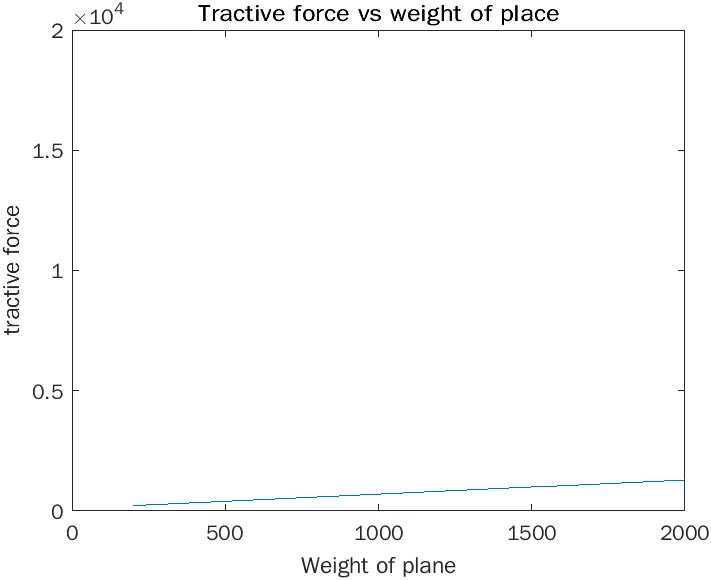
plot(m,Ft)
title('Tractive force vs weight of place')
xlabel('Weight of plane')
ylabel('tractive force')
axis([0 2000 0 20000])
7.
| Mass of vehicle | 16000 | ||
| Cd | 0.8 | ||
| A | 6.8 | ||
| Rw | 0.575 | ||
| Fr | 2 | ||
| Fb max | 800 | ||
| Density | 1.2 | ||
| Inertia | 2.4 | ||
| Traction force | Rolling resistance+aerodynamic force+brake forrce | Output Values | Input Values |
| rolling resistance | Frr=U*m*g | 313920 | 2*16000*9.81 |
| Aerodynamic force | Ad=1/2 *density*A*Cd*v^2 | 53.0944 | 0.5*0.8*6.8*1.22*(4)^2 |
| Total force | Rolling resistance+aerodynamic force+brake forrce | 313973.0944 | 53.0944+313920 |
| Power= | Force*velocity | 1255892.378 | 313973.0944*4 |
| Max Torque | Rw*Force | 180534.5293 |
313973.0944*.575 |
https://drive.google.com/file/d/1dzAjoO4H9yLLfgECgAdL9NzyqwVOSCiE/view?usp=sharing