Project-1: Powertrain for aircraft in runways
SOLUTION FOR PART 'A':-
SOLUTION 1. Any vehicle that is manufactured and made to fly in the air is called an aircraft. While the airplane is the most known, familiar, and popular kind of aircraft we know, other vessels that fly through the air also come in this category.
Classifications Of Aircraft:
Aerostats (Lighter Than Air): Aerostats or lighter than air aircraft are very lightweight in weight. These types of light aircraft generally use buoyancy like ships, which help them float in the air. Low-density gas such as hydrogen, helium, or hot air balloons is used to fill in the aircraft.The most common types of aerostats known to us are hot air balloons.
Aerodynes (Heavier Than Air): The other aircraft, heavier than air or aerodynes, as we understand, is much higher in weight and size. They push the gas or air downwards; which reaction helps to make aircraft upwards.
The Aircraft Gross Weight (also known as the ALL UP-WEIGHT and abbreviated as AUW) is the total weight at any moment during the flight or ground operation. An aircraft's gross weight will decrease during a flight due to fuel and oil consumption.
TYPES OF AIRCRAFT:-
1. Amphibious:
Amphibious aircraft, otherwise also popularly known as amphibian is a multipurpose aircraft that can work, take off, and land both water and ground. They are used as both seaplanes or flying boats, or also airplanes.
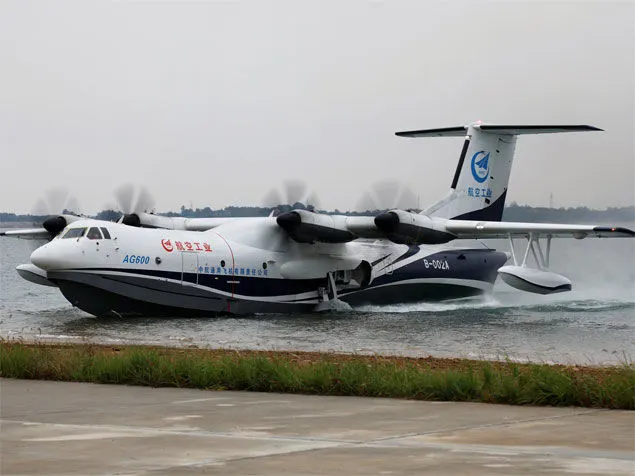 MAXIMUM GROSS WEIGHT=53.5 TON (ON RUNWAY) &
49 TON (ON WATERS)
2. Helicopter:
Helicopter aircraft, also known as a chopper, is commonly known to most of us and belongs to rotorcrafts. Horizontally spinning rotors help and aid the helicopter to lift and thrust. These aircraft have the advantage of taking vertically, horizontally and flying both backward and forward.
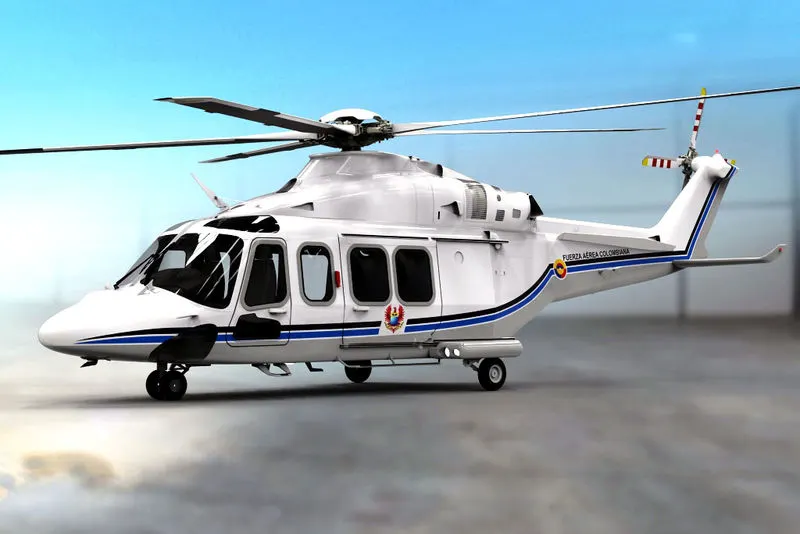 MAXIMUM GROSS WEIGHT = 7000KG
3. Balloons:
The balloon-type aircraft are standard aircrafts most of us are aware of and are mostly spotted during tourist activities. It comes under a kind of aircraft that floats in the sky and is much different from other airships and aircraft categories.
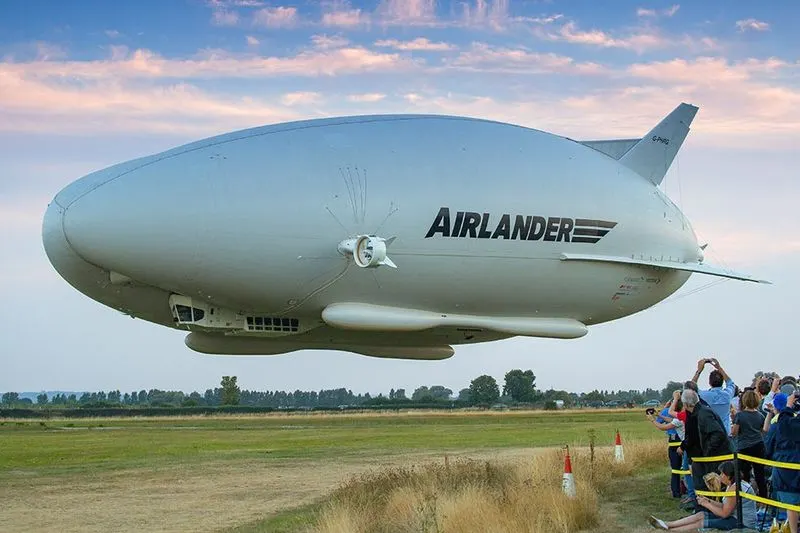 MAXIMUM GROSS WEIGHT =30000KG
4. Gliders:
Gliders come again under the category of fixed-wing aircraft. The types of gliders aircraft are used through air reaction against lifting surfaces and mostly do not use any engine. Although small engines may be used as required (in cases like a motor glider), most glider aircraft are efficient for self-take without engines.
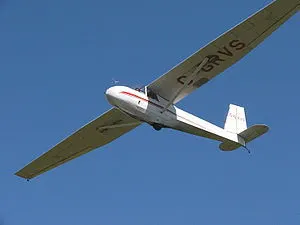 MAXIMUM GROSS WEIGHT=272 KG
5. Gyroplanes:
Gyroplanes, also known as autogyro or gyrocopter, is a rotorcraft aircraft category that uses rotor machines to lift. They are similar to helicopters in appearance, although a bit narrow, and have an engine-driven propeller. The air flows help the gyroplanes lift upwards, and the rotor self-propels as per the way air flows through it.
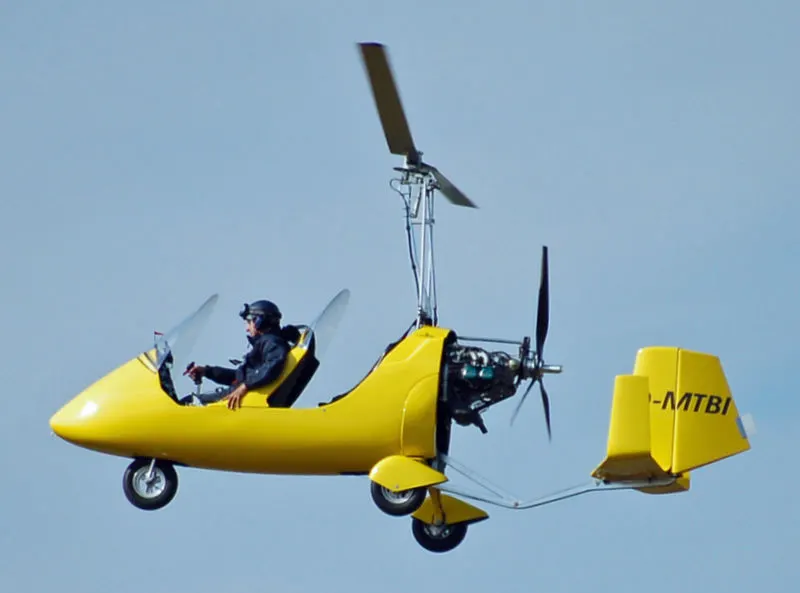 MAXIMUM GROSS WEIGHT= 450KG
6. Tiltrotors:
Tiltrotors use powered rotors for propulsion and to generate lift. These powered rotors, also called proprotors, are added to rotating shafts of a fixed-wing. These use transverse rotor design and combines the vertical lift capability of a helicopter. The rotors, similar to the chopper, helps lift this aircraft.The speed and range are heavier and higher than a normal helicopter.The altitude capability of tiltrotors is higher than helicopters.
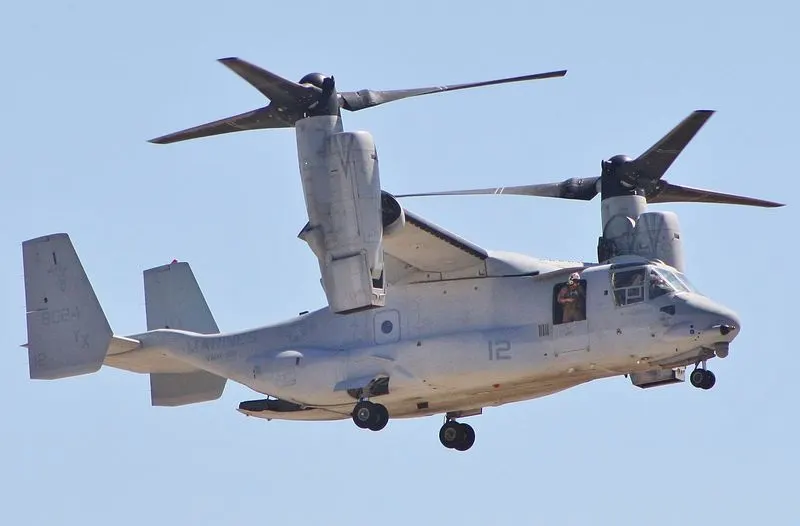 MAXIMUM GROSS WEIGHT = 15030 KG
7. Turboprops:
Turboprops aircraft have gas turbine engines connected to the gears to turn the propeller to move them through and around the air. They burn much lesser fuels and have lesser operating costs too. These types of turboprops are larger than piston aircraft and can carry more passengers. They are slower in speed than jet planes.
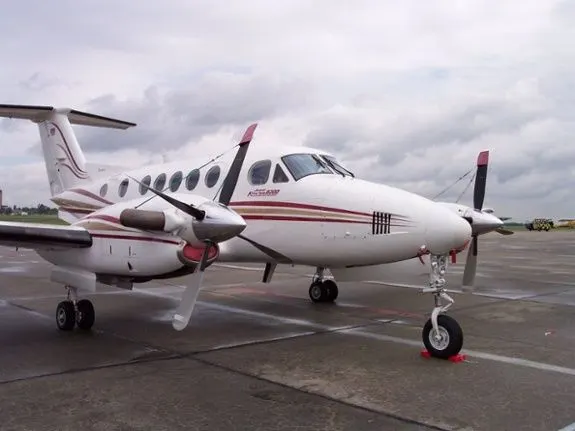 MAXIMUM GROSS WEIGHT = 3370KG
8. Fighter jets:
Fighter jets, also known as fighter or fighter aircraft, is military particular fixed-wing aircraft. They are designed only to use for combatting air-to-air fights against other aircraft. They have very high speed, manufactured for use against air attacks only. However, few fighters have a second capacity to use for ground attacks, too, in which case they are known as fighter bombers.
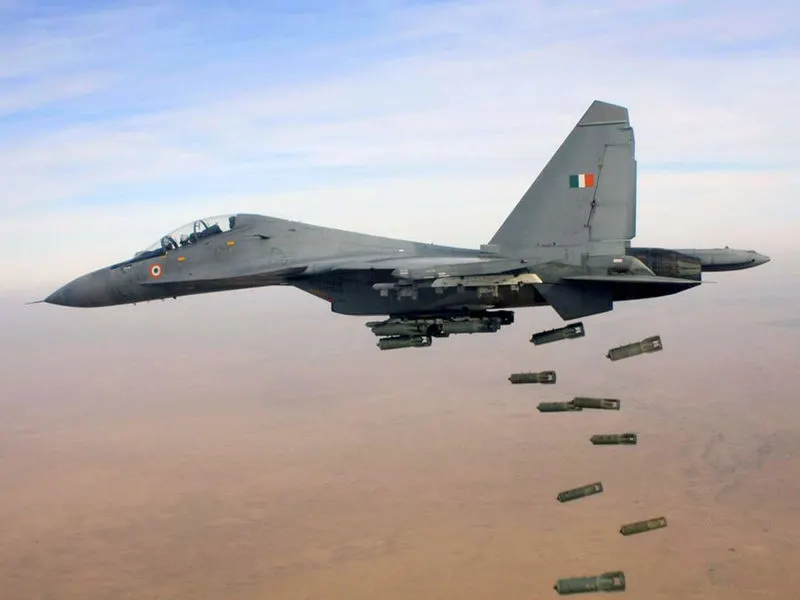
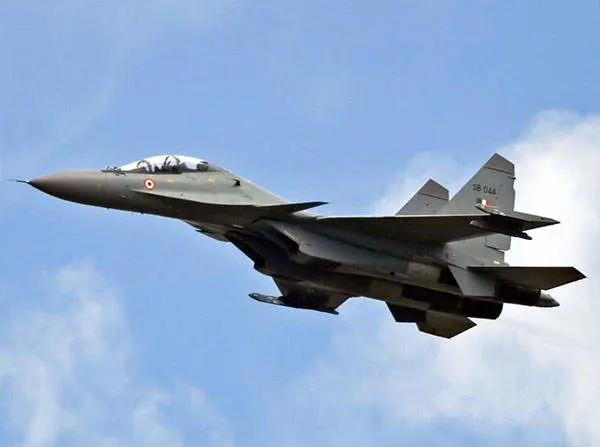
MAXIMUM GROSS WEIGHT = 38800KG
9.Cargo planes:
Cargo aircraft or cargo planes are also known as freight aircraft, airlifter, or cargo jets. These are the fixed-wing classification of aircraft known only for carriage or cargo instead of individual passengers. These cargos are specially built only for lifting carriages and do not have amenities for fitting people or passengers. They have wide doors and facilities to protect and provide shipment.
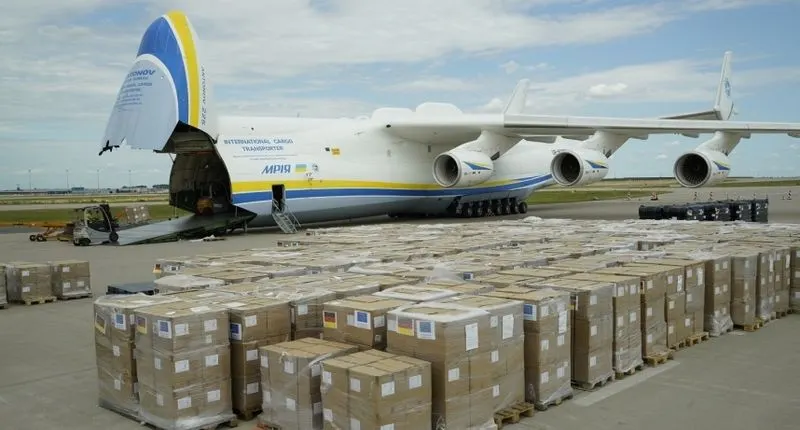
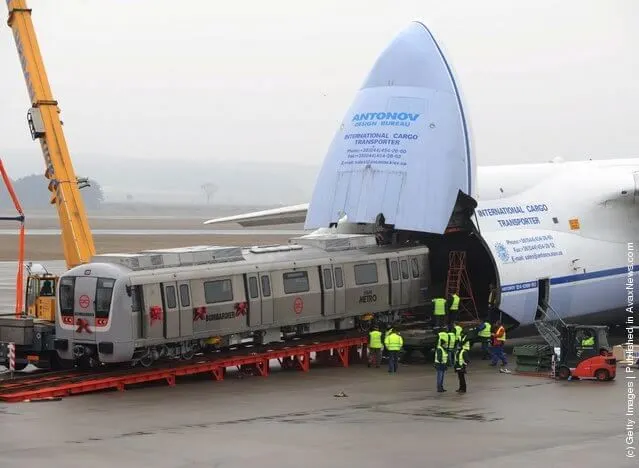
MAXIMUM GROSS WEIGHT = 640TON
SOLUTION 2.
DIFFERENCE BETWEEN GROUND SPEED AND AIRSPEED
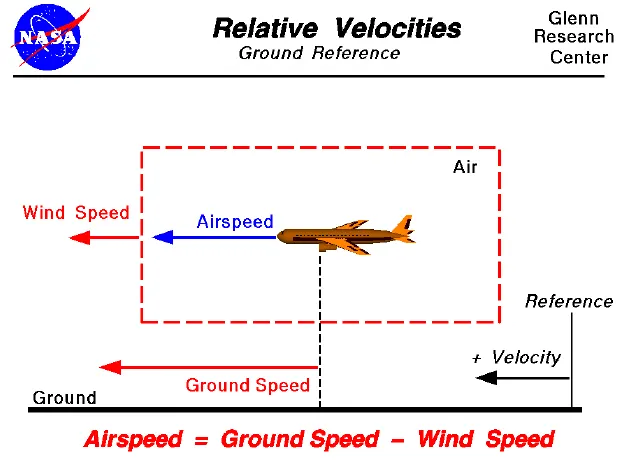
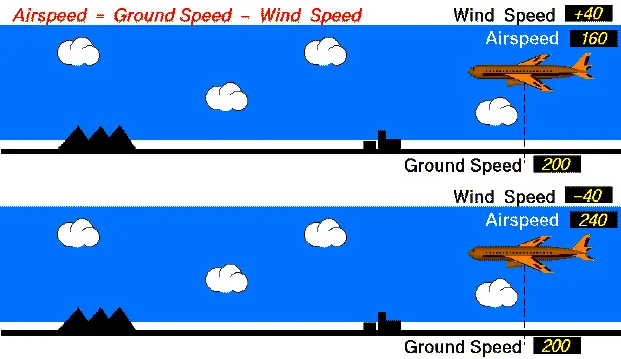
AIRSPEED:-Airspeed is simply the speed at which an aircraft is moving relative to the air it is flying in. It’s also the speed at which the air is flowing around the aircraft’s wings.
Airspeed is what determines whether there is enough airflow around an aircraft to make it fly. It is independent of Ground speed.
GROUND SPEED:-Ground speed is the aircraft’s speed relative to the ground. One thing that should be noted here is that it’s horizontal rather than vertical speed – an aircraft climbing completely vertically would have a ground speed of zero.
Ground speed is what determines how fast an Aircraft will get to its destination. Ground Speed is simply the sum of Airspeed and windspeed.
SOLUTION 3.
TOWING:-
Towing is coupling two or more objects together so that they may be pulled by a designated power source. The towing source may be a motorized land vehicle, vessel, animal, or human, and the load being anything that can be pulled. These may be joined by a chain, rope, bar, hitch, fifth wheel, coupling, drawbar, integrated platform, or other means of keeping the objects together while in motion.
AIRCRAFT TOWING:-The forward movement of an aircraft, usually with engines off, using the power of a specialized ground vehicle attached to or supporting the nose landing gear. It may occur for the movement of both in service and out of service aircraft.
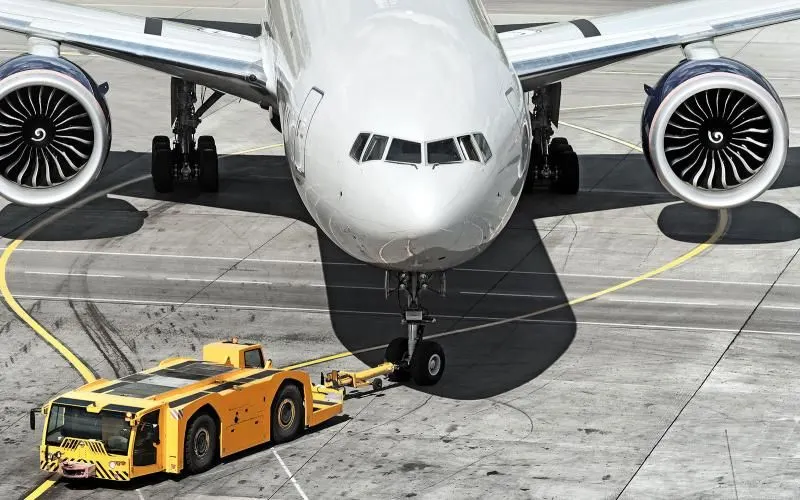
Although many Aircraft are capable of moving themselves backward on the ground using reverse thrust (a procedure referred to as a POWERBACK), the resulting jet propulsion might cause damage to the terminal building or equipment. Engine close to the ground may also blow sand and debris forward and then suck them into the Engine, causing damage to the engine. A pushback is therefore the preferred method to move the aircraft away from the gate.
Although most aircraft are capable of moving themselves backward on the ground using reverse thrust a procedure called as a POWERBACK, it is not typically done due to the following reasons:
- The engine can blow sand & debris.
- The jet blast from the engine can damage the terminal building and nearby equipment.It can even throw away people standing nearby.
- Then Engine can suck in sand and debris which can cause serious damage to the engine.
- It is easier for the truck driver to see the surrounding better than the pilot sitting in the cockpit with limited windows.
- The PUSHBACK truck driver knows the airport better than the pilot.
- The plane engine is very loud. This noise can add up substantially when multiple planes are moving around the airport. It won't be a pleasant experience for people sitting inside the terminal.
- It saves fuel. Virgin Atlantic had proposed a new system in which the pushback truck will push the plane all the way to the runway to save fuel and reduce the impact on the nearby environment.
SOLUTION 4.
TAXING is the movement of an aircraft on the ground, under its own power, in contrast to towing or pushback where the aircraft is moved by a tug. The aircraft usually moves on wheels, but the term also includes aircraft with skis or floats (for water-based travel).
An airplane uses taxiways to taxi from one place on an airport to another; for example, when moving from a hanger to the runways. The term "taxing" is not used for the accelerating run along a runway prior to takeoff, or the decelerating run immediately after landing, which is called the takeoff roll and landing rollout, respectively.
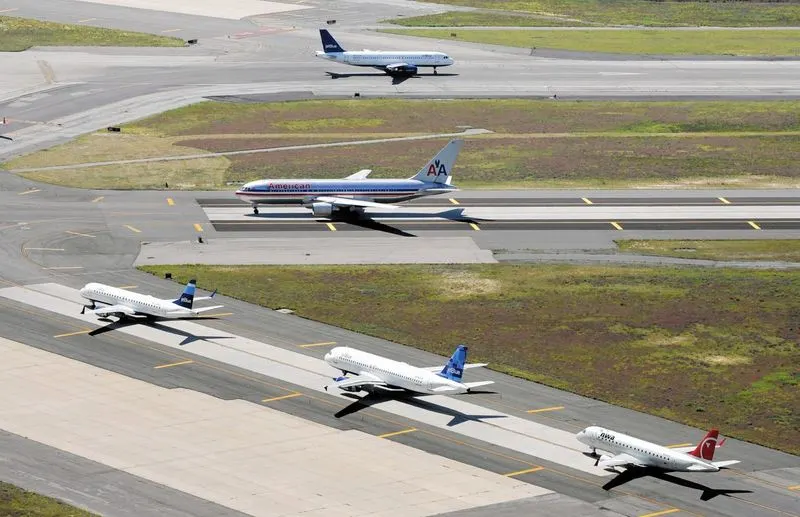
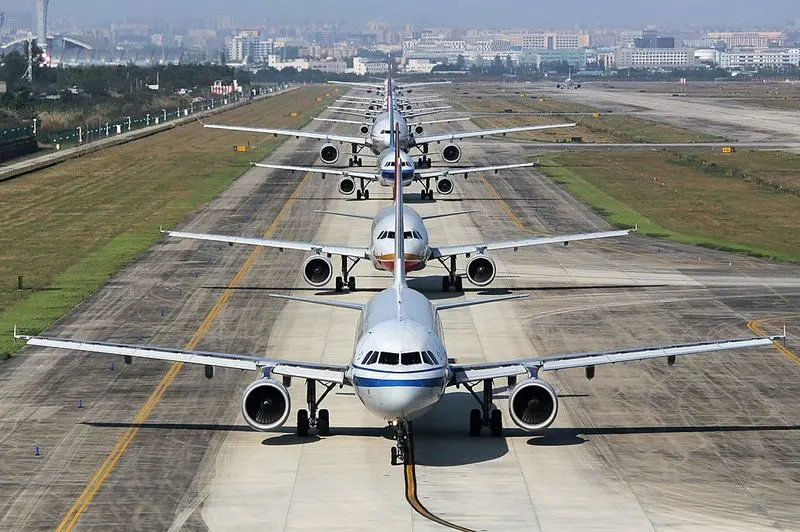
The Power for taxing comes from the Engines itself. If it is propeller-powered aircraft, the propeller provides thrust and pulls the aircraft, like it would in air. If it is a jet engine, the exhaust air that comes out of the engine creates a forward force due to Newton's third law and moves the aircraft.
Airliners have nose wheel steering, controlled by a cockpit control called a tiller. The tiller allows the nose wheel to rotate at quite extreme angles making tighter turns possible. It also reduces fuel consumption as you do not need much engine power during taxing. If rudders were used, the power has to be increased to make sure sufficient air flows over the rudder surface to make if effective.
Once on the take-off roll and the airplane gains sufficient speed i.e enough air flows over the rudders, pilots go back to using the rudder pedals to maintain the centerline.
Small general aviation aircraft uses the rudder for turns during taxi. They don't have a separate control for the nose wheel. In such airplanes, to make tighter turns, you could use differential braking. That is if you want to make a tight turn for example to the left, you would push the upper part of your left rudder which would apply left braking. This allows the airplane to make sharper turns to the left.
SOLUTION 5.
TAKE OFF POWER:-
The amount of power that an engine is allowed to produce for a limited period of time for takeoff. The use of takeoff power is usually limited to 5 min for reciprocating engines and up to 2½ min for gas turbine engines. This may not always be the case. Specifically, with respect to reciprocating engines, it is the brake horsepower developed under standard, sealevel conditions and under the maximum conditions of the crankshaft rotational speed and the engine manifold pressure approved for the normal takeoff. It is limited in continuous use to the period of time shown in the approved engine specifications. With respect to gas turbine engines, it is the thrust developed under static conditions at a specified altitude and atmospheric conditions of the rotor shaft rotational speed and gas temperature approved for the normal takeoff. It is limited in continuous use to the period of time shown in the approved engine specifications.
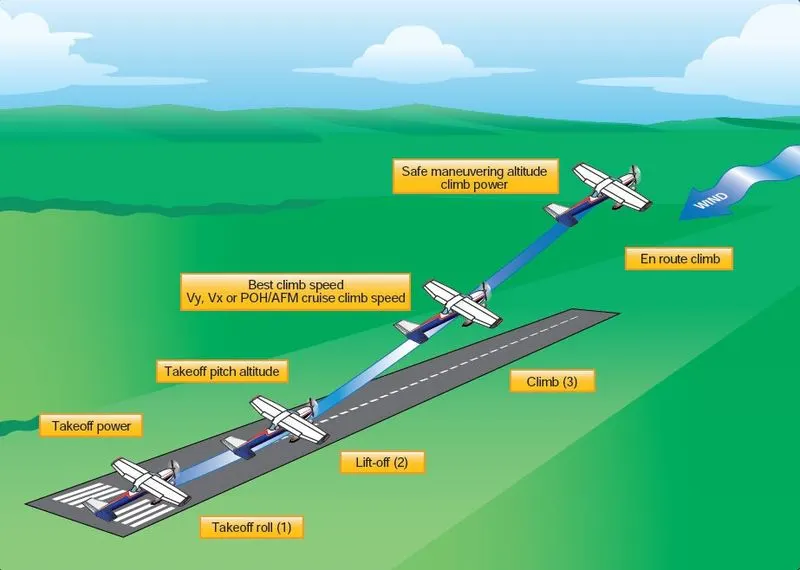
The power required by the aircraft engines to use to lift them into a horizontal takeoff is known as take-off power. For aircraft that take off horizontally, this usually involves starting with the transition from moving along the ground on a runway for light aircraft, usually, full power is used during the takeoff. Large transport category aircraft may use reduced power for takeoff, where less than fullpower is applied in order to prolong engine life, reduce maintenance costs and reduce noise emissions.
After taxing onto the runway, the airplane should be carefully aligned with the intended takeoff direction, and the nose wheel positioned straight or centered. After releasing the brakes, the throttle should be advanced smoothly and continuously to take off power.
Take off performance can be predicted by using a simple measure of acceleration of the Aircraft along the runway based on the force equilibrium. The force involved will be
T=Thrust of propulsion system pushing aircraft along the runway
D=Aerodynamic Drag of vehicle resisting the Aircraft Motion
R=Rolling resistance friction due to the contact of wheels on the ground.
During take-off run, the imbalance in these forces will produce an acceleration along the runway
dv/dt=(T-D-F)/m
m=mass of aircraft
dv/dt=Acceleration of Aircraft along the runway
TYRE DESIGN:-
When it comes to safety, tires are one of the most important components of aircraft. They help to absorb the shock of landing and provide cushioning. It also provides the necessary traction for braking and stopping of an aircraft. An aircraft tire is designed to withstand extremely heavy loads while landing, take off, taxing, and parking. The number of wheels required for aircraft increases with the weight of the aircraft, as the weight of the airplane needs to be distributed more evenly.
An aircraft tire is constructed for the purpose it serves:-
1. They support the weight of an aircraft while it is on the ground.
2. It also provides the necessary traction for the braking and stopping of an airplane.
3. Tyre also helps to absorb the shock of landing and provides cushioning for the roughness of takeoff, roll-out, and taxi operations.
Unlike an automobile or truck tire, it does not have to carry a load for a long period of continuous operation. However, an aircraft tire absorbs the high impact loads of landing, and also it’s operating at high speeds for a short time when required.
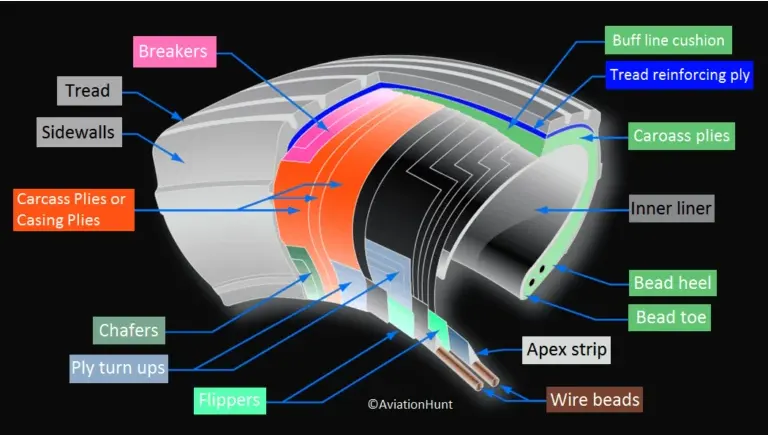
Some Technical Aspects of the Tyre:-
Retreading – Retreading is method of restoring a worn tire by renewing the tread area or by renewing the tread area plus one or both sidewalls. Repairs are included in the tire retreading process.
Load Rating – Load rating is the maximum permissible load at a specified inflation pressure.
Ply Rating – Ply Rating is used to identify the maximum recommended load rating and inflation pressure for a specified tyre. It is an index of tyre strength.
Speed Rating – The speed rating is the maximum takeoff speed to which the tyre has been tested.
Skid Depth – Skid depth is the distance between the tread surface and the deepest groove as measured in the mould.
- Tubeless tires are more advantageous over tube-type. There is no longer the use of tube-type tyre in recent aviation. Nowadays all airliners are using tubeless tires.
- Almost all airliners are using Radial tyres. Bias is an older design, and it’s mainly used for road vehicles. Radial tires are in demand because of their lower life cycle cost and long-term value.
- Aircraft tyres are conductive. Aircraft tires are manufactured with tread rubber with conducting compounds to permit earthing of static charges.
ROLLING RESISTANCE:-
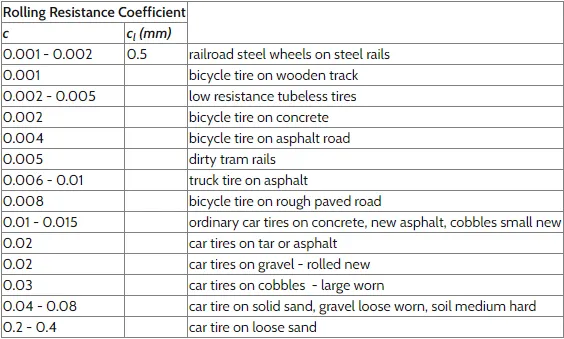
Rolling Resistance sometimes called Rolling friction or rolling drag is the force resisting the motion when a body (such as a ball, tire or wheel) rolls on a surface. It is mainly caused by the non-elastic effects; that is not all the energy needed for deformation (or movement) of the wheel, roadbed etc, is recovered when the pressure is removed. Two forms of this is hysteresis losses and permanent deformation of the object or the surface.
The "Rolling Resistance Coefficient" is defined by the following equation:
F=Crr*N
where,
F=Rolling resistance force
Crr=Dimensionless rolling resistance coefficient or Coefficient of rolling friction (CRF)
N=Normal force, the force perpendicular to the surface on which the wheel is rolling
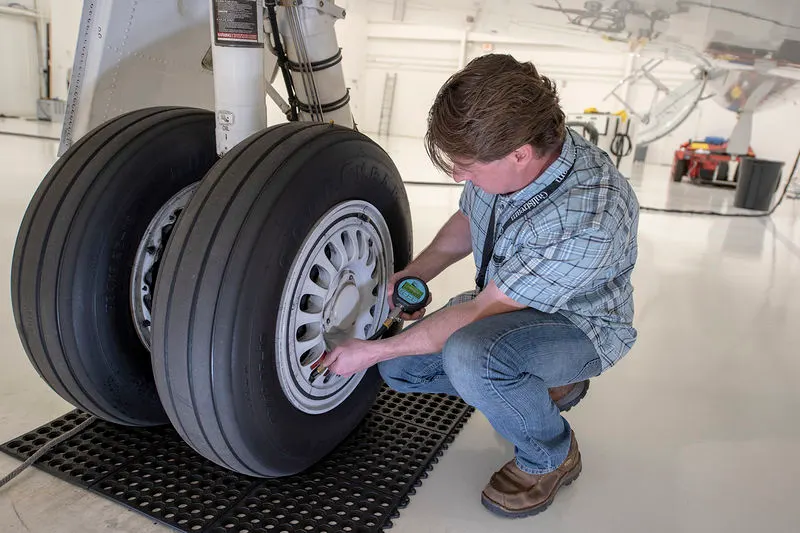
TYRE PRESSURE:-
Aircraft tires are usually inflated with NITROGEN to minimize expansion and contraction from extreme changes in ambient temperature and pressure experienced during flight. Dry nitrogen expands at the same rate as other dry atmospheric gases (normal air is about 80% nitrogen), but common compressed air sources may contain moisture, which increases the expansion rate with temperature.
Aircraft tires generally operate at high pressures, up to 200 psi (14 bar; 1,400 kpa) for airliners, and even higher for business jets. The main landing gear on the CONCORDE was typically inflated to 232 psi (16.0 bar), whilst its tail bumper gear tires were as high as 294 psi (20.3 bar).
BRAKE-FORCE WHEN LANDING:-
Stopping a 200-tonne aircraft landing at 180 mph requires a lot of braking force. To do this, the aircraft has one brake unit on each of the eight wheels on the main gear assembly. Some other aircraft types have brake units are powered by the hydraulics system. An electrical signal is sent from the flight deck to hydraulic actuators near the main landing gear. Here, hydraulic fluid at 3,000 pounds per square inch is used to force the brake unit against the wheel, thus slowing it down.
This system works fine, but the pipes and actuators that form this part of the hydraulic system come at a considerable weight cost. Extra weight means more fuel burn, which in turn increases costs and carbon emissions. What if the brakes could be powered a different way?
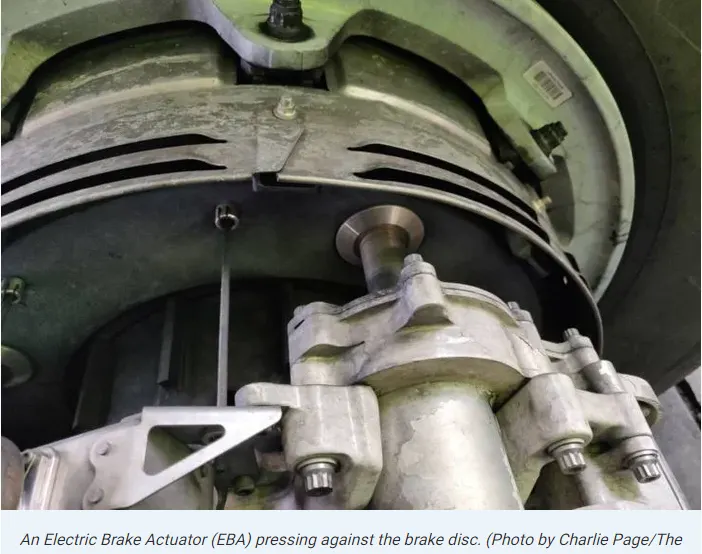
That's the case on the 787 Dreamliner, Designers did away with the use of the hydraulic system and all its associated architecture and instead used electricity to power the brakes. When the pilots press on the brake pedals, an electrical signal is sent to the brake unit on the wheel. Here, electrically powered actuators are used to press the carbon brake disc against the wheel, slowing it down. The brakes are also known as “plug and play” because electrical wiring replaces the traditional hydraulics and it’s much easier and quicker to change the brake units when needed.
SOLUTION FOR PART -B
SOLUTION 6.
The force required to push/pull an aircraft by a towing are rolling resistance force and aerodynamic drag force:-
1.ROLLING RESISTANCE:-
Rolling Resistance sometimes called Rolling friction or rolling drag is the force resisting the motion when a body (such as a ball, tire or wheel) rolls on a surface.
F=Crr*N
where,
F=Rolling resistance force
Crr=Dimensionless rolling resistance coefficient or Coefficient of rolling friction (CRF)
N=Normal force, the force perpendicular to the surface on which the wheel is rolling
2. AERODYNAMIC DRAG FORCE:-
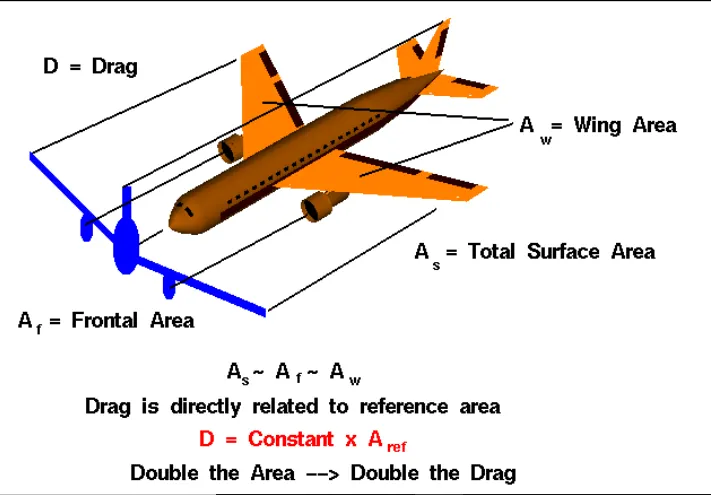
Drag is the aerodynamic force that opposes an aircraft's motion through the air. Drag is generated by every part of the airplane. Drag is a mechanical force. It is generated by the interaction and contact of a solid body with a fluid (liquid or gas). For drag to be generated, the solid body must be in contact with the fluid.
Aerodynamic Drag force:-
Fd=(1/2*ρ*v^2*Cd*A)
Where:-
Fd=Drag Force
ρ=mass density of the air
v=Flow velocity relative to the object
Cd=Drag coefficient
A=Reference area
Let us assume that
Mass of Towing Vehicle=40000 KG
Mass of Aircraft=155,000 KG
Total Mass (m)=40,000+155,000
=195,000 KG
The frontal area of aircraft (A)=18 m^2
Speed of vehicle (v)=25Kmph
Converting speed to m/sec =6.9445 m/sec
Drag Coefficient (Cd)=0.75
Air Density (ρ)=1.225 Kg/m^3
CALCULATING ROLLING RESISTANCE FORCE (Frr)=Crr*m*g
=0.01*195000*9.8
=19,110 Newton-----------(1)
CALCULATING AERODYNAMIC DRAG FORCE (Fd)=0.5*ρ*Cd*A*v^2
=0.5*1.225*18*0.75*(6.945)^2
=398.769 Newton------------(2)
Therefore the total force required to push/pull the aircraft by the towing vehicle (F)=(1)+(2)
=Frr+Fd
=19,110+398.769
=19508.769 Newton
Calculating the Power (P)=Force*Velocity
=19508.769*6.9445
=135.478 KW
Developing the model for the calculated force and power using Simulink:-
Blocks used:-
1. Constant Value
2. Sum Block
3. Product Block
4. Square Block
5. Display Block
Simulink Model:-
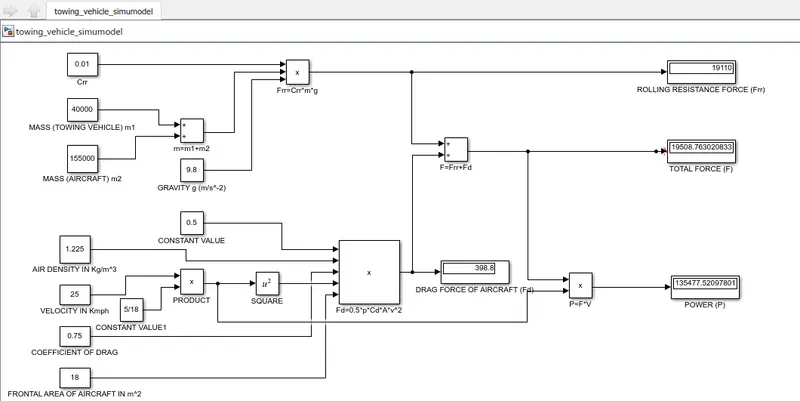
In order to understand the above Simulink model Focus on the following points:
- For calculating power we have to multiply both total force(F) & velocity in m/sec for this we have used the "Product" block (P=F*V).
- For calculating the Total force (F) we have Added both Frr & Fd by using the "Sum" block as shown in the above figure.
- To find the value of rolling resistance(Frr) we used the product to multiply the value Crr, Total mass(m) & Gravity(g) which are to be entered in the "Constant Block".
- Similarly for calculating Drag Force (Fd) we have to multiply the velocity in m/sec, Drag Coefficient, Frontal area of aircraft(A) and a constant value 0.5 which are to be entered in the "Constant" block.
- In order to convert velocity in Kmph to m/sec, we have to multiply it with 5/18.
SOLUTION 7.
BLOCK DIAGRAM OF POWER-TRAIN:-
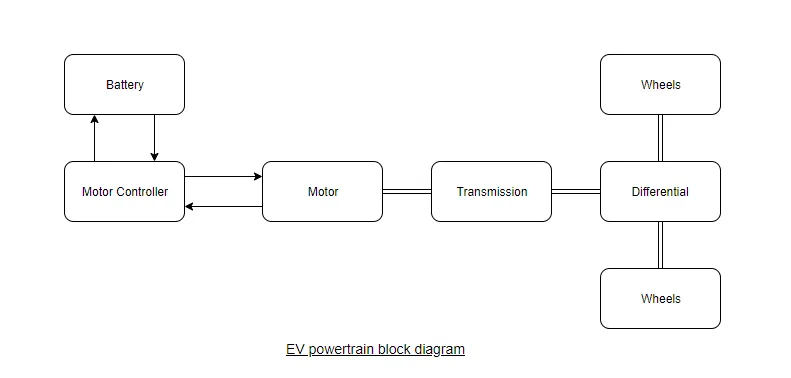
Based on the calculation of above Question 6
The force required to PUSH/PULL the aircraft=19.508KN
Power required =135.478KW
Let us assume,
The Radius of the Tyre for the Tug=25 inches
=0.635m
Gear ratio =8
Transmission Efficiency(ηt)=87%
Motor Efficiency (ηm)=95%
then,
Torque required for the wheels(Tw)=Total force*Radius in meters
=19.508*0.635
=12.387KNm
Motor Torque=Wheel torque/(Gear ratio*ηt)
=12.387/(8*0.87)
=1.778KNm
For ηm=95% the required motor torque(Tm)
=1.778/0.95
=1.871KNm
Similarly, the total power required by the motor considering all the efficiencies (Pt)=135.478/(0.87*0.95)
=163.917KW
Let us assume the following operation was done for a 15minutes (0.25Hrs) duration
Then Total Energy Consumed=163.917*0.25
=40.98KWh
If we consider the battery capacity=220KW is used by the towing vehicle then, The Duty cycle range to control the speed from 0 to max speed (3m/sec) is given as
Duty cycle(d)=(Required Power)/(Rated power)
=163.917/220
=0.75
Therefore the controller will be able to provide a duty cycle ranging from 0 to 75% in order to control the towing speed.
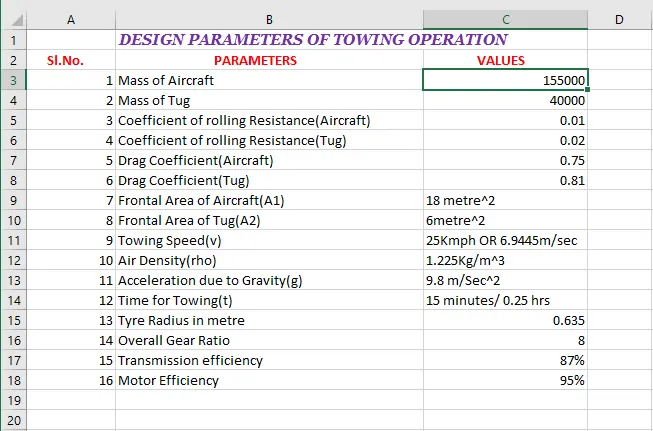
DESIGN PARAMETERS OF TOWING OF VEHICLE IN EXCEL SHEET: