Project-1: Powertrain for aircraft in runways
Introduction:-
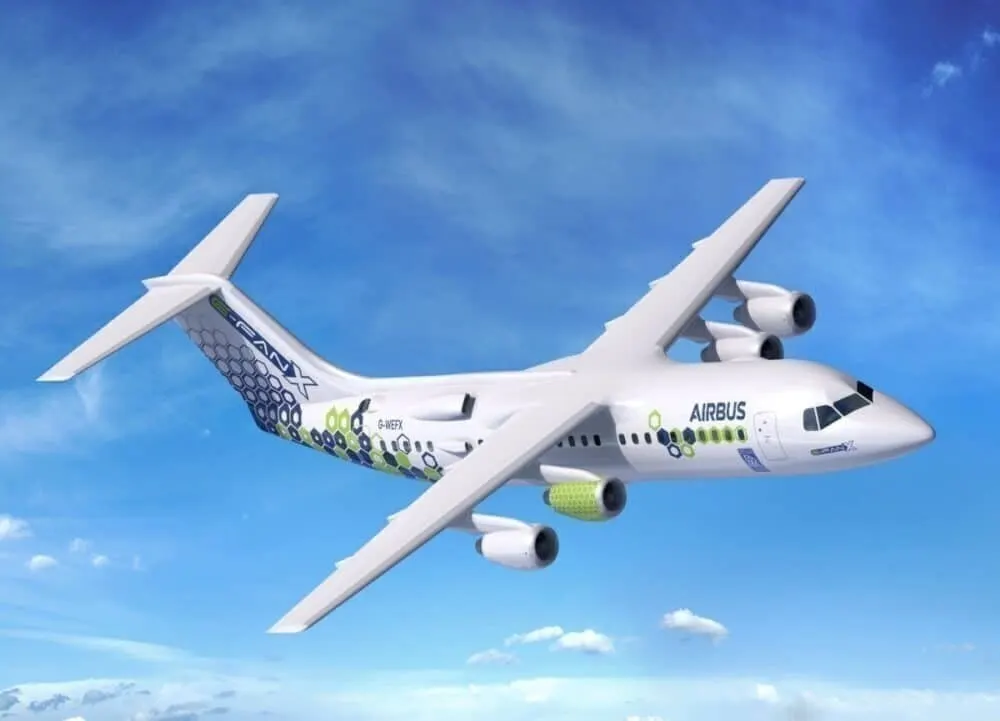
An aircraft is a vehicle or machine that is able to fly by gaining support from the air. It counters the force of gravity by using either static lift or by using the dynamic lift of an airfoil or in a few cases the downward thrust from jet engines. Common examples of aircraft include airplanes, helocopters, airships (including blimps), gliders, paramotors, and hot air ballons.
Part A:
Que 1] Search and list out the total weight of various types of aircrafts.
Aircraft gross weight:-
It is the total aircraft weight at any moment during the flight or ground operation. An it will decrease during a flight due to fuel and oil consumption. It may also vary during a flight due to payload droppin or in flight refuelling.
Types of weight is Aircraft:-
1] Maximum Ramp Weight (MRW)/Maximum Taxi Weight (MTW):-
The Maximum Ramp Weight (MRW) also known as the Maximum Taxi Weight (MTW) is the maximum weight authorised for manoeuvring (taxiing or towing) an aircraft on the ground as limited by aircraft strength and airworthiness requirements. It includes the weight of taxi and run-up fuel for the engines and the APU.
It is greater than the maximum takeoff weight due to the fuel that will be burned during the taxi and runup operations.
2] Maximum Takeoff Weight (MTOW)/Maximum Gross TakeOff Weight (MGTOW)/Maximum TakeOff Mass (MTOM):-
It is the maximum weight at which the pilot is allowed to attempt to take off, due to structural or other limits. It is also known as maximum gross takeoff weight (MGTOW) or Maximum Takeoff mass (MTOW). It is usually specified in units of kilograms or pounds.
Maximum Landing Weight (MLW):-
It is the maximum aircraft gross weight due to design or operational limitations at which an aircraft is permitted to land. It is set in order to ensure safe landings; if an aircraft weighs too heavy during touchdown, it may suffer structural damage or even break apart upon landing. Aircraft also have a maximum take-off weight, which is almost always higher than the maximum landing weight, so that an aircraft can weigh less upon landing due to burning fuel during the flight.
Maximum Zero Fuel Weight (MZFW):-
The maximum zero fuel weight (MZFW) is the maximum weight allowed before usable fuel and other specified usable agents (engine injection fluid, and other consumable propulsion agents) are loaded in defined sections of the aircraft as limited by strength and airworthiness requirements. It may include usable fuel in specified tanks when carried in lieu of payload. The addition of usable and consumable items to the zero fuel weight must be in accordance with the applicable government regulations so that airplane structure and airworthiness requirements are not exceeded.
When an aircraft is being loaded with crew, passengers, baggage and freight it is most important to ensure that the ZFW does not exceed the MZFW. When an aircraft is being loaded with fuel it is most important to ensure that the takeoff weight will not exceed the maximum permissible takeoff weight.
The aircraft has:
- Basic Empty Weight (BEW) is the weight of the aircraft "as built" and includes the weight of the structure, power plant, furnishings, installations, systems and other equipment that are considered an integral part of an aircraft before additional operator items are added for operation.
- Dry Operating Wieght (DOW) BEW + Weight of Crew (Pilot + Cabin including their bags) + Pantry
- Operating Weight (OW) DOW + Takeoff fuel (i.e. Ramp Fuel - Taxi fuel)
- Maximum Zero Fuel Weight (MZFW) DOW + Payload (anything put on the aircraft that generates revenue to the company, e.g. passenger, baggage, cargo, mail and fret)
- Maximum Taxi Weight (MTW) MZFW + Ramp fuel
- Maximum Takeoff Weight (MTOW) MZFW + Takeoff fuel, or MTW - Taxi fuel
- Maximum Landing Weight (MLW) MTOW - Trip Fuel
Reference Link:- https://en.wikipedia.org/wiki/Aircraft_gross_weight
https://en.wikipedia.org/wiki/List_of_airliners_by_maximum_takeoff_weight
Que 2] Is there any difference between ground speed and air speed?
Answer:-
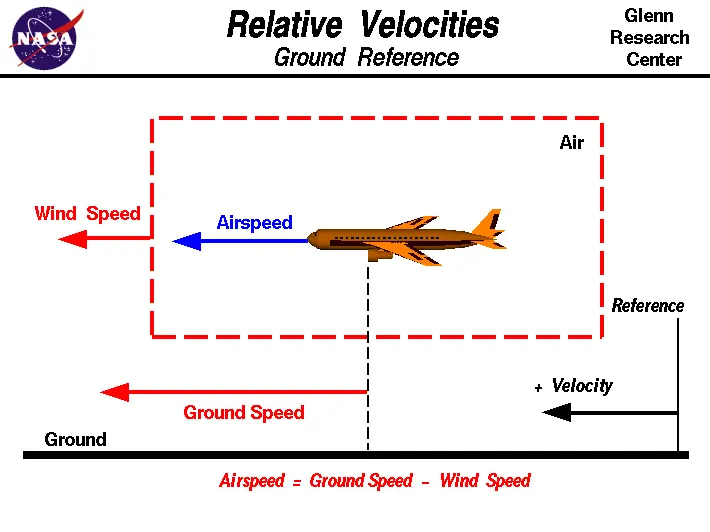
Ground speed and Air Speed are not always the same speed. On a windy day, an airplane may have an Air Speed of 80 knots but a Ground Speed of only 60 knots.
Wind Speed:-
Wind speed is the vector difference between the airspeed and the ground speed. On a perfectly still day the wind speed is zero and the airspeed is equal to the ground speed. If the measured airspeed is greater than the observed ground speed, the wind speed is positive.
Ground Speed:-
Ground speed can be determined by the vector sum of the aircraft's true airspeed and the current wind speed and direction; a headwind subtracts from the ground speed, while a tailwind adds to it. Winds at other angles to the heading will have components of either headwind or tailwind as well as a crosswind component.
Air Speed:-
The important quantity in the generation of lift is the relative velocity between the object and the air, which is called the airspeed. Airspeed cannot be directly measured from a ground position, but must be computed from the ground speed and the wind speed. Airspeed is the vector difference between the ground speed and the wind speed.
Airspeed = Ground Speed - Wind Speed
On a perfectly still day, the airspeed is equal to the ground speed. But if the wind is blowing in the same direction that the aircraft is moving, the airspeed will be less than the ground speed.
Examples
Suppose we had an airplane that could take off on a windless day at 100 mph (liftoff airspeed is 100 mph). We are at an airport with an east-west runway that is 1 mile long. The wind is blowing 20 mph towards the west and the airplane takes off going east. The wind is blowing towards the aircraft which we call a headwind. Since we have defined a positive velocity to be in the direction of the aircraft's motion, a headwind is a negative velocity. While the plane is sitting still on the runway, it has a ground speed of 0 and an airspeed of 20 mph:
Airspeed = Ground Speed (0) - Wind Speed (-20) = 20 mph
The airplane starts its take off roll and has a constant acceleration (a). From Newton's second law of motion, the ground speed (V) at any time (t) is:
V = a * t
and the distance (d) down the runway at any time is:
d = 1/2 * a * t^2
For a fixed length runway, this specifies the time to be used in the velocity equation. Let's assume that at 5000 feet down the runway, the velocity is 80 mph. Then the airspeed is given by
Airspeed = Ground Speed (80) - Wind Speed (-20) = 100 mph
and the airplane begins to fly. Now another pilot, with exactly the same airplane decides to take off to the west. The wind is now in the same direction as the motion and this is called a tailwind. The sign on the wind speed is now positive, not negative as with the headwind. The acceleration along the ground is the same, so at 5000 feet down the runway, the ground speed is again 80 mph. The airspeed is then given by:
Airspeed = Ground Speed (80) - Wind Speed (20) = 60 mph
Reference Link:- https://www.grc.nasa.gov/www/k-12/airplane/move.html
http://www.aerospaceweb.org/question/instruments/q0210.shtml
https://basicmahiti.com/generalknowledge/what-is-the-difference-between-air-speed-and-ground-speed/
Que 3] Why is it not recommended to use aircraft engine power to move it on the ground at Airport?
Answer:-
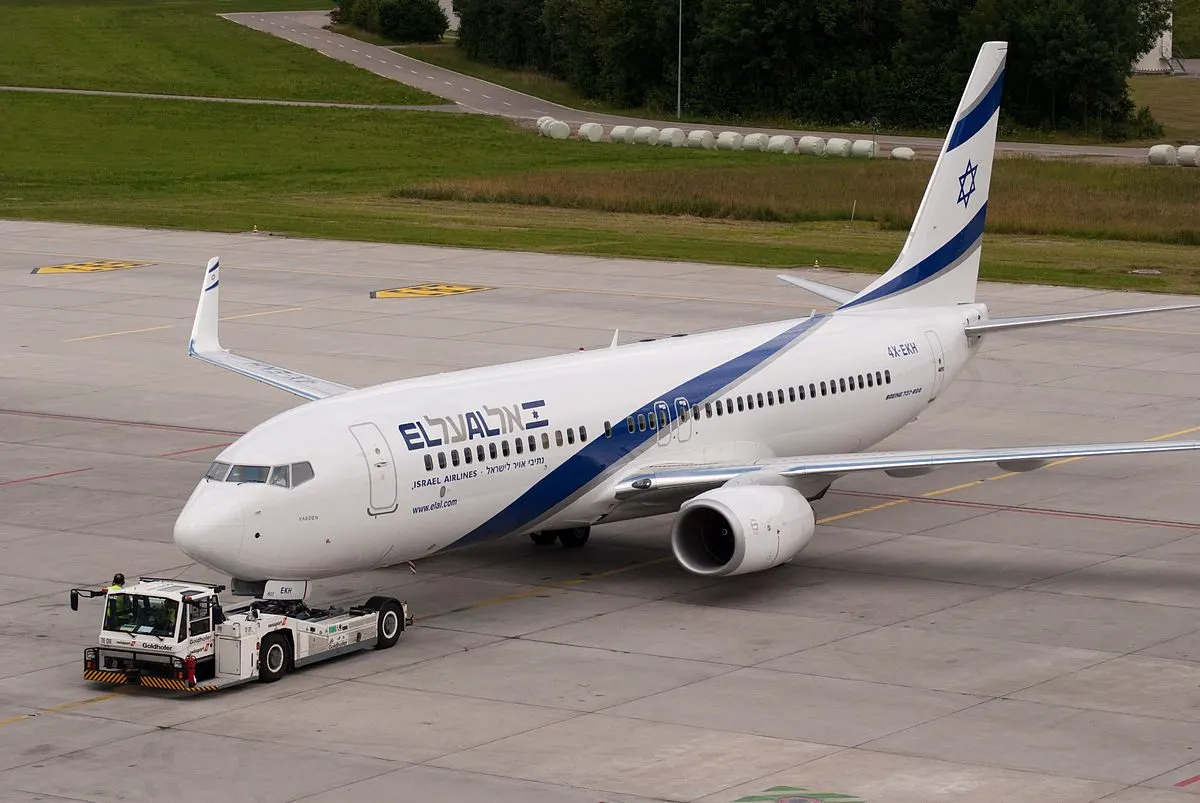
The aircraft can be move using their own engine power all the time on the airport apron and taxiways under their own powere to go towards runways and after landing taxi to thier assignbed gate. But the thrust produced resulting jet blast might cause damage to terminal building or equipment. Engine close to the ground may also blow sand and debris forward and then suck them into the engine causing damage to the engine. A pushback is therefore are preferred method to move the aircraft away from the gate. and also it can reduce the cost of fuel, Taxing can save money.
Thrust reverse:-
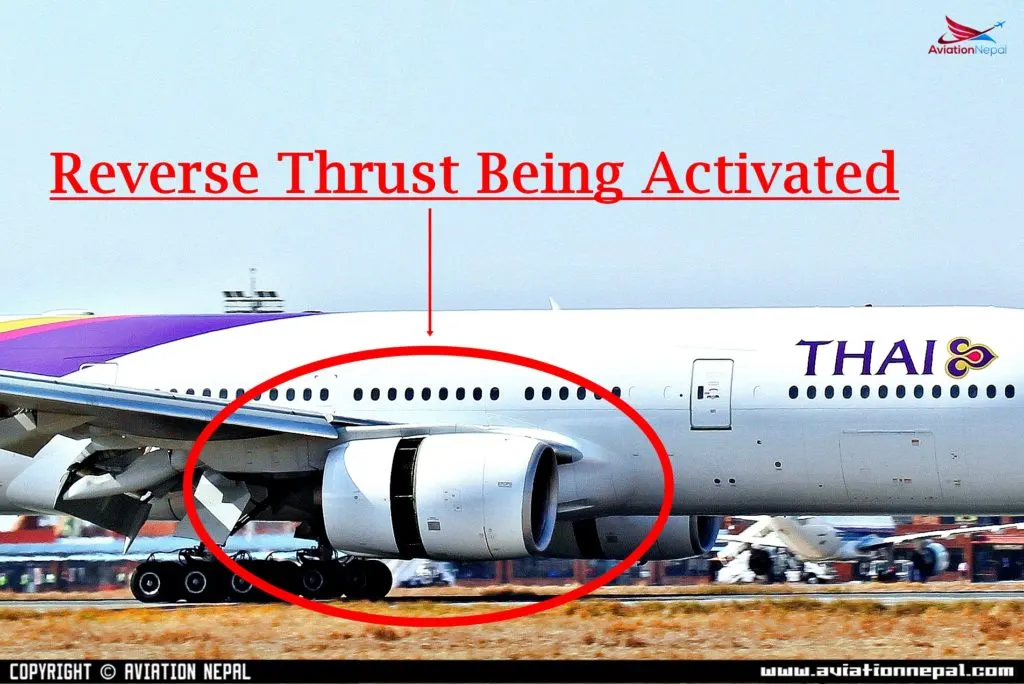
It is known in the majority as reverse thrust, is projected in the opposite way and is used after landing, in the case of rejected departures or, in some cases, in flight, to decelerate the aircraft. Pushback is used by aircraft to move backward on the ground using the power of their engines along with the reverse thrust of the aircraft.
Disadvantages for thrust back process:-
- Need To maintain the fuel:-
Using reverse thrust for pushback, it consumes a lot of fuel. Aviation fuels are very expensive. It will therefore become more expensive for the airline itself. Airlines therefore discontinued this practice in order to reduce costs and conserve fuel.
- Causes more wear and tear:-
Since the engines were used for pushback, other than normal operation, they would cause more wear and tear in the engine parts, thus reducing the operating life of the engine.
- More maintenace cost:-
Generally, the engine that will operate more will require more maintenance to check the wear and tear of the engine parts. This will add to the maintenance cost of the operating airline. This practice has therefore been discontinued.
- No back view:-
Unlike our cars, aircraft don’t have rear-view mirrors to look backwards while using the Reverse Thrust (a procedure referred to as a powerback) pushback method. This is causing serious accidents.
- Injuries to the ground staff:-
The powerful jet blast created during the reverse thrust can throw the ground personnel at his feet. In order to avoid such events, the reverse thrust (a procedure referred to as a powerback) procedure has been discontinued.
- Damage to the engine of the aircarft:-
The powerful jet blast can throw ground equipment and debris into the engine intake. This will cause serious engine damage and ultimately lead to engine failure.
- Damage to the terminal at the airport:-
The jet blast from the engine’s thrust reversers can throw anything away and hurl it toward the terminal. Thus, the terminal of the airport can be damaged.
Reference Link:- https://www.aviationnepal.com/how-pushback-is-performed-why-do-civil-aircraft-do-not-use-a-power-back-pushback/
Que 4] How an aircraft is pushed to runway when its ready to take off?
Answer:-
Airplanes have engines, and they can use them to move forward along the ground. So they push themselves to the runway.
It is true that most of the time, a small vehicle is needed to push the larger commercial airplanes backwards away from the terminal building, because even if a plane can reverse it’s thrust, it’s not always safe to hit the buildings with that reverse thrust. So the little trucks push the bigger planes back away from the buildings, but after that, the planes can apply a small amount of engine power to roll forward just as all airplanes can.
Aircraft push themselves to the runway.
Aircraft Towing :-
The forward movement of an aircraft, usually with engines off, using the power of a specialised ground vehicle attached to or supporting the nose landing gear. It may occur for the movement of both in service and out of service aircraft. it may also follow the pushback from a nose-in gate of an empty aircraft with engines off.
It is towed by a Tug.
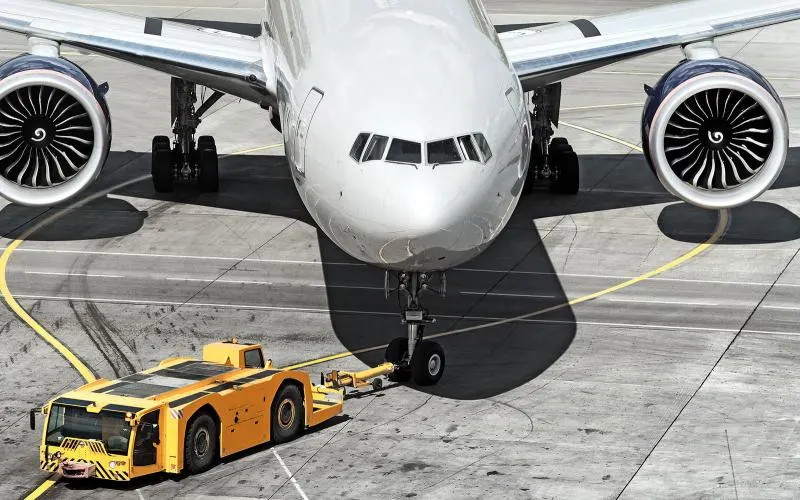
It is a towbarless tug.
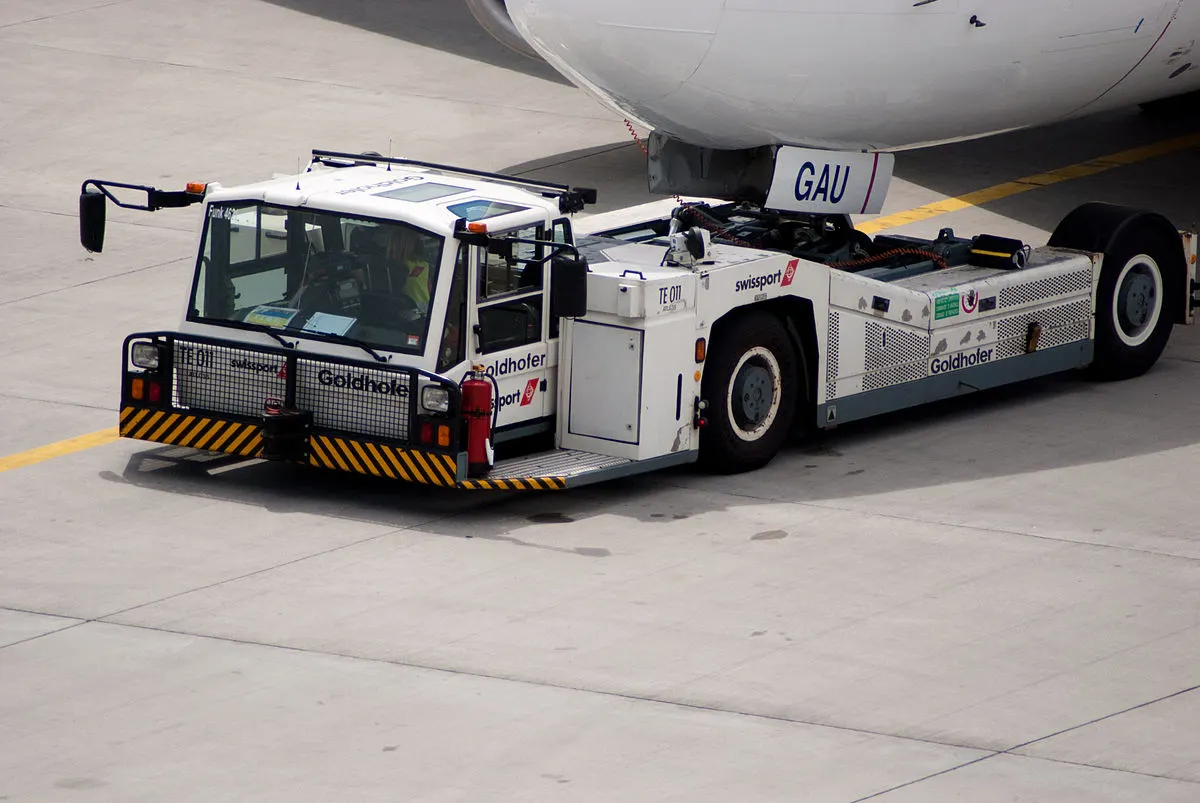
Reference link:- https://skybrary.aero/articles/aircraft-towing
Que 5] Learn about take off power, tyre design, rolling resistance, tyre pressure, brake forces when landing.
Answer:-
1] Take Off Power:-
Takeoff is the phase of flight in which an aerospace vehicle leaves the ground and becomes airborne. For aircraft that take off horizontally, this usually involves starting with a transition from moving along the ground on a runway.
Although the takeoff is one continuous maneuver it will be divided into three separate steps for purposes of explanation: 1. takeoff roll, 2. lift-off, and 3. initial climb after becoming airborne.
Takeoff roll (ground roll) is the portion of the takeoff procedure during which the airplane is accelerated from a standstill to an airspeed that provides sufficient lift for it to become airborne.
Lift-off is when the wings are lifting the weight of the airplane off the surface. In most airplanes, this is the result of the pilot rotating the nose up to increase the angle of attack (AOA).
The initial climb begins when the airplane leaves the surface and a climb pitch attitude has been established. Normally, it is considered complete when the airplane has reached a safe maneuvering altitude or an en route climb has been established.
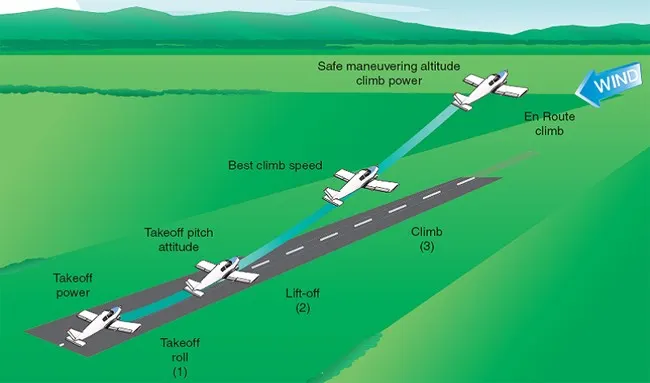
Cross winding Take off:-
Take off performance can be predicted using a simple measure of the acceleration of the aircraft along the runway based on force equilibrium. The forces will be involved by,
T – Thrust of propulsion system pushing aircraft along runway.
D – Aerodynamic Drag of vehicle resisting the aircraft motion.
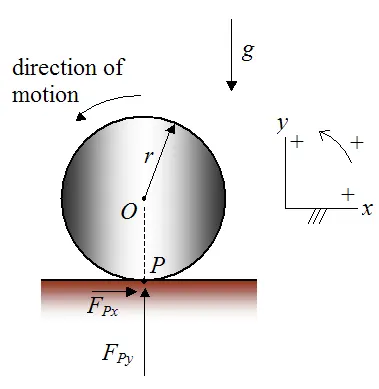
F – Rolling resistance friction due to the contact of wheels or skids on the ground.
During take-off run the imbalance in these forces will produce an acceleration along the runway.
`m*frac{dv}{dt} = T-D-F`
where (dV/dt) is the acceleration along the runway and (m) is the mass of the vehicle.
The procedure for take-off will be that the vehicle will accelerate until it reaches a safe initial flying speed. The pilot can then rotate the vehicle to an attitude to produce climb lift and it will ascend from the ground. The determination of this safe flying speed or rotation speed, (VR), is a critical factor in determining take-off performance. Take-off rules vary slightly depending on the aircraft category.
Small commuter aircraft,
`V = 1.1*Vstall` or
`V = 1.05*Vcontrol`,
`Vstall = sqrtfrac{W}{0.5*C_Lmax*rho* S}`
wheer S =runway length
Take OFF power = Force*Displacement,
`(m*frac{dv}{dt})*2*S = (T-D-F)*S`
Reference link:- https://www.faa.gov/regulations_policies/handbooks_manuals/aviation/airplane_handbook/media/07_afh_ch5.pdf
http://www.aerodynamics4students.com/aircraft-performance/take-off-and-landing.php
2] Tyre Design:-
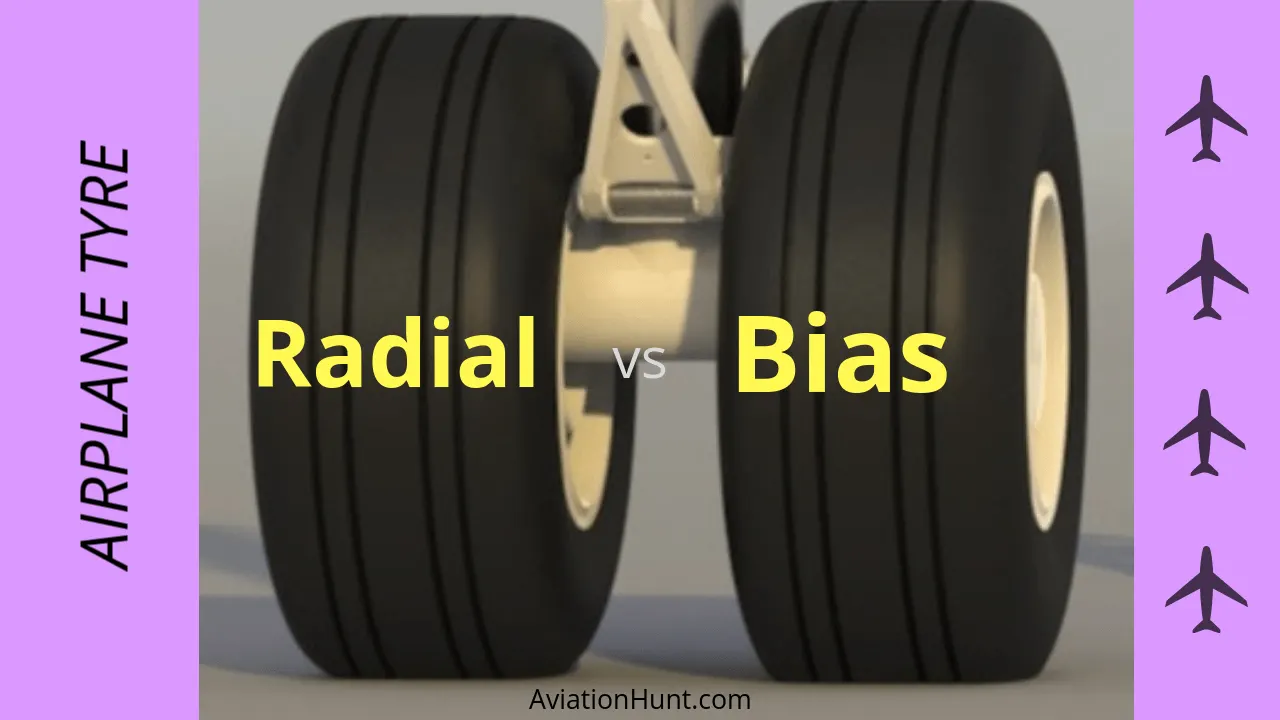
When it comes to safety, tyres are one of the most important components of aircraft. They help to absorb the shock of landing and provide cushioning. It also provides the necessary traction for braking and stopping of an aircraft.
An aircraft tyre is designed to withstand extremely heavy loads while landing, take off, taxing, and parking. The number of wheels required for aircraft increases with the weight of the aircraft, as the weight of the aeroplane needs to be distributed more evenly.
Constuction of Tyres:-
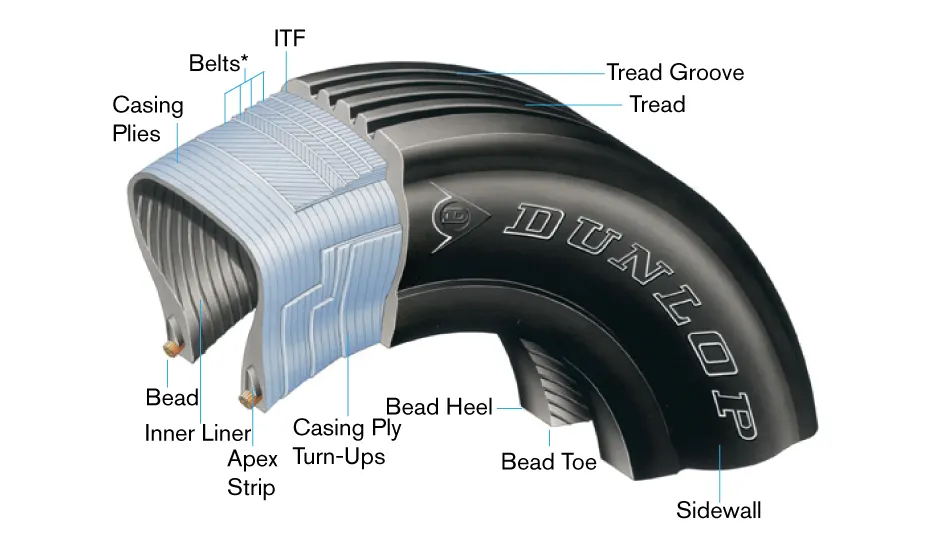
Radial type Tyre:-
It has the fibre strands of the ply fabric oriented with and at 90° to the direction of rotation and the tyre sidewall. This restricts flexibility bidirectionally and the flexibility of the sidewall while it strengthens the tyre to carry heavy loads.
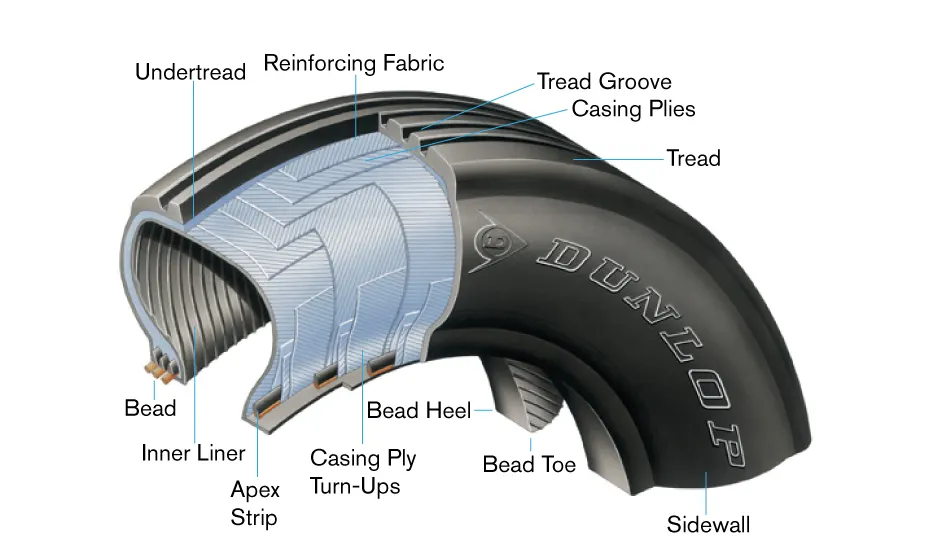
Bias-ply type Tyre:-
It has the fabric bias oriented with and across the direction of rotation and the sidewall. Since fabric can stretch on the bias, the tyre is flexible and can absorb loads. Tyre strength is obtained by adding plies.
Reference Link:- https://www.aviationhunt.com/aircraft-tyre-construction/
https://www.aviationhunt.com/aircraft-radial-vs-bias-tyre/
3] Rolling Resistance:-
4] Tyre pressure:-
Aircraft tires generally operate at high pressures, up to 200 psi (14 bar; 1,400 kpa) for airliners, /and even higher for business jets. The main landing gear on the concorde was typically inflated to 232 psi (16.0 bar), whilst its tail bumper gear tires were as high as 294 psi (20.3 bar). Tests of airliner aircraft tires have shown that they are able to sustain pressures of maximum 800 psi (55 bar; 5,500 kPa) before bursting. During the tests the tires have to be filled with water, to prevent the test room being blown apart by the energy that would be released by a gas when the tire bursts.
Aircraft tires are usually inflated with nitrogen to minimize expansion and contraction from extreme changes in ambient temperature and pressure experienced during flight. Dry nitrogen expands at the same rate as other dry atmospheric gases (normal air is about 80% nitrogen), but common compressed air sources may contain moisture, which increases the expansion rate with temperature.
The requirement that an inert gas, such as nitrogen, be used instead of air for inflation of tires on certain transport category airplanes was prompted by at least three cases in which the oxygen in air-filled tires had combined with volatile gases given off by a severely overheated tire and exploded upon reaching autoignition temperature. The use of an inert gas for tire inflation eliminates the possibility of tire explosion.
Reference link:- https://en.wikipedia.org/wiki/Aircraft_tire
5] Brake forces when landing:-
In general, when the wheels touch the ground, a set of spoilers raise up quickly, which kills the lift provided by the wings. (There are two sets seen in the image below: ground spoilers that only deploy on landing, and spoilers that are used in flight as speed brakes as well as on landing.) While the spoilers provide some drag, their primary purpose is to stop the plane from actually flying, putting all of the weight on the landing gear and in turn making the brakes that much more effective.
Before landing, when the landing gear is lowered, the pilots arm the ground spoilers to deploy automatically on touchdown.
This lever controls the speed brakes, or ground spoilers. Here, it is shown in the armed position, prior to landing.
Hit the Brakes:-
Aircraft have highly-engineered, multi-disc brakes made of a carbon-steel material. Manufacturers include Honeywell and Goodrich, part of Collins Aerospace. In general, the brakes are composed of discs that rotate with the wheel and separate discs that are fixed. When pressure is applied—and below you see pressure applied from the right fixed disc on all of the discs—the entire assembly compresses to create the braking action. Carbon brakes are standard today; they cool faster than steel brakes (their predecessor) and can weigh up to 700 pounds less. That represents a significant weight saving for airlines.
Autobrakes:-
Wheel brakes are usually selected to engage automatically after landing, Brady explained. These are called “autobrakes”. Brady says that all airliners have several levels of autobrake “severity”. The crew will decide which is the most appropriate to use for every landing depending upon factors like the length of runway, if it is wet or dry, or if the pilots want to exit the runway at a particular point. “For a short wet runway you might select autobrake 3, or MED on the Airbus. For a long dry runway you might select autobrake 1 or LOW on the Airbus,”.
Part B:
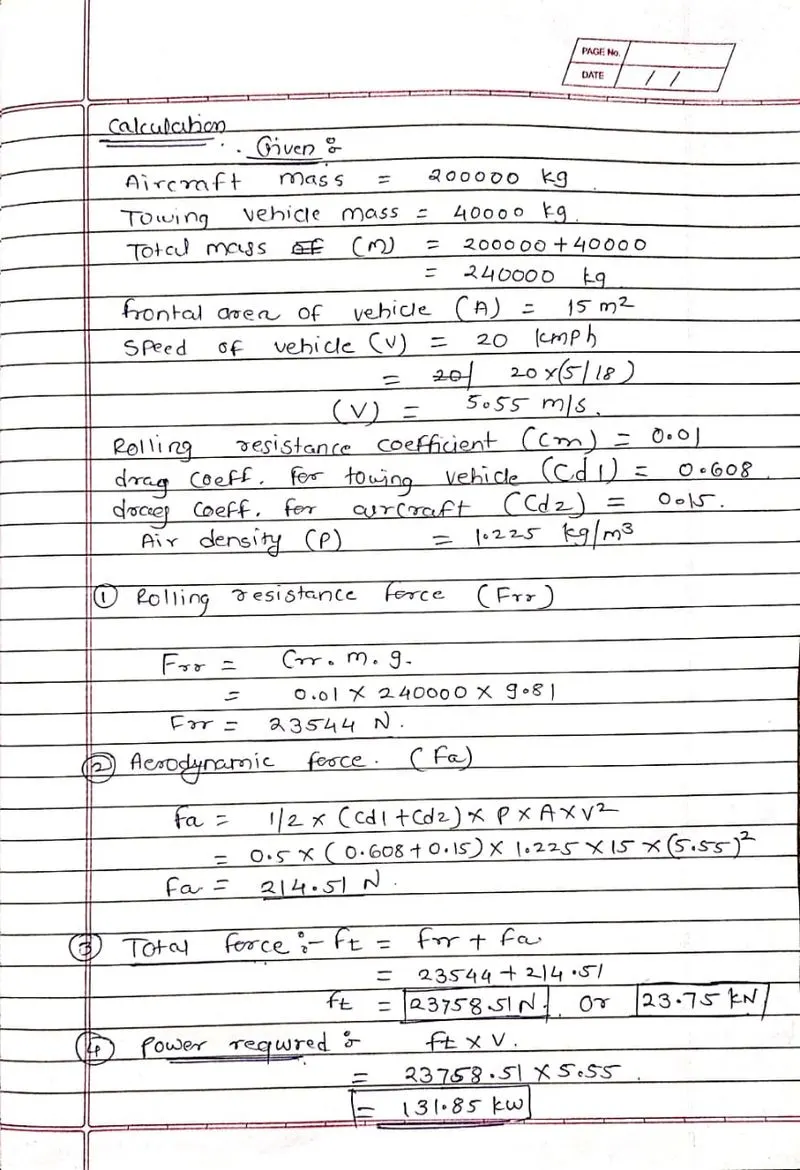
Que 6] a] With necessary assumptions, calculate the force and power required to push / pull an aircraft by a towing vehicle.
Answer:-
B] Develop the model for the calculated force and power using Simulink.
Its calculating in Matlab Coding:-
%% Calculations of total force and required power for pull/push the aircraft
clear all
close all
clc

%% given
m1 = 200000;  % mass of aircraft in [kg]
m2 = 40000;   % mass of towing vehicle in [kg]
M = m1+m2;    % total mass in [kg]
A = 15;       % frontal area in [m^2]
n = 20;       % speed of towing vehicle in [kmph]
V = n*(5/18); % velocity of towing vehicle in [m/s]
Cr = 0.01;    % coefficient of rolling resistance
cd1 = 0.608;  % drag coefficient of towing vehicle
cd2 = 0.15;   % drag coefficient of aircraft
p = 1.225;    % air density in[kg/m^3]
g = 9.81;      % acceleration due to gravity [m/s^2]

%% calculate rolling resistance force
Frr = Cr*M*g;

%% calculate aerodyanamic force
Fa = 0.5*(cd1+cd2)*p*A*V^2;

%% total force
Ft = Frr+Fa;

%% total power required
P = Ft*V;

%% print
fprintf('Rolling Resistance Force is %3f N\n',(Frr) )
fprintf('Aerodynamic Force is %3f N\n',(Fa))
fprintf('Total force is  %3f N\n',(Ft))
fprintf('Total Required Power is %3f KW\n',(P))
Simulink Model:-
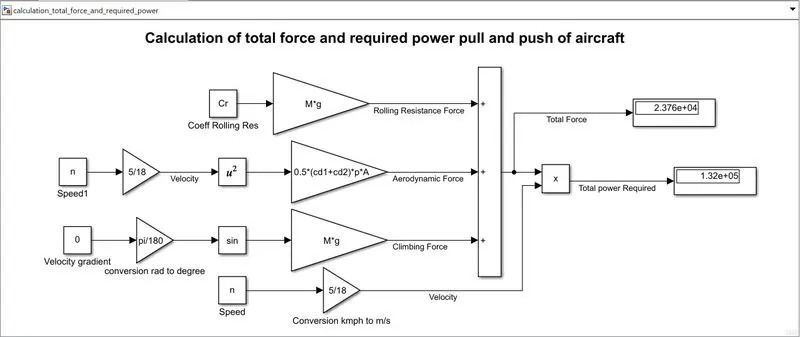
Result:-
1] Total Force = 23.64KN
2] Total required Power = 132.85KW
Que 7] A. Design an electric powertrain with type of motor, it’s power rating, and energy requirement to fulfill aircraft towing application in Simulink. Estimate the duty cycle range to control the aircraft speed from zero to highest. Make all required assumptions. Prepare a table of assumed parameters. Draw a block diagram of powertrain.
Answer:-
Estimating the data
Based on the calculations done in 6a.
Force required to push/pull the aircraft = 23.56 KN
Power required = 132.85KW
let us assume
Radius of tyre for the tug = 30 inches = 0.762m
Gear ratio = 8
Transmission efficiency (`etat)` = 87%
motor efficiency `(etam)` = 95%
Torque required for the wheels (Tw) = Total force*Radius of wheel
= 23.56*0.762
= 17.95KNm
Motor torque = wheel torque/(gear ratio*transmission efficiency)
= 17.95/(8*0.87)
= 2.57KNm
Required motor torque (Tm) = motor torque/motor efficiency
= 2.57/0.95
= 2.70KNm
lly, The total power required by the motor considering all efficiencies (Pt) = Total required power/(transmission eff*motor eff)
= 132.85/(0.87*0.95)
= 160.73KW
let us assume the towing operation was done in 15 min (0.25hrs) duration
then total energy consumed = Pt*duration
= 160.73*0.25
= 40.18KWh
If we consider the battery capacity 220KW is used by the towing vehicle then the duty cycle range to control the speed,
Duty cycle (d) = (required power)/(rated power)
= 160.73/220
= 0.73
Therefore the controller will be able to provide duty cycle ranging from 0 to 73% in order to control the towing speed.
Block diagram of powertrain:-
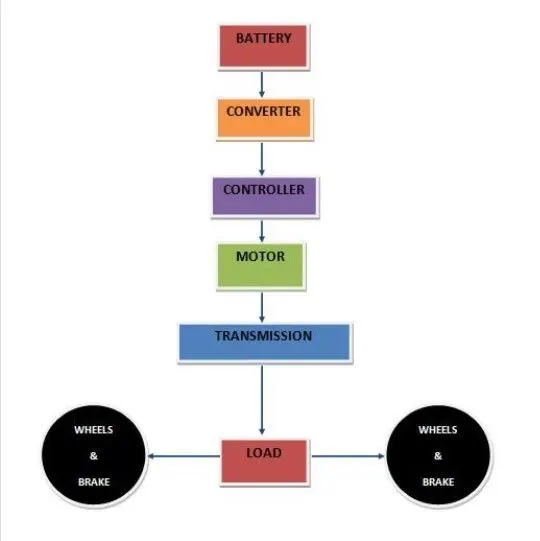
Simulink Diagram of powertarin:-
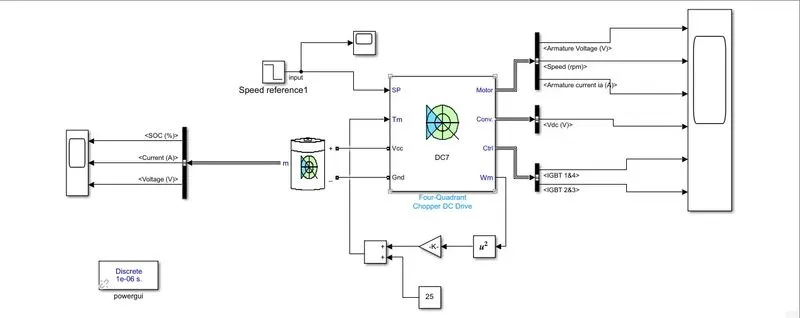
Result:-
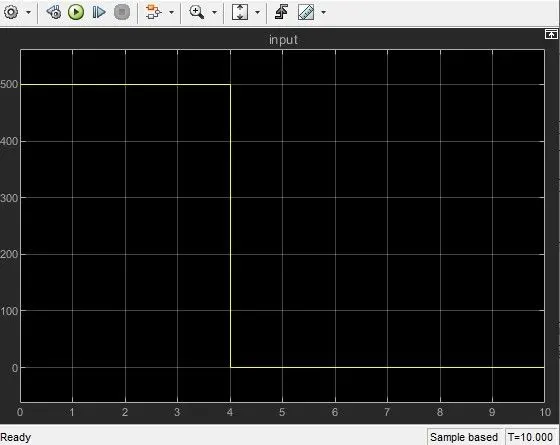
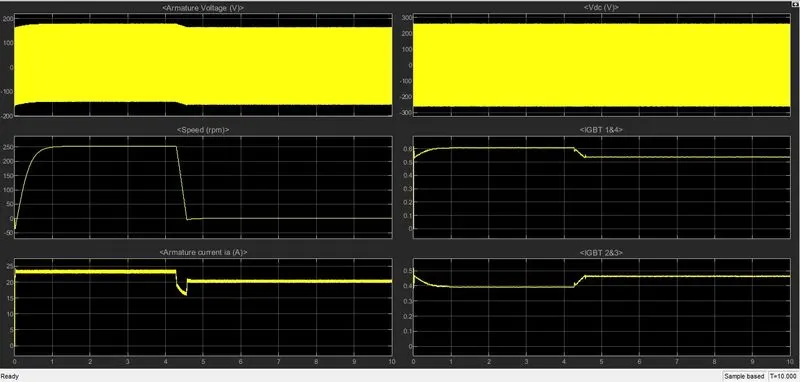
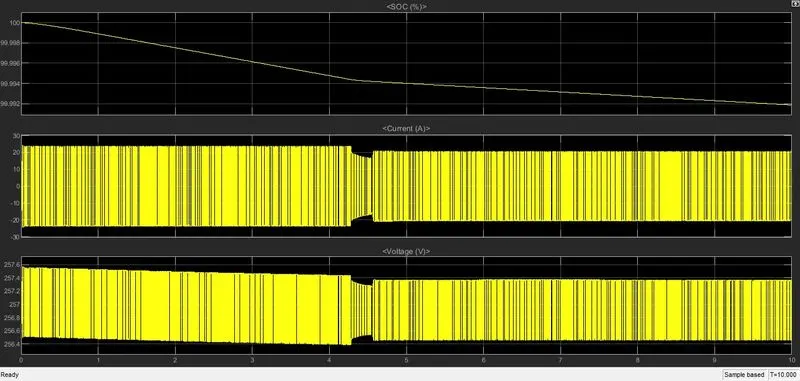
B. Also, Design the parameters in excel sheet.
| Propulsion Power | ||
| Mass of vehicle (m1) | 40000 | Kg |
| Mass of aircraft (m2) | 200000 | Kg |
| Total mass (M) | 240000 | Kg |
| Frontal area (A) | 15 | M^2 |
| Speed of vehicle (kmph) | 20 | KMph |
| Velcoity (V) (m/s) | 5.555555556 | m/s |
| Rolling resistance coefficient (Cr) | 0.01 | |
| Drag Coefficient of vehicle (Cd1) | 0.608 | |
| Drag Coefficient of aircraft (Cd2) | 0.15 | |
| Air density (p) | 0.1225 | Kg/m^3 |
| Rolling Resistance Force (N) | 23544 | N |
| Aerodynamic Force (N) | 21.49421296 | N |
| Hill Climbing Force (N) | negligible | |
| Total tractive force (N) | 23560 | N |
| Total power required (P) (KW) | 130.8888889 | KW |
| Transmission efficiency | 0.87 | |
| motor efficiency | 0.95 | |
| radius of tyre | 0.762 | |
| gear ratio | 8 | |
| Torque required for the wheels (Tw) | 17.95 | KNm |
| Required motor torque (Tm) | 2.7 | KNm |
| The total power required by the motor considering all efficiencies (Pt) | 160.73 | KW |
| total energy consumed | 40.18 | KWh |
| Duty cycle (d) | 0.73 |
Thank You
Dharmesh Bonde...