Project-1: Powertrain for aircraft in runways
Question 1
list of Weight Of Different aircrat has been attach in tbe Exel file report (Project 1)
Question 2
Is there any difference between ground speed and air speed?
Airspeed and ground speed are completely different when it comes to determining how fast an airplane flies.
Ground speed is that speed how fast the airplane is travelling on the ground relative to fixed point.
Air speed is that speed ,under his own engine power how fast airplane is travelling
In general ,If there no wind Ground speed=Air speed.
but as there is wind present
ground spped - Wind speed = Air speed.
NASA Explains,
On a perfectly still day, the airspeed is equal to the ground speed. But if the wind is blowing in the same direction that the aircraft is moving, the airspeed will be less than the ground speed.
This is because that Drag is require for the lift of the airplane ,and its only generated from the Wind coming From the Opposite Side.
Question 3
Why is it not recommended to use aircraft engine power to move it on the ground at Airport?
Air craft Engine Power are Very much High ,as they are used to produced thrust.
Its works on sucking the wind and throwing backwards direction ,this way it Moved forward.
But the Wind Generating due to enhine power are high as Hurricane wind .
This types of wind can Damage the Buildings near air ports ,small houses, and the ROOF of Airports Buildings which are Prone to small forces.
Risk factor is high While using the aircfrat engine power At airport..
Question 4
How an aircraft is pushed to runway when its ready to take off?
A truck Called pushback truck Is used to push and pull the Aircraft,pushing it with a towbar attached to the nose-wheel or you can say Front Single wheel.
A Pushback Vehicle is shown in the Image.
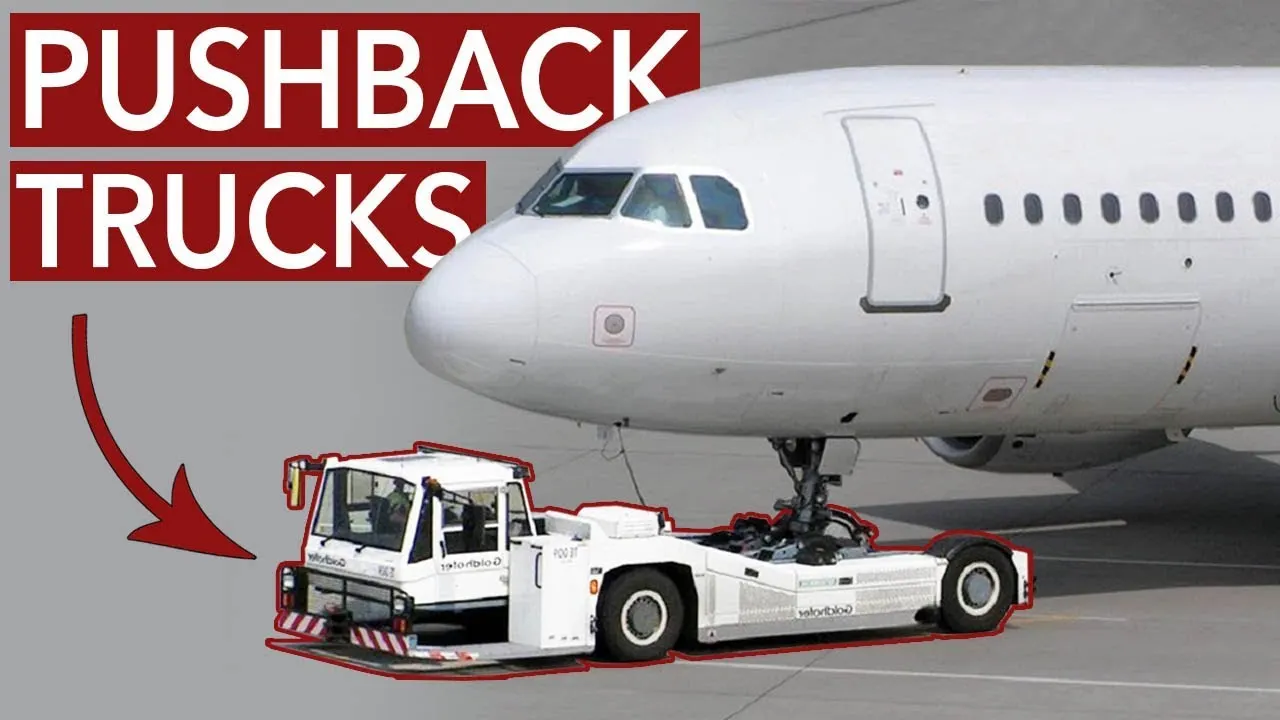
(this the new versions of push back late where used a TOW bar attchteach to airplane and Truck)
By Lookinf this picture you may be wondering that ,How a little truck and pull this heavy airplane?
actuclly This they dont have to lift the heavy weight of the airplane ,airplane itself is mounted on high pressure tyre, thney Only have to use the Firction thing here to get Reduced.
This truck are slow speed but produce very large amount of torque ,used to pull or push aircraft.
IMPOTANT Terms When the Aircraft is Landing.
Tafe Off Power
The amount of power that an engine is allowed to produce for a limited period of time for takeoff.
The use of takeoff power is usually limited to 5 min for reciprocating engines and up to 2½ min for gas turbine engines.
tyre design
An aircraft tyre is designed to withstand extremely heavy loads while landing, take off, taxing, and parking. The number of wheels required for aircraft increases with the weight of the aircraft, as the weight of the aeroplane needs to be distributed more evenly.
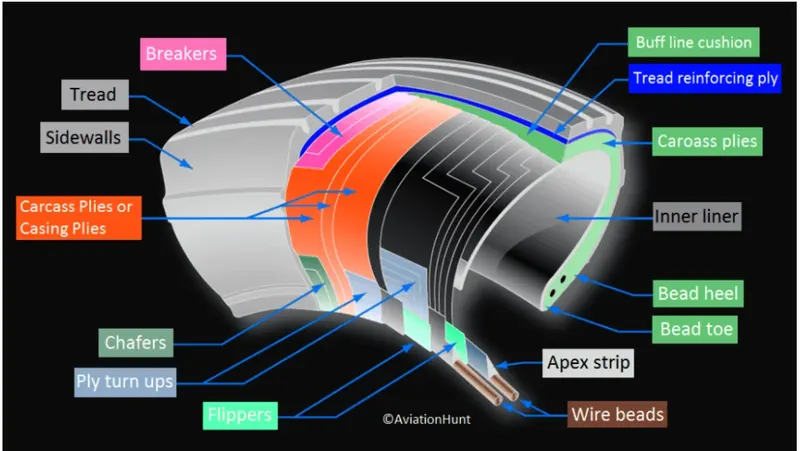
Load Rating – Load rating is the maximum permissible load at a inflation pressure.
Ply Rating – Ply Rating is used to identify the maximum load rating and inflation pressure for a specified tyre.
Speed Rating – The speed rating is the maximum takeoff speed to which the tyre has been tested.
Skid Depth – Skid depth is the distance between the tread surface and the deepest groove as measured in the mould.
Tyre pressure
Tyre of an air craft is fas different from the tyre used in cars and trucks.,
generally car needs a 30 to 40 psi tyre pressure in it But airplane have a tyre pressure of 200 psi,to with stand on heavy loads, diffreent temperatures etc.
Rather than a normal air as used in the car or truck ,Nitrogen gas used in the tyre of airplane.
nitrogen is a inert gas, it does not change its structure in high and Low temperature, this is reason they used in airplane tyres.
brake forces.
From below example you can get Which forces are needed to calculate a brake power for airplane.
some assumptions
Landing weight = takeoff weight in case of aborted takeoff =20000 lbf
Landing distance = 1000 ft
Speed (assume aborted takeoff) = 120 kt (200 ft/sec)
We will use Newton’s second law to determine force due to deceleration:
Deceleration: from simple kinematics, acceleration = velocity^2 / distance
= (200 ft/s)^2 / 1000 ft = 40 ft / s^2
Mass of aircraft = (weight) / g = 20000/32.2 = 621.11 lbf*s^2 / ft
Force = mass * acceleration (621.11 lbf*s^2/ft) * (40 ft / s^2) = 24844.4 lbf
So in this example, the braking (deceleration) force is 24844.4 lbf
Notice that in the English foot-pound-second units the mass unit is
pound-second^2 per foot, called a slug in order for the units to work out.
Question 6
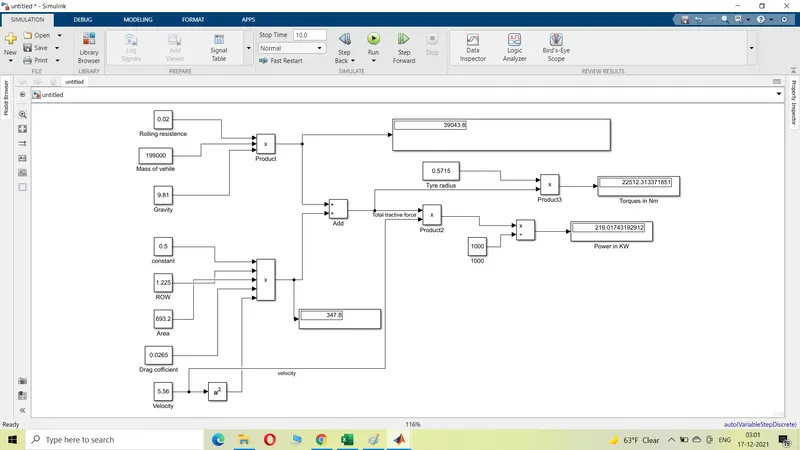
A. With necessary assumptions, calculate the force and power required to push / pull an aircraft by a towing vehicle.
Airplane Value
Gross weight = 35,000 kg
Now
Total Tractive froce = Rolling resistence +Arodynamic drag