Project-1: Powertrain for aircraft in runways
Aim: Study of powertrian for aircrafts in runways.
Objectives:
01.
Search and list out the total weight of various types of aircrafts.
02.
Is there any difference between ground speed and air speed?
03.
Why is it not recommended to use aircraft engine power to move it on the ground at Airport?
04.
How an aircraft is pushed to runway when its ready to take off?
05.
Learn about take off power, tyre design, rolling resistance, tyre pressure, brake forces when landing.
06. A.
With necessary assumptions, calculate the force and power required to push / pull an aircraft by a towing vehicle.
06. B.
Develop the model for the calculated force and power using Simulink.
07. A.
Design an electric powertrain with type of motor, it’s power rating, and energy requirement to fulfill aircraft towing application in Simulink. Estimate the duty cycle range to control the aircraft speed from zero to highest. Make all required assumptions. Prepare a table of assumed parameters. Draw a block diagram of powertrain.
(Hint :DC7 Block)
07. B.
Also, Design the parameters in excel sheet.
Introduction:
What is an aircraft?
An aircraft is a vehicle or machine that is able to fly by gaining support from the air. It counters the force of gravity by using either static lift or by using the dynamic lift of an airfoil, or in a few cases the downward thrust from jet engines. Common examples of aircraft include airplanes, helicopters, airships (including blimps), gliders, paramotors, and hot air balloons.
The human activity that surrounds aircraft is called aviation. The science of aviation, including designing and building aircraft, is called aeronautics.
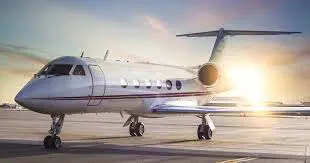
Fig01: Airplane or Aeroplane.
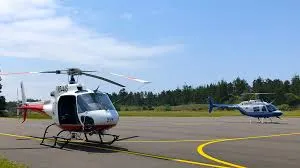
Fig02: Helicopters.
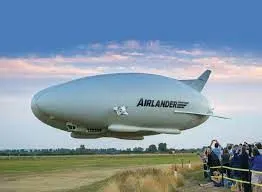
Fig03: Airship.
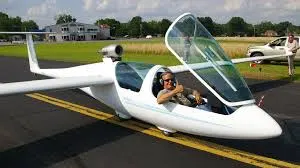
Fig04: Gliders.
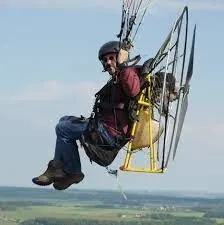
Fig05: Paramotors.
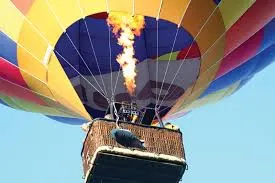
Fig06: Hot air balloon.
What is Powertrain?
Engine: As the heart of your vehicle, an engine generates power to drive the car. An engine consists of pistons that move up and down inside cylinders and a crankshaft that translates the reciprocating motion into a rotating motion.
Transmission: A transmission is a basic component in your car that makes sure the proper amount of power is transmitted to the wheels. Like a car's gearbox, the transmission takes the power from the engine and adjusts it according to driving conditions, ultimately transferring it to the wheels.
Driveshaft: A driveshaft is a component that transfers the torque from the transmission to the wheels. To perform this task, it has to work through various angles and change its length to adjust to movement in the suspension.
Axles: Axles are an important member of a powertrain. It lies between the wheels and mainly performs two functions: first, it puts up with the weight of the vehicle and it also rotates and transmits the power of the engine to the wheels.
Differential: A differential is a part of the rear axle. It allows each rear wheel to turn at a different speed. For instance, the differential is important when turning a corner, as the outside wheel needs to rotate faster than the inside wheel.
The powertrain is crucial because without the system working properly, your vehicle cannot move forward. To sum up, it's a group of parts that generate, convert, and consume energy to thrust your vehicle into motion.
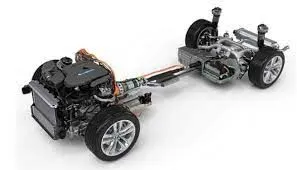
Fig07: Powertrain in IC engine cars.
What is Takeoff?
Takeoff is the phase of flight in which an aircraft goes through a transition from moving along the ground (taxiing) to flying in the air, usually starting on a runway. For balloons, helicopters and some specialized fixed-wing aircraft (VTOL aircraft such as the Harrier), no runway is needed.
What is Landing?
Landing is the last part of a flight, where a flying aircraft or spacecraft (or animals) returns to the ground. When the flying object returns to water, the process is called alighting, although it is commonly called "landing" and "touchdown" as well. A normal aircraft flight would include several parts of flight including taxi, takeoff, climb, cruise, descent and landing.
What is taxiing?
Taxiing (rarely spelled taxying) is the movement of an aircraft on the ground, under its own power, in contrast to towing or pushback where the aircraft is moved by a tug. The aircraft usually moves on wheels, but the term also includes aircraft with skis or floats (for water-based travel).
An airplane uses taxiways to taxi from one place on an airport to another; for example, when moving from a hanger to the runway. The term "taxiing" is not used for the accelerating run along a runway prior to takeoff, or the decelerating run immediately after landing, which are called the takeoff roll and landing rollout, respectively.
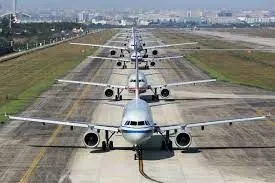
Fig08: Taxiing of airplanes.
Problem Statement:
01.
Search and list out the total weight of various types of aircrafts.
02.
Is there any difference between ground speed and air speed?
03.
Why is it not recommended to use aircraft engine power to move it on the ground at Airport?
04.
How an aircraft is pushed to runway when its ready to take off?
05.
Learn about take off power, tyre design, rolling resistance, tyre pressure, brake forces when landing.
06. A.
With necessary assumptions, calculate the force and power required to push / pull an aircraft by a towing vehicle.
06. B.
Develop the model for the calculated force and power using Simulink.
07. A.
Design an electric powertrain with type of motor, it’s power rating, and energy requirement to fulfill aircraft towing application in Simulink. Estimate the duty cycle range to control the aircraft speed from zero to highest. Make all required assumptions. Prepare a table of assumed parameters. Draw a block diagram of powertrain.
(Hint :DC7 Block)
07. B.
Also, Design the parameters in excel sheet.
Solution:
01.
Search and list out the total weight of various types of aircrafts.
The different terms represent different weights or masses. For each flight, the weights are taken into account for several reasons.
A brief description about these is below:
Manufacturer's empty weight (MEW):Also called Manufacturer's Weight Empty (MWE) or Licensed Empty Weight
It is the weight of the aircraft "as built" and includes the weight of the structure, power plant, furnishings, installations, systems and other equipment that are considered an integral part of an aircraft.
This excludes any baggage, passengers, or usable fuel.
Zero-fuel weight (ZFW):
This is the total weight of the airplane and all its contents (including unusable fuel), but excluding the total weight of the usable fuel on board.
As a flight progresses and fuel is consumed, the total weight of the airplane reduces, but the ZFW remains constant.
Maximum zero fuel weight (MZFW):
is the maximum weight allowed before usable fuel and other specified usable agents (engine injection fluid, and other consumable propulsion agents) are loaded.
Operating empty weight (OEW): (Roughly equivalent to basic empty weight on light aircraft)
It is the basic weight of an aircraft including the crew, all fluids necessary for operation such as engine oil, engine coolant, water, unusable fuel and all operator items and equipment required for flight but excluding usable fuel and the payload.
Payload:
It is the carrying capacity of an aircraft. It includes cargo, people, extra fuel. In the case of a commercial airliner, it may refer only to revenue-generating cargo or paying passengers.
Maximum takeoff weight (MTOW):
This is the maximum weight at which the pilot of the aircraft is allowed to attempt to take off.
Regulated takeoff weight (RTOW):
Depending on different factors (e.g. flap setting, altitude, air temperature, length of runway), RTOW or maximum permissible takeoff weight varies for each takeoff. It can never be higher than MTOW. More information is on this answer.
Maximum landing weight (MLW):
This maximum weight at which an aircraft is permitted to land.
Airplanes and thier weights:
I. The Antonov An-225 Mriya:
Fig09: The Antonov An-225 Mriya.
The Antonov An-225 Mriya is a strategic airlift cargo aircraft that was designed by the Antonov Design Bureau in the Ukrainian SSR within the Soviet Union during the 1980s. It is powered by six turbofan engines and is the heaviest aircraft ever built, with a maximum takeoff weight of 640 tonnes (705 short tons; 1,410×103 lb). It also has the largest wingspan of any aircraft in operational service.
II. The Boeing 747-8.
Fig10: The Boeing 747-8.
The Boeing 747-8 is a wide-body airliner developed by Boeing Commercial Airplanes. While keeping its basic structure and sweep, the wing is thicker and deeper, holding more fuel, and wider with raked wingtips. Powered by the more efficient General Electric GEnx turbofan, its maximum take-off weight (MTOW) grew to 975,000 lb (442 t), the heaviest Boeing airliner. The Freighter version has a shorter upper deck and can haul 137 t (302,000 lb) over 4,120 nmi (7,630 km).
III. The Airbus A380.
Fig11: The Airbus A380.
The Airbus A380 is a wide-body aircraft manufactured by Airbus. It is the world's largest passenger airliner. The full-length double-deck aircraft, sometimes nicknamed the superjumbo, has a typical seating for 525 passengers, with a maximum certified capacity for 853 passengers. It is powered by four Engine Alliance GP7200 or Rolls-Royce Trent 900 turbofans providing a range of 8,000 nmi (14,800 km), its maximum take-off weight (MTOW) grew to 1,268,000 lb (575 t).
IV. The Lockheed C-5 Galaxy.
Fig12: The Lockheed C-5 Galaxy.
The Lockheed C-5 Galaxy is a large military transport aircraft designed and built by Lockheed, and now maintained and upgraded by its successor, Lockheed Martin. It provides the United States Air Force (USAF) with a heavy intercontinental-range strategic airlift capability, one that can carry outsized and oversized loads, including all air-certifiable cargo. The C-5 is among the largest military aircraft in the world, its maximum take-off weight (MTOW) grew to 839,961 lb (381 t).
V. The Concorde.
Fig13: The Concorde.
The Concorde is a British–French turbojet-powered supersonic passenger airliner that was operated from 1976 until 2003. It had a maximum speed over twice the speed of sound, at Mach 2.04 (1,354 mph or 2,180 km/h at cruise altitude), with seating for 92 to 128 passengers, its maximum take-off weight (MTOW) grew to 407,855 lb (185 t).
VI. The Embraer EMB-505 Phenom 300.
Fig14: The Embraer EMB-505 Phenom 300.
The Embraer EMB-505 Phenom 300 is a single pilot certified light business jet developed by the Brazilian aerospace manufacturer Embraer. It can carry up to 11 occupants, its maximum take-off weight (MTOW) grew to 17968 lb (8.15 t).
02.
Is there any difference between ground speed and air speed?
Yes,there ia a difference between ground speed and air speed.
While ground speed is the airplane’s speed relative to the surface of the Earth, airspeed – at least true airspeed – is its speed relative to the air it is flying in.
As mentioned above, true airspeed is simply the speed at which an aircraft is moving relative to the air it is flying in. As such, it’s also the speed at which the air is flowing around the aircraft’s wings.
Ground speed, on the other hand, is the aircraft’s speed relative to the ground. One thing that should be noted here is that it’s its horizontal rather than vertical speed – an aircraft climbing completely vertically would have a ground speed of zero.
In other words, while airspeed is what determines whether there is enough airflow around an aircraft to make it fly, ground speed is what determines how fast an aircraft will get to its destination.
Wind's effect on the ground speed:
The relationship between airspeed and ground speed is fairly simple. Ground speed is simply the sum of airspeed and wind speed.
If the aircraft is flying in the same direction as the wind is blowing, the aircraft experiences tailwind, and its ground speed is higher than its airspeed. On the other hand, if the wind is blowing against the direction the aircraft is traveling in, the aircraft experiences headwind, and its ground speed is lower than its airspeed.
To give you an actual example, imagine an aircraft that cruises at an airspeed of 500 miles per hour that has to cover a ground distance of 2,000 miles.
If there is no wind at all, then both the aircraft’s airspeed and ground speed would be the same 500 miles per hour, and the aircraft would reach its destination in four hours.
If there was a 100 miles per hour headwind – wind blowing against the aircraft’s direction of travel – the aircraft would still be traveling at an airspeed of 500 miles per hour. However, its ground speed would be just 400 miles per hour (100 miles per hour slower than its airspeed). And as such, it would take the aircraft five hours to reach its destinations.
Finally, if there was a 100 miles per hour tailwind – wind blowing in the same direction as the aircraft’s travel – the aircraft would still be traveling at an airspeed of 500 miles per hour, but its ground speed would be 100 miles faster. And, at 600 miles an hour, the aircraft would reach its destination in just three hours and twenty minutes.The above is the reason why some flights go “out of their way” to avoid headwinds or catch tailwinds. And, why some flights might appear to be traveling at “supersonic speeds,” even though their airspeed – the speed that would actually matter in determining whether or not the flight truly is supersonic – is subsonic.
03.
Why is it not recommended to use aircraft engine power to move it on the ground at Airport?
Although most of the airplanes are capable of moving themselves backwards on the ground using reverse thrust, a procedure called as a powerback, it is not usually done because of the following reasons:
Engines can blow sand and debris which increases the probability of severe accidents and damage to engines.The jet blast from the engines can damage the terminal building and nearby equipemnt.It can even throw the humans nearby.It is easy for the truck driver to see the surrounding better than the pilot sitting in the cockpit with limited windows.The pushback truck driver knows the airport better than the pilot.The noise of an engine is very loud. This noise can add up substantially when multiple planes are moving around the airport. And it won't be a pleasant experience for the people sitting inside the terminal.It saves the fuel and reduce impact on nearby environment.
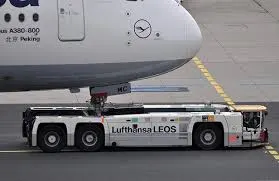
Fig15: Towing of airplanes.
04.
How an aircraft is pushed to runway when its ready to take off?
Following steps are involved while preparing the airplane for the take off:
The pilot parks the aircraft in exactly the right place. Usually with the help of an automatic system, but occasionally guided by a marshaller waving two paddles or wands. Dozens of handling personnel are already standing by to perform a whole range of tasks simultaneously.As soon as the aircraft is stationary and the engines are switched off, the first priority is to disembark the passengers as quickly as possible. The apron handler places chocks in front of the wheels and connects the ground power. Meanwhile, the passenger bridge manoeuvres up to the door and a belt loader rolls up to the cargo hold. Luggage is unloaded and transferred to the terminal on baggage carts.Refuelling begins, usually from a hydrant at the stand. A hose is attached to this from a special vehicle called a dispenser, with the other side connected to the fuel tank in the wing.
Now it is time to service the aircraft. The caterer loads new meals and takes away the food waste and used cutlery and crockery. Other activities include draining the lavatories, replacing the headrest covers, removing rubbish and distributing fresh blankets and in-flight magazine.A specialist team – or sometimes the crew themselves – cleans the cabin so that the new passengers board a pristine aircraft.Meanwhile, specialists from the airline conduct a technical check to make sure that the engines, wings, control surfaces, landing gear, instruments, doors and other equipment are in full working order.The aircraft is now ready for baggage to be loaded for the next flight. This is a quick process, on average taking only 10-15 minutes. A little later the passengers start boarding. As soon as they are all in their seats, the door is closed and the pilot informs air-traffic control that the flight is ready for departure.The apron handler removes the chocks. A so-called pushback truck reverses the aircraft into taxiing position, pushing it with a towbar attached to the nose-wheel strut. Or, in the most modern versions, by actually lifting the wheel. That speeds up coupling and decoupling.The aircraft taxis to the runway to depart at the agreed time.The pilot waits for permission to take off from air-traffic control. This is possible once the departure route is clear. As soon as the go-ahead is received, the plane takes to the air at full power.
05.
Learn about take off power, tyre design, rolling resistance, tyre pressure, brake forces when landing.
Take off power:
Takeoff is the phase of flight in which an aerospace vehicle leaves the ground and becomes airborne. For aircraft traveling vertically, this is known as liftoff. The amount of power that an engine is allowed to produce for a limited period of time for takeoff. The use of takeoff power is usually limited to 5 min forreciprocating engines and up to 2½ min for gas turbine engines. This may not always be the case.
Tyre design:
Why are tyres important in aircraft?
When it comes to safety, tyres are one of the most important components of aircraft. They help to absorb the shock of landing and provide cushioning. It also provides the necessary traction for braking and stopping of an aircraft.
An aircraft tyre is designed to withstand extremely heavy loads while landing, take off, taxing, and parking. The number of wheels required for aircraft increases with the weight of the aircraft, as the weight of the aeroplane needs to be distributed more evenly.
A Boeing 737NG & 737MAX uses 6 wheels, Boeing 787 uses 10 wheels, Boeing 777 uses 14 wheels and Airbus A380 uses 22 wheels. Aircraft tyres work under extreme conditions, carrying up to 340 tons and accelerating at over 250 km/hour at takeoff, in addition to enduring varied environmental stress when in flight and taxiing.
Design and Construction of aircraft tyre:
Carcass plies are used to form the tire. They are sometimes called casing plies. An aircraft tyre is constructed for the purpose it serves.
They support the weight of an aircraft while it is on the ground.It also provides the necessary traction for braking and stopping of an aeroplane.Tyre also helps to absorb the shock of landing and provide cushioning the roughness of takeoff, roll-out, and taxi operations.
Unlike an automobile or truck tyre, it does not have to carry a load for a long period of continuous operation. However, an aircraft tyre absorbs the high impact loads of landing, and also it’s operating at high speeds for a short time when required.
Fig16: Design of airplane's tyre.
Let’s go through some technical aspects of the tyre.
Retreading – Retreading is methods of restoring a worn tyre by renewing the tread area or by renewing the tread area plus one or both sidewalls. Repairs are included in the tyre retreading process.
Load Rating – Load rating is the maximum permissible load at a specified inflation pressure.
Ply Rating – Ply Rating is used to identify the maximum recommended load rating and inflation pressure for a specified tyre. It is an index of tyre strength.
Speed Rating – The speed rating is the maximum takeoff speed to which the tyre has been tested.
Skid Depth – Skid depth is the distance between the tread surface and the deepest groove as measured in the mould.
Aircraft tyres must have an approved speed and load rating and have sufficient clearance when retracted through landing gear to allow for tyre growth. Tyre growth is the increase in the size of the tyre due to centrifugal forces at high speed.
Aircraft tyre may be tube-type or tubeless:
Tubeless tyres are more advantageous over tube-type. There is no longer the use of tube-type tyre in recent aviation. Nowadays all airliners are using tubeless tyres. Tubeless that are meant to be used without a tube has the word TUBELESS on the sidewall of the tyre.
Aircraft tyre may be radial or bias:
Almost all airliners are using Radial tyre. Bias is an older design, and it’s mainly used for road vehicles. Radial tyres have the word RADIAL on the sidewall. Radial tires are more expensive than bias-ply tyres. Radial tires are in demand because of their lower life cycle cost and long term value.
Are aviation tyres are conductive?
Yes, Today’s tyres are conductive. Aircraft tyres are manufactured with tread rubber with conducting compounds to permit earthing of static charges.
In early days when tyres were not sufficiently conductive, aircraft used to have a conductive strip hanging down from the axle of the landing gear. Upon landing, this strip would be the first part of the aircraft to touch the earth. This discharges any static electricity accumulated on the outer surfaces of the aircraft. Now you don’t see them anymore.
What is the purpose of Chines in aviation tyre:
Fig17: Chine in airplane tyre.
Chines are also called deflectors. Chine tyre used on the nose wheel of aircraft, specially fuselage-mounted jet engines. It diverts runway water away from the engine inlets.
Chines are circumferential protrusions that are moulded into the sidewall of nose tyres that deflect water sideways to help reduce excess water ingestion into the engines. Tyres may have chines on one or both sides, depending on the number of nose tyres on the aircraft.
Aircraft tyre standards:
Each tyre manufacturer produces their own designs of the tyre with different tread patterns, wear patterns, wear limits etc, and in some cases, different names for the same part of the tyre. But all tyres must meet the approved standards before being accepted by the FAA or CAA.
All commercial aircraft tyres approved under FAA Requirement Technical Standard Order (TSO) C62. A TSO is a minimum performance standard for specified materials, parts, and appliances used on civil aircraft.
Rolling Resistance:
The friction between aircraft and runway will be proportional to the normal force exerted by the aircraft on the runway.
`F=mu(W-L)`
The normal force will be the difference between Weight of aircraft and Lift, the friction coefficient will be typically of a magnitude of 0.02 for a standard tarmac runway.
Tyre Pressure:
The key to their remarkable durability is maximizing the air pressure, says Lee Bartholomew, lead test engineer for Michelin Aircraft Tires. The high-flying rubber is typically inflated to 200 psi, roughly six times what you put in an automobile tire, and the tires on an F-16 fighter are pumped to 320 psi. “It's really pressurized air that's so strong,” he says.
Thousands of airplane tires are inflated during routine maintenance each day around the world. On occasion, a mechanic or other ground service employee has been severely or fatally injured in an explosion caused by use of unregulated pressure from an air or nitrogen tank.
Causes of Wheel/Tire Assembly Explosions:
Airplane wheel/tire assemblies are inflated to high pressures (many in excess of 200 psi). In addition, the pressure in the bottle or tire-servicing cart can be as high as 3,000 psi. As a result, when the high-pressure bottle is connected directly to the wheel without a regulator, the wheel is suddenly subjected to the high pressure, which can exceed the design limits for the wheel and the wheel tie bolts. Consequently, the wheel, the wheel tie bolts, or both experience an explosive fracture and become projectiles.
In addition, the wheels were not equipped with an overinflation pressure relief (OPR) valve. It is included in many wheel assemblies to limit the pressure in the wheel/tire assembly. However, certain older wheels do not include this valve. If the pressure in the wheel exceeds a predetermined value, a disk in the OPR valve will rupture, allowing the gas to escape, thus reducing the pressure in the wheel before it can fracture. After the disk ruptures, the gas in the wheel will exit through the OPR valve. The valve is designed so that when the disk ruptures, the gas will exit from the wheel faster than it can be supplied from the pressure source.
In addition, Boeing has received reports of three confirmed cases and other suspected cases in which a wheel/tire assembly exploded when the oxygen in air-filled tires combined with volatile gases given off by a severely overheated tire. In one case, the tire became overheated as a result of a dragging brake, and the wheel/tire assembly exploded when it reached the auto-ignition temperature. In another case, a wheel/tire assembly explosion in the wheel well during flight was suspected in the catastrophic loss of one airplane. A similar explosion caused severe damage to two others.
Preventive Measures:
Using a regulator.Using inflation cages.Following established maintenance manual procedures.Outfitting all servicing equipment with regulators.Inflating wheel/tire assemblies only with nitrogen.
Outfitting all servicing equipment with regulators:Operators should ensure that tire-servicing equipment is properly equipped with regulators to preclude an over-pressure condition.
Inflating wheel/tire assemblies only with nitrogen:Tires must be initially inflated only with nitrogen. However, air can be used to top off a low-pressure tire if the airplane is in a location where nitrogen is not readily available, provided that the oxygen content does not exceed 5 percent by volume.
Braking forces on landing:
First, some requirement assumptions . . .
Landing weight = takeoff weight in case of aborted takeoff = 1500 lbf
Landing distance = 500 ft
Speed (assume aborted takeoff) = 60 kt (100 ft/sec)
We will use Newton’s second law to determine force due to deceleration:
Deceleration: from simple kinematics, acceleration = velocity^2 / distance
= (100 ft/s)^2 / 500 ft = 20 ft / s^2
Mass of aircraft = (weight) / g = 1500/32.2 = 46.58 lbf*s^2 / ft
Force = mass * acceleration (46.58 lbf*s^2/ft) * (20 ft / s^2) = 931.6 lbf
So in this example, the braking (deceleration) force is 931.6 lbf
Notice that in the English foot-pound-second units the mass unit ispound-second^2 per foot, called a slug in order for the units to work out.
In the SI, the mass units would be kg while the force unit would be N (newton).
06. A.
With necessary assumptions, calculate the force and power required to push / pull an aircraft by a towing vehicle.
Pulling force required to push/pull an airplane by a towing vehicle is given by the following relation:
Pulling force = Drag force + Friction force + Rolling resistance force
Drag force:
Drag force Fd in Newtons acting on the body (tow) is given as:
`Fd = frac{1}{2}*C*rho*A*v^2`
The force to move an airplane on an absolute flat surface at constant low speed is equal to the rolling resistance between the plane and the tarmac.
The rolling resistance for the air plane can be calculated as
`Fr= cr*mr*ag`
where
Fr = rolling resistance (N)
cr = rolling resistance coefficient
mr = rolling mass (kg)
ag = acceleration of gravity (9.81 m/s2)
Frictional force:
`Ff= cf*mf*ag`
Ff = frictional force (N)
cf = frictional coefficient
mf = frictional mass (kg)
ag = acceleration of gravity (9.81 m/s2)
06. B.
Develop the model for the calculated force and power using Simulink.
Simulink model:
Simulink model for calculation of pull forces required by the towing vehicle for an airplane.
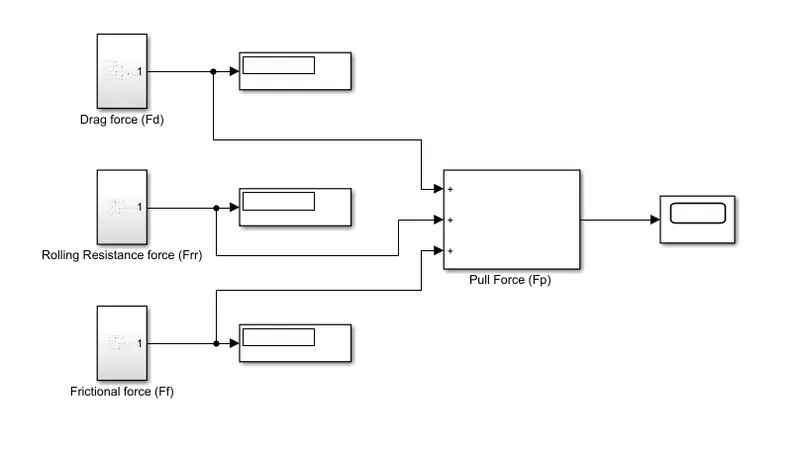
Fig18: Simulink model for pull forces required to tow an airplane.
Following parameters were assumed to study the model:
Case:I
Coefficient of drag: 0.1
Density of air: 1.225 kg/m^3
Area: 50 m^2
speed of vehicle: 5 m/s
Coefficient of rolling resistance: 0.02
Mass of rolling resistance: 9000 kgs
Coefficient of frictional resistance: 0.01
Mass of frictional resistance: 9000 kgs
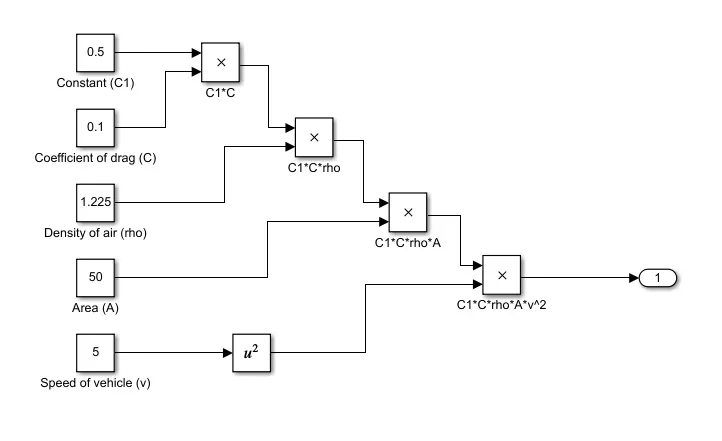
Fig19: Sub-block: Drag forces.
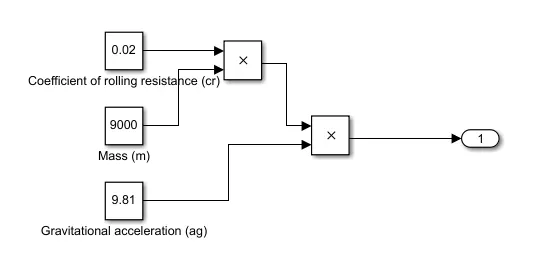
Fig20: Sub-block: Rolling resistance forces.
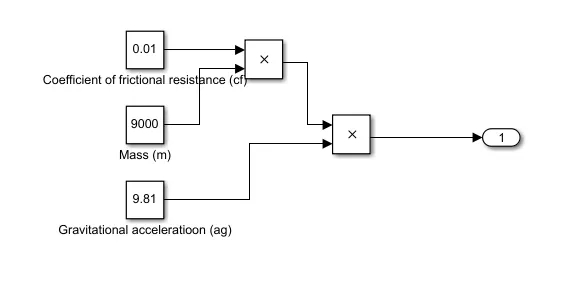
Fig21: Sub-block: Frictional forces.
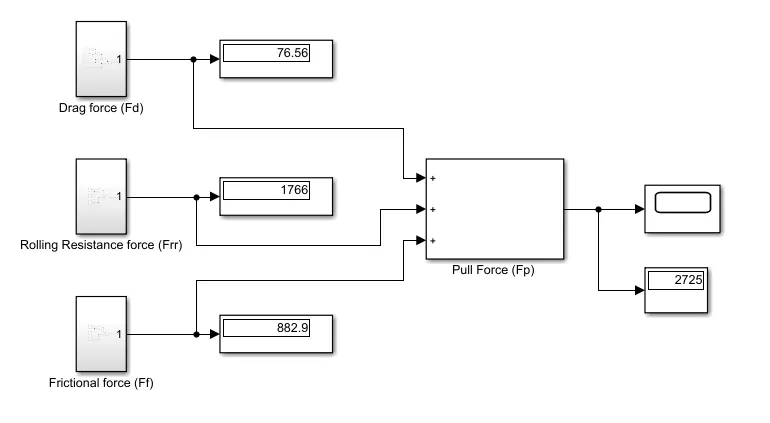
Fig22: Simulink model-Results.
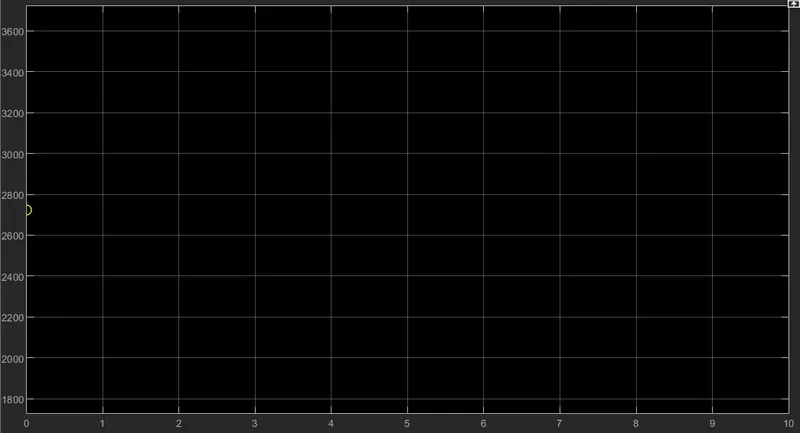
Fig23: Simulink model-Plot.
Pull force required is 2725 N.
Case:II
Coefficient of drag: 0.1
Density of air: 1.225 kg/m^3
Area: 100 m^2
speed of vehicle: 5 m/s
Coefficient of rolling resistance: 0.02
Mass of rolling resistance: 25000 kgs
Coefficient of frictional resistance: 0.01
Mass of frictional resistance: 25000 kgs
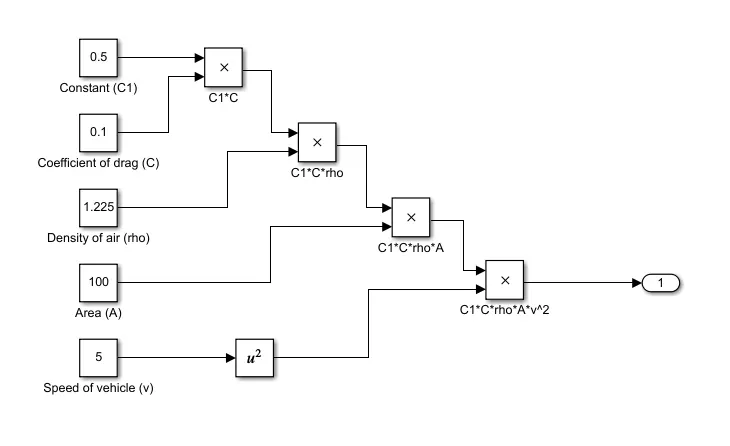
Fig24: Sub-block: Drag forces.
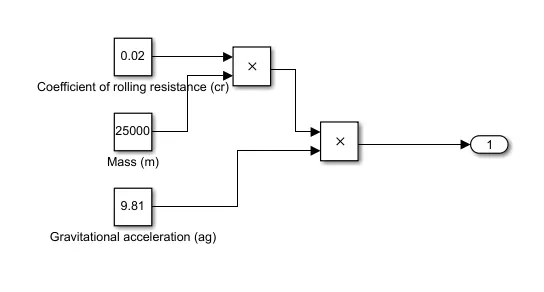
Fig25: Sub-block: Rolling resistance forces.
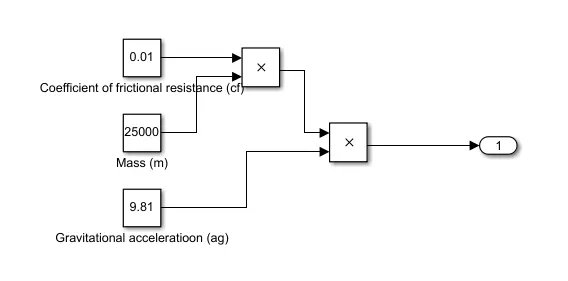
Fig26: Sub-block: Frictional forces.
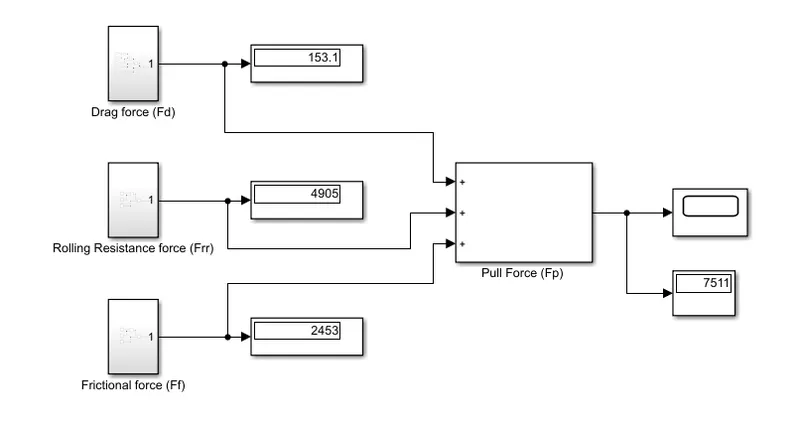
Fig27: Simulink model-Results.
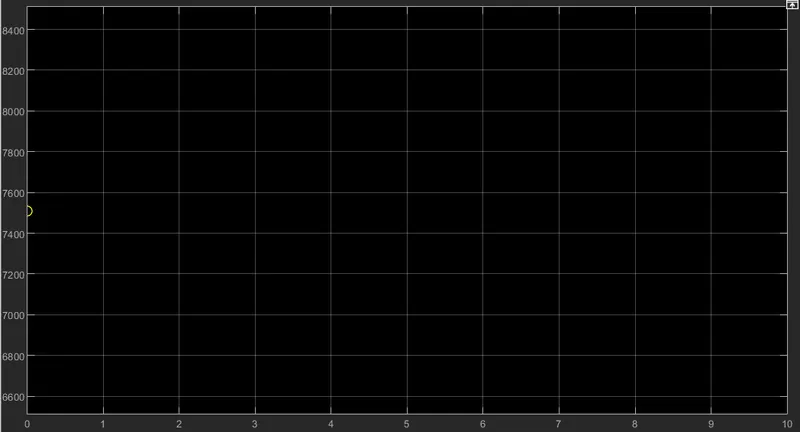
Fig28: Simulink model-Plot.
Pull force required is 7511 N.
There from the study of both cases we can conclude that the pull force required to pull an airplane is directly proportional to the weight and area of the airplane.
07. A.
Design an electric powertrain with type of motor, it’s power rating, and energy requirement to fulfill aircraft towing application in Simulink. Estimate the duty cycle range to control the aircraft speed from zero to highest. Make all required assumptions. Prepare a table of assumed parameters. Draw a block diagram of powertrain.
Following are the parameters assumed to study the pull force required to tow an airplane in case II, same case we will study further to design the powertrain for towing vehicle:
Coefficient of drag: 0.1
Density of air: 1.225 kg/m^3
Area: 100 m^2
speed of vehicle: 5 m/s
Coefficient of rolling resistance: 0.02
Mass of rolling resistance: 25000 kgs
Coefficient of frictional resistance: 0.01
Mass of frictional resistance: 25000 kgs
(Note: 25000 kgs is the collective weight of the towing vehicle and the airplane.)
Towing operation time: 20 mins
Battery rating: 96V
Current required: 200A
Pull force required: 7511 N.
Aircrafts use electric drives for ground operations in order to save the jet fuel consumptions.
There are two alternatives for an electric motor one is PMDC motor (Permanent Magnet DC motor) and BLDC motor (Brushless DC motor). For this case we will select the PMDC motor as it is widely used in the electric applications.
To calculate the power rating of the DC motor chosen.
The power required for a towing vehicle to pull an airplane is:
P = F*V
P = 7511*5
P = 37555 W
P = 37.555 KW
Now let's calculate the energy required for towing:
Energy for towing (KW-h) = (Power for towing)*(Time for towing)
Energy for towing = 37.555*(20/60)
Energy for towing = 12.52 KW-h
To calculate the duty cycle for the towing operation. So we will have to use the standard lithium ion battery pack for this operation. Assuming battery of voltage 96V and current required 200A.
Input power = Voltage*Current
Input power = 96*200
Input power = 19200 W
Input power = 19.20 KW
As Duty cycle is defined: Power output/Power input
Therefoe,
Duty cycle for towing operation is (d):
d = 12.52/19.20
d = 65 %
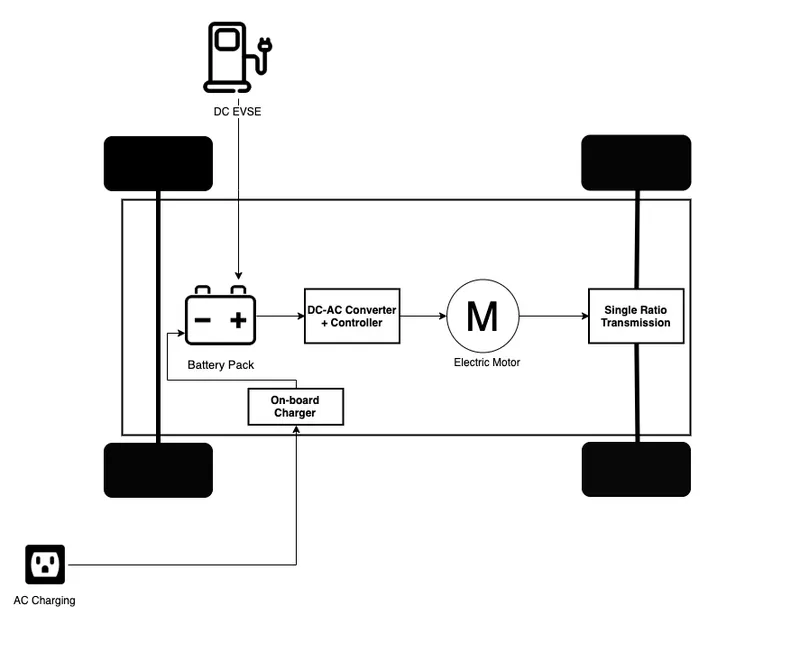
Fig29: Block diagram for electric powertrain.
Simulink model: Electric powertrain in Towing vehicle.
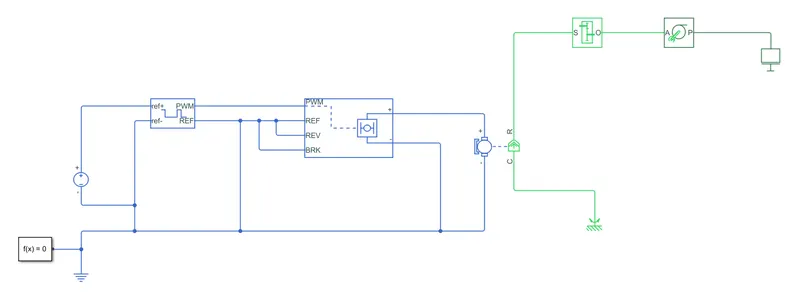
Fig30: Simulink model electric powertrain in towing vehicle.
Conclusion:
In this study we learnt about the different types of aircrafts and thier weights. We also learn the concept of air speed and ground speed. During study we also get to know about application of engine power in ground movement of airplanes. Design specifications and applicattion of airplane tyres are studied. Study and developement of simulink model for calculating the forces and power required to pull/push an aircraft by a towing vehicle are also practiced. We also designed the powertrain for towing vehicle applications including power rating and energy requirements for the same.