Project-1: Powertrain for aircraft in runways
PART-A:
QUESTION-1: Search and list out the total weight of various types of aircrafts.
ANSWER:-
Types Of Aircrafts In The World:
the most common classification, categories, and subcategories under the aircrafts, let us see different types of aircrafts and a list of all aircraft with pictures.
1. Amphibious:
Amphibious aircraft, otherwise also popularly known as amphibian is a multipurpose aircraft which can work, take off and land both water and ground. They are used as both seaplanes or flying boats, or also airplanes. In this aircraft, the engine is either placed in front, or even above the wing, that is most commonly found in floatplanes, On the other hand, the modern and other amphibious aircraft have engine and propeller placed above the wings. The size of amphibians differs as per the purpose; there are military amphibians, leisure purpose seaplanes, and civil amphibious aircraft.the largest flying boats with a 53.5 t (118,000 lb) MTOW.
2. Helicopters:
Helicopter aircraft, also known as a chopper, is commonly known to most of us and belongs to rotorcrafts. Horizontally spinning rotors help and aid the helicopter to lift and thrust. These aircraft have the advantage of taking vertically, horizontally, and fly both backward and forward or laterally. Unlike the other fixed-wing aircraft, these benefit from taking off and land at several places and flying even in congested areas. The engine depends on the size, purpose, and function of the chopper. Today, the helicopter is mostly used for military purposes, cargo, construction, rescue, tourism, aerial observation, and the government. The size of the chopper hence mostly depends on the usage.
- Ultra-Lights: Helicopters weighing up to 254 lb / 1,15 kg Empty Weight
- Lights: Helicopters weighing up to 3,500 lb / 1,590 kg Maximum Gross Weight
- Intermediates: Helicopters weighing from 3,500 to 7,000 lb / 1,590 kg to 3,180 kg Maximum Gross Weight
- Mediums: Helicopters weighing from 7,000 to 12,500 lb / 3,1880 kg to 5,670 kg Maximum Gross Weight
- Heavies: Helicopters weighing over 12,500 lb / 5,670 kg Maximum Gross Weight
3. Multi-Engine Piston:
As the name suggests, Multiple or Multi-engine piston aircraft has more than one single-engine, unlike the other categories and types of aircraft. These multi-engine pistons are known to have a second power source, which is greatly helpful during another engine’s failure. Due to this multiple power and engine facility, the aircraft-quality, capacity, speed, and climb rate is much higher than the usual air crafts. In most cases, this kind of aircraft is used by air service for their services and duties.
4. Biplanes:
Biplanes come under the category of fixed-wing aircraft. In this category, two wings come one above each other on both sides. This kind of plane is among the first aircraft to discover fixed-wing planes. The biplanes have lower weight but with excellent stiffness and efficiency. The biplanes are fitted with reciprocating engines. Only two adults, in most cases, can do these. In most cases, biplanes are spotted and used for army and military purposes of specific countries. These aircraft were among the most commonly used ones during world war times.as a tank. At an empty weight of almost 2000 lbs, a Stearman is almost twice the empty weight of its British counterpart, the Tiger Moth, which weighs in at only 1200 lbs. A more modern trainers such as the Cessna 152 weighs a mere 1100 lbs
5. Balloons:
The balloon type aircraft are standard aircrafts most of us are aware of and are mostly spotted during tourist activities. It comes under a kind of aircraft that floats in the sky and is much different from other airships and aircraft categories. While most confuse them with airships, the balloons are distinct in that they do not possess any engine and cannot change their direction, except for up and down. The balloon’s top is called an envelope, and the bottom part is a basket where people can sit. The most common ones in the category of balloons are hot air balloons.weigh about 2 1/2 tons.
6. Gliders:
Gliders come again under the category of fixed-wing aircraft. The types of gliders aircraft are used through air reaction against lifting surfaces and mostly do not use any engine. Although small engines may be used as required (in cases like a motor glider), most glider aircraft are efficient for self-take without engines. A wheeled undercarriage helps in take-off or landing. In the past, gliders are used for military purposes and wars; however, nowadays, we even see them in tourist activities and entertainment or leisure. The most common types in this category include hand gliders and paragliders. Most gliders are small in size and can fit a maximum of two people.
| Maximum gross weight | 1,100 lb |
| Empty weight | 600 lb |
7. Gyroplanes:
Gyroplanes, also known as autogyro or gyrocopter, is a rotorcraft aircraft category that uses rotor machines to lift. They are similar to helicopter in appearance, although a bit narrow, and have an engine-driven propeller. The air flows help the gyroplanes lift upwards, and the rotor self-propels as per the way air flows through it. While gyroplanes or autogyros are mostly used for military and war purposes during the 20th century, nowadays, they are spotted in Olympics and police departments at some states.The aircraft has an empty weight of 245 kg (540 lb) and a gross weight of 450 kg (990 lb)
8. Parachutes:
Parachutes are the most common types we often hear and see. They are slow-moving air flowing craft that helps move through, creating drag to land. They are made through lightweight yet stable and fitting fabric such as nylon or silk. Most parachutes may be in the shapes of round, dome, or inverted dome. Although most parachutes are spotted during leisure activities and entertainment, they are also used and deployed by state and operations during expeditions to ice areas such as polar ends. Only one or two maximum can fit in one parachute.
9. Single Engine Piston Aircraft:
Like the multi-engine piston plane, we have seen earlier. This aircraft uses only one engine. These aircraft are used for shorter distance works and not for heavy works. They can access smaller runways, takes less space, and has lesser climb and speed. Most single-engine pistons can fit only four to six people, depending on the plane and size.
10. Tricycle Gear Aircraft:
The tricycle gear aircraft is a kind of plane that has tricycle fashion fixed landing gear. The arrangement has a nose wheel in the front and two more in the main wheels. These are lightweight and are known to have better visibility of the ground, and is very easy to take off and land. The aircraft also has significantly less drag and allows the application of a full brake. They are used for lighter and quick uses, given the advantages of easy runs.
11. Business Jets:
Business or private jet aircraft are known to be among the luxurious or unique aircraft to transport and fly a small group of people, even individuals. While they are costly due to their design, plush appearance, and very sophisticated looks, the business jets are used by different classes of people – from government officials to armed forces for special operations to companies and private ownership. While the speed, engine, and other manufacturing are similar to airplanes, the size differs from lightweight or small jets to mid-sized ones to long business jets. The heavy and long jets can accommodate 16 to 18 people, whereas the mid-size (depending on the capacity) can accommodate up to 12 or 10 people. The smaller types of business aircraft are only for four to six individuals.
12. Taildraggers:
Taildraggers, also known as tail-wheel type gear draggers, consists of two main wheels at the forward size and a small-sized wheel to skid near the tail area. These are the conventional aircraft variety which uses such gear draggers instead of the modern tricycle propeller aircraft. These are the much lighter size and weight aircraft and can even be operated in skis. However, they have very poor visibility on the ground and are difficult during heavy wind conditions.
13. Tiltrotors:
Tiltrotors use powered rotors for propulsion and to generate lift. These powered rotors, also called proprotors, are added to rotating shafts of a fixed-wing. These use transverse rotor design and combines the vertical lift capability of a helicopter. The rotors, similar to the chopper, helps lift this aircraft. However, the propulsion is much more efficient and can avoid retreating blade stall, commonly seen in choppers. The speed and range are heavier and higher than a normal helicopter and almost near a fixed-wing aircraft. The altitude capability of tiltrotors is higher than helicopters. weight about 52,600 lbs. (23,859 kg)
14. Light-Sport Aircraft:
The light-sport aircraft, also known as LSA, differs from country to country. However, they are into the new category of small and very lightweight aircraft. These are super simpler to fly. Although they may be a bit heavier than ultralight aircraft, they are sophisticated, looks grand. These are two-seater versions and are much affordable too.1,320 pounds maximum takeoff weight for aircraft not intended for operation on water; or. 1,430 pounds maximum takeoff weight for aircraft intended for operation on water.
15. Turboprops:
As the name suggests, turboprops or turboprop aircraft have gas turbine engines connected to the gears to turn the propeller to move them through and around the air. They burn much lesser fuels and have lesser operating costs too. These types of turboprops are larger than piston aircraft and can carry more passengers. These also fly high and can go to an altitude of 35000 feet. However, they are slower in speed than jet planes. The turboprops size varies according to the need and can fit a small set of people or up to eight or ten at maximum.
16. Floatplanes:
The floatplanes are similar to seaplanes, which floats on water through the floats mounted under the fuselage. These mounts are added instead of the undercarriage, where wheels are placed in other planes. These do not have landing gear, which makes it possible to land, in which case it becomes similar to amphibious aircraft (as seen earlier). Seaplanes or floatplanes are heavily used during world war times for military operations; however, now is witnessed more of a pleasure flight in many countries.
17. Fighter jets:
Fighter jets, also known as a fighter or fighter aircraft, is military particular fixed-wing aircraft. They are designed only to use for combatting air to air fights against other aircraft. They have very high speed, manufactured for use against air attacks only. However, few fighters have a second capacity to use for ground attacks, too, in which case they are known as fighter bombers. There are several categories in the fighters: light fighter, heavy fighter, interceptor, night fighter, all-weather fighter, and more. With the help of technological advances and breakthroughs, today’s fighters have numerous other capacities and innovations such as data transmissions, sensors, secure cockpits, high bandwidth, and more
| Length | 63.8 ft (19.45 m) |
|---|---|
| Wing Span | 42.8 ft (13.05 m) |
| Propulsion | Two P&W F100 or two GE F110 turbofan engines in 29,000 lb (13,154 kg) thrust class with afterburning |
| Weight | 45,000 lb (20, 411 kg) class 81,000 lb (36, 700 kg) max gross takeoff |
| Speed | 1,875 mph (3,017 kph) |
18. Cargo planes:
Cargo aircraft or cargo planes are also known as freight aircraft, airlifter, or cargo jets. These are the fixed-wing classification of aircraft known only for carriage or cargo instead of individual passengers. These cargos are specially built only for lifting carriages and do not have amenities for fitting people or passengers. They have wide doors and facilities to protect and provide shipment. Unlike usual passenger jets, the high-wings presence allows to preserve and make the cargo sit near the ground. The number of wheels is also more in cargo jets. These cargo aircraft can be used both for civil purposes as well as military usage.The Antonov AN 124-100 - the world's largest air cargo carrier - is 70 metres long and nearly 75 metres wide. The plane, which weighs around 1.8 lakh kilograms, usually has six crew members and two load masters
QUESTION-2:-Is there any difference between ground speed and air speed?
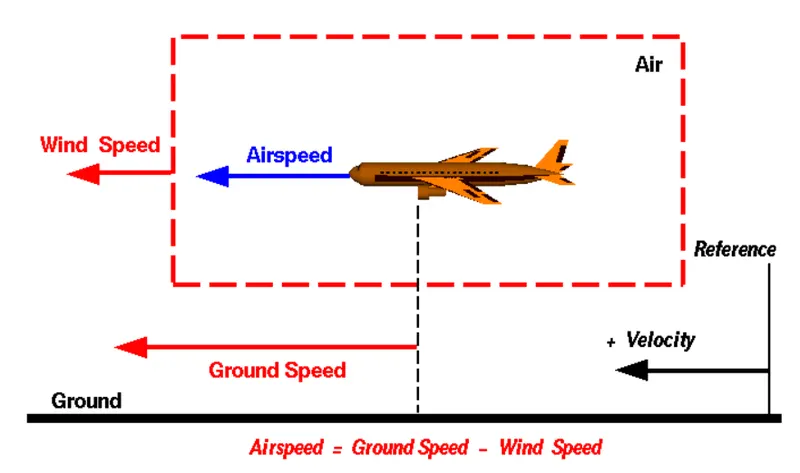
ANSWER:- ground speed is how fast an airplane is traveling, relative to a fixed point on the ground. Think of it this way: Ground speed is how fast an airplane's shadow would move across the land. If there's a strong wind pushing an aircraft, that's reflected in the ground speed.
Airspeed, in contrast, is how fast an airplane is really flying strictly under its own power, which is calculated by subtracting the wind speed from the ground speed.
QUESTION-3:- Why is it not recommended to use aircraft engine power to move it on the ground at Airport?
ANSWER:- when aircraft engine is started the propellers start rotating & due to its high power dust in floor gets pulls towards it which can damage the propellers. therefore a tug is use to move the aircraft in airport, towing & pushback reduce lots of fuel consumption & noise is also controlled. the propellers will cause wind disturbance around the aircraft nearby to it.
QUESTION-4:- How an aircraft is pushed to runway when its ready to take off?
ANSWER:- Taxi or pushback is a procedure use when aircraft gets ready before take off. airplane uses taxiway to taxi from one place to another in airport, a vehicle (tug ) is use to push backwards from airport gate by external power . a tug is a vehicle having heavy weight with high torque, use for moving aircraft push or pull from terminal to runway.
QUESTION-5:- Learn about take off power, tyre design, rolling resistance, tyre pressure, brake forces when landing.
ANSWER:- takeoffpower- The amount of power that an engine is allowed to produce for a limited period of time for takeoff. The use of takeoff power is usually limited to 5 min for reciprocating engines and up to 2½ min for gas turbine engines. This may not always be the case. Specifically, with respect to reciprocating engines, it is the brake horsepower developed under standard, sea-level conditions and under the maximum conditions of the crankshaft rotational speed and the engine manifold pressure approved for the normal takeoff. It is limited in continuous use to the period of time shown in the approved engine specifications. With respect to gas turbine engines, it is the thrust developed under static conditions at a specified altitude and atmospheric conditions of the rotor shaft rotational speed and gas temperature approved for the normal takeoff. It is limited in continuous use to the period of time shown in the approved engine specifications.
tyre design-
Carcass plies are used to form the tire. They are sometimes called casing plies. An aircraft tyre is constructed for the purpose it serves.
- They support the weight of an aircraft while it is on the ground.
- It also provides the necessary traction for braking and stopping of an aeroplane.
- Tyre also helps to absorb the shock of landing and provide cushioning the roughness of takeoff, roll-out, and taxi operations.
Unlike an automobile or truck tyre, it does not have to carry a load for a long period of continuous operation. However, an aircraft tyre absorbs the high impact loads of landing, and also it’s operating at high speeds for a short time when required.
Retreading – Retreading is methods of restoring a worn tyre by renewing the tread area or by renewing the tread area plus one or both sidewalls. Repairs are included in the tyre retreading process.
Load Rating – Load rating is the maximum permissible load at a specified inflation pressure.
Ply Rating – Ply Rating is used to identify the maximum recommended load rating and inflation pressure for a specified tyre. It is an index of tyre strength.
Speed Rating – The speed rating is the maximum takeoff speed to which the tyre has been tested.
Skid Depth – Skid depth is the distance between the tread surface and the deepest groove as measured in the mould.
Aircraft tyres must have an approved speed and load rating and have sufficient clearance when retracted through landing gear to allow for tyre growth. Tyre growth is the increase in the size of the tyre due to centrifugal forces at high speed.
Aircraft tyres may be Tube-type or Tubeless
Tubeless tyres are more advantageous over tube-type. There is no loger the use of tube-type tyre in recent aviation. Nowadays all airliners are using tubeless tyres. Tubeless that are meant to be used without a tube has the word TUBELESS on the sidewall of the tyre.
Aircraft tyres may be Radial or Bias
Almost all airliners are using Radial tyre. Bias is an older design, and it’s mainly used for road vehicles. Radial tyres have the word RADIAL on the sidewall. Radial tires are more expensive than bias-ply tyres. Radial tires are in demand because of their lower life cycle cost and long term value.
Are aviation tyres are conductive?
Yes, Today’s tyres are conductive. Aircraft tyres are manufactured with tread rubber with conducting compounds to permit earthing of static charges.
In early days when tyres were not sufficiently conductive, aircraft used to have a conductive strip hanging down from the axle of the landing gear. Upon landing, this strip would be the first part of the aircraft to touch the earth. This discharges any static electricity accumulated on the outer surfaces of the aircraft. Now you don’t see them anymore.
What is the purpose of Chines in aviation tyre
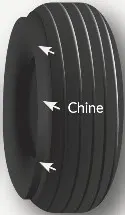
Chines are also called deflectors. Chine tyre used on the nose wheel of aircraft, specially fuselage-mounted jet engines. It diverts runway water away from the engine inlets.
Chines are circumferential protrusions that are moulded into the sidewall of nose tyres that deflect water sideways to help reduce excess water ingestion into the engines. Tyres may have chines on one or both sides, depending on the number of nose tyres on the aircraft.
Aircraft Tyre Standards
Each tyre manufacturer produces their own designs of the tyre with different tread patterns, wear patterns, wear limits etc, and in some cases, different names for the same part of the tyre. But all tyres must meet the approved standards before being accepted by the FAA or CAA.
All commercial aircraft tyres approved under FAA Requirement Technical Standard Order (TSO) C62. A TSO is a minimum performance standard for specified materials, parts, and appliances used on civil aircraft.
rolling resistance-
Rolling resistance, sometimes called rolling friction or rolling drag, is the force resisting the motion when a body (such as a ball, tire, or wheel) rolls on a surface. It is mainly caused by non-elastic effects; that is, not all the energy needed for deformation (or movement) of the wheel, roadbed, etc., is recovered when the pressure is removed. Two forms of this are hysteresis losses and permanent (plastic) deformation of the object or the surface (e.g. soil). Note that the slippage between the wheel and the surface also results in energy dissipation. Although some researchers have included this term in rolling resistance, some suggest that this dissipation term should be treated separately from rolling resistance because it is due to the applied torque to the wheel and the resultant slip between the wheel and ground, which is called slip loss or slip resistance.
tyre pressure-
Airplane wheel/tire assemblies are inflated to high pressures (many in excess of 200 psi). In addition, the pressure in the bottle or tire-servicing cart can be as high as 3,000 psi. As a result, when the high-pressure bottle is connected directly to the wheel without a regulator, the wheel is suddenly subjected to the high pressure, which can exceed the design limits for the wheel and the wheel tie bolts. Consequently, the wheel, the wheel tie bolts, or both experience an explosive fracture and become projectiles.
brake forces when landing-
The brake system on the 787 Dreamliner is controlled by the pilots pressing the tops of the rudder pedals under their feet, demanding the rate of braking which they require. This sends an electronic signal to the Left and Right Brake System Control Units (BSCUs).
These then send signals to the four Electronic Brake Actuator Controllers (EBAC) which control the rate of braking on the wheels. Each wheel has four Electric Brake Actuators (EBA), a kind of piston which presses against the carbon brake discs.

The brake disks themselves are made up of two parts. Firstly, there are the rotors. These are connected to the wheel by drive tabs (in the video below they are the black rectangles on the rotor disks). As these drive tabs are in contact with the inside of the wheel, they spin at the same speed. Depending on the brake manufacturer, there are either four or five of these rotors on each brake assembly.
The second part of the disks are the stators. These sit around each rotor and are fixed in place and thus don’t move. As the wheel turns, the rotors spin round inside the stators.
When the brakes are applied, the four EBAs apply pressure to the first stator. This in turn squeezes the stationary stators up against the spinning rotors and it’s this friction which slows the wheel down. https://www.youtube.com/watch?v=n0nXiQPwHE8
Anti-skid protection
When landing on slippery runways, there’s a chance that the wheels may start to skid as the brakes are applied. To stop this from happening and to maintain maximum effective braking, each wheel has anti-skid protection.
Using a variety of sources to determine the aircraft speed, the brake units know how fast the wheels should be spinning. If that speed drops significantly, it’s because the current brake pressure on that wheel is too great and the wheel is just skidding over the surface.
In this situation, the anti-skid system automatically reduces the braking on that wheel to a point where the skid stops before reapplying the pressure. All this is done in a fraction of a second.
Autobrake
Pressing on the brakes is pretty straight forward when taxiing in a straight line at low speed. However, when we’re landing in strong winds, it can be a little tricky. We need to use our feet on the rudder pedals to line the nose of the aircraft up with the runway centerline at the last moment. Then, whilst holding that position, slide our feet up to press the toe brakes. Really not very easy when moving at 160 mph.
To help us get the braking underway as soon as we touch down, we have the autobrake system.This provides automatic braking at a preselected rate as soon as the aircraft senses that it is on the ground. It also provides full braking pressure in the case of a rejected takeoff if the speed is above 85 knots (98 mph).
Brake temperature indication
With friction comes heat. As a result, each brake unit displays its temperature on the wheel synoptic page in the flight deck. Here, numerical values relating to brake temperature are shown next to each wheel. A value of 0-4.9 is in the normal range. When a temperature becomes 5.0 or above, an advisory message is displayed to the pilots.
Should the brakes become too hot, there’s a chance that the heat transferred to the wheels could cause the tires to explode. To stop this from happening, when a certain temperature is reached, fuse plugs in the tires melt. This allows the air to be released safely and slowly deflate the tires.
Parking brake
Every so often we need to engage the brakes and keep them on. This is particularly useful on long taxis to the runway and obviously when parked at the gate. The park brake is set by fully pressing down both toe brakes and pulling the parking brake lever up. With this set, we can then release the pressure from the pedals. To release, we just press the brake pedals again.
PART-B:
QUESTION-6: A) With necessary assumptions, calculate the force and power required to push / pull an aircraft by a towing vehicle.
ANSWER:- different forces involved while moving aircraft by tug
rolling resistance force of aircraft=Fr1
rolling resistance force of tug=Fr2
air drag force of aircraft=Fd1
air drag force of tug=Fd2
let,
mass of aircraft(m1)= 85000 kg (boieng 737-900)
mass of tug(m2)= 50000kg
coefficient of rolling resistance of aircraft(u1)= 0.02
coefficient of rolling resistance of tug(u2)= 0.03
drag coefficient of aircraft(Cd1)= 0.15
drag coefficient of tug(Cd2)= 0.7
frontal area of aircraft(A1)=20 M^2
frontal area of tug(A2)=4 M^2
towing speed (v)= 3M/sec
air density (ρ)= 1.25kg/M^3
gravitational accn. (g)= 9.81 M/sec^2
formulas,
rolling resistance force,Fr= u*m*g
drag force, Fd= 0.5*ρ*A*Cd*v^2
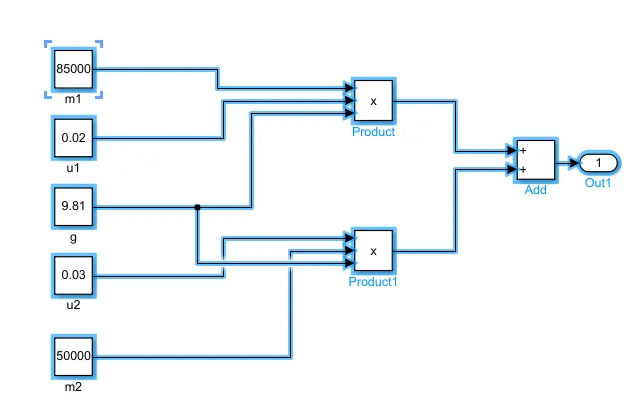
Fr1=u1*m1*g=0.02*85000*9.81= 16677 N
Fr2=u2*m2*g=0.03*50000*9.81= 14715 N
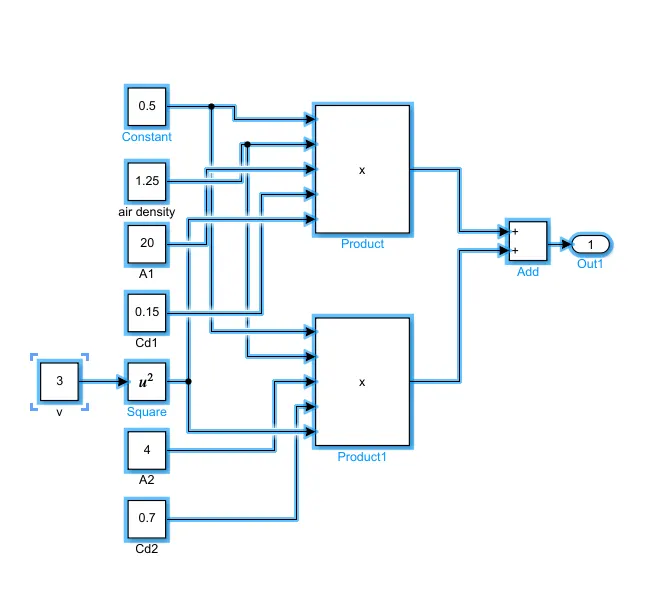
Fd1=0.5*1.25*20*0.15*3^2= 16.875 N
Fd1=0.5*1.25*4*0.7*3^2= 15.75 N
while towing the aircraft drag force is very low than rolling resistance force
total force= Fr1+Fr2+Fd1+Fd2= 16677+14715+16.875+15.75= 31.424 KN
power required= total force* towing velocity= 31.424* 3 = 94.272 KW
QUESTION-6: B) Develop the model for the calculated force and power using Simulink.
LINK:- https://drive.google.com/file/d/1maoTCxXSnp6AKRExyPGrt4TIKFA1MVGl/view?usp=sharing
Model:-
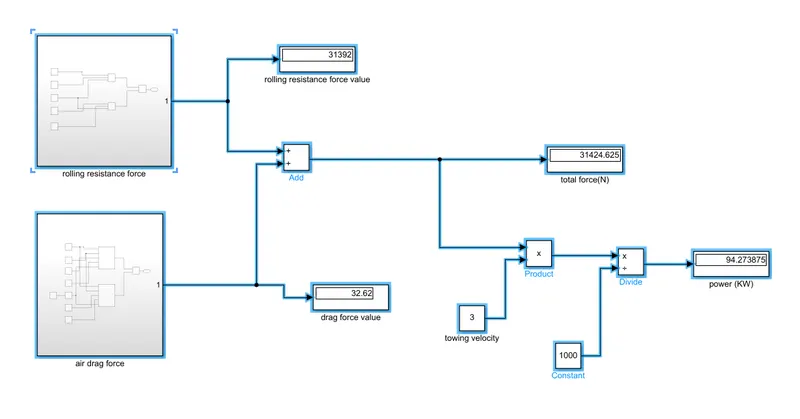
rolling resistance force subsystem-
air drag force subsystem-
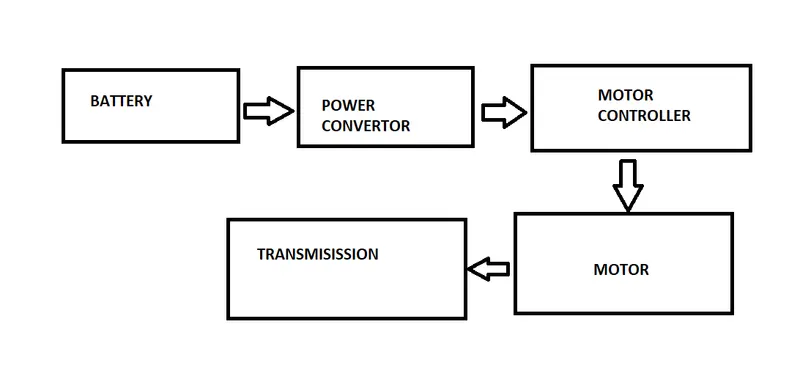
QUESTION-7: A)Design an electric powertrain with type of motor, it’s power rating, and energy requirement to fulfill aircraft towing application in Simulink. Estimate the duty cycle range to control the aircraft speed from zero to highest. Make all required assumptions. Prepare a table of assumed parameters. Draw a block diagram of powertrain.
ANSWER:- From above calculation we got total force to pull push the aircraft= 31.424KN & required power = 94.272 KW
assume radius of tyre in tug = 25 inch = 0.635 m
torque at wheels= total force * radius= 31.424 * 0.635= 19.954 KNm
let gear ratio = 8 & transmission efficiency(n)= 85%
motor torque= wheel torque/(gear ratio*n)= 19.954/(8*0.85) = 2.934 KNm
if motor consider 95% efficient, motor torque= 2.934/0.95= 3.088 KNm
power required by motor= motor power/ effficiencies = 94.272/(0.85*0.95) = 116.745 KW
assume towing operation runs for 30 min= 0.5hrs
total energy consume= 116.745 * 0.5= 58.372 KWh
a battery capacity must be heigher than we need, let battery be of 150KWh power rating, duty cycle range to control the speed from 0 to max. speed= 3m/s (we have already assumed)
D=required power/ rated power= 116.745/150= 0.778
the controller should be provide a duty cycle ranging from 0 to 77.8% to control the towing speed.
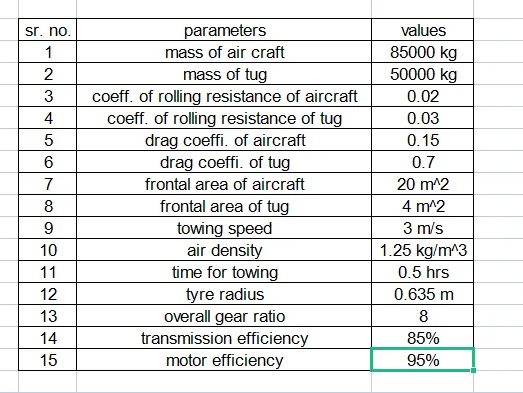
block diagram of powertrain