Project-1: Powertrain for aircraft in runways
1. Search and list out the total weight of various types of aircrafts.
Manufacture's empty weight(MEW)-
Also called Manufacturer's Weight Empty (MWE) or Licensed Empty Weight
It is the weight of the aircraft "as built" and includes the weight of the structure, power plant, furnishings, installations, systems and other equipment that are considered an integral part of an aircraft.This excludes any baggage, passengers, or usable fuel.
The different terms represent different weights or masses1. For each flight, the weights are taken into account for several reasons.
A brief description about these is below:
Zero fuel weight (ZFW)
This is the total weight of the airplane and all its contents (including unusable fuel), but excluding the total weight of the usable fuel on board.
As a flight progresses and fuel is consumed, the total weight of the airplane reduces, but the ZFW remains constant.
Maximum zero fuel weight (MZFW) is the maximum weight allowed before usable fuel and other specified usable agents (engine injection fluid, and other consumable propulsion agents) are loaded.
Operating empty weight-
(OEW) (Roughly equivalent to basic empty weight on light aircraft)
It is the basic weight of an aircraft including the crew, all fluids necessary for operation such as engine oil, engine coolant, water, unusable fuel and all operator items and equipment required for flight but excluding usable fuel and the payload.
Payload
It is the carrying capacity of an aircraft. It includes cargo, people, extra fuel. In the case of a commercial airliner, it may refer only to revenue-generating cargo or paying passengers.
Maximum take off weight-
This is the maximum weight at which the pilot of the aircraft is allowed to attempt to take off3
Regulated take off weight-
Depending on different factors (e.g. flap setting, altitude, air temperature, length of runway), RTOW or maximum permissible takeoff weight varies for each takeoff. It can never be higher than MTOW.
Maximum ramp weight-
It is the maximum weight authorized for maneuvering (taxiing or towing) an aircraft on the ground
Aircraft gross weight-
It is the total aircraft weight at any moment during the flight or ground operation. This decreases during flight due to fuel and oil consumption.
Maximum landing weight-
It's the maximum landing weight at which aircraft is to land.
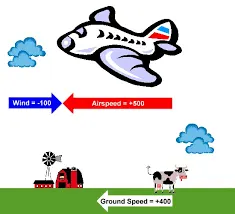
2. Is there any difference between ground speed and air speed?
ground speed is how fast an airplane is traveling, relative to a fixed point on the ground. Think of it this way: Ground speed is how fast an airplane's shadow would move across the land. If there's a strong wind pushing an aircraft, that's reflected in the ground speed.
Airspeed, in contrast, is how fast an airplane is really flying strictly under its own power, which is calculated by subtracting the wind speed from the ground speed.
3. Why is it not recommended to use aircraft engine power to move it on the ground at Airport?
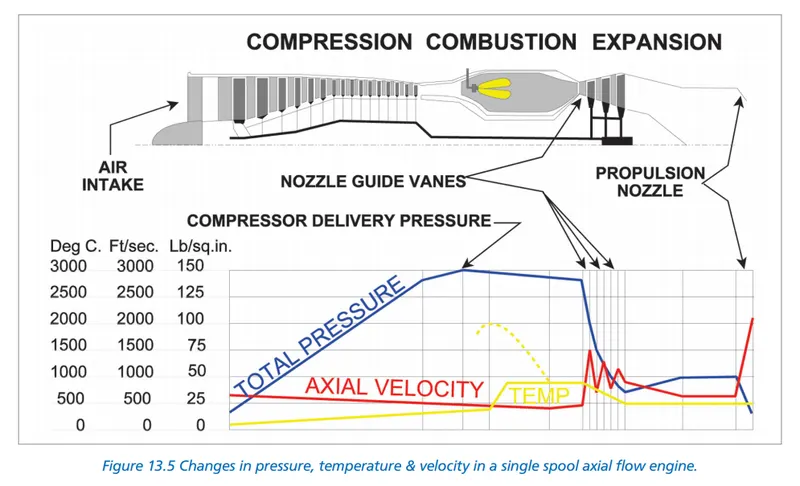
Generally aircrafts move with the help of Engine power on the ground at airport. The difference being that the engine power is not used at its full performance as obtained during the flight of the aircraft. The engine is operated under throttle 1 condition which uses engine power to obtain less speed. Sometimes it is not recommended to use the engine power to move the aircraft on the ground at Airport. There are multiple reasons for this one of which is that there are a lot of things as well as airport crew members surrounding the aircraft. If the aircraft uses its engine power in such an environment, the engine turbine or fan may suck or throw the surrounding objects, trash or even human beings which are accidental.
he air intake of a jet engine is powerful enough to suck in a human body. Even at a distance, the jet engine suction is strong enough to devour loose debris e.g., rags, bolts, paper, stones, catering foils, plastic cups and bags. All these will damage the jet engine. In case of Jet exhaust, the temperatures of the exhaust can severely burn the skin of a person standing too close. The jet blast or prop wash can exceed 100 mph and is capable of moving or toppling heavy persons or equipment. Other reasons being the noise of the engine which are at very high decibels as well as the fumes emitted by the burning of the fuel, the fuel consumption of an aircraft and also the risk of damage to the engine due to foreign objects.
4.How an aircraft is pushed to runway when its ready to take off?
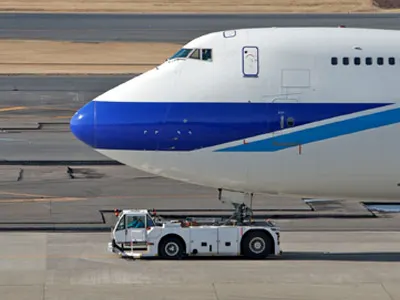
When every aircraft is cleared from the security then it is required for pushback. and thee aircraft cannot be moved or move back while in-ground below are some of the things which are taken into account for pushback and taxing:-
There are many towing vehicles which have high torque so that they can tow the aeroplane to the parking place.
And for huge aeroplane they are Auxillary pwer units APUs are mounted in the tail of the aircraft and the aircraft can rely on that as they are more efficient and uses less fuel and safe in-ground. these APUs help them in the ground while taxing, in case of service and case of emergency while the engine gets fail in the air. The APUs are nothing they are only some short of Generators that have very little voltage and high frequency, the power output of the APUs is 115V and 400Hz.
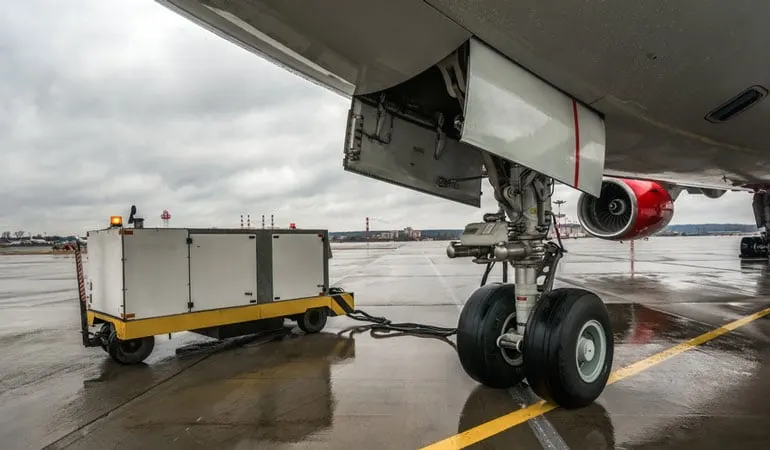
5.Learn about take off power, tyre design, rolling resistance, tyre pressure, brake forces when landing.
Take off power-
Takeoff is the phase of flight in which an aerospace vehicle leaves the ground and becomes airborne.For aircraft that take off horizontally, this usually involves starting with a transition from moving along the ground on a runway,The takeoff speed required varies with air density, aircraft gross weight, and aircraft configuration ,The power from the engine of the aircraft used to achieve the flight is called take off powerFor light aircraft, usually full power is used during takeoff,Large transport category (airliner) aircraft may use a reduced power for takeoff, where less than full power is applied in order to prolong engine life, reduce maintenance costs and reduce noise emissions.
Tyre Design-
When it comes to safety, tyres are one of the most important components of aircraft. They help to absorb the shock of landing and provide cushioning. It also provides the necessary traction for braking and stopping of an aircraft.
An aircraft tyre is designed to withstand extremely heavy loads while landing, take off, taxing, and parking. The number of wheels required for aircraft increases with the weight of the aircraft, as the weight of the aeroplane needs to be distributed more evenly.
A Boeing 737NG & 737MAX uses 6 wheels, Boeing 787 uses 10 wheels, Boeing 777 uses 14 wheels and Airbus A380 uses 22 wheels. Aircraft tyres work under extreme conditions, carrying up to 340 tons and accelerating at over 250 km/hour at takeoff, in addition to enduring varied environmental stress when in flight and taxiing.
Carcass plies are used to form the tire. They are sometimes called casing plies. An aircraft tyre is constructed for the purpose it serves.
- They support the weight of an aircraft while it is on the ground.
- It also provides the necessary traction for braking and stopping of an aeroplane.
- Tyre also helps to absorb the shock of landing and provide cushioning the roughness of takeoff, roll-out, and taxi operations.
Unlike an automobile or truck tyre, it does not have to carry a load for a long period of continuous operation. However, an aircraft tyre absorbs the high impact loads of landing, and also it’s operating at high speeds for a short time when required.
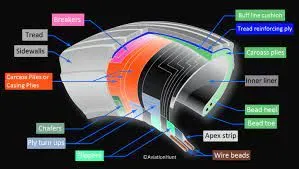
Rolling resistance-
Rolling resistance, sometimes called rolling friction or rolling drag, is the force resisting the motion when a body (such as a ball, tire, or wheel) rolls on a surface. It is mainly caused by non- elastic effects; that is, not all the energy needed for deformation (or movement) of the wheel, roadbed, etc., is recovered when the pressure is removed.
Tyre pressure-
Aircraft wheels are fitted with pneumatic tyres which may be tubeless or have an inner tube. Tubes tend to be fitted to light and older aircraft. Tyres are usually inflated with nitrogen which absorbs shock and supports the weight of the aircraft, while the cover restrains and protects the tube from damage, maintains the shape of the tyre, transmits braking and provides a wearing surface.
There are four main categories of tyre pressures, which are as follows:
- Low Pressure: Designed to operate at a pressure of 25 lb. to 35 lb. per sq. in, (1.73 - 2.42 bar), used on grass surfaces.
- Medium Pressure: Operates at a pressure of 35 lb. to 70 lb. per sq. in, (2.42 - 4.83 bar) and is used on grass surfaces or medium-firm surfaces without a consolidated base.
- High Pressure: Operates at a pressure of 70 lb. to 90 lb. per sq. in, (4.83 - 6.21 bar) and is suitable for concrete runways.
- Extra-High Pressure: Operates at pressures of over 90 lb. per sq. in (some tyres of this type are inflated to 350 lb. per sq. in) (6.21 - 24.2 bar), the tyre is suitable for concrete runways.
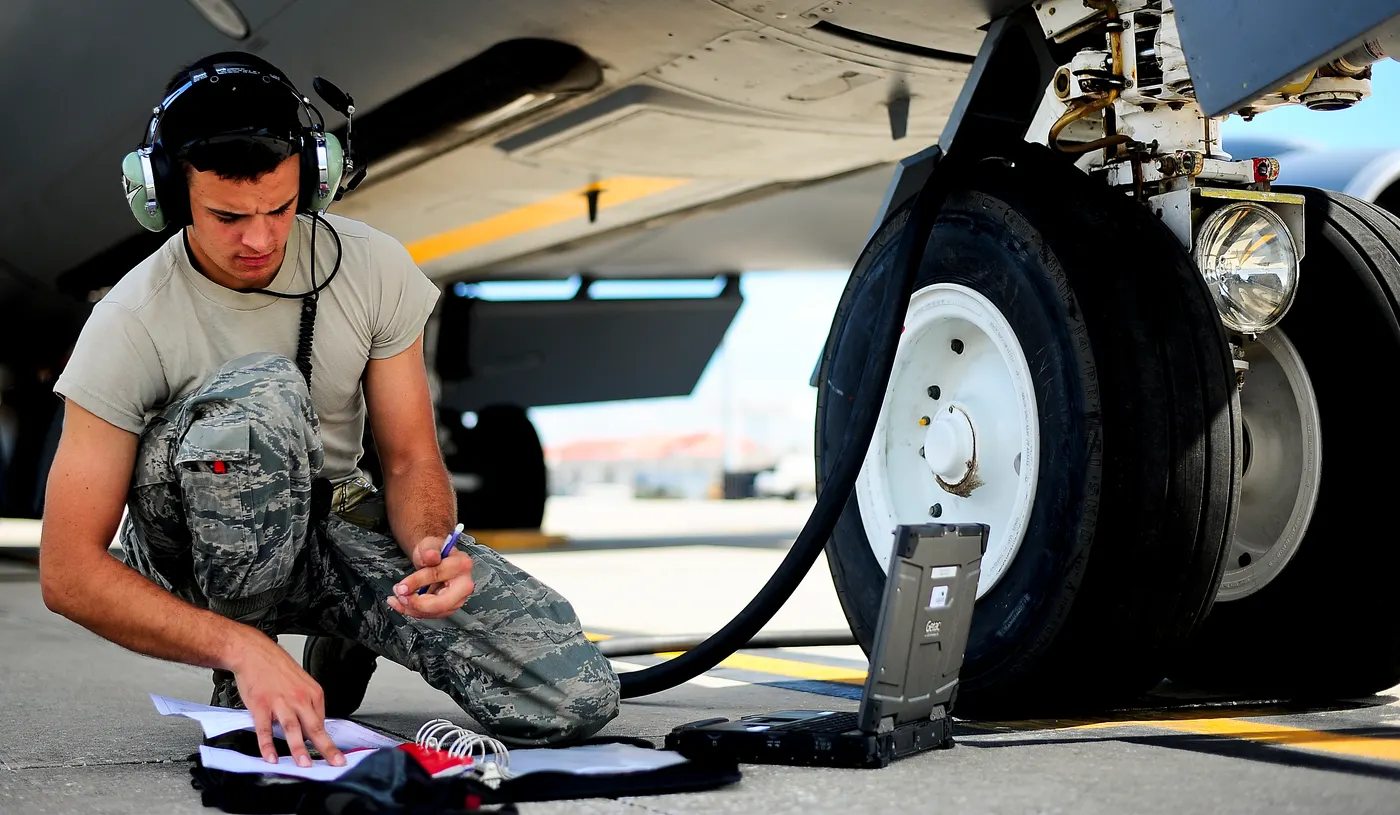
Brake force (Landing)-
The brake disks themselves are made up of two parts. Firstly, there are the rotors. These are connected to the wheel by drive tab. As these drive tabs are in contact with the inside of the wheel, they spin at the same speed. Depending on the brake manufacturer, there are either four or five of these rotors on each brake assembly.
The second part of the disks are the stators. These sit around each rotor and are fixed in place and thus don’t move. As the wheel turns, the rotors spin round inside the stators.
When the brakes are applied, the four EBAs apply pressure to the first stator. This in turn squeezes the stationary stators up against the spinning rotors and it’s this friction which slows the wheel down.

When landing on slippery runways, there’s a chance that the wheels may start to skid as the brakes are applied. To stop this from happening and to maintain maximum effective braking, each wheel has anti-skid protection.
Using a variety of sources to determine the aircraft speed, the brake units know how fast the wheels should be spinning. If that speed drops significantly, it’s because the current brake pressure on that wheel is too great and the wheel is just skidding over the surface.
In this situation, the anti-skid system automatically reduces the braking on that wheel to a point where the skid stops before reapplying the pressure. All this is done in a fraction of a second.
With friction comes heat. As a result, each brake unit displays its temperature on the wheel synoptic page in the flight deck. Here, numerical values relating to brake temperature are shown next to each wheel. A value of 0-4.9 is in the normal range. When a temperature becomes 5.0 or above, an advisory message is displayed to the pilots.
Should the brakes become too hot, there’s a chance that the heat transferred to the wheels could cause the tires to explode. To stop this from happening, when a certain temperature is reached, fuse plugs in the tires melt. This allows the air to be released safely and slowly deflate the tires
Part B:
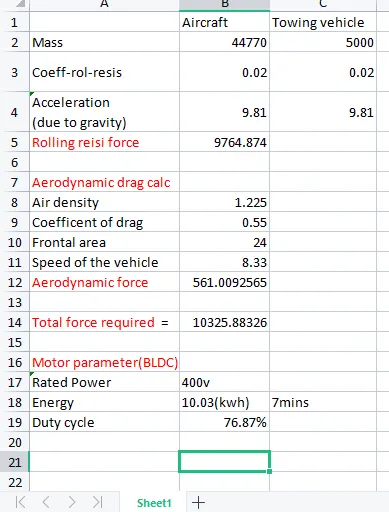
6. A. With necessary assumptions, calculate the force and power required to push / pull an aircraft by a towing vehicle.
B. Develop the model for the calculated force and power using Simulink.
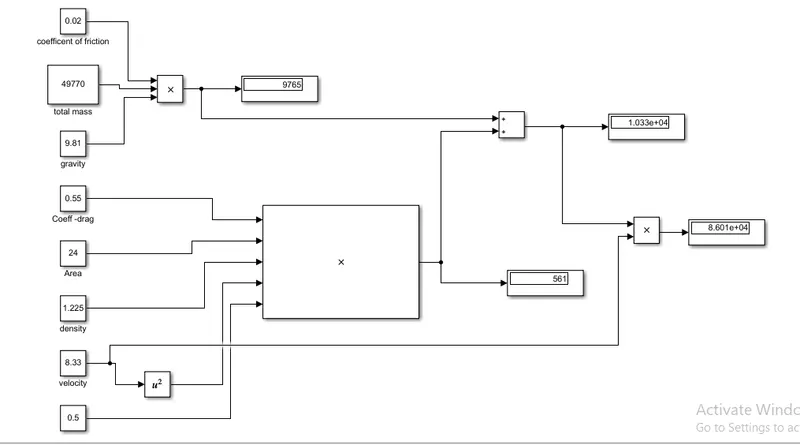
Friction force = μrr*(Mg)
μrr = Rolling resistance coefficent
m= Mass of the vehicle
g = acceleration due to gravity.
Assumption for the mas of aircraft and towing vehicle-
Mass of the aircraft = 44770(kg)
Mass of towing vehicle= 5000(kg)
Total mass= 49770(kg)
Rolling resistance = 0.02
Speed of the vehicle(V) = 8.33m/s
As per friction formulae= μrr*(total mass)*g
= 0.02*(497700)*9.81
= 9765
Aerodynamic drag= Fd= Cd*A*ρ*U^2*0.5
Coefficent of drag = 0.55
Frontal Area = 24m^2
Speed of vehicle = 8.33(m/s)
Density of air = 1.225(kg/m^3)
Fd= 0.5*0.55*24*1.225*(8.33)^2
= 561.006
Total force required = Friction force+Aerodynamic drag
= 10326
Total power required = Total force* velocity
= 10326*8.33
=86010(W)
=86.010(kw)
Simulink Model-
2. Design an electric powertrain with type of motor, it’s power rating, and energy requirement to fulfill aircraft towing application in Simulink. Estimate the duty cycle range to control the aircraft speed from zero to highest. Make all required assumptions. Prepare a table of assumed parameters. Draw a block diagram of powertrain.
(Hint :DC7 Block)
B. Also, Design the parameters in excel sheet.
MOTOR SPECIFICATIONS
Assuming motor type to be BLDC motor
Output power – 110 KW, 150 hp
Full load speed – 740 rpm
Full load Efficiency – 94.5%
Full load current – 210A
Full load Torque – 1420 Nm
Rated voltage – 400V/50 Hz
DUTY CYCLE
The rated voltage is 400V and the current is assumed to be 250A. So, the input power of the motor is calculated as product of voltage and current.
Pi = V * I
Pi = 400 *280
Pi = 112000W
Pi = 112KW
Duty cycle- required power /Total power=86.010/112 = 0.76 = 76.87%duty cycle.
To calculate energy required in power train, the energy is calculated by multiplying power and time, assuming it took 7mins-
E= P0*t
= 86.010*7*60
= 36124.2(kJ).
since battery are rated in KWh convert Kj to KWh = 36124.2/3600 =10.03(Kwh).
So, the battery should provide 10.03(kwh).
Power train design-
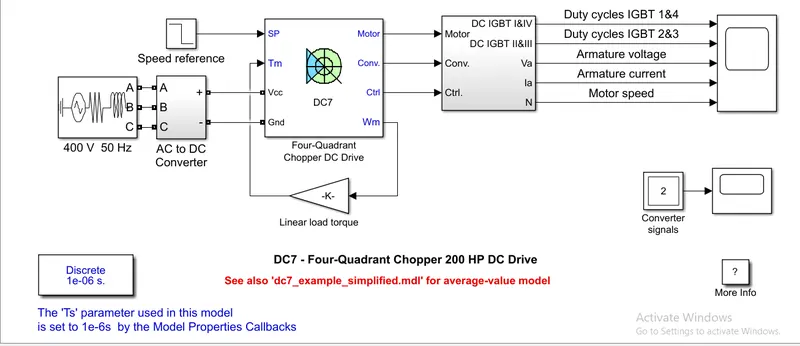
The 200 HP DC motor is separately excited with a constant 150 V DC field voltage source. The armature voltage is provided by an IGBT converter controlled by two PI regulators. The converter is fed by a 515 V DC bus obtained by rectification of a 400 V AC 50 Hz voltage source. In order to limit the DC bus voltage during dynamic braking mode, a braking chopper has been added between the diode rectifier and the DC7 block.
The first regulator is a speed regulator, followed by a current regulator. The speed regulator outputs the armature current reference (in p.u.) used by the current controller in order to obtain the electromagnetic torque needed to reach the desired speed. The speed reference change rate follows acceleration and deceleration ramps in order to avoid sudden reference changes that could cause armature over-current and destabilize the system.
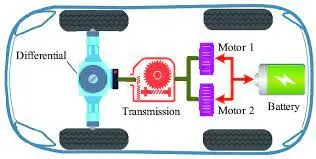
Excel sheet-