Project-1: Powertrain for aircraft in runways
1. Search and list out the total weight of various types of aircrafts.
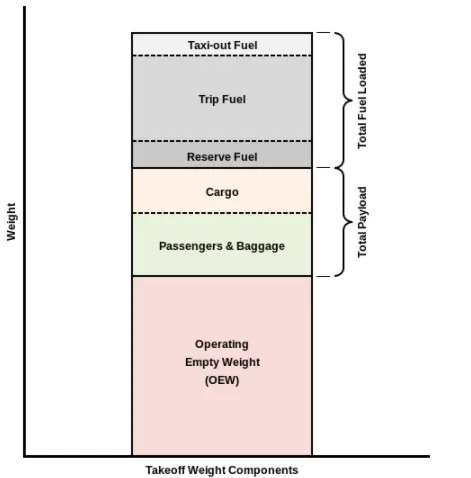
The aircraft gross weight (also known as the all-up weight and abbreviated AUW) is the total aircraft weight at any moment during the flight or ground operation. An aircraft's gross weight will decrease during a flight due to fuel and oil consumption. An aircraft's gross weight may also vary during a flight due to payload dropping or refuelling. At the moment of releasing its brakes, the gross weight of an aircraft is equal to its take-off weight. During flight, an aircraft's gross weight is referred to as the en-route weight or in-flight weight.
An aircraft's gross weight is limited by several weight restrictions in order to avoid overloading its structure or to avoid unacceptable performance or handling qualities while in operation. Aircraft gross weight limits are established during an aircraft's design and certification period and are laid down in the aircraft's type certificate and manufacturer specification documents.
Maximum design taxi weight (MDTW)
The maximum design taxi weight (also known as the maximum design ramp weight (MDRW)) is the maximum weight certificated for aircraft manoeuvring on the ground (taxiing or towing) as limited by aircraft strength and airworthiness requirements.
Maximum design take-off weight (MDTOW)
Is the maximum certificated design weight when the brakes are released for take-off and is the greatest weight for which compliance with the relevant structural and engineering requirements has been demonstrated by the manufacturer.
Maximum design landing weight (MDLW)
The maximum certificated design weight at which the aircraft meets the appropriate landing certification requirements. It generally depends on the landing gear strength or the landing impact loads on certain parts of the wing structure.
The MDLW must not exceed the MDTOW.
The maximum landing weight is typically designed for 10 feet per second (600 feet per minute) sink rate at touch down with no structural damage.
MTOW = Maximum take-off weight, MLW = Maximum landing weight, TOR = Take-off run, LR = Landing run
|
Type |
MTOW [kg] |
MLW [tonnes] |
TOR [m] |
LR [m] |
|
640,000 |
591.7 |
3500 |
||
|
589,670 |
3660 |
|||
|
575,000 |
394 |
3100 |
1930 |
|
|
447,700 |
346.091 |
3100 |
1800 |
|
|
443,613 |
306.175 |
3100 |
||
|
412,770 |
295.742 |
3090 |
||
|
Antonov An-124-100M |
405,060 |
330 |
2520 |
900 |
|
396,900 |
295.742 |
3018 |
2179 |
|
|
381,000 |
288.417 |
2530 |
1494 |
|
|
377,840 |
285.700 |
3338 |
2109 |
|
|
377,840 |
260.320 |
3222 |
1905 |
|
|
371,950 |
240 |
3050 |
2010 |
|
|
367,400 |
256 |
3100 |
2100 |
2. Is there any difference between ground speed and air speed?
Yes there is difference between air speed and the ground speed.Airspeed is simply the speed at which an aircraft is moving relative to the air it is flying in. As such, it’s also the speed at which the air is flowing around the aircraft’s wings.
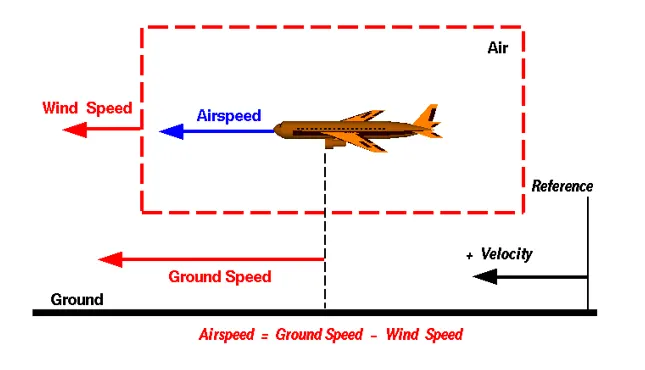
Ground speed, on the other hand, is the aircraft’s speed relative to the ground. One thing that should be noted here is that it’s horizontal rather than vertical speed. An aircraft climbing completely vertically would have a ground speed of zero.
In other words, while airspeed is what determines whether there is enough airflow around an aircraft to make it fly, ground speed is what determines how fast an aircraft will get to its destination.
The relationship between airspeed and ground speed is fairly simple. Ground speed is simply the sum of airspeed and wind speed.
3. Why is it not recommended to use aircraft engine power to move it on the ground at Airport?
Taxiing is the movement of an aircraft on the ground, under its own power, in contrast to towing or pushback where the aircraft is moved by a tug. The aircraft usually moves on wheels, but the term also includes aircraft with skis or floats (for water-based travel).An airplane uses taxiways to taxi from one place on an airport to another; for example, when moving from a hangar to the runway. The term "taxiing" is not used for the accelerating run along a runway prior to take-off, or the decelerating run immediately after landing, which are called the take-off roll and landing rollout, respectively.
Following are the some reasons:
a. Effectively the loss of the control can happen during high power engine running due loss of control damage can occur to the aircraft.There maybe risk of injury to the ground support personnel who are close to the aircraft.
b. It also saves the fuel.
c. It makes a noise very much which may disturb the passengers in the plane.
4. How an aircraft is pushed to runway when its ready to take off?
Pushback is an airport procedure during which an aircraft is pushed backwards away from its parking position, usually at an airport gate by external power. Pushbacks are carried out by special, low-profile vehicles called pushback tractors or tugs.Although many aircraft are capable of moving themselves backwards on the ground using reverse thrust, the resulting jet blast or prop wash would cause increased noise, damage to the terminal building or equipment, and hurt airport staff due to high-speed debris. This debris would also be sucked into the engine, as it is in normal use, and cause excessive wear a major cause of wear on aircraft engines is during ground use. A pushback is therefore the preferred method when ground-handling aircraft.
Pushbacks at busy aerodromes are usually subject to ground control clearance to facilitate ground movement on taxiways. Once clearance is obtained, the pilot will communicate with the tractor driver (or a ground handler walking alongside the aircraft in some cases) to start the pushback. To communicate, a headset may be connected near the nose gear.Since the pilots cannot see what is behind the aircraft, steering is done by the pushback tractor driver and not by the pilots. Depending on the aircraft type and airline procedure, a bypass pin may be temporarily installed into the nose gear to disconnect it from the aircraft's normal steering mechanism.Once the pushback is completed, the tow bar is disconnected, and any bypass pin removed. The ground handler will show the bypass pin to the pilots to make it clear that it has been removed. The pushback is then complete, and the aircraft can taxi forward under its own power.
5. Learn about take off power, tyre design, rolling resistance, tyre pressure, brake forces when landing.
Take off Power: The total energy of an aircraft flying in the atmosphere can be calculated using the equation
E= 1/2 mv^2 + mgh
However the engines mounted onto the wings of the plane are required to provide additional energy per time,power in order to keep the aircraft flying at the constant altitude and speed.This extra power needed to overcome the drag acting on the aeroplane and is calculated using
P= (dh/dt)mg
where dh/dt is decent speed required to keep the planes speed constant if the engines fail.
Design and Construction of Aircraft Tyre:
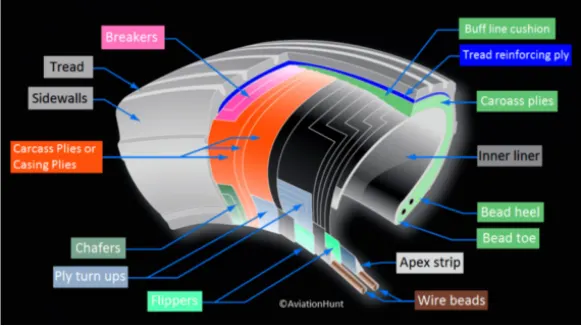
Carcass plies are used form the tyre.They are sometimes called casing plies. An aircraft tyre constructed for the purpose it serves.
1. They support the weight of an aircraft while it is on the ground.
2. It also provides necessary traction for braking and stopping of an aeroplane.
3. Tyre also helps to to absorb the shock of landing and provide cushioning the roughness of takeoff,roll out and taxi operations.
Some technical aspects of the tyre:
Retreading: method of restoring the worn tyreby renewing the tread area.
Load rating: Maximum permissible load at a specified inflation pressure.
Ply Rating : Used to identify the maximum recomended load rating and inflation pressure for a specified tyre.
Speed Rating: Maximum take off speed for which the tyre has to be tested.
skid depth: it is distance between the tread surface and the deepest groove as measured in the mould.
Rolling Resistance:
Rolling reistance is the force resisting the motion when a body rolls on a surface.Rolling resistance can be seen in the aircraft when the aircraft take off from the runway and while landing at the runway with the help of their wheels.
Rolling reistance can be expressed as Frr= πrr*m*g......N
Where Frr is the rolling resistance
πrr= coefficient of rolling resistance
m is mass in kg
g is the acceleration due to gravity
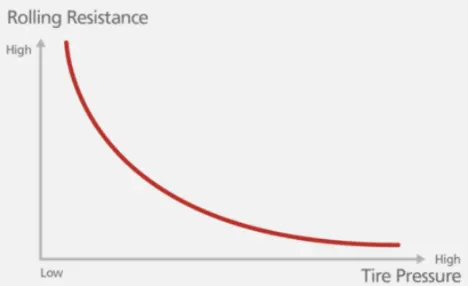
Below is the graph representing rolling resistance and the tyre pressure.
Tyre Pressure:
Aircraft tyres operate at such high extremes of pressure ,load and speed their care and service is critically important.The most important action an operator can take to prevent tyre related events is to maintain proper tyre inflation pressure.Failure to keep aircraft tyres properly inflated can lead to very serious consequences. One relatively easy way to help avoid those consequences is to check tyre pressure regularly and service them as necessary.
Brake forces:
Following are the braking devices are used to decelerate the aircraft
Spoilers
Wheel Brakes
Reverse Thrust
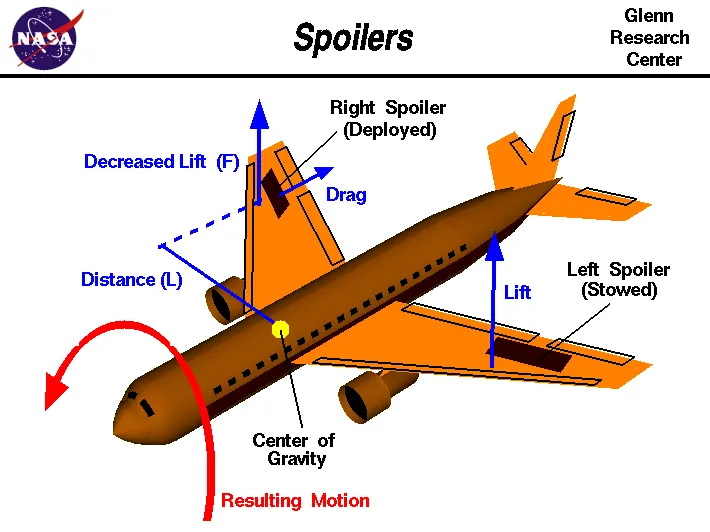
Spoilers are small, hinged plates on the top portion of wings. Spoilers can be used to slow an aircraft, or to make an aircraft descend, if they are deployed on both wings. Spoilers can also be used to generate a rolling moton for an aircraft, if they are deployed on only one wing. This slide shows what happens when the pilot only deflects the spoiler on the right wing.
Wheel Brakes: In the typical brake system, mechanical and/or hydraulic linkages to the rudder pedals allow the pilot to control the brakes. Pushing on the top of the right rudder pedal activates the brake on the right main wheels and pushing on the top of the left rudder pedal operates the brake on the left main wheels. The basic operation of brakes involves converting the kinetic energy of motion into heat energy through the creation of friction. A great amount of heat is developed and forces on the brake system components are demanding. Proper adjustment, inspection, and maintenance of the brakes is essential for effective operation.
Reverse Thrust: Thrust reversal, also called reverse thrust, is the temporary diversion of an aircraft engine's thrust for it to act against the forward travel of the aircraft, providing deceleration. Thrust reverser systems are featured on many jet aircfarft to help slow down just after touch-down, reducing wear on the brakes and enabling shorter landing distances. Such devices affect the aircraft significantly and are considered important for safe operations by airlines. There have been accidents involving thrust reversal systems, including fatal ones.Reverse thrust is also available on many propellor drive aircraft through reversing the controllable pitch propeller to a negative angle. The equivalent concept for a ship is called astern propulsion.
6. A. With necessary assumptions, calculate the force and power required to push / pull an aircraft by a towing vehicle.
B. Develop the model for the calculated force and power using Simulink.
Consider total mass of the aircraft including payload is 575000kg
Mass of the push back assumed 1000kg
Frr calculation
πrr= coefficient of rolling resistance is 0.002
Frr= πrr*m*g
= 0.002*575000*9.81
= 11281.5 N
For towing vehicle,
Frrt= 0.002*1000*9.81
= 19.62 N (low value can be neglected)
Aerodynamics Resistance(Far) calculation:
Assumptions,
Cd= 0.025
Air Density= 1.125kg/m^3
A= 150m^2
v= 14.5kmph or 4m/s
Far= 1/2*Cd*Air Density*A*V^2
= 0.5*0.025*1.125*150*4^2
= 33.75N
Total Force= 11281.5 + 33.75
= 11315.25 N
Power Required is P= Ft*V
= 11315.25*4
= 45.26 kW
The minimum power required by the tow vehicle is 45.26 kW
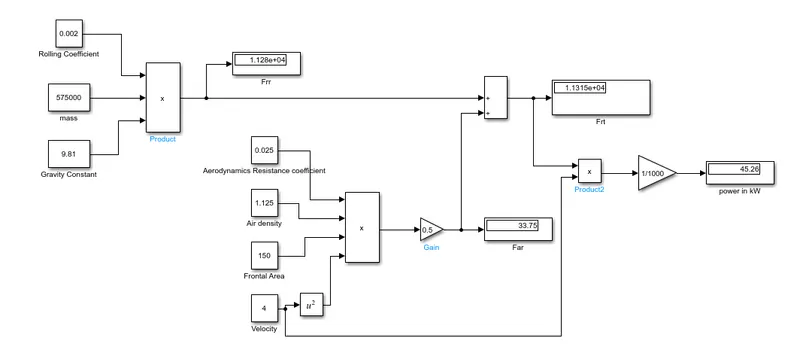
The mathematical model of above all equations is given by
7. A. Design an electric powertrain with type of motor, it’s power rating, and energy requirement to fulfill aircraft towing application in Simulink. Estimate the duty cycle range to control the aircraft speed from zero to highest. Make all required assumptions. Prepare a table of assumed parameters. Draw a block diagram of powertrain.
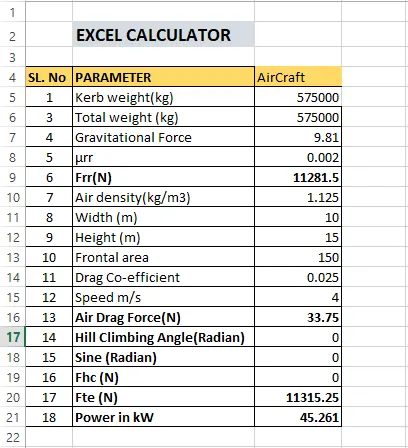
B. Also, Design the parameters in excel sheet.
Assume that the power required by the aircraft is 45.26kW
Consider a motor with following data specifications
Voltage 400-800V
Peak Power 60-70kW
RPM 1500-4000 rpm
Torque 300 Nm
Consider 60kW as peak power therefore voltage will be 400V.
Assume battery power to be 550V.
Now we can calculate the duty cycle
d= Vo/Vs = 400/550 = 0.7272
Assume Parameters
Mass of the aircraft 575000 kg
Mass of Push backk truck 1000kg
πrr= 0.002
Cd= 0.025
Air Density= 1.125kg/m^3
A= 150m^2
v= 14.5kmph or 4m/s
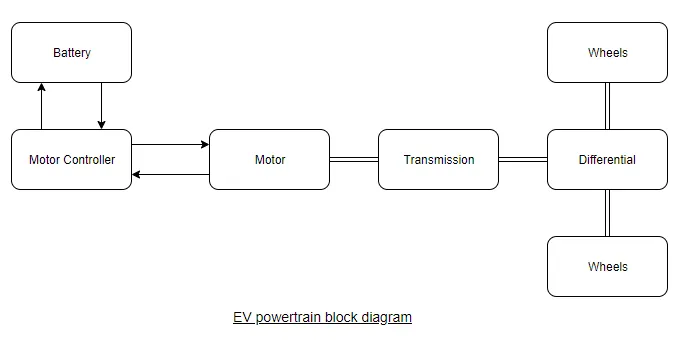
Below is the block diagram of EV
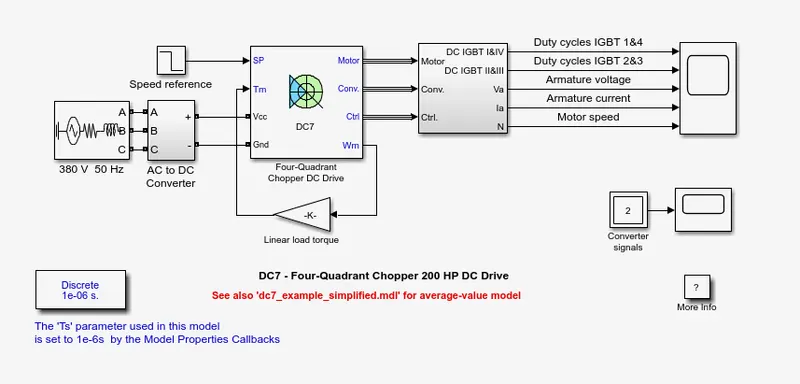
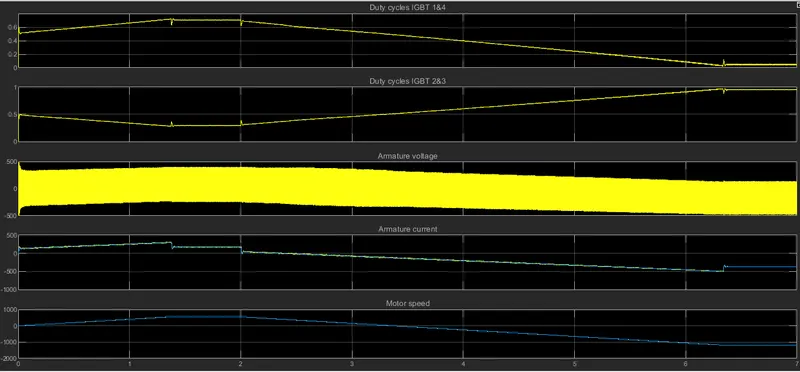
Below are the waveforms of the armature voltage, armature current, motor speed and the duty cycles of the switch.
Excel sheet attached below.