Project-1: Powertrain for aircraft in runways
AIM - To prepare a Project report on Powertrain for Aircraft In Runway under given sections -
Part A:
1. Search and list out the total weight of various types of aircrafts.
2. Is there any difference between ground speed and air speed?
3. Why is it not recommended to use aircraft engine power to move it on the ground at Airport?
4. How an aircraft is pushed to runway when its ready to take off?
5. Learn about take off power, tyre design, rolling resistance, tyre pressure, brake forces when landing.
Part B:
6. A. With necessary assumptions, calculate the force and power required to push / pull an aircraft by a towing vehicle.
B. Develop the model for the calculated force and power using Simulink.
7. A. Design an electric powertrain with type of motor, it’s power rating, and energy requirement to fulfill aircraft towing application in Simulink. Estimate the duty cycle range to control the aircraft speed from zero to highest. Make all required assumptions. Prepare a table of assumed parameters. Draw a block diagram of powertrain.
(Hint :DC7 Block)
B. Also, Design the parameters in excel sheet.
Part A -
1. Search and list out the total weight of various types of aircrafts.
List Of Total weight of various types of aircrafts.
MTOW = Maximum take-off weight, MLW = Maximum landing weight, TOR = Take-off run (SL, ISA+15°, MTOW), LR = Landing run (SL, ISA+15°, MLW)
| Type | MTOW [kg] | MLW [tonnes] | TOR [m] | LR [m] | ICAO category | FAA category |
|---|---|---|---|---|---|---|
| Antonov An-225 | 640,000 | 591.7 | 3500 | Heavy | Super | |
| Scaled Composites Model 351 Stratolaunch | 589,670 | 3660 | Heavy | Super | ||
| Airbus A380-800 | 575,000 | 394 | 3100 | 1930 | Super | Super |
| Boeing 747-8F | 447,700 | 346.091 | 3100 | 1800 | Heavy | Heavy |
| Boeing 747-8 | 443,613 | 306.175 | 3100 | Heavy | Heavy | |
| Boeing 747-400ER | 412,770 | 295.742 | 3090 | Heavy | Heavy | |
| Antonov An-124-100M | 405,060 | 330 | 2520 | 900 | Heavy | Heavy |
| Boeing 747-400 | 396,900 | 295.742 | 3018 | 2179 | Heavy | Heavy |
| Lockheed C-5 Galaxy | 381,000 | 288.417 | 2530 | 1494 | Heavy | Heavy |
| Boeing 747-200 | 377,840 | 285.700 | 3338 | 2109 | Heavy | Heavy |
| Boeing 747-300 | 377,840 | 260.320 | 3222 | 1905 | Heavy | Heavy |
| Airbus A340-500 | 371,950 | 240 | 3050 | 2010 | Heavy | Heavy |
| Airbus A340-600 | 367,400 | 256 | 3100 | 2100 | Heavy | Heavy |
| Boeing 777F | 347,800 | 260.816 | 2830 | Heavy | Heavy | |
| Airbus A330-900 | 352,000 | 251.5 | 3100 | Heavy | Heavy | |
| Boeing 777-300ER | 351,800 | 251.29 | 3100 | Heavy | Heavy | |
| Boeing 777-200LR | 347,450 | 223.168 | 3000 | Heavy | Heavy | |
| Boeing 747-100 | 340,200 | 265.300 | Heavy | Heavy | ||
| Airbus A350-1000 | 308,000 | 233.5 | Heavy | Heavy | ||
| Boeing 777-300 | 299,370 | 237.683 | 3380 | Heavy | Heavy | |
| Boeing 777-200ER | 297,550 | 213.00 | 3380 | 1550 | Heavy | Heavy |
| Airbus A340-300 | 276,700 | 190 | 3000 | 1926 | Heavy | Heavy |
| McDonnell Douglas MD-11 | 273,300 | 185 | 2990 | 1890 | Heavy | Heavy |
| Airbus A350-900 | 270,000 | 175 | 2670 | 1860 | Heavy | Heavy |
| Ilyushin Il-96M | 270,000 | 195.04 | 3115 | 2118 | Heavy | Heavy |
| McDonnell Douglas DC-10 | 256,280 | 183 | 2990 | 1890 | Heavy | Heavy |
| Boeing 787-9 | 254,000 | 192.777 | 2900 | Heavy | Heavy | |
| Boeing 787-10 | 254,000 | 201.849 | Heavy | Heavy | ||
| Airbus A340-200 | 253,500 | 181 | 2990 | Heavy | Heavy | |
| Ilyushin IL-96-300 | 250,000 | 175 | 2600 | 1980 | Heavy | Heavy |
| Airbus A330-300 | 242,000 | 185 | 2500 | 1750 | Heavy | Heavy |
| Airbus A330-200 | 242,000 | 180 | 2220 | 1750 | Heavy | Heavy |
| Lockheed L-1011-500 | 231,300 | 166.92 | 2636 | Heavy | Heavy | |
| Boeing 787-8 | 228,000 | 172.365 | 3300 | 1695 | Heavy | Heavy |
| Lockheed L-1011-200 | 211,400 | Heavy | Heavy | |||
| Ilyushin IL-86 | 208,000 | 175 | Heavy | Heavy | ||
| Boeing 767-400ER | 204,000 | 158.758 | 3414 | Heavy | Heavy | |
| Airbus A300-600R | 192,000 | 140 | 2385 | 1555 | Heavy | Heavy |
| Boeing 767-300ER | 187,000 | 136.08 | 2713 | 1676 | Heavy | Heavy |
| Concorde | 185,000 | 111.1 | 3440 | 2220 | Heavy | Heavy |
| Airbus A300-600 | 163,000 | 138 | 2324 | 1536 | Heavy | Heavy |
| Boeing 767-300 | 159,000 | 136.078 | 2713 | 1676 | Heavy | Heavy |
| Airbus A310-300 | 157,000 | 124 | 2290 | 1490 | Heavy | Heavy |
| Vickers VC10 | 152,000 | 151.9 | Heavy | Heavy | ||
| Boeing 707-320B | 151,000 | 97.5 | Heavy | Heavy | ||
| Boeing 707-320C | 151,000 | 112.1 | Heavy | Heavy | ||
| Douglas DC-8-61 | 147,000 | Heavy | Heavy | |||
| Airbus A310-200 | 142,000 | 123 | 1860 | 1480 | Heavy | Heavy |
| Airbus A400M | 141,000 | 122 | 980 | 770 | Heavy | Heavy |
| Douglas DC-8-32 | 140,000 | Heavy | Heavy | |||
| Douglas DC-8-51 | 125,000 | Medium | Large | |||
| Boeing 757-300 | 124,000 | 101.6 | 2550 | 1750 | Medium | Large |
| Boeing 707-120B | 117,000 | 86.3 | Medium | Large | ||
| Boeing 757-200 | 116,000 | 89.9 | 2347 | 1555 | Medium | Large |
| Boeing 720B | 106,000 | 79.5 | Medium | Large | ||
| Boeing 720 | 104,000 | 79.5 | Medium | Large | ||
| Tupolev Tu-154M | 104,000 | 80 | Medium | Large | ||
| Tupolev Tu-204SM | 104,000 | 87.5 | 2250 | Medium | Large | |
| Convair 880 | 87,500 | Medium | Large | |||
| Boeing 737-900 | 85,000 | 66.36 | 2500 | 1704 | Medium | Large |
| Boeing 737-900ER | 85,000 | 71.35 | 2804 | 1829 | Medium | Large |
| Boeing 727-200 Advanced | 84,000 | 70.1 | Medium | Large | ||
| Airbus A321-100 | 83,000 | 77.8 | 2200 | 1540 | Medium | Large |
| Boeing 737-800 | 79,000 | 65.32 | 2308 | 1634 | Medium | Large |
| Boeing 727-200 | 78,000 | 68.1 | Medium | Large | ||
| McDonnell-Douglas MD-83 | 73,000 | 63.28 | Medium | Large | ||
| Boeing 727-100 | 72,500 | 62.4 | Medium | Large | ||
| Boeing 727-100C | 72,500 | 62.4 | Medium | Large | ||
| McDonnell-Douglas MD-90-30 | 71,000 | 64.41 | 2165 | 1520 | Medium | Large |
| de Havilland Comet 4 | 70,700 | Medium | Large | |||
| Boeing 737-700 | 70,000 | 58.06 | 1921 | 1415 | Medium | Large |
| Airbus A320-100 | 68,000 | 66 | 1955 | 1490 | Medium | Large |
| Boeing 737-400 | 68,000 | 54.9 | 2540 | 1540 | Medium | Large |
| de Havilland Comet 3 | 68,000 | Medium | Large | |||
| Boeing 377 | 67,000 | Medium | Large | |||
| Boeing 737-600 | 66,000 | 54.66 | 1796 | 1340 | Medium | Large |
| Airbus A220-300 | 65,000 | 57.61 | 1890 | 1494 | Medium | Large |
| Hawker Siddeley Trident 2E | 65,000 | Medium | Large | |||
| Airbus A319 | 64,000 | 62.5 | 1850 | 1470 | Medium | Large |
| Boeing 737-300 | 63,000 | 51.7 | 1939 | 1396 | Medium | Large |
| Boeing 737-500 | 60,000 | 49.9 | 1832 | 1360 | Medium | Large |
| Airbus A220-100 | 59,000 | 50.80 | 1463 | 1356 | Medium | Large |
| Airbus A318 | 59,000 | 57.5 | 1375 | 1340 | Medium | Large |
| Boeing 717-200HGW | 55,000 | 47.174 | 1950 | Medium | Large | |
| Douglas DC-7 | 55,000 | Medium | Large | |||
| de Havilland Comet 2 | 54,000 | Medium | Large | |||
| Boeing 717-200BGW | 50,000 | 46.265 | 1950 | Medium | Large | |
| de Havilland Comet 1 | 50,000 | Medium | Large | |||
| Douglas DC-6A | 48,600 | Medium | Large | |||
| Douglas DC-6B | 48,500 | Medium | Large | |||
| Embraer 190 | 48,000 | 43 | 2056 | 1323 | Medium | Large |
| Caravelle III | 46,000 | Medium | Large | |||
| Fokker 100 | 46,000 | 39.95 | 1621 | 1350 | Medium | Large |
| Douglas DC-6 | 44,000 | Medium | Large | |||
| Avro RJ-85 | 42,000 | 36.74 | Medium | Large | ||
| Handley Page Hermes | 39,000 | Medium | Large | |||
| Embraer 175 | 37,500 | 32.8 | 2244 | 1304 | Medium | Large |
| Bombardier CRJ900 | 36,500 | 33.345 | 1778 | 1596 | Medium | Large |
| Embraer 170 | 36,000 | 32.8 | 1644 | 1274 | Medium | Large |
| Bombardier CRJ700 | 33,000 | 30.39 | 1564 | 1478 | Medium | Large |
| Douglas DC-4 | 33,000 | Medium | Large | |||
| Vickers Viscount 800 | 30,400 | Medium | Large | |||
| Bombardier Q400 | 28,000 | 28.01 | 1219 | 1295 | Medium | Large |
| Bombardier CRJ200 | 23,000 | 21.319 | 1918 | 1479 | Medium | Large |
| ATR 72-600 | 22,800 | 22.35 | 1333 | 914 | Medium | Large |
| Saab 2000 | 22,800 | 21.5 | 1300 | Medium | Large | |
| Embraer ERJ 145 | 22,000 | 19.3 | 2270 | 1380 | Medium | Large |
| ATR 42-500 | 18,600 | 18.3 | 1165 | 1126 | Medium | Small |
| Saab 340 | 13,150 | 12.930 | 1300 | 1030 | Medium | Small |
| Embraer 120 Brasilia | 11,500 | 11.25 | 1560 | 1380 | Medium | Small |
| BAe Jetstream 41 | 10,890 | 10.570 | 1493 | 826 | Medium | Small |
| Learjet 75 | 9,752 | 8.709 | 1353 | 811 | Medium | Small |
| Pilatus PC-24 | 8,300 | 7.665 | 893 | 724 | Medium | Small |
| Embraer Phenom 300 | 8,150 | 7.65 | 956 | 677 | Medium | Small |
| Beechcraft 1900D | 7,765 | 7.605 | 1036 | 853 | Medium | Small |
| Cessna Citation CJ4 | 7,761 | 7.103 | 1039 | 896 | Medium | Small |
| de Havilland Hercules | 7,000 | Medium | Small | |||
| Embraer Phenom 100 | 4,800 | 4.43 | 975 | 741 | Light | Small |
- Maximum Take-Off Weight (MTOW) -
The maximum takeoff weight (also known as the maximum brake-release weight) is the maximum weight authorised at brake release for takeoff, or at the start of the takeoff roll.
The maximum takeoff weight is always less than the maximum taxi/ramp weight to allow for fuel burned during taxi by the engines and the APU.
In operation, the maximum weight for takeoff may be limited to values less than the maximum takeoff weight due to aircraft performance, environmental conditions, airfield characteristics (takeoff field length, altitude), maximum tire speed and brake energy, obstacle clearances, and/or en route and landing weight requirements.
-
Maximum landing weight (MLW) -
The maximum weight authorised for normal landing of an aircraft.
The MLW must not exceed the MTOW.
The operation landing weight may be limited to a weight lower than the Maximum Landing Weight by the most restrictive of the following requirements:
- Aircraft performance requirements for a given altitude and temperature:
-
- landing field length requirements,
- approach and landing climb requirements
- Noise requirements
-
Maximum taxi weight (MTW) -
The maximum taxi weight (MTW) (also known as the maximum ramp weight (MRW) is the maximum weight authorized for maneuvering (taxiing or towing) an aircraft on the ground as limited by aircraft strength and airworthiness requirements. It includes the weight of taxi and run-up fuel for the engines and the APU.
It is greater than the maximum takeoff weight due to the fuel that will be burned during the taxi and runup operations.
The difference between the maximum taxi/ramp weight and the maximum take-off weight (maximum taxi fuel allowance) depends on the size of the aircraft, the number of engines, APU operation, and engines/APU fuel consumption, and is typically assumed for 10 to 15 minutes allowance of taxi and run-up operations.
-
Maximum zero-fuel weight (MZFW) -
The maximum permissible weight of the aircraft less all usable fuel and other specified usable agents (engine injection fluid, and other consumable propulsion agents). It is the maximum weight permitted before usable fuel and other specified usable fluids are loaded in specified sections of the airplane.
2. Is there any difference between ground speed and air speed?
- Ground Speed -
Ground speed is the horizontal speed of an aircraft relative to the Earth’s surface. It is vital for accurate navigation to the destination that the pilot has an estimate of the ground speed that will be achieved during a flight.
An aircraft diving vertically would have a ground speed of zero. Information displayed to passengers through the entertainment system of airline aircraft usually gives the aircraft ground speed rather than airspeed.
Ground speed can be determined by the vector sum of the aircraft's true airspeed and the current wind speed and direction; a headwind subtracts from the ground speed, while a tailwind adds to it. Winds at other angles to the heading will have components of either headwind or tailwind as well as a crosswind component.
- Air Speed - In aviation, airspeed is the speed of an aircraft relative to the air.
Airspeed is the vector difference between the ground speed and the wind speed. On a perfectly still day, the airspeed is equal to the ground speed. But if the wind is blowing in the same direction that the aircraft is moving, the airspeed will be less than the ground speed.
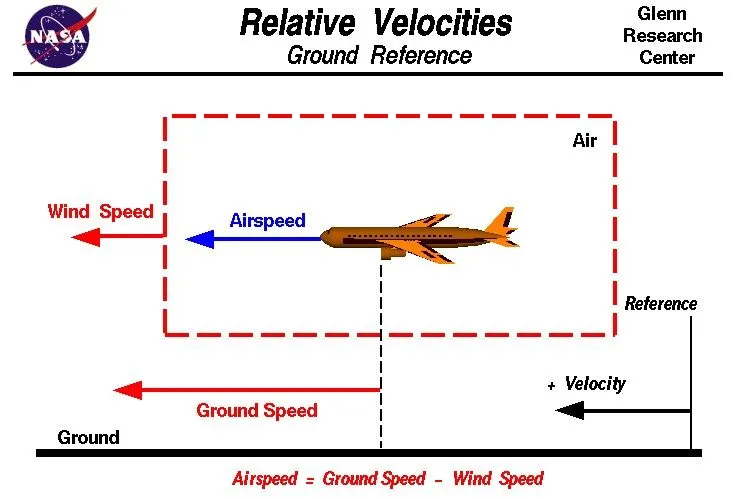
Conclusion - Yes there is a difference between air speed and the ground speed , On a perfectly still day, the airspeed is equal to the ground speed. But if the wind is blowing in the same direction that the aircraft is moving, the airspeed will be less than the ground speed.
3. Why is it not recommended to use aircraft engine power to move it on the ground at Airport?
Taxiing (rarely spelled taxying) is the movement of an aircraft on the ground, under its own power, in contrast to towing or pushback where the aircraft is moved by a tug. The aircraft usually moves on wheels, but the term also includes aircraft with skis or floats (for water-based travel).
An airplane uses taxiways to taxi from one place on an airport to another; for example, when moving from a hangar to the runway. The term "taxiing" is not used for the accelerating run along a runway prior to takeoff, or the decelerating run immediately after landing, which are called the takeoff roll and landing rollout, respectively.
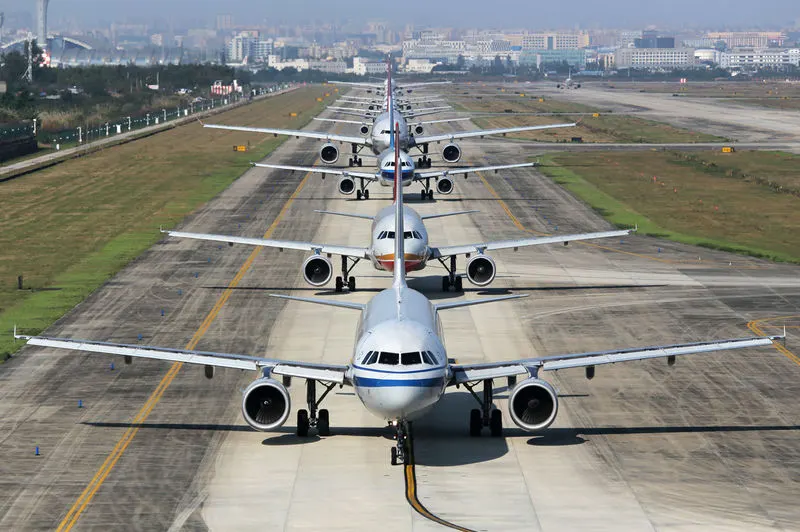
However it not recommended to use aircraft engine power to move it on the ground at Airport because -
- The jet blast or prop wash might cause damage to the terminal building or equipment.
- Engine close to ground may also blow sand and debris forward and then suck them into the engine, causing damage to the engine.
- It is easier for truck driver to see surrounding better than the pilot sitting in the cockpit with limited window.
- It also save fuel.
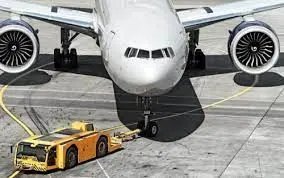
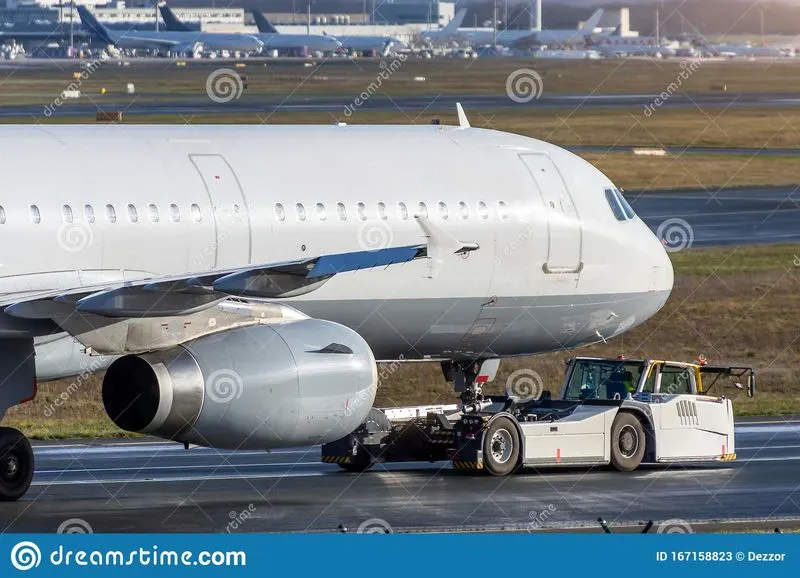
Aircraft towing is a frequent and vital operation around any airport. The aircraft is attached it to the tow vehicle by the use of a towbar or other specialized methods that connect to or raise the nose or landing gear off the ground.
4. How an aircraft is pushed to runway when its ready to take off?
In aviation, pushback is an airport procedure during which an aircraft is pushed backwards away from its parking position, usually at an airport gate by external power. Pushbacks are carried out by special, low-profile vehicles called pushback tractors or tugs.
Although many aircraft are capable of moving themselves backwards on the ground using reverse thrust (a procedure referred to as a powerback), the resulting jet blast or prop wash might cause damage to the terminal building or equipment. Engines close to the ground may also blow sand and debris forward and then suck them into the engine, causing damage to the engine. A pushback is therefore the preferred method to move the aircraft away from the gate.
Aircraft towing is a frequent and vital operation around any airport. The aircraft is attached it to the tow vehicle by the use of a towbar or other specialized methods that connect to or raise the nose or landing gear off the ground.
5. Learn about take off power, tyre design, rolling resistance, tyre pressure, brake forces when landing.
- Take Off power -
Takeoff is the phase of flight in which an aerospace vehicle leaves the ground and becomes airborne. For aircraft traveling vertically, this is known as liftoff.
For aircraft that take off horizontally, this usually involves starting with a transition from moving along the ground on a runway. For ballons, helicopter and some specialized fixed-wing aircraft (VTOL aircraft such as the Harrier), no runway is needed.
-
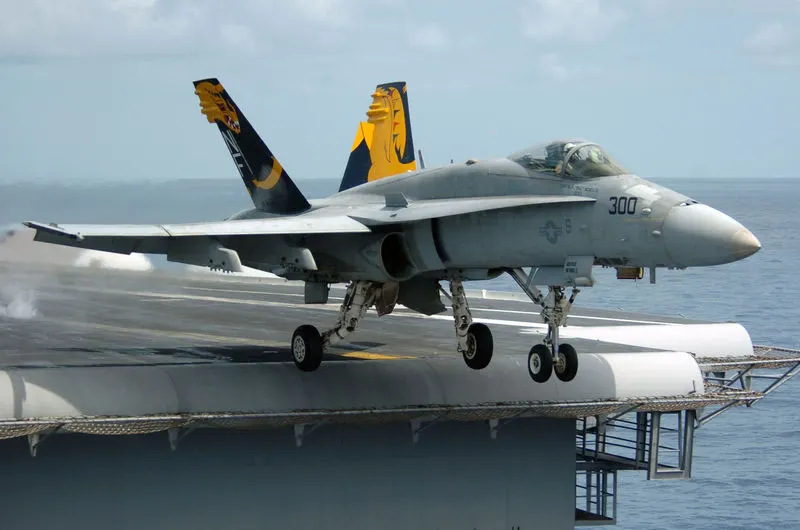
For light aircraft , usually full power is used during takeoff. Large transport category (airliner) aircraft may use a reduced power for takeoff, where less than full power is applied in order to prolong engine life, reduce maintenance costs and reduce noise emissions. In some emergency cases, the power used can then be increased to increase the aircraft's performance. Before takeoff, the engines, particularly piston engine, are routinely run up at high power to check for engine-related problems. The aircraft is permitted to accelerate to rotation speed (often referred to as Vr). The term rotation is used because the aircraft pivots around the axis of its main landing gear while still on the ground, usually because of gentle manipulation of the flight controls to make or facilitate this change in aircraft attitude (once proper air displacement occurs under / over the wings, an aircraft will lift off on its own; controls are to ease that in).
The nose is raised to a nominal 5°–15° nose up pitch attitude to increase lift from the wings and effect liftoff. For most aircraft, attempting a takeoff without a pitch-up would require cruise speeds while still on the runway.
- Tyre Design -
Tire Markings
Tire Terminologies -
1. Apex strip - A triangular piece of stiff rubber which is fitted onto the bead core to taper the rigid bead into the flexible body plies in the sidewall.
2. Aramid cord protector - The tire is constructed with an aramid ply insert between the tread and the top belt to prevent damage to the tire belts.
3. Bead heel - Outer edge of the bead.
4. Bead toe - Inner edge of the bead.
5. Belt plies (Nylon cord) - Angled belt plies which serve to add strength to the tire especially in the tread area.
6. Belt plies (High modulus cord) - Belt plies which serve to add strength to the tire especially in the tread area.
7. Chafer strip - Protective layer of rubber and fabric which prevents chafing between cord body plies and the wheel.
8. Carcass plies - Layers of rubber-coated fabric plies which have the cords running radially from bead to bead. These provide the tire with strength in the sidewall area.
9. Innerliner - A sheet of low permeable rubber laminated to the inside of the first casing ply of a tubeless tire to insure retention of air when tire is inflated.
10. Sidewall - The side area of the tire located between the shoulder and the beads. Composed of rubber, it protects the carcass from damage.
11. Undertread - A rubber layer provided for use in retreading the tire and which provides adhesion of tread to the tire carcass. Bridgestone makes this rubber layer thick enough to ensure a high number of retreads.
12. Venting hole - The hole through which gas is vented from inside the carcass plies.
- Rolling Resistance -
Rolling resistance, sometimes called rolling friction or rolling drag, is the force resisting the motion when a body (such as a ball, tire, or wheel) rolls on a surface. It is mainly caused by non-elastic effects; that is, not all the energy needed for deformation (or movement) of the wheel, roadbed, etc., is recovered when the pressure is removed.
A rubber tire will have higher rolling resistance on a paved road than a steel rail-road wheel on a steel rail. Also, sand on the ground will give more rolling resistance than concrete. Sole rolling resistance factor is not dependent on speed.
The "rolling resistance coefficient" is defined by the following equation:

- where
 is the rolling resistance force
 is the dimensionless rolling resistance coefficient or coefficient of rolling friction (CRF), and
 is the normal force, the force perpendicular to the surface on which the wheel is rolling.
- Tyre Pressure -
Aircraft tires generally operate at high pressures, up to 200 psi (14 bar; 1,400 kPa) for airliners, and even higher for business jets. The main landing gear on the Concorde was typically inflated to 232 psi (16.0 bar), whilst its tail bumper gear tires were as high as 294 psi (20.3 bar).
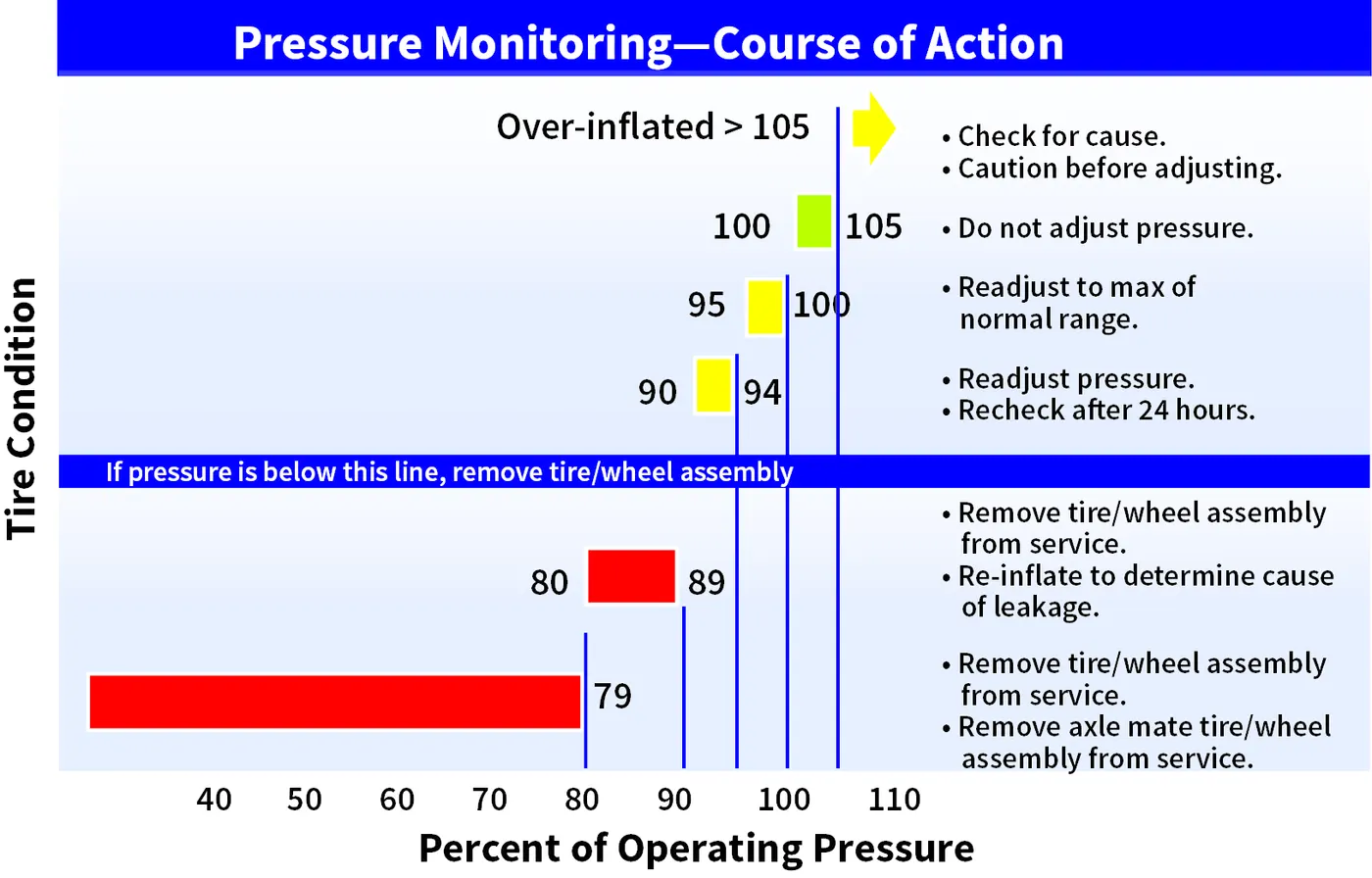
Because aircraft tires operate at such high extremes of pressure, load, and speed, their care and service is critically important. The most important action an operator can take to prevent tire-related events is to maintain proper tire inflation pressure. Failure to keep aircraft tires properly inflated can lead to very serious consequences. The most serious of these is the structural failure of the tire. If the tire operates underinflated or overdeflected/overloaded, the nylon cords which form the structure of the tire go in and out of compression as the tire rotates. This weakens the cords – much like a paperclip which is bent back and forth – until eventually the cords break. If enough cords break, the entire structure will eventually fail.
- Brake Force When Landing -
Aircraft braking systems include:
- Aircraft Disc Brakes in the landing gear, used to brake the wheels while touching the ground. These brakes are operated hydraulically or pneumatically. In most modern aircraft they are activated by the top section of the rudder pedals ("toe brakes"). In some older aircraft the bottom section is used instead ("heel brakes"). Levers are used in a few aircraft. Most aircraft are capable of differential braking.
- Thrust Reverses, that allow thrust from the engines to be used to slow the aircraft.
- Air Brakes, dedicated flight control surfaces that work by increasing drag.
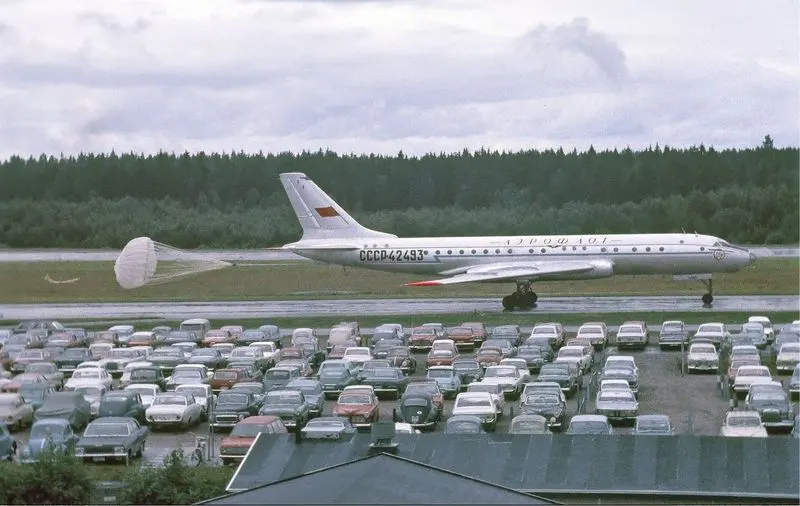
- Large drogue parachutes, used by several former and current military and civilian aircraft (examples include the American B-52 and the soviet Tu-134 and Tu-144) and in the Space Shuttle.
Aircraft Disc Brakes -
A disc brake is a type of brake that uses the calipers to squeeze pairs of pads against a disc or a "rotor" to create friction. This action slows the rotation of a shaft, such as a vehicle action, either to reduce its rotational speed or to hold it stationary. The energy of motion is converted into waste heat which must be dispersed.
Hydraulically Actuated disc brakes are the most commonly used form of brake for motor vehicles, but the principles of a disc brake are applicable to almost any rotating shaft. The components includes the disc, master cylinder, caliper (which contains cylinder and two brake pads) on both side of the disc.
Thrust Reversal -
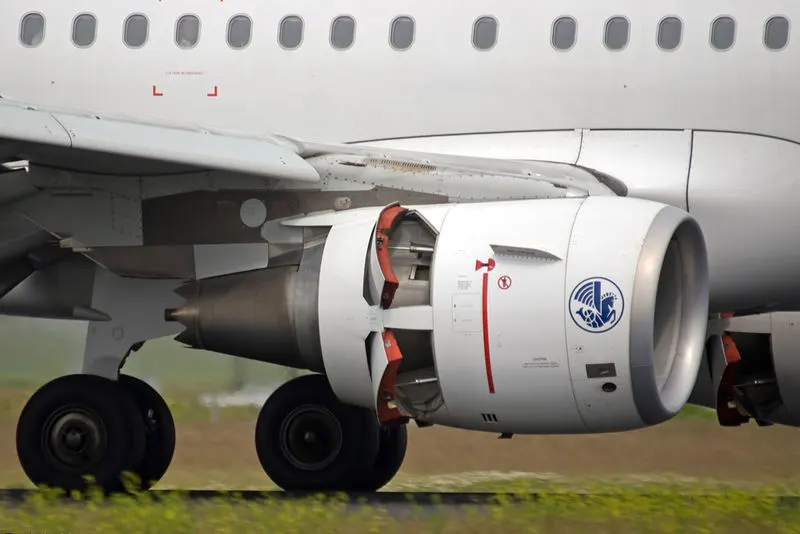
Thrust reversal, also called reverse thrust, is the temporary diversion of an aircraft engine's thrust for it to act against the forward travel of the aircraft, providing deceleration. Thrust reverser systems are featured on many jetaircraft to help slow down just after touch-down, reducing wear on the brakes and enabling shorter landing distances. Such devices affect the aircraft significantly and are considered important for safe operations by ailines. There have been accidents involving thrust reversal systems, including fatal ones.
Reverse thrust is also available on many propeller driven aircraft through reversing the controllable pitch propeller to a negative angle. The equivalent concept for a ship is called astern propulsion.
Drogue parachute -
A drogue parachute is a parachute designed for deployment from a rapidly-moving object. It can be used for various purposes, such as to decrease speed, to provide control and stability, or as a pilot parachute to deploy a larger parachute. Vehicles that have used drogue parachutes include multi-stage parachutes, aircraft, and spacecraft recovery systems.
PART B -
6. A. With necessary assumptions, calculate the force and power required to push / pull an aircraft by a towing vehicle.
B. Develop the model for the calculated force and power using Simulink.
A. With necessary assumptions, calculate the force and power required to push / pull an aircraft by a towing vehicle.
Forces in consideration -
- Rolling Resistance Force
- Aerodynamic Drag Force
There is no inclination taking Hill Climbing Force = 0
Assumption For Calculation -
1. Rolling Resistance Force (Frr)
Frr = μrr * m * g
μrr = Rolling Resistance Coefficient
m = Mass of Vehicle
g = Acceleration due to gravity (9.81 m / s^2)
Assumption -
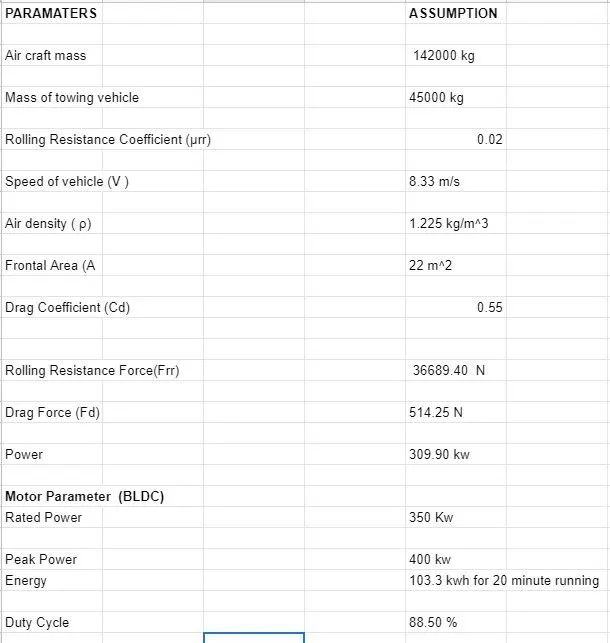
Air craft mass (Airbus A310-200) = 142000 kg
Mass of towing vehicle = 45000 kg
Total mass (m) = 142000 + 45000 = 187000 kg
Rolling Resistance Coefficient (μrr) = 0.02
Speed of vehicle (V ) = 30 kmph = 8.33 m/s
We Know That -
Frr = μrr * m * g
Frr = 0.02 * 187000 * 9.81 = 36689.40 N
2. Aerodynamic Drag Force (Fd)
Fd = 0.5 * ρ * A * V^2 *Cd
Assumption -
Air density ( ρ) = 1.225 kg/m^3
Frontal Area (A) = 22 m^2
Drag Coefficient (Cd) = 0.55
Speed of vehicle (V ) = 30 kmph = 8.33 m/s
We Know That -
Fd = 0.5 * ρ * A * V^2 *Cd
Fd = 0.5 * 1.225 *22 * 8.33^2 * 0.55 = 514.25 N
Total Force required to push / pull an aircraft by a towing vehicle = Frr + Fd = 36689.40 + 514.25 = 37203.65 N
Power Calculation (P)-
Power (P) = Ftotal * V
P = 37203.65 * 8.33 = 309.90 KW
B. Develop the model for the calculated force and power using Simulink.
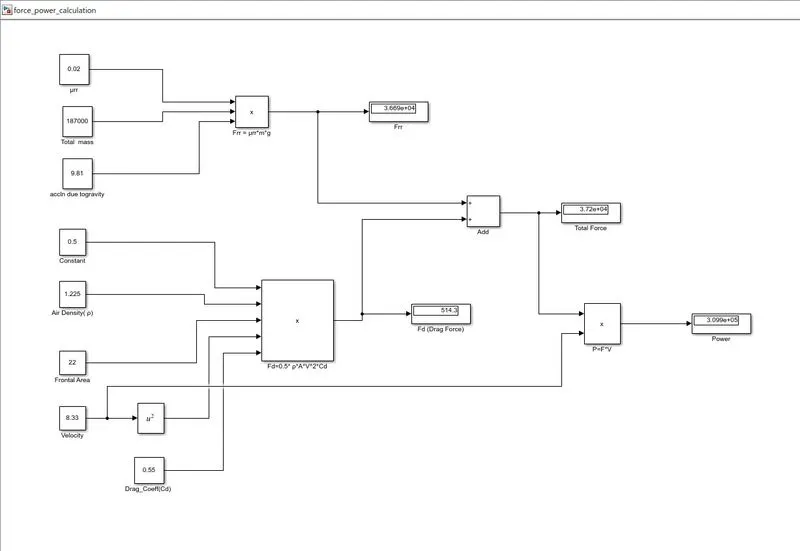
Simulink Modal -
Blocks Used -
- Constant Block For putting the data for calculatioin of Friction Resistance Force and Drag Force .
- Product Block for multiplying the values.
- Addition Block - For adding Friction Resistance Force and Drag Force
- Display Block - Our output is shown in the display block .
Conclusion -
- Friction Resistance Force (Frr) = 36689.40 N
- Drag Force (Fd) = 514.25 N
- Total Force (Ft) = 37203.65 N
- Power (P) = 309.90 KW
7. A. Design an electric powertrain with type of motor, it’s power rating, and energy requirement to fulfill aircraft towing application in Simulink. Estimate the duty cycle range to control the aircraft speed from zero to highest. Make all required assumptions. Prepare a table of assumed parameters. Draw a block diagram of powertrain.
Assumption For Designing Electric Power train -
Motor Type - BLDC Motor
Rated Power - 350 Kw
Peak power - 400 Kw
Time For Running - 20 min
Output Power = 309.90 Kw
- Energy requirement (E) = Energy (E) = P * t = 309.90 * 20 / 60 = 103.3 KWh ( energy required for towing the aircraft for 20 minutes)
- Duty Cycle(D) = Power Required / Rated Power
Duty Cycle = 309.90 / 350 = 0.885
Duty Cycle = 88.50 %
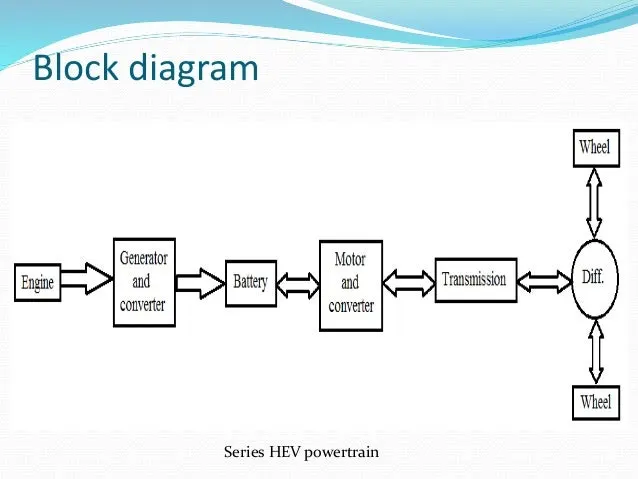
Block Diagram Of Powertrain -
EXCEL SHEET -