Project-1: Powertrain for aircraft in runways
1)
Search and list out the total weight of various types of aircrafts.
1)aerostat
2)aerodyne
AEROSTAT
An Aerostat (From Greek ἀήρ aer (air) + στατός statos (standing) through French) is a lighter than air aircraft that gains its lift through the use of a buoyant gas. Aerostats include unpowered balloons and powered airships. A balloon may be free-flying or tethered.
- Balloons
- Airships
- Hybrid aerostats
| S/NO | BALLOONS | AIRSHIPS |
Hybrid aerostats |
| 1 | A hot-air balloon is a lighter-than-air aircraft consisting of a bag, called an envelope, which contains heated air. |
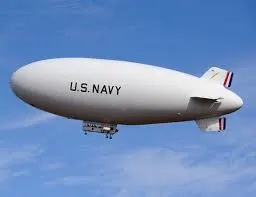
An airship, dirigible balloon or blimp is a type of aerostat or lighter-than-air aircraft that can navigate through the air under its own power. Aerostats gain their lift from a lifting gas that is less dense than the surrounding air. |
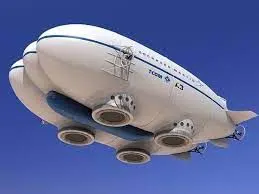
A hybrid type uses both static buoyancy and dynamic airflow to provide lift. The dynamic movement may be created either using propulsive power as a hybrid airship or by tethering in the wind like a kite, as a Helikite or kytoon. |
| 2 |  |
 |
 |
AERODYNE
- With engine
- Without engine
WITH ENGINE
- airplane
- rotory wing aircraft
- ornithopter
AIRPLANE
An airplane or aeroplane (informally plane) is a fixed-wing aircraft that is propelled forward by thrust from a jet engine, propeller, or rocket engine. Airplanes come in a variety of sizes, shapes, and wing configurations. The broad spectrum of uses for airplanes includes recreation, transportation of goods and people, militay, and research.
| S/NO | AMPHIBIAN | LAND PLANE | SEA PLANE |
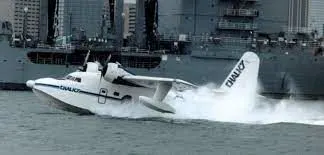
| 1 | An amphibious aircraft or amphibian is an aircraft that can take off and land on both solid ground and water |
Land planes are can be take off and land on a solid ground.example for passenger plane,cargo. |
A seaplane is a powered fixed-wing aircraft capable of taking off and landing (alighting) on water.seaplanes are usually divided into two categories based on their technological characteristics: floatplanes and flying boats; |
| 2 | 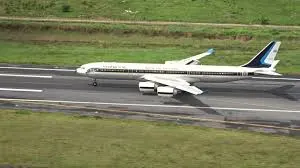 |
 |
ROTORCRAFT
- helecopter
- autogyro
- gyrodyne
- rotorkite
| S/NO | HELICOPTYER | AUTOGYRO | GYRODYNE | ROTORKITE |
| 1 | A helicopter is a rotorcraft whose rotors are driven by the engine(s) throughout the flight to allow the helicopter to take off vertically, hover, fly forwards, backwards and laterally, as well as to land vertically. Helicopters have several different configurations of one or more main rotors. | An autogyro (sometimes called gyrocopter, gyroplane, or rotaplane) utilizes an unpowered rotor, driven by aerodynamic forces in a state of autorotation to develop lift, and an engine-powered propeller, similar to that of a fixed-wing aircraft, to provide thrust | The rotor of a gyrodyne is normally driven by its engine for takeoff and landing – hovering like a helicopter – with anti-torque and propulsion for forward flight provided by one or more propellers mounted on short or stub wings | A rotor kite or gyroglider is an unpowered rotary-wing aircraft. Like an autogyro or helicopter, it relies on lift created by one or more sets of rotors in order to fly |
| 2 | 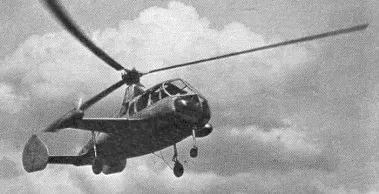 |
ORNITHOPTER
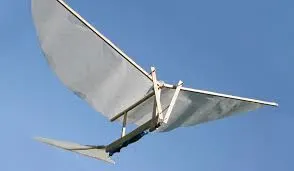
An ornithopter (from Greek ornithos "bird" and pteron "wing") is an aircraft that flies by flapping its wings. Designers seek to imitate the flapping-wing flight of birds, bats, and insects.
WITHOUT ENGINE
- glider
- kite
| S/NO | GLIDER | KITE |
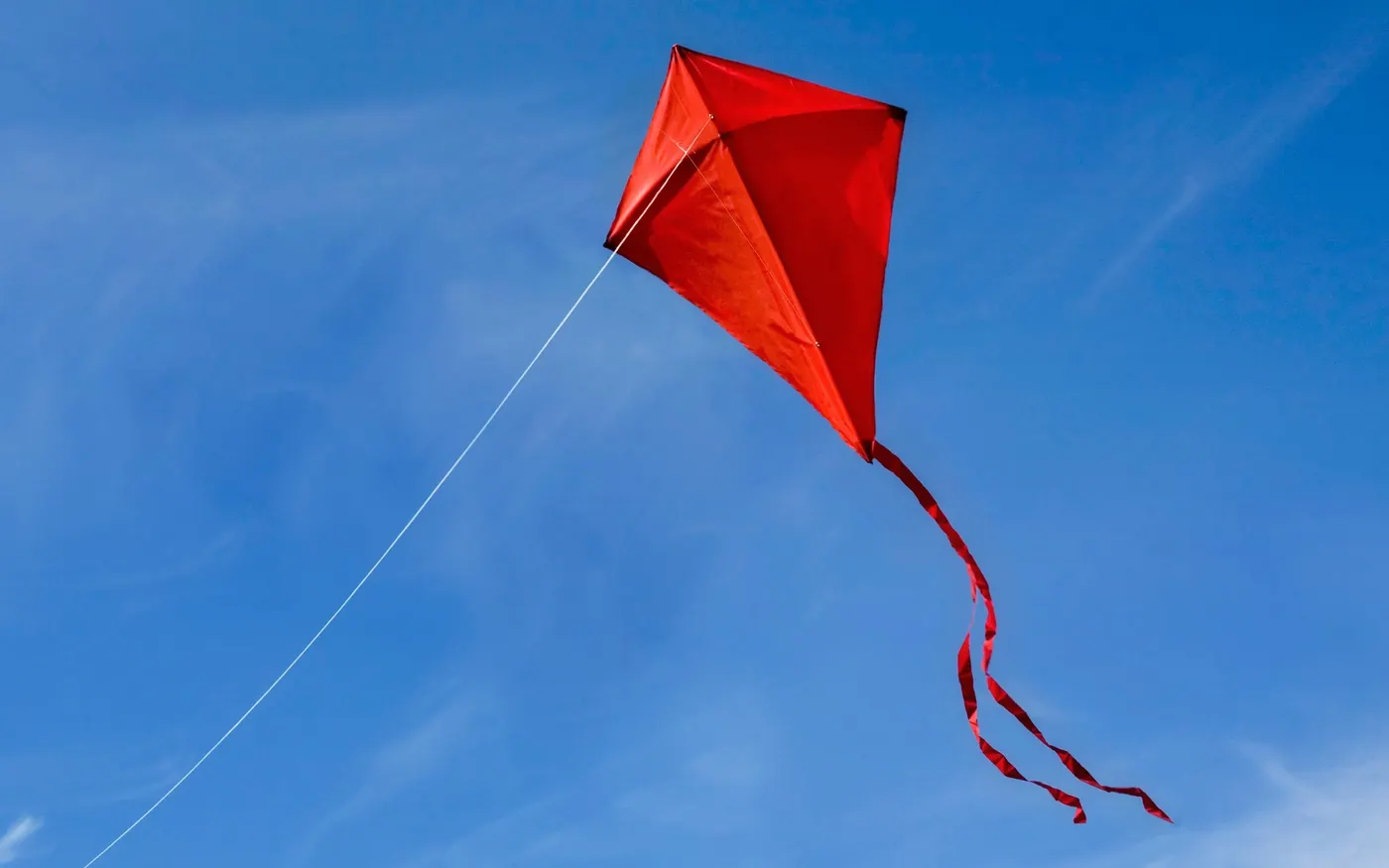
| 1 | glider is a fixed-wing aircraft that is supported in flight by the dynamic reaction of the air against its lifting surfaces, and whose free flight does not depend on an engine | A kite is a tethered heavier-than-air or lighter-than-air craft with wing surfaces that react against the air to create lift and drag forceS.A kite consists of wings, tethers and anchors. |
| 2 | 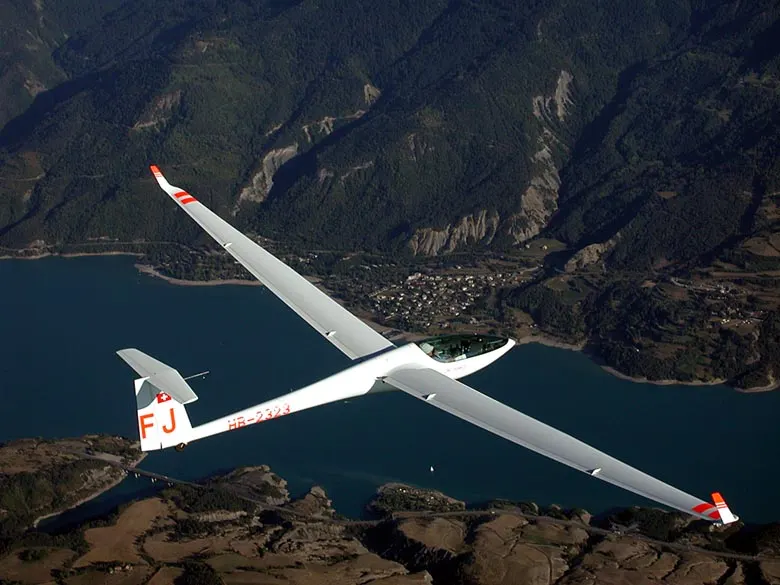 |
 |
2)
Is there any difference between ground speed and air speed?
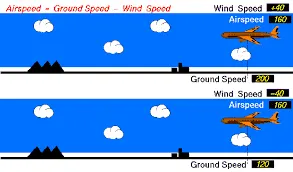
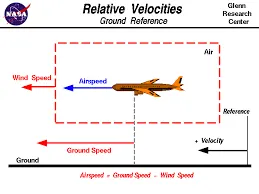
Airspeed is the vector difference between the ground speed and the wind speed. On a perfectly still day, the airspeed is equal to the ground speed. But if the wind is blowing in the same direction that the aircraft is moving, the airspeed will be less than the ground speed.
Ground Speed
For a reference point picked on the ground, the aircraft moves relative to the reference point at the ground speed. Ground speed is also a vector quantity so a comparison of the ground speed to the wind speed must be done according to rules for vector comparisons.
Airspeed
The important quantity in the generation of lift is the relative velocity between the object and the air, which is called the airspeed. Airspeed cannot be directly measured from a ground position, but must be computed from the ground speed and the wind speed. Airspeed is the vector difference between the ground speed and the wind speed.
Airspeed = Ground Speed - Wind Speed
3) Why is it not recommended to use aircraft engine power to move it on the ground at Airport?
Although many aircrafts are capable of moving in backward using reverse thrust, as result the jet blast or prop wash might cause damage to the terminal building or equipment. Engine close to ground may also blow sand and debris forward and then suck them into the engine, causing damage to the engine.
We are assuming passenger commuter aircraft and large airliners. Aircraft move using their own engine power all the time on the airport apron and taxiways under their own power to go towards runways and after landing taxi to their assigned gate.
The only time they use external assistance is to pushback from the gate. Large turbofan aircraft need help to reverse via a pushback tractor. The engines are turned on after the pushback is complete and the aircraft can move forward under It’s own power.
Most Aircraft Can’t Reverse
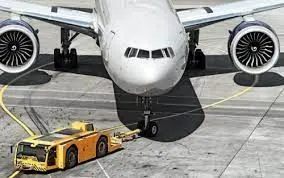
the obvious problem with parking facing the terminal is that in order to get to the runway, we need to move backward off the stand first. If this was on your drive at home, you’d just pop your car into reverse, back out onto the street and off you go. Unfortunately, aircraft are unable to do this as they don’t have a reverse gear. In order to get round this problem, we use the assistance of a pushback tug.
4)How an aircraft is pushed to runway when its ready to take off?
Before an aircraft can take off, it has to taxi (i.e. move on the ground under its own power) from the airport terminal to the runway. Aircraft always take off into a headwind, as this increases airspeed and so reduces the length of the take-off run, so the plane will taxi to the downwind end of the runway.
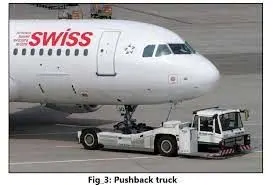
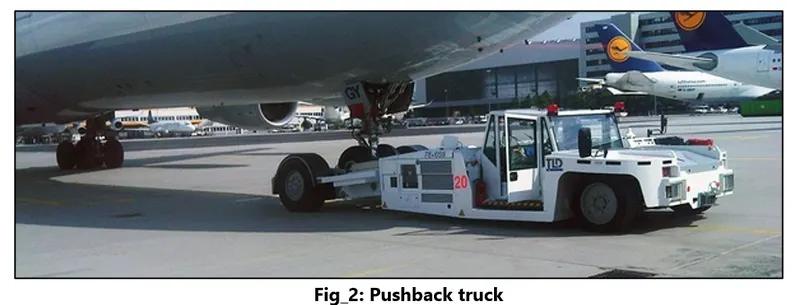
pushback truck reverses the aircraft into taxiing position, pushing it with a towbar attached to the nose-wheel strut. Or, in the most modern versions, by actually lifting the wheel. ... The aircraft taxis to the runway to depart at the agreed time
In aviation, pushback is an airport procedure during which an aircraft is pushed backwards away from an airport gate by external power. Pushbacks are carried out by special, low-profile vehicles called pushback tractors or tugs. ... A pushback is therefore the preferred method to move the aircraft away from the gate.
5) Learn about take off power, tyre design, rolling resistance, tyre pressure, brake forces when landing.
Aircraft Takeoff Performance Calculation Method
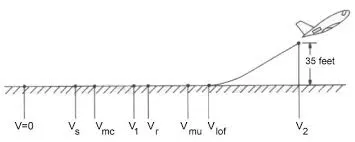
1)Takeoff speeds and takeoff distance
When an aircraft takes off, one or more engines may fail suddenly and it may encounter a
variety of situations. There are four basic situations which should be researched for
calculating the takeoff performance of an aircraft, including:
(i) takeoff with all engines operating(AEO),
(ii) takeoff with one engine inoperative(OEI),
(iii) rejected takeoff with all engines operating,
(iv) rejected takeoff with one engine inoperative.
2)tyre design
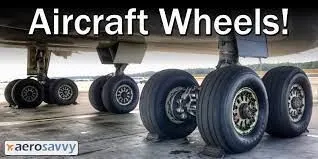
When it comes to safety, tyres are one of the most important components of aircraft. They help to absorb the shock of landing and provide cushioning. It also provides the necessary traction for braking and stopping of an aircraft.
An aircraft tyre is designed to withstand extremely heavy loads while landing, take off, taxing, and parking. The number of wheels required for aircraft increases with the weight of the aircraft, as the weight of the aeroplane needs to be distributed more evenly.
A Boeing 737NG & 737MAX uses 6 wheels, Boeing 787 uses 10 wheels, Boeing 777 uses 14 wheels and Airbus A380 uses 22 wheels. Aircraft tyres work under extreme conditions, carrying up to 340 tons and accelerating at over 250 km/hour at takeoff, in addition to enduring varied environmental stress when in flight and taxiing.
some technical aspects of the tyre.
Retreading – Retreading is methods of restoring a worn tyre by renewing the tread area or by renewing the tread area plus one or both sidewalls. Repairs are included in the tyre retreading process.
Load Rating – Load rating is the maximum permissible load at a specified inflation pressure.
Ply Rating – Ply Rating is used to identify the maximum recommended load rating and inflation pressure for a specified tyre. It is an index of tyre strength.
Speed Rating – The speed rating is the maximum takeoff speed to which the tyre has been tested.
Skid Depth – Skid depth is the distance between the tread surface and the deepest groove as measured in the mould.
Aircraft tyres may be Tube-type or Tubeless
Tubeless tyres are more advantageous over tube-type. There is no longer the use of tube-type tyre in recent aviation. Nowadays all airliners are using tubeless tyres. Tubeless that are meant to be used without a tube has the word TUBELESS on the sidewall of the tyre.
Aircraft Tyre Standards
Each tyre manufacturer produces their own designs of the tyre with different tread patterns, wear patterns, wear limits etc, and in some cases, different names for the same part of the tyre. But all tyres must meet the approved standards before being accepted by the FAA or CAA.
All commercial aircraft tyres approved under FAA Requirement Technical Standard Order (TSO) C62. A TSO is a minimum performance standard for specified materials, parts, and appliances used on civil aircraft.
3)Rolling resistance:
The friction between aircraft and runway will be proportional to the normal force exerted by the aircraft on the runway.
f=u(W-L)
The normal force will be the difference between Weight of aircraft and Lift, the friction coefficient will be typically of a magnitude of 0.02 for a standard tarmac runway.
4)Tyre pressure
Aircraft tires generally operate at high pressures, up to 200 psi (14 bar; 1,400 kPa) for airliners, and even higher for business jets. The main landing gear on the Concorde was typically inflated to 232 psi (16.0 bar), whilst its tail bumper gear tires were as high as 294 psi (20.3 bar).
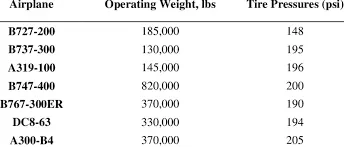
Normal tire pressure is usually between 32~40 psi(pounds per square inch) when they are cold.
Aircraft Tire Inflation: When inflating aircraft tires, many regulatory agencies require nitrogen gas to be used. It provides a stable and inert atmosphere while also eliminating the presence of moisture within the tire's cavity, preventing oxidative degradation of the rubber tires.
5)brake forces when landing.
Depending on the various aspects of landing, the level of the auto brake can be changed to get the desired effect. ... For this reason, most pilots nowadays have to prepare the autobraking system before landing. After the aircraft has slowed down to an extent, the pilots switch to manual braking.
Most-modern aircraft are nowadays equipped with autobraking systems controlled by the autopilot. Depending on the various aspects of landing, the level of the auto brake can be changed to get the desired effect. A lot depends on the length and the state of the runway. For example, it will take some tough braking to stop a B747 touching down on a wet runway at the speed of 290 km/hr.
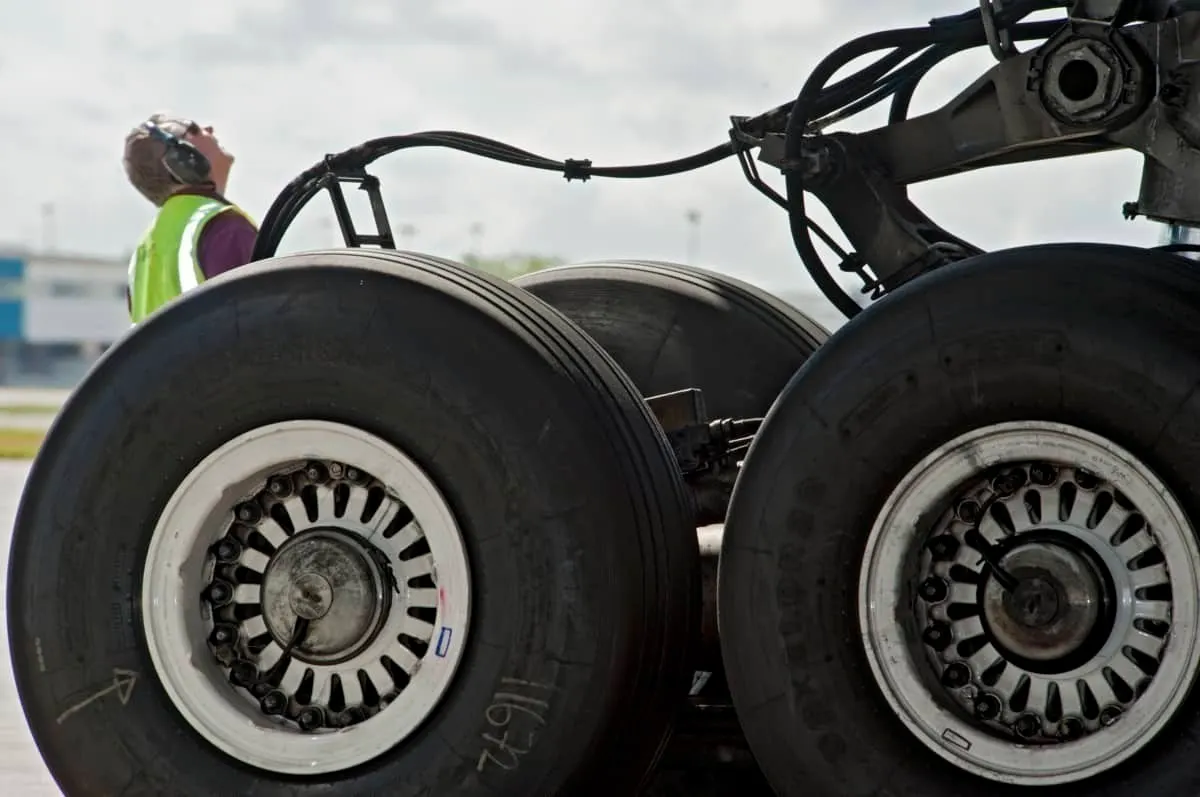
Wheel brakes
The wheel braking system is the most common form of braking on any given vehicle in the world. Unsurprisingly an aircraft has it too. Nevertheless, the braking system on any given aircraft is highly-engineered and sophisticated. The complexity of a disc-braking system is such that it is hard to explain it in few words.
Simply put, the disc braking system of a wheel is a part that is fixed and doesn’t rotate with the other part of the wheel. Just like a pad on any modern-vehicle, these stationary discs act as friction to the rotating part and cause it to either gradually stop or reduce its rotation speed.
Hit the brakes
Aircraft have highly-engineered, multi-disc brakes made of a carbon-steel material. Manufacturers include Honeywell and Goodrich, part of Collins Aerospace. In general, the brakes are composed of discs that rotate with the wheel and separate discs that are fixed. When pressure is applied—and below you see pressure applied from the right fixed disc on all of the discs—the entire assembly compresses to create the braking action. Carbon brakes are standard today; they cool faster than steel brakes (their predecessor) and can weigh up to 700 pounds less. That represents a significant weight saving for airlines.
6)With necessary assumptions, calculate the force and power required to push / pull an aircraft by a towing vehicle.
The force to move an airplane on an absolute flat runway with no wind at constant low speed is equal to the rolling resistance between the plane and the tarmac.
The rolling resistance for the air plane can be calculated as
Fr = c mr ag (1)
where
Fr = rolling resistance (N, lbf)
c = rolling resistance coefficient
mr = rolling mass (kg, lbm)
ag = acceleration of gravity (9.81 m/s2)
if the mass of a plane is 40000 kg and the rolling coefficient between the aircraft wheel and the tarmac is 0.02 - the force required to overcome the rolling resistance can be calculated as
Fr = 0.02 (40000 kg) (9.81 m/s2)
= 7848 N
This force can be delivered by a pulling truck or - as occasionally seen - by a number of pulling people. Enough weight for the pullers are required to create friction forces against the tarmac that equals the plane rolling resistance.
The friction force for the puller can be calculated to
Ff = μ W
= μ mf ag (2)
where
Ff = frictional force (N, lb)
μ = friction coefficient
W = weight (N, lbf)
mf = friction mass (kg)
Required Mass for Pulling Truck
The friction coefficient between a pulling truck rubber wheels and dry tarmac is 0.9. Since pulling trucks are connected to air crafts nose wheels close to tarmac we simplify the calculation of required truck mass to
mf = (7848 N) / (0.9 (9.81 m/s2))
= 889 kg
Air Craft Pulled by People
When persons participates in aircraft pulling there is normally an offset between the rope connected to the air craft nose wheel and the tarmac. It is common for persons to bend over with the rope over the shoulder or holding it in the hands.
The horizontal friction force between the persons shoes and the tarmac must be equal or larger than the air plane rolling resistance. The minimum required vertical force - or minimum weight of the people - depends on the bending angle as illustrated in the vector diagram below.
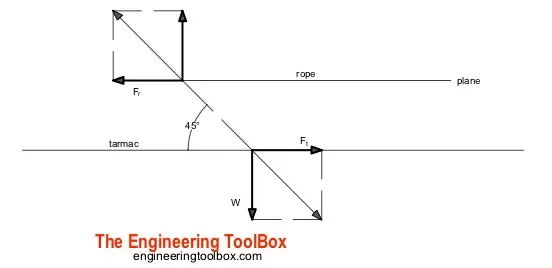
If they bend over 45o - the vertical force or weight equals to the horizontal force. With rubber shoes and the same friction coefficient as above for the truck the weight of the people should be 889 kg. With an average weight of 80 kg/person - the number of persons can be calculated to
n = (889 kg) / (80 kg/person)
= 11.1
= 12
With a more realistic bending angle 60o - the minimum vertical force or weight can be calculated as
W = tan(60o) (7848 N)
= 13593 N
The minimum mass of people to achieve this weight can be calculated as
mf = W / ag
= (13593 N) / (9.81 m/s2)
= 1386 kg
With an average weight of 80 kg/person - the minimum number of persons can be calculated to
n = (1386 kg) (80 kg/person)
= 17.3
= 18
How does drag affect an aircraft in flight?
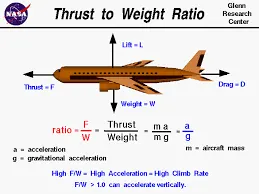
Drag is the force which delays or slows the forward movement of an airplane through the air. It is the friction of the air as it meets and passes over and about an airplane and its components. The more surface area exposed to rushing air, the greater the drag. An airplane's streamlined shape helps it pass through the air more easily.
Drag is created by the force of air particles striking and flowing around the airplane, and it is overcome through thrust. If you've ever tried running or riding a bike into a strong headwind, then you have directly experienced how hard drag can be to overcome at times (in the case of riding a bicycle, you create thrust by pedaling).
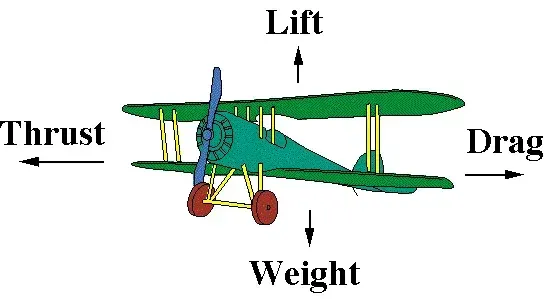
Drag depends on the density of the air, the square of the velocity, the air's viscosity and compressibility, the size and shape of the body, and the body's inclination to the flow. In general, the dependence on body shape, inclination, air viscosity, and compressibility is very complex.
One way to deal with complex dependencies is to characterize the dependence by a single variable. For drag, this variable is called the drag coefficient, designated "Cd." This allows us to collect all the effects, simple and complex, into a single equation. The drag equation states that drag D is equal to the drag coefficient Cd times the density r times half of the velocity V squared times the reference area A.
D = Cd * A * .5 * r * V^2
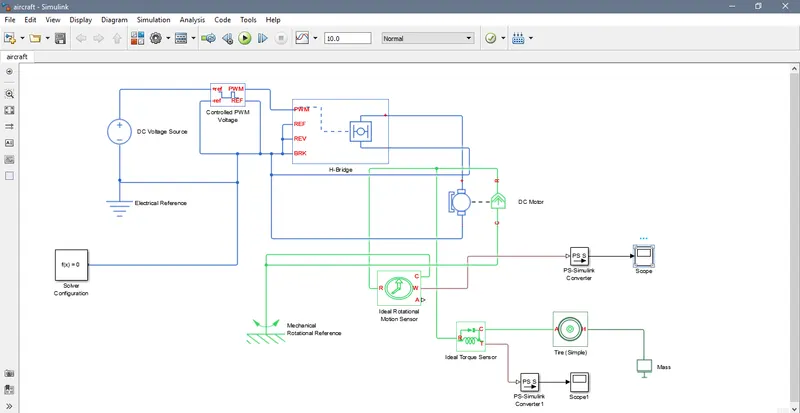
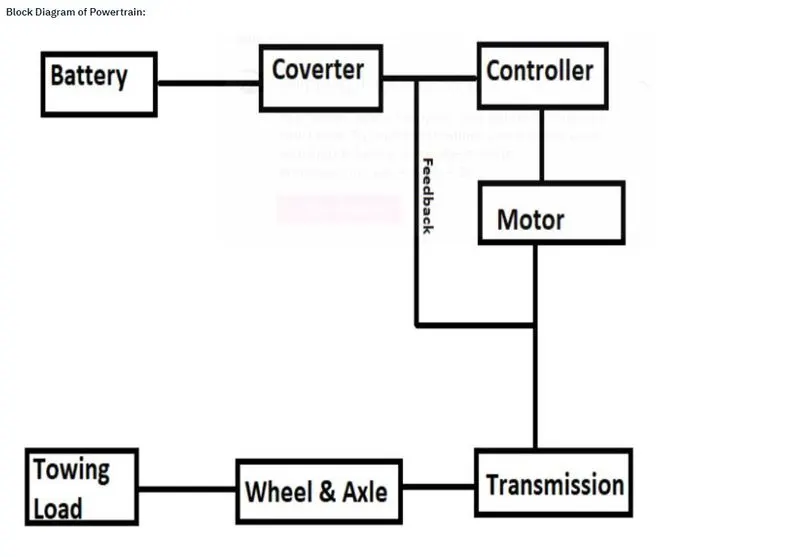
7)A. Design an electric powertrain with type of motor, it’s power rating, and energy requirement to fulfill aircraft towing application in Simulink. Estimate the duty cycle range to control the aircraft speed from zero to highest. Make all required assumptions. Prepare a table of assumed parameters. Draw a block diagram of powertrain.
simulink model
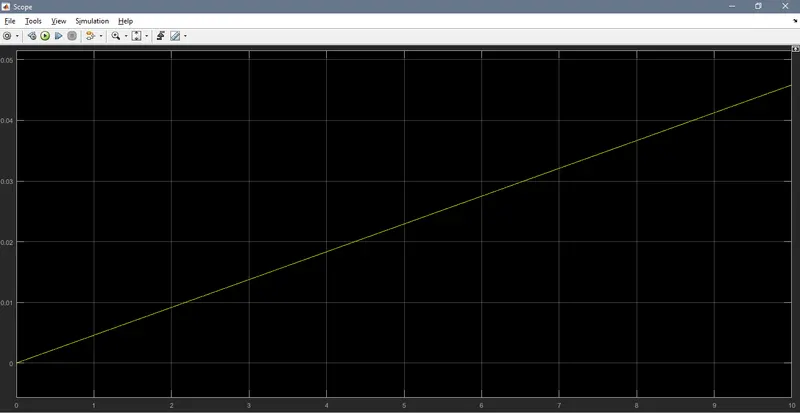
result:
for speed :