MATLAB program for Parsing NASA thermodynamic data
AIM: To write a MATLAB program to parse the NASAs thermodynamic data file and obtain the required objectives.
OBJECTIVE: The objectives are shown below,
- Write a MATLAB program that will extract fourteen coefficients and calculates the enthalpy, specific heat, and entropy for all the species in the given data file.
- Determine the molecular weight of each individual species.
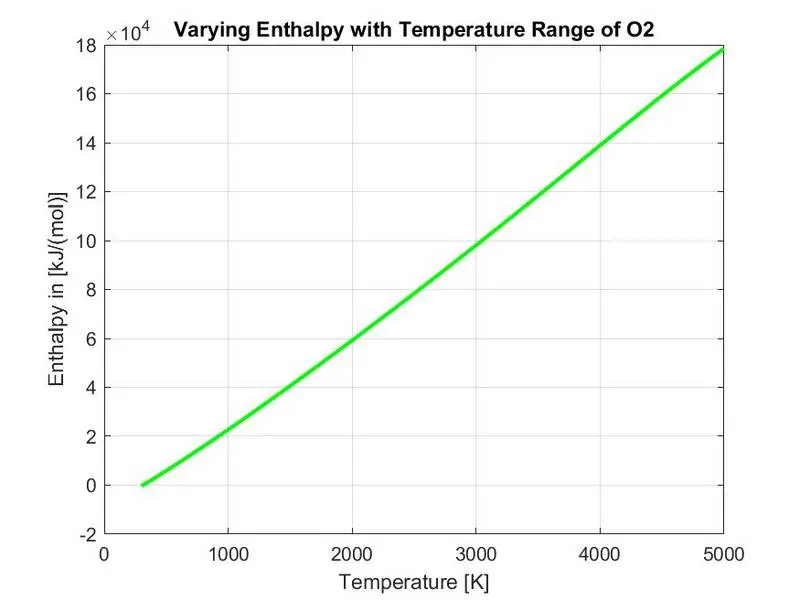
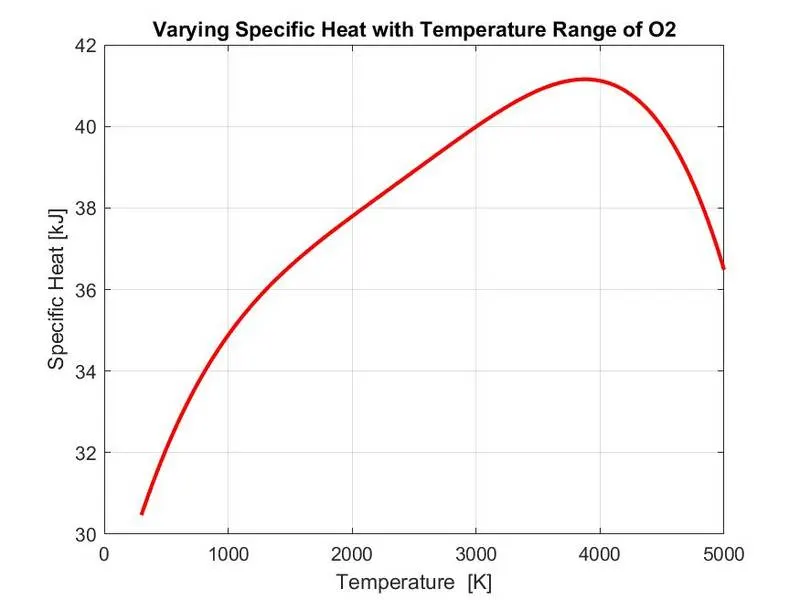
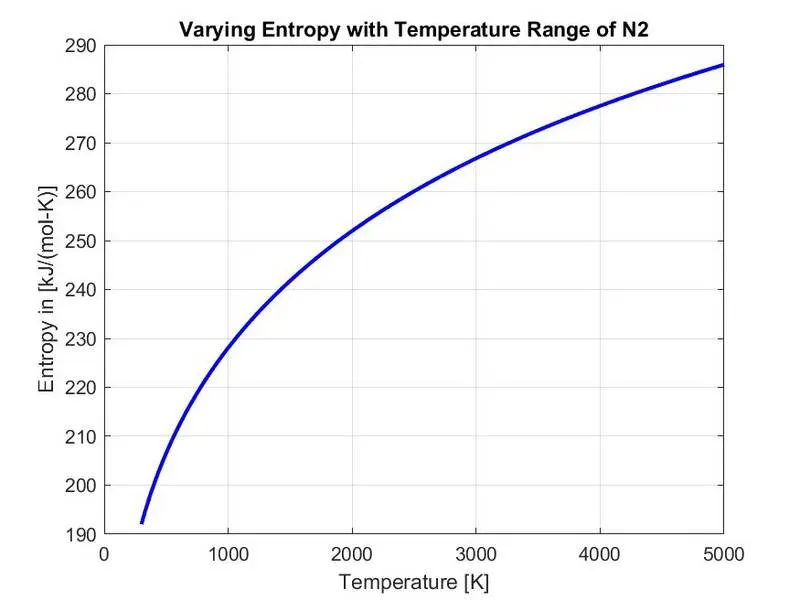
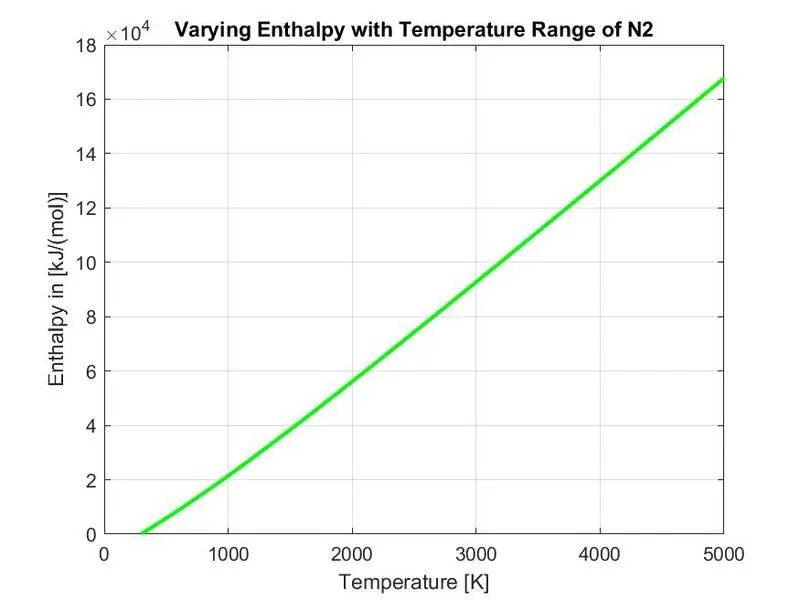
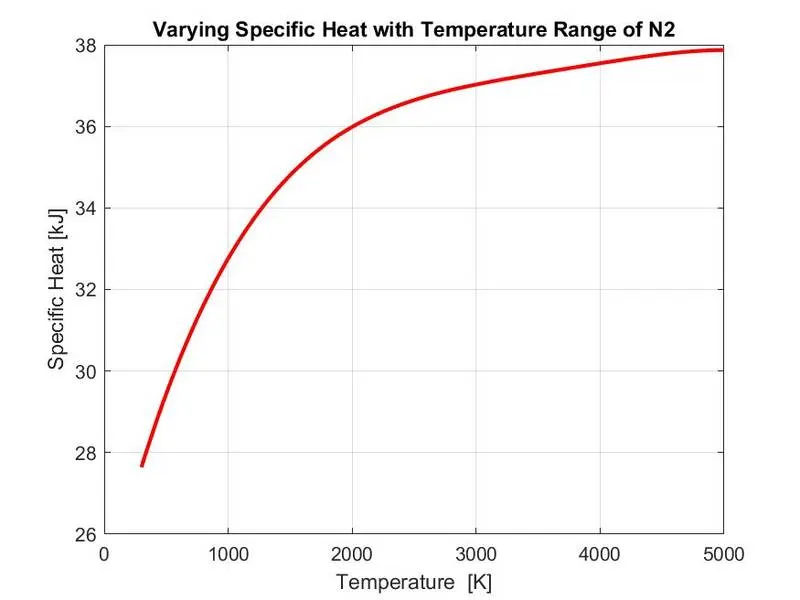
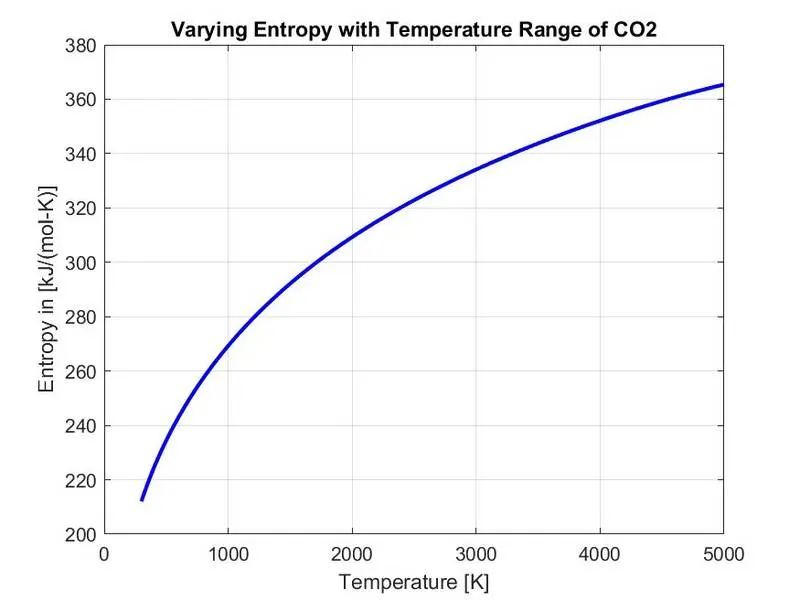
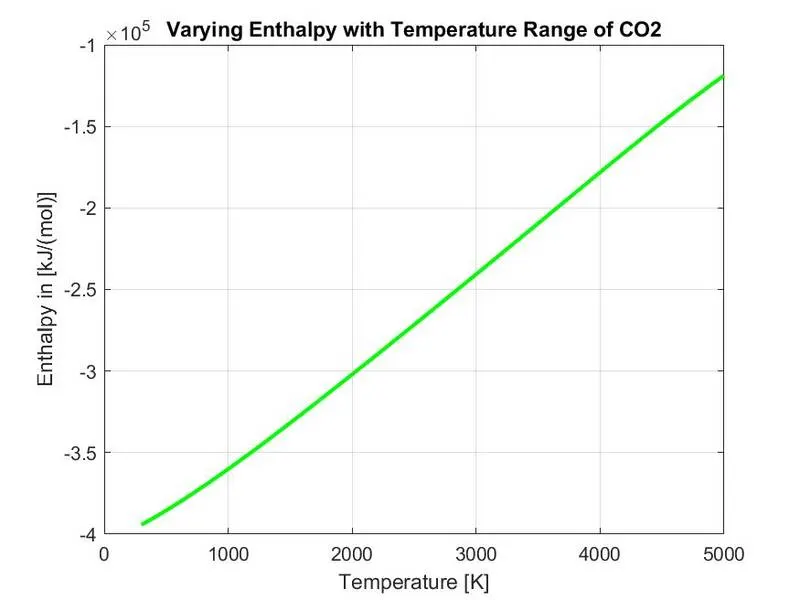
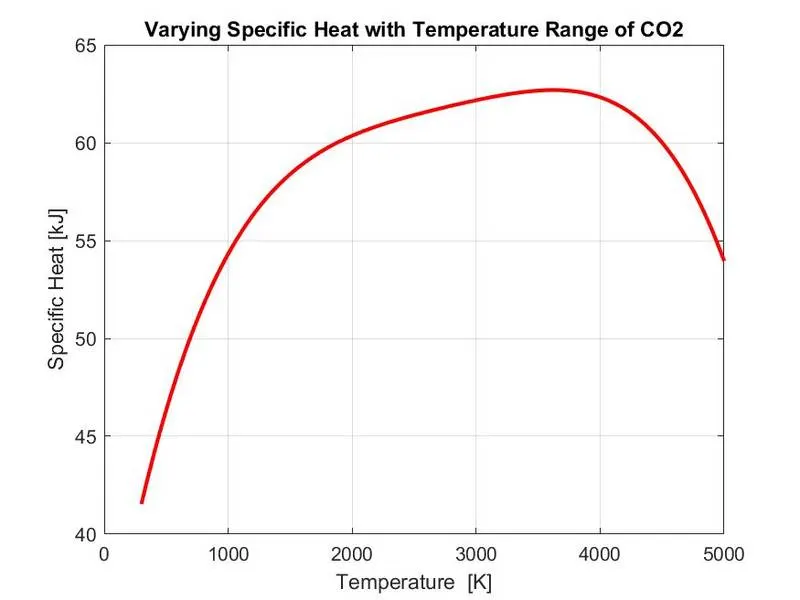
- Plot the specific heat, enthalpy, and entropy for the local temperature range (low temperature, and high temperature) specific for each individual species.
- Save each plot as an image with the appropriate name and collect it in a file
INTRODUCTION:
File Parsing: According to formal grammar rules, parsing, syntax analysis is a method of examining a string of symbols, either in computer languages, natural language, or data structures. The term parsing originates from the Latin term pars (orationis), representing part (of speech). In computational linguistics, the word refers to the formal analysis by a computer of a sentence or another string of terms into its elements, resulting in a parse tree presenting their syntactic relation, which may also contain semantic and other information. Some parsing algorithms may create a parse forest or record of parse trees for a syntactically ambiguous input.
Parsing a file means reading in a data stream of some sort and building an in-memory model of that data's semantic content. This points at helping to perform some change in the data.
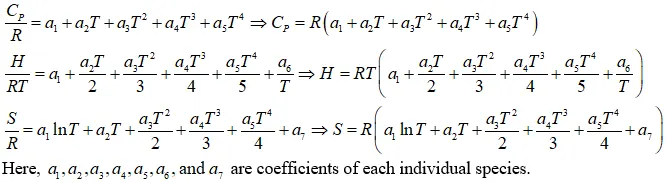
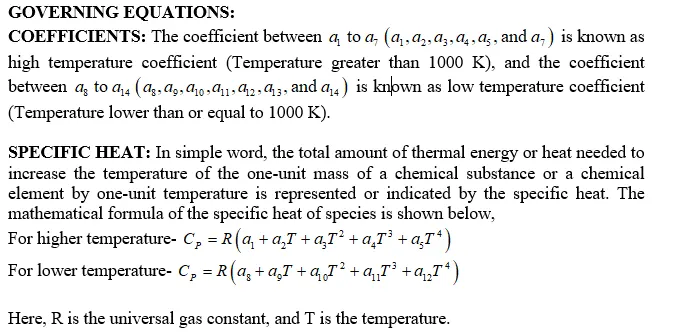
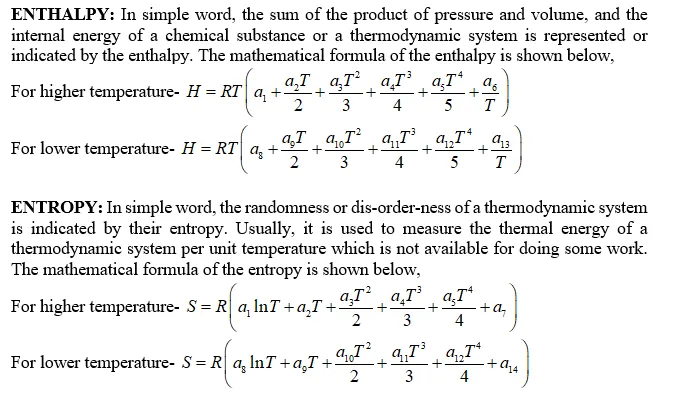
NASA Thermodynamic File: NASA thermodynamics file is the THERMO.dat file in which there are temperature ranges, and 53 species are given in these data, and each species contains 14 coefficients and temperature ranges. We have to parse these 14 coefficients to find Specific heat, Entropy, and Enthalpy using the formula as shown below,
MOLECULAR WEIGHT: In simple words, the total mass available in the one-unit moles of a chemical substance is generally represented or indicated by the term molecular weight. We know that the molecular weight of a chemical compound is equivalent to the sum of each individual chemical element present on it with its proper number. For example, the molecular weight of water (H2O) is equivalent to the sum of the molecular weight of one oxygen, and the molecular weight of two hydrogens.
MATLAB PROGRAM:
MATLAB program for the function of Specific heat (Cp):
function  Cp = specific_heat_function(a1,a2,a3,a4,a5,a8,a9,a10,a11,a12,Temp,R,Global_Medium_temp)
%Compare the temperature with Global Temperatures, if the temperature is
%less than 1000, then we need to use following condition:
if  T <= Global_Medium_temp
    Cp = R*(a8 + (a9*T) + (a10*(T).^2) + (a11*(T).^3) + (a12*(T).^4));
%Compare the temperature with Global Temperatures, if the temperature is
%higher than 1000, then we need to use following condition:
else
    Cp = R*(a1 + (a2*T) + (a3*(T).^2) + (a4*(T).^3) + (a5*(T).^4));
end
MATLAB program for the function of Enthalpy (H):
function H = enthalpy_function(a1,a2,a3,a4,a5,a6,a8,a9,a10,a11,a12,a13,T,R,Global_Medium_temp)
%Compare the temperature with Global Temperatures, if the temperature is
%less than 1000, then we need to use following condition:
 if T <= Global_Medium_temp
        H = R*T.*(a8 + ((a9*T)/2) + ((a10*(T).^2)/3) + ((a11*(T).^3)/4) + ((a12*(T).^4)/5) +((a13./T)));
 %Compare the temperature with Global Temperatures, if the temperature is
%higher than 1000, then we need to use following condition:
 else
     H = R*T.*(a1 + ((a2*T)/2) + ((a3*(T).^2)/3) + ((a4*(T).^3)/4) + ((a5*(T).^4)/5) +((a6./T)));
end
MATLAB program for the function of Entropy (H):
function S = entropy_function(a1,a2,a3,a4,a5,a7,a8,a9,a10,a11,a12,a14,T,R,Global_Medium_temp)
%Compare the temperature with Global Temperatures, if the temperature is
%less than 1000, then we need to use following condition:
   if T <= Global_Medium_temp
        S = R.*(a8.*log(T) + (a9.*T) + (a10*((T).^2)/2) + (a11*((T).^3)/3) + (a12*((T).^4)/4) + a14);
%Compare the temperature with Global Temperatures, if the temperature is
%higher than 1000, then we need to use following condition:
   else
        S = R.*(a1.*log(T) + (a2.*T) + (a3*((T).^2)/2) + (a4*((T).^3)/3) + (a5*((T).^4)/4) + a7);
end
MATLAB program for the function of the Molecular weight (M):
function M = molecular_weight_function(Species)
%Atomic name of each individual standard chemical element is shown below,
% Hydrogen (H), Carbon (C), Oxygen (O), Nitrogen (N), Argon (A):
Atomic_name = ['H','C','O','N','A'];
fprintf('Molecular Weight of ');
fprintf(Species);
fprintf(' : ');
%Atomic Number of each individual standard chemical element is shown below,
% Hydrogen (H)-(1.008), Carbon (C)-(12.011), Oxygen (O)-(15.999), Nitrogen (N)-(14.007)
%, Argon (A)-(39.948):
Atomic_weight = [1.008 12.011 15.999 14.007 39.948];
% Starting Range of Molecule
M = 0;
% Adding Atomic number to obtain particular value
 for i = 1:length(Species)
     for j = 1:length(Atomic_name)
         if strcmpi(Species(i),Atomic_name(j))
             M = M +Atomic_weight(j);
             position = j;
         end
     end
     n = str2num(Species(i));
     if n>1
         M = M + Atomic_weight(position)*(n-1);
     end
        end
            fprintf('molecular weight %s :',Species);
            fprintf('%d',M);
            disp(' ');
end
Syntax Needed to write the MATLAB program is shown below,
|
Fopen |
Open a file or obtain information about open files |
|
‘r’ |
Open the file for reading |
|
fgetl |
Read line from file |
|
Split string or character vector at the specified delimiter |
|
|
strsplit |
Split string or character vector at the specified delimiter |
|
str2num |
Convert character array or string to numeric array |
|
strfind |
Find one string within another |
|
linspace |
Generate linearly spaced vectors |
|
fprintf |
Write formatted data to file |
|
pwd |
Identify current directory |
|
mkdir |
Make a new directory |
|
cd |
Change the working directory |
Steps needed to write the code:
- Read the text file 'Thermo.dat' file and open it by using ‘fopen’ and 'r' command.
- Read the line in a text file using ‘fgetl’ command.
- Obtain the temperature range from the Thermo.dat file, using ‘strsplit’ command.
- Use ‘str2num’ command for converting string cells into numbers.
- Divide the temperature into a string and then convert it into a number of thermodynamics.
- Use ‘for & end’ loops and skip the next three comment lines in the text file.
- Read all the 53 species to plot specific heat(cp), enthalpy(H), and entropy(S), with temperature values, and determine the molecular weights.
- Use ‘strfind’ command to find the string.
- Use 'linspace' command to specify the temperature range from low to high.
- Add universal gas constant numerical value ‘R’.
- Call specific heat, enthalpy, entropy function codes.
- Calculate Molecular weight.
MATLAB program to parse the NASAs thermodynamic data file and obtain the required objectives:
clear all
close all
clc
%  Reading Data file - NASA Thermodynamic
% Open the file and read it
f1 = fopen('THERMO.dat','r');
gt = fgetl(f1);
%Obtan Global Temperatures by Reading the header information of the
% THERMO.dat file
Global_temp = fgetl(f1);
%Split the global temperature as low, mid, and max
t = strsplit(Global_temp);
%Converting string cells to numbers,
Global_Low_temp = str2num(t{2});
Global_Medium_temp = str2num(t{3});
Global_High_temp = str2num(t{4});
%Assume and show the temperature Range,
T = linspace(Global_Low_temp,Global_High_temp,1000);
%Value of the Universal Gas Constant,
R = 8.314;
%skip all three comment lines present in the file
for i = 1:3
    gt=fgetl(f1);
end
 for i = 1:53
gt=fgetl(f1);
A=strsplit(gt,' ');
Species=(A{1});
line_1=fgetl(f1);
a=strfind(line_1,'E');
%Extract each indivudual higher and lower temperature coefficients
%Extract first 7 coefficients that is also known as high-temperature coefficients
%First Coefficients
a1=line_1(1:a(1)+3);
a1=str2num(a1);
%Second Coefficients
a2=line_1(a(1)+4:a(2)+3);
a2=str2num(a2);
%Third Coefficients
a3=line_1(a(2)+4:a(3)+3);
a3=str2num(a3);
%Fourth Coefficients
a4=line_1(a(3)+4:a(4)+3);
a4=str2num(a4);
%Fifth Coefficients
a5=line_1(a(4)+4:a(5)+3);
a5=str2num(a5);
line_2=fgetl(f1);
b=strfind(line_1,'E');
%Sixth Coefficients
a6=line_2(1:b(1)+3);
a6=str2num(a6);
%Seventh Coefficients
a7=line_2(a(1)+4:b(2)+3);
a7=str2num(a7);
% Extract second 7 coefficients that is also known as low temperature coefficients
%Eighth Coefficients
a8=line_2(b(2)+4:b(3)+3);
a8=str2num(a8);
%Nineth Coefficients
a9=line_2(b(3)+4:b(4)+3);
a9=str2num(a9);
%Tenth Coefficients
a10=line_2(b(4)+4:b(5)+3);
a10=str2num(a10);
line_3=fgetl(f1);
c=strfind(line_1,'E');
%Eleventh Coefficients
a11=line_3(1:c(1)+3);
a11=str2num(a11);
%Twelth Coefficients
a12=line_3(c(1)+4:c(2)+3);
a12=str2num(a12);
%Thirteenth Coefficients
a13=line_3(c(2)+4:c(3)+3);
a13=str2num(a13);
%fourteenth Coefficients
a14=line_3(c(3)+4:c(4)+3);
a14=str2num(a14);
%Calculate specific heat by using the specific heat function,
Cp = specific_heat_function(a1,a2,a3,a4,a5,a8,a9,a10,a11,a12,T,R,Global_Medium_temp);
%Calculate enthalpy by using the enthalpy function,
H = enthalpy_function(a1,a2,a3,a4,a5,a6,a8,a9,a10,a11,a12,a13,T,R,Global_Medium_temp);
%Calculate Entropy by using the Entropy function,
S = entropy_function(a1,a2,a3,a4,a5,a7,a8,a9,a10,a11,a12,a14,T,R,Global_Medium_temp);
%Calculate molecular weight of specie by using the molecular weight function,
 M(i) = molecular_weight_function(Species);
%Read and write Molecular list,
Molecular_list = fopen('Molecular weight.txt','a+');
fprintf( Molecular_list,'Molecular weight of %s is %d n',Species,M);
fclose(Molecular_list);
%Plot(Cp,H,S,T,Species)
%Save in the folder
cur_dir=pwd;
mkdir(Species);
cd(Species);
% Plot 1, Specific heat (CP) vs Temperature Range (Temp) plot,
figure(1)
plot(T,Cp,'linewidth',2,'color','r');
xlabel('Temperature  [K]');
ylabel('Specific Heat [kJ]');
title(sprintf('Varying Specific Heat with Temperature Range of %s',Species));
grid on
saveas(figure(1),'Specific Heat.jpg');
% Plot 2, Enthalpy (H) vs Temperature Range (Temp) plot,
figure(2)
plot(T,H,'linewidth',2,'color','g');
xlabel('Temperature [K]');
ylabel('Enthalpy in [kJ/(mol)]');
title(sprintf('Varying Enthalpy with Temperature Range of %s',Species));
grid on
saveas(figure(2),'Ethalpy.jpg');
% Plot 3, Entropy (S) vs Temperature Range (Temp) plot,
figure(3)
plot(T,S,'linewidth',2,'color','b');
xlabel('Temperature [K]');
ylabel('Entropy in [kJ/(mol-K)]');
title(sprintf('Varying Entropy with Temperature Range of %s',Species));
grid on
saveas(figure(3),'Entropy.jpg');
cd(cur_dir);
% Molecular weight of each species
M = molecular_weight_function(Species);
f2 = fopen('molecular mass','w');
fprintf('%s n %s n %f n','species','Molecular mass',M)
fclose(f2)
 end
OUTPUT:
Species =
'O'
Molecular Weight of O : molecular weight O :1.599900e+01
Molecular Weight of O : molecular weight O :1.599900e+01
M =
15.9990
species n Molecular mass n 15.999000 n
ans =
0
Species =
'O2'
Molecular Weight of O2 : molecular weight O2 :3.199800e+01
Molecular Weight of O2 : molecular weight O2 :3.199800e+01
M =
31.9980
species n Molecular mass n 31.998000 n
ans =
0
Species =
'H'
Molecular Weight of H : molecular weight H :1.008000e+00
Molecular Weight of H : molecular weight H :1.008000e+00
M =
1.0080
species n Molecular mass n 1.008000 n
ans =
0
Species =
'H2'
Molecular Weight of H2 : molecular weight H2 :2.016000e+00
Molecular Weight of H2 : molecular weight H2 :2.016000e+00
M =
2.0160
species n Molecular mass n 2.016000 n
ans =
0
Species =
'OH'
Molecular Weight of OH : molecular weight OH :1.700700e+01
Molecular Weight of OH : molecular weight OH :1.700700e+01
M =
17.0070
species n Molecular mass n 17.007000 n
ans =
0
Species =
'H2O'
Molecular Weight of H2O : molecular weight H2O :1.801500e+01
Molecular Weight of H2O : molecular weight H2O :1.801500e+01
M =
18.0150
species n Molecular mass n 18.015000 n
ans =
0
Species =
'HO2'
Molecular Weight of HO2 : molecular weight HO2 :3.300600e+01
Molecular Weight of HO2 : molecular weight HO2 :3.300600e+01
M =
33.0060
species n Molecular mass n 33.006000 n
ans =
0
Species =
'H2O2'
Molecular Weight of H2O2 : molecular weight H2O2 :3.401400e+01
Molecular Weight of H2O2 : molecular weight H2O2 :3.401400e+01
M =
34.0140
species n Molecular mass n 34.014000 n
ans =
0
Species =
'C'
Molecular Weight of C : molecular weight C :1.201100e+01
Molecular Weight of C : molecular weight C :1.201100e+01
M =
12.0110
species n Molecular mass n 12.011000 n
ans =
0
Species =
'CH'
Molecular Weight of CH : molecular weight CH :1.301900e+01
Molecular Weight of CH : molecular weight CH :1.301900e+01
M =
13.0190
species n Molecular mass n 13.019000 n
ans =
0
Species =
'CH2'
Molecular Weight of CH2 : molecular weight CH2 :1.402700e+01
Molecular Weight of CH2 : molecular weight CH2 :1.402700e+01
M =
14.0270
species n Molecular mass n 14.027000 n
ans =
0
Species =
'CH2(S)'
Molecular Weight of CH2(S) : molecular weight CH2(S) :1.402700e+01
Molecular Weight of CH2(S) : molecular weight CH2(S) :1.402700e+01
M =
14.0270
species n Molecular mass n 14.027000 n
ans =
0
Species =
'CH3'
Molecular Weight of CH3 : molecular weight CH3 :1.503500e+01
Molecular Weight of CH3 : molecular weight CH3 :1.503500e+01
M =
15.0350
species n Molecular mass n 15.035000 n
ans =
0
Species =
'CH4'
Molecular Weight of CH4 : molecular weight CH4 :1.604300e+01
Molecular Weight of CH4 : molecular weight CH4 :1.604300e+01
M =
16.0430
species n Molecular mass n 16.043000 n
ans =
0
Species =
'CO'
Molecular Weight of CO : molecular weight CO :2.801000e+01
Molecular Weight of CO : molecular weight CO :2.801000e+01
M =
28.0100
species n Molecular mass n 28.010000 n
ans =
0
Species =
'CO2'
Molecular Weight of CO2 : molecular weight CO2 :4.400900e+01
Molecular Weight of CO2 : molecular weight CO2 :4.400900e+01
M =
44.0090
species n Molecular mass n 44.009000 n
ans =
0
Species =
'HCO'
Molecular Weight of HCO : molecular weight HCO :2.901800e+01
Molecular Weight of HCO : molecular weight HCO :2.901800e+01
M =
29.0180
species n Molecular mass n 29.018000 n
ans =
0
Species =
'CH2O'
Molecular Weight of CH2O : molecular weight CH2O :3.002600e+01
Molecular Weight of CH2O : molecular weight CH2O :3.002600e+01
M =
30.0260
species n Molecular mass n 30.026000 n
ans =
0
Species =
'CH2OH'
Molecular Weight of CH2OH : molecular weight CH2OH :3.103400e+01
Molecular Weight of CH2OH : molecular weight CH2OH :3.103400e+01
M =
31.0340
species n Molecular mass n 31.034000 n
ans =
0
Species =
'CH3O'
Molecular Weight of CH3O : molecular weight CH3O :3.103400e+01
Molecular Weight of CH3O : molecular weight CH3O :3.103400e+01
M =
31.0340
species n Molecular mass n 31.034000 n
ans =
0
Species =
'CH3OH'
Molecular Weight of CH3OH : molecular weight CH3OH :3.204200e+01
Molecular Weight of CH3OH : molecular weight CH3OH :3.204200e+01
M =
32.0420
species n Molecular mass n 32.042000 n
ans =
0
Species =
'C2H'
Molecular Weight of C2H : molecular weight C2H :2.503000e+01
Molecular Weight of C2H : molecular weight C2H :2.503000e+01
M =
25.0300
species n Molecular mass n 25.030000 n
ans =
0
Species =
'C2H2'
Molecular Weight of C2H2 : molecular weight C2H2 :2.603800e+01
Molecular Weight of C2H2 : molecular weight C2H2 :2.603800e+01
M =
26.0380
species n Molecular mass n 26.038000 n
ans =
0
Species =
'C2H3'
Molecular Weight of C2H3 : molecular weight C2H3 :2.704600e+01
Molecular Weight of C2H3 : molecular weight C2H3 :2.704600e+01
M =
27.0460
species n Molecular mass n 27.046000 n
ans =
0
Species =
'C2H4'
Molecular Weight of C2H4 : molecular weight C2H4 :2.805400e+01
Molecular Weight of C2H4 : molecular weight C2H4 :2.805400e+01
M =
28.0540
species n Molecular mass n 28.054000 n
ans =
0
Species =
'C2H5'
Molecular Weight of C2H5 : molecular weight C2H5 :2.906200e+01
Molecular Weight of C2H5 : molecular weight C2H5 :2.906200e+01
M =
29.0620
species n Molecular mass n 29.062000 n
ans =
0
Species =
'C2H6'
Molecular Weight of C2H6 : molecular weight C2H6 :3.007000e+01
Molecular Weight of C2H6 : molecular weight C2H6 :3.007000e+01
M =
30.0700
species n Molecular mass n 30.070000 n
ans =
0
Species =
'CH2CO'
Molecular Weight of CH2CO : molecular weight CH2CO :4.203700e+01
Molecular Weight of CH2CO : molecular weight CH2CO :4.203700e+01
M =
42.0370
species n Molecular mass n 42.037000 n
ans =
0
Species =
'HCCO'
Molecular Weight of HCCO : molecular weight HCCO :4.102900e+01
Molecular Weight of HCCO : molecular weight HCCO :4.102900e+01
M =
41.0290
species n Molecular mass n 41.029000 n
ans =
0
Species =
'HCCOH'
Molecular Weight of HCCOH : molecular weight HCCOH :4.203700e+01
Molecular Weight of HCCOH : molecular weight HCCOH :4.203700e+01
M =
42.0370
species n Molecular mass n 42.037000 n
ans =
0
Species =
'H2CN'
Molecular Weight of H2CN : molecular weight H2CN :2.803400e+01
Molecular Weight of H2CN : molecular weight H2CN :2.803400e+01
M =
28.0340
species n Molecular mass n 28.034000 n
ans =
0
Species =
'HCN'
Molecular Weight of HCN : molecular weight HCN :2.702600e+01
Molecular Weight of HCN : molecular weight HCN :2.702600e+01
M =
27.0260
species n Molecular mass n 27.026000 n
ans =
0
Species =
'HNO'
Molecular Weight of HNO : molecular weight HNO :3.101400e+01
Molecular Weight of HNO : molecular weight HNO :3.101400e+01
M =
31.0140
species n Molecular mass n 31.014000 n
ans =
0
Species =
'N'
Molecular Weight of N : molecular weight N :1.400700e+01
Molecular Weight of N : molecular weight N :1.400700e+01
M =
14.0070
species n Molecular mass n 14.007000 n
ans =
0
Species =
'NNH'
Molecular Weight of NNH : molecular weight NNH :2.902200e+01
Molecular Weight of NNH : molecular weight NNH :2.902200e+01
M =
29.0220
species n Molecular mass n 29.022000 n
ans =
0
Species =
'N2O'
Molecular Weight of N2O : molecular weight N2O :4.401300e+01
Molecular Weight of N2O : molecular weight N2O :4.401300e+01
M =
44.0130
species n Molecular mass n 44.013000 n
ans =
0
Species =
'NH'
Molecular Weight of NH : molecular weight NH :1.501500e+01
Molecular Weight of NH : molecular weight NH :1.501500e+01
M =
15.0150
species n Molecular mass n 15.015000 n
ans =
0
Species =
'NH2'
Molecular Weight of NH2 : molecular weight NH2 :1.602300e+01
Molecular Weight of NH2 : molecular weight NH2 :1.602300e+01
M =
16.0230
species n Molecular mass n 16.023000 n
ans =
0
Species =
'NH3'
Molecular Weight of NH3 : molecular weight NH3 :1.703100e+01
Molecular Weight of NH3 : molecular weight NH3 :1.703100e+01
M =
17.0310
species n Molecular mass n 17.031000 n
ans =
0
Species =
'NO'
Molecular Weight of NO : molecular weight NO :3.000600e+01
Molecular Weight of NO : molecular weight NO :3.000600e+01
M =
30.0060
species n Molecular mass n 30.006000 n
ans =
0
Species =
'NO2'
Molecular Weight of NO2 : molecular weight NO2 :4.600500e+01
Molecular Weight of NO2 : molecular weight NO2 :4.600500e+01
M =
46.0050
species n Molecular mass n 46.005000 n
ans =
0
Species =
'HCNO'
Molecular Weight of HCNO : molecular weight HCNO :4.302500e+01
Molecular Weight of HCNO : molecular weight HCNO :4.302500e+01
M =
43.0250
species n Molecular mass n 43.025000 n
ans =
0
Species =
'HOCN'
Molecular Weight of HOCN : molecular weight HOCN :4.302500e+01
Molecular Weight of HOCN : molecular weight HOCN :4.302500e+01
M =
43.0250
species n Molecular mass n 43.025000 n
ans =
0
Species =
'HNCO'
Molecular Weight of HNCO : molecular weight HNCO :4.302500e+01
Molecular Weight of HNCO : molecular weight HNCO :4.302500e+01
M =
43.0250
species n Molecular mass n 43.025000 n
ans =
0
Species =
'NCO'
Molecular Weight of NCO : molecular weight NCO :4.201700e+01
Molecular Weight of NCO : molecular weight NCO :4.201700e+01
M =
42.0170
species n Molecular mass n 42.017000 n
ans =
0
Species =
'CN'
Molecular Weight of CN : molecular weight CN :2.601800e+01
Molecular Weight of CN : molecular weight CN :2.601800e+01
M =
26.0180
species n Molecular mass n 26.018000 n
ans =
0
Species =
'HCNN'
Molecular Weight of HCNN : molecular weight HCNN :4.103300e+01
Molecular Weight of HCNN : molecular weight HCNN :4.103300e+01
M =
41.0330
species n Molecular mass n 41.033000 n
ans =
0
Species =
'N2'
Molecular Weight of N2 : molecular weight N2 :2.801400e+01
Molecular Weight of N2 : molecular weight N2 :2.801400e+01
M =
28.0140
species n Molecular mass n 28.014000 n
ans =
0
Species =
'AR'
Molecular Weight of AR : molecular weight AR :3.994800e+01
Molecular Weight of AR : molecular weight AR :3.994800e+01
M =
39.9480
species n Molecular mass n 39.948000 n
ans =
0
Species =
'C3H8'
Molecular Weight of C3H8 : molecular weight C3H8 :4.409700e+01
Molecular Weight of C3H8 : molecular weight C3H8 :4.409700e+01
M =
44.0970
species n Molecular mass n 44.097000 n
ans =
0
Species =
'C3H7'
Molecular Weight of C3H7 : molecular weight C3H7 :4.308900e+01
Molecular Weight of C3H7 : molecular weight C3H7 :4.308900e+01
M =
43.0890
species n Molecular mass n 43.089000 n
ans =
0
Species =
'CH3CHO'
Molecular Weight of CH3CHO : molecular weight CH3CHO :4.405300e+01
Molecular Weight of CH3CHO : molecular weight CH3CHO :4.405300e+01
M =
44.0530
species n Molecular mass n 44.053000 n
ans =
0
Species =
'CH2CHO'
Molecular Weight of CH2CHO : molecular weight CH2CHO :4.304500e+01
Molecular Weight of CH2CHO : molecular weight CH2CHO :4.304500e+01
M =
43.0450
species n Molecular mass n 43.045000 n
ans =
0
>>
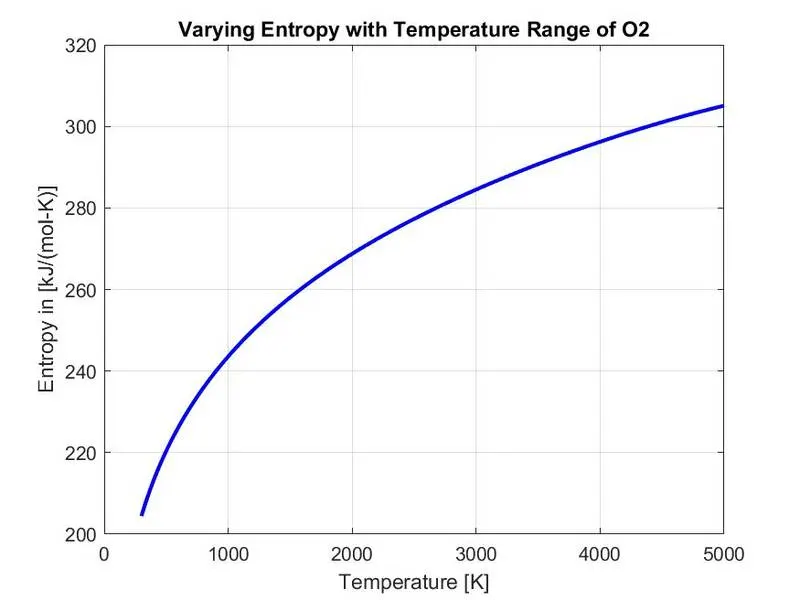
Plots of O2 Species is shown below,
Plot of N2 Species:
Plot of CO2 Species:
Conclusion:
The link of the file is attached below,
https://drive.google.com/drive/folders/1fH08fCTNLu2FjDs0scCKqNSO_ekzITkQ?usp=sharing
REFERENCES:
http://combustion.berkeley.edu/gri-mech/data/thermo_table.html
http://combustion.berkeley.edu/gri-mech/data/nasa_plnm.html
http://combustion.berkeley.edu/gri-mech/version30/files30/thermo30.dat