Project 1 - Parsing NASA thermodynamic data
Aim: To write a code in Matlab to parshing the NASA thermodynamic data file and then calculate the thermodynamic properties of various gases .
Objective :
1. To write a function that extracts the 14 coefficients and calculates the enthalpy, entropy, and specific heats for all the species in the NASA thermodynamic data file "Thermo.dat".
The NASA polynomials have the form as shown below:
Where R is the universal gas constant, T is the temperature
2. To calculate the molecular weight of each species and display it in the command window.
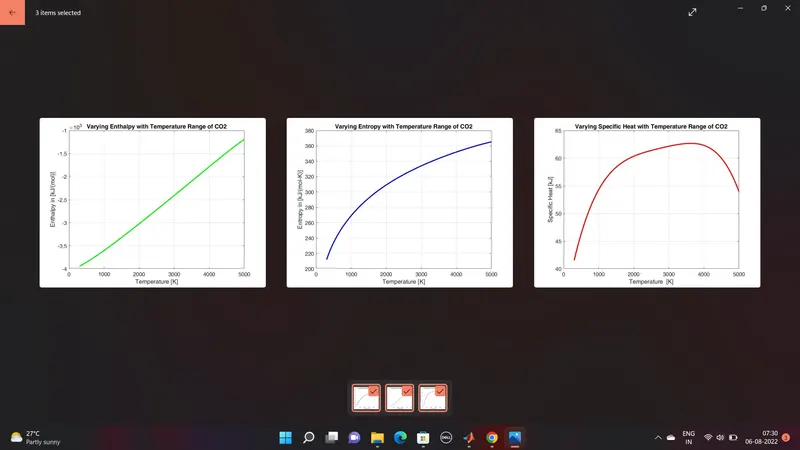
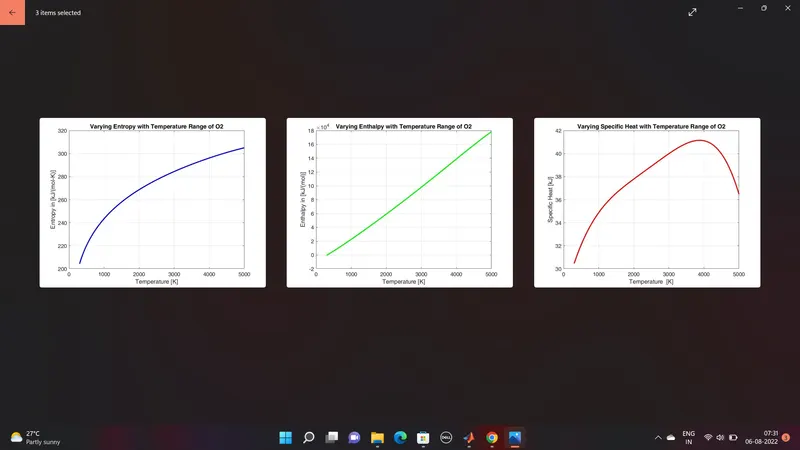
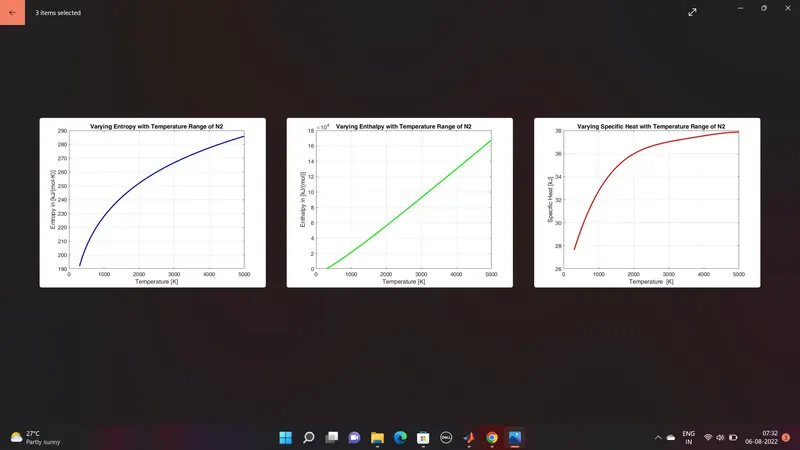
3. To plot the Cp, Enthalpy, and Entropy for the local temperature range (low temperature: high temperature) specific for each species.
4. To save the plots as images with appropriate names and dump them in separate folders for each species with suitable name automatically.
File Parsing:
File parsing refers to how information can be read from a particular text file or any type of file and how that information can be used in a computer program.
- Step 1 - Define the function like Enthalpy, Entropy, and Specific Heat or MOLECULAR WEIGHT
- Step 2 - Create an InputParser object
- Step 3 - Add inputs to the scheme.
- Step 4 - Set properties to adjust parsing.
- Step 5 - Parse the inputs.
- Step 6 - Use the inputs in function.
- Step 7 - Calling function.
NASA Thermodynamic File
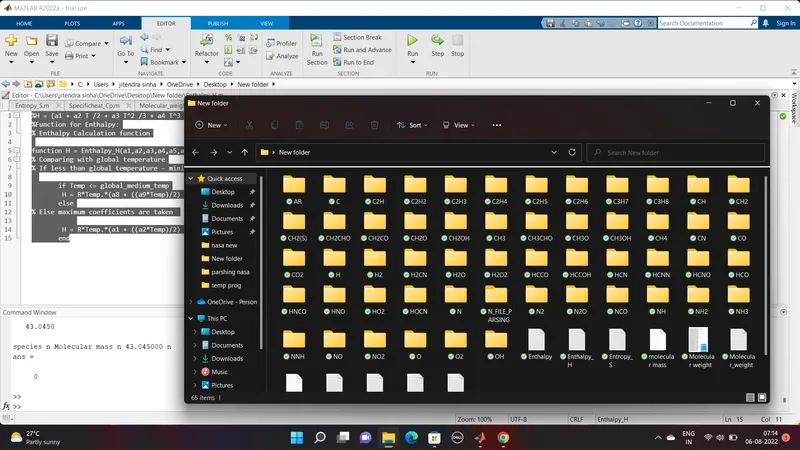
THERMO.dat file is a data file containing 14 coefficients for 53 different elements given by NASA. These coefficients are utilized to calculate the specific heat, enthalpy & entropy for a particular element. Each element has its own range of local temperature. Below screenshot of the THERMO.dat file is displayed.
List of 53 Elements contained in 'THERMO.dat' file:
AR C C2H C2H2 C2H3 C2H4
C2H5 C2H6 C3H7 C3H8 CH CH2
CH2(S) CH2CHO CH2CO CH2O CH2OH CH3
CH3CHO CH3O CH3OH CH4 CN CO
CO2 H H2 H2CN H2O H2O2
HCCO CCOH HCN HCNN HCNO HCO
HNCO HNO HO2 HOCN N N2
N2O NCO NH NH2 NH3 NNH
NO NO2 O O2 OH
Enthalpy, Entropy, and Specific Heat:
Enthalpy, entropy, and specific heat, of various species values at different temperatures are required extensively to analyze the thermodynamic process.
For example, if the combustion process is considered during this, these quantities are required to observe how the combustion is going on and how efficient it will be. It eventually allows seeking the scope of improvement in the process. Similarly in the other processes like refrigeration, air conditioning, chemical kinetics, nozzle flow, detonation process, etc, these quantities are widely involved to observe the phenomenon.
NASA came up with polynomials that can be used to evaluate thermodynamic properties such as Cp, H, and S. They have documented the coefficients that are required to evaluate these polynomials for 1000+ species.
The NASA polynomials have the form:
Cp/R = a1 + a2 T + a3 T^2 + a4 T^3 + a5 T^4
H/RT = a1 + a2 T /2 + a3 T^2 /3 + a4 T^3 /4 + a5 T^4 /5 + a6/T
S/R = a1 lnT + a2 T + a3 T^2 /2 + a4 T^3 /3 + a5 T^4 /4 + a7
Where R is the universal gas constant, T is the temperature and a1, a2, a3, a4, a5, a6, and a7 are the numerical coefficients supplied in the thermodynamic file. The FIRST 7 coefficients are HIGH-temperature coefficients (above 1000 K) and the SECOND 7 coefficients are LOW-temperature coefficients (below 1000 K).
ENTHALPY CALCUATION:-
%H = (a1 + a2 T /2 + a3 T^2 /3 + a4 T^3 /4 + a5 T^4 /5 + a6/T)*R*T
%Function for Enthalpy:
% Enthalpy Calculation function

function H = Enthalpy_H(a1,a2,a3,a4,a5,a6,a8,a9,a10,a11,a12,a13,Temp,R,global_medium_temp)
% Comparing with global temperature
% If less than global temperature - minimum coefficients are taken

       if Temp <= global_medium_temp
        H = R*Temp.*(a8 + ((a9*Temp)/2) + ((a10*(Temp).^2)/3) + ((a11*(Temp).^3)/4) + ((a12*(Temp).^4)/5) +((a13./Temp)));
       else
% Else maximum coefficients are taken

        H = R*Temp.*(a1 + ((a2*Temp)/2) + ((a3*(Temp).^2)/3) + ((a4*(Temp).^3)/4) + ((a5*(Temp).^4)/5) +((a6./Temp)));
       end
MOLECULAR WEIGHT CALCULATION
% Molecular Weight Calculation function

function Molecularweight = Molecular_weight(Species_SP)
         % Standard - Atomic Name
         atomic_name = ['H','C','O','N','A'];
         % Hydrogen, Carbon, Oxygen, Nitrogen, Argon

         fprintf('Molecular Weight of ');
         fprintf(Species_SP);
         fprintf(' : ');
         % Standard Atomic Number
         Atomic_Weight = [1.008 12.011 15.999 14.007 39.948];
         % Starting Range of Molecule
         Molecularweight = 0;

         % Adding Atomic number to obtain particular value
        for i = 1:length(Species_SP)
            for j = 1:length(atomic_name)
                if strcmpi(Species_SP(i),atomic_name(j))
                        Molecularweight = Molecularweight +Atomic_Weight(j);
                    position = j;
                end
            end
            n = str2num(Species_SP(i));

            if n>1

                Molecularweight = Molecularweight + Atomic_Weight(position)*(n-1);

            end
        end
            fprintf('molecular weight %s :',Species_SP);
            fprintf('%d',Molecularweight);
            disp(' ');
end
SPECIFIC HEAT CALCULATION
%Cp = (a1 + a2 T + a3 T^2 + a4 T^3 + a5 T^4)*R
%Function for Specific heat
% Specific heat calculation function

function Cp = Specificheat_Cp(a1,a2,a3,a4,a5,a8,a9,a10,a11,a12,Temp,R,global_medium_temp)
% Comparing with global temperature
% If less than global temperature - minimum coefficients are taken
if  Temp <= global_medium_temp
Cp = R*(a8 + (a9*Temp) + (a10*(Temp).^2) + (a11*(Temp).^3) + (a12*(Temp).^4));
else
Cp = R*(a1 + (a2*Temp) + (a3*(Temp).^2) + (a4*(Temp).^3) + (a5*(Temp).^4));
% Else maximum coefficients are taken
end
ENTROPY CALCULATION
%S = (a1 lnT + a2 T + a3 T^2 /2 + a4 T^3 /3 + a5 T^4 /4 + a7)*R
%Function for Entropy:
% Entropy Calculation function

function S = Entropy_S(a1,a2,a3,a4,a5,a7,a8,a9,a10,a11,a12,a14,Temp,R,global_medium_temp)
% Comparing with global temperature
% If less than global temperature - minimum coefficients are taken

    if Temp <= global_medium_temp
        S = R.*(a8.*log(Temp) + (a9.*Temp) + (a10*((Temp).^2)/2) + (a11*((Temp).^3)/3) + (a12*((Temp).^4)/4) + a14);
    else

% Else - maximum coefficients are taken
        S = R.*(a1.*log(Temp) + (a2.*Temp) + (a3*((Temp).^2)/2) + (a4*((Temp).^3)/3) + (a5*((Temp).^4)/4) + a7);
    end
MAIN CODE FOR FILE PARSING
clear all
close all
clc

% Make directory for use mkdir command.
mkdir 'C:\Users\jitendra sinha\OneDrive\Desktop\New folder\N_FILE_PARSING'

%  Reading Data file - NASA Thermodynamic
% Open a file  'r' Open the file for reading use fopen command
f1=fopen('THERMO.dat','r')
gt=fgetl(f1);

% Obtaing Temperatures - by Reading Header Information
global_temp=fgetl(f1);

% Spliting
t=strsplit(global_temp);

% Converting string cells to numbers using str2num,
global_low_temp=str2num(t{2});
global_medium_temp=str2num(t{3});
global_high_temp=str2num(t{4});

% Temperature range and Gas Constant
    % Temperature Range assumed
Temp=linspace(global_low_temp,global_high_temp,1000);
% Universal Gas Constant J/(mol-K)
    R = 8.314;

% skipping three comment lines in the file
for i = 1:3
    gt=fgetl(f1);
end

 for i = 1:53
gt=fgetl(f1);
A=strsplit(gt,' ');
Species_SP=(A{1})


line_1=fgetl(f1)  ;
a=strfind(line_1,'E');

% Extracting higher and lower temperature coefficients

% % Extracting FIRST 7 coefficients i.e HIGH-temperature coefficients
a1=line_1(1:a(1)+3);
a1=str2num(a1);              %1
a2=line_1(a(1)+4:a(2)+3);
a2=str2num(a2) ;             %2
a3=line_1(a(2)+4:a(3)+3);
a3=str2num(a3)  ;            %3
a4=line_1(a(3)+4:a(4)+3);
a4=str2num(a4);              %4
a5=line_1(a(4)+4:a(5)+3);
a5=str2num(a5)  ;            %5

line_2=fgetl(f1);
b=strfind(line_1,'E');
a6=line_2(1:b(1)+3);
a6=str2num(a6)  ;            %6
a7=line_2(a(1)+4:b(2)+3);
a7=str2num(a7);              %7

 % Extracting SECOND 7 coefficients - LOW-temperature coefficients
a8=line_2(b(2)+4:b(3)+3);
a8=str2num(a8);              %8
a9=line_2(b(3)+4:b(4)+3);
a9=str2num(a9) ;             %9
a10=line_2(b(4)+4:b(5)+3);
a10=str2num(a10) ;           %10


line_3=fgetl(f1);
c=strfind(line_1,'E');

a11=line_3(1:c(1)+3);
a11=str2num(a11);               %11
a12=line_3(c(1)+4:c(2)+3);
a12=str2num(a12);               %12
a13=line_3(c(2)+4:c(3)+3);
a13=str2num(a13);               %13
a14=line_3(c(3)+4:c(4)+3);
a14=str2num(a14);               %14

% Specific heat calculation
    Cp = Specificheat_Cp(a1,a2,a3,a4,a5,a8,a9,a10,a11,a12,Temp,R,global_medium_temp);

    % Enthalpy calculation
    H = Enthalpy_H(a1,a2,a3,a4,a5,a6,a8,a9,a10,a11,a12,a13,Temp,R,global_medium_temp);

    % Entropy calculation
    S = Entropy_S(a1,a2,a3,a4,a5,a7,a8,a9,a10,a11,a12,a14,Temp,R,global_medium_temp);

    % Calculating molecular weight of species
    Molecularweight(i) = Molecular_weight(Species_SP);

    % Read & Write Molecular list
     Molecular_list = fopen('Molecular weight.txt','a+');
         fprintf( Molecular_list,'Molecular weight of %s is %d \n',Species_SP,Molecularweight);
         fclose(Molecular_list);

     % plotting(CP,H,S,Temp,Species_SP)
        % Saving as a folder

           cur_dir=pwd;
           mkdir(Species_SP);
           cd(Species_SP);

        % Plot 1, Specific heat (CP) vs Temperature Range (Temp)

        figure(1)
        plot(Temp,Cp,'linewidth',2,'color','r');
        xlabel('Temperature  [K]');
        ylabel('Specific Heat [kJ]');
        title(sprintf('Varying Specific Heat with Temperature Range of %s',Species_SP));
        grid on
        saveas(figure(1),'Specific Heat.jpg');

        % Plot 2, Enthalpy (H) vs Temperature Range (Temp)

        figure(2)
        plot(Temp,H,'linewidth',2,'color','g');
        xlabel('Temperature [K]');
        ylabel('Enthalpy in [kJ/(mol)]');
        title(sprintf('Varying Enthalpy with Temperature Range of %s',Species_SP));
        grid on
        saveas(figure(2),'Ethalpy.jpg');

        % Plot 3, Entropy (S) vs Temperature Range (Temp)

        figure(3)
        plot(Temp,S,'linewidth',2,'color','b');
        xlabel('Temperature [K]');
        ylabel('Entropy in [kJ/(mol-K)]');
        title(sprintf('Varying Entropy with Temperature Range of %s',Species_SP));
        grid on
        saveas(figure(3),'Entropy.jpg');

        cd(cur_dir);

        % Molecular weight

        M = Molecular_weight(Species_SP)
        f2 = fopen('molecular mass','w');
        fprintf('%s n %s n %f n','species','Molecular mass',M)
        fclose(f2)
 end
Code Explanation:
-
'clear all' - clear all the variables in the workspace,
'close all' - closes all the plots and figures and
'clc' - clears the command window.
- we Making a directory using 'mkdir' with location address.
- then After that, reading the text file 'Thermo.dat' file and opening it by using ‘fopen’ and 'r' as reading command.
- For reading the line in a text file using ‘fgetl’. then
- and To obtain the temperature range from the Thermo.dat file, using ‘strsplit’ to split the temperature into a particular string cell.
- then we Used ‘str2num’ for converting string cell to numbers.
- and then Divided the temperature into a string and then converted to a number so that temperature values can be used separately to solve the NASA thermodynamics.
- we Using ‘for & end’ loops to skip the next three comment lines in the text file.
- then we Reading all the 53 species to plot specific heat(cp), enthalpy(H), and entropy(S), with temperature values, and to find the molecular weights.
- we Used ‘for’ loop to read 53 species.
- we Used ‘strfind’ to find string.
- we Using 'linspace' specified the temperature range from low to high.
- we Adding universal gas constant value ‘R’.
- we Extracted higher and lower temperature coefficient by reading line by line from the species.
- then Calling specific heat, enthalpy, entropy function codes.
- then Calculating Molecular weight.
Syntax Used during Coding
|
Fopen : |
Open a file or obtain information about open files |
|
‘r’ : |
Open the file for reading |
|
fgetl |
Read line from file |
|
strsplit |
Split string or character vector at specified delimiter |
|
str2num |
Convert character array or string to numeric array |
|
strfind |
Find one string within another |
|
linspace |
Generate linearly spaced vectors |
|
fprintf |
Write formatted data to file |
|
pwd |
Identify current directory |
|
mkdir |
Make new directory |
|
cd |
Change working directory |
SCREEN SHORTS .
co2 graph;-
o2 graph;-
n2 graph
ERRORS AND EXPLAINATION :
error 1:
in the function pogram of specific heat we get an error due to the ' . ' dot product in not having in the formula.
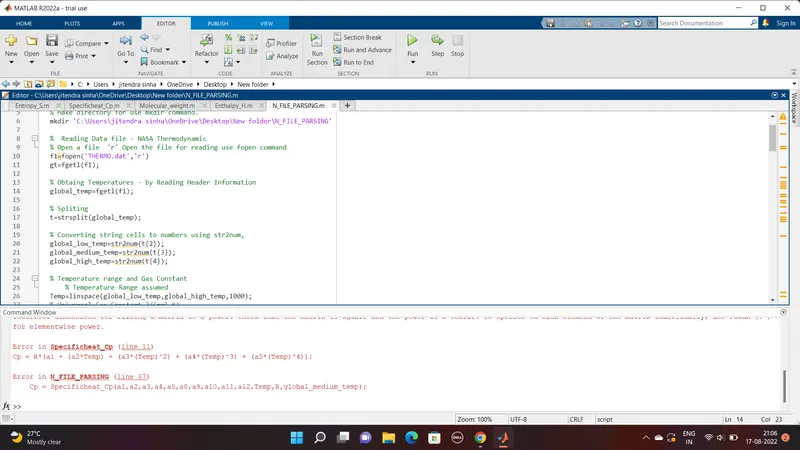
error 2 : error in the finction name and spelling like small letter and capital letter .etc and correct the all letters and spelling in the function and same as the write in the main code .
error 3 :
in the function error issue in brackets assigned to the variables.like , .[ ] () etc write the correct brackets on the code.
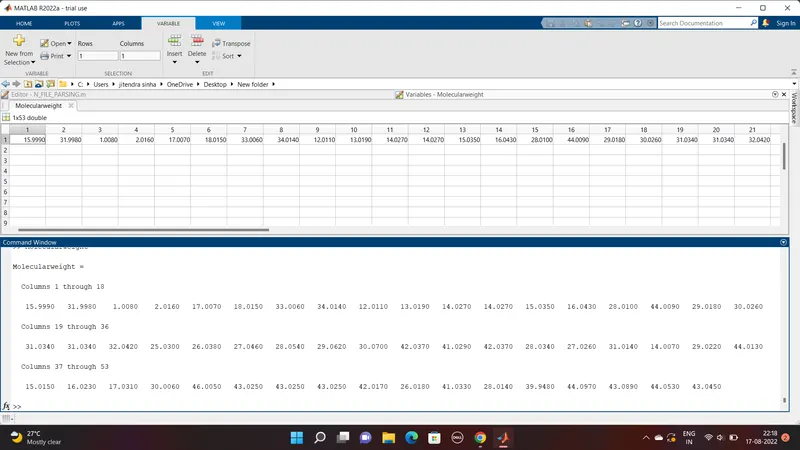
- Calculate the molecular weight of each species and display it in the command window.
Conclusion :
- Using MATLAB code, the necessary coefficients required to evaluate various thermodynamic parameters for different species are extracted from NASA thermodynamic data file.
- The specific heat, enthalpy, and entropy for all the species are calculated and plotted against the local temperature range. T
- he molecular weight is calculated for all the species.