Project 1 - Parsing NASA thermodynamic data
%Parsing NASA thermodynamic data
%clearing and close and clc in the start of program
clear all
close all
clc
% reading the first line of the thermo.dat file
f1= fopen('THERMO.dat','r');
get=fgetl(f1);
% reading the global temperature  its the second line
temp=fgetl(f1);

A= strsplit(temp,' ');      % strspit command is used to seperate every word and temp after space
% str2num command is used to covert the string into number from the
% temperature
global_low_temp= str2num(A{2});
global_mid_temp= str2num(A{3});
global_high_temp= str2num(A{4});

% to avoid the three comments in the table

for i=1:3
    fgetl(f1)
end

% reading the species from the table there are 53 species name.
%for loop is used to read every species from species name, coefficient and
%local temperaure of the individual species
for j=1:53
    line1=fgetl(f1);
    line1_split=strsplit(line1,' ');
    species=(line1_split{1});
     % reading the local temperature which is in string and converting to
     % number
    local_min_temp=str2num(line1_split{end-3});
    local_mid_temp=str2num(line1_split{end-1});
    local_high_temp=str2num(line1_split{end-2});
    T=linspace(local_min_temp,local_high_temp,1000);

    % reading the co-efficient of every species
    line2=fgetl(f1);
    line3=fgetl(f1);
    line4=fgetl(f1);

    find_E_in_line2=findstr(line2,'E');
    l2E=find_E_in_line2;

    %reading the coefficient from line 2
    cf1 = str2double(line2(1:(l2E(1)+3)));
    cf2= str2double(line2((l2E(1)+4):(l2E(2)+3)));
    cf3= str2double(line2((l2E(2)+4):(l2E(3)+3)));
    cf4= str2double(line2((l2E(3)+4):(l2E(4)+3)));
    cf5= str2double(line2((l2E(4)+4):(l2E(5)+3)));

    find_E_in_line3=findstr(line3,'E');
    l3E=find_E_in_line3;

    %reading the coefficient from line 3
    cf6 = str2double(line3(1:(l3E(1)+3)));
    cf7= str2double(line3((l3E(1)+4):(l3E(2)+3)));
    cf8= str2double(line3((l3E(2)+4):(l3E(3)+3)));
    cf9= str2double(line3((l3E(3)+4):(l3E(4)+3)));
    cf10= str2double(line3((l3E(4)+4):(l3E(5)+3)));

     find_E_in_line4=findstr(line4,'E');
    l4E=find_E_in_line4;

    %reading the coefficient from line 4
    cf11= str2double(line4(1:(l4E(1)+3)));
    cf12= str2double(line4((l4E(1)+4):(l4E(2)+3)));
    cf13= str2double(line4((l4E(2)+4):(l4E(3)+3)));
    cf14= str2double(line4((l4E(3)+4):(l4E(4)+3)));


    %calculating specific heat (cp),enthalpy(H),entropy(S)

    %R Gas constant which is 8.3145(j/k.mol)

    R=8.3145;

for i=1:length(T)

    if T(i)<= local_mid_temp
        cp(i)=R*(cf1+cf2*T(i)+cf3*T(i)^2+cf4*T(i)^3+cf5*T(i)^4);
        H(i)=R*T(i)*(cf1+cf2*T(i)/2+cf3*T(i)^2/3+cf4*T(i)^3/4+cf5*T(i)^4/5+cf6/T(i));
        S(i)=R*(cf1*log(T(i)) +cf2*T(i)+cf3*T(i)^2/2+cf4*T(i)^3/3+cf5*T(i)^4/4+cf7);

    else
        cp(i)=R*(cf8+cf9*T(i)+cf10*T(i)^2+cf11*T(i)^3+cf12*T(i)^4);
        H(i)=R*T(i)*(cf8+cf9*T(i)/2+cf10*T(i)^2/3+cf11*T(i)^3/4+cf12*T(i)^4/5+cf13/T(i));
        S(i)=R*(cf8*log(T(i)) +cf9*T(i)+cf10*T(i)^2/2+cf11*T(i)^3/3+cf12*T(i)^4/4+cf14);

    end

end


% now plotting the temperature with the specific heat,enthalphy,entrophy.

%plot for temerature vs specific heat cp
mkdir(species)
cd(species)
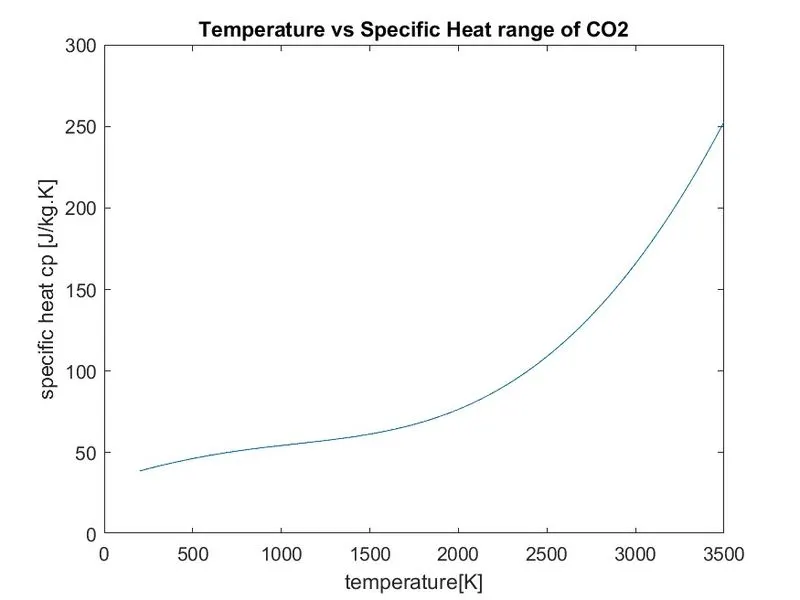
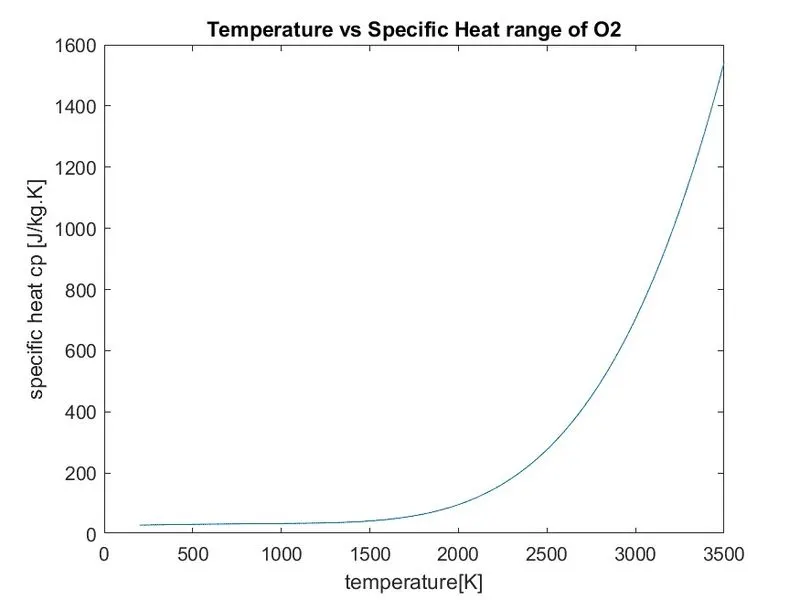
figure (1)
plot(T,cp);
xlabel('temperature[K]');
ylabel('specific heat cp [J/kg.K]');
title(sprintf('Temperature vs Specific Heat range of %s',species));
saveas(figure(1),'specific heat.jpg');

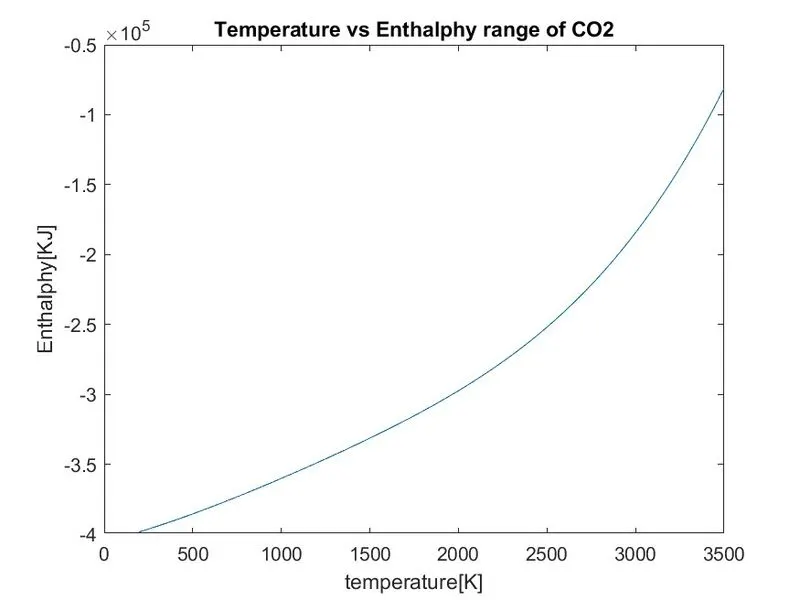
figure (2)

plot(T,H);
xlabel('temperature[K]');
ylabel('Enthalphy[KJ]');
title(sprintf('Temperature vs Enthalphy range of %s',species));
saveas(figure(2),'Enthalphy.jpg');
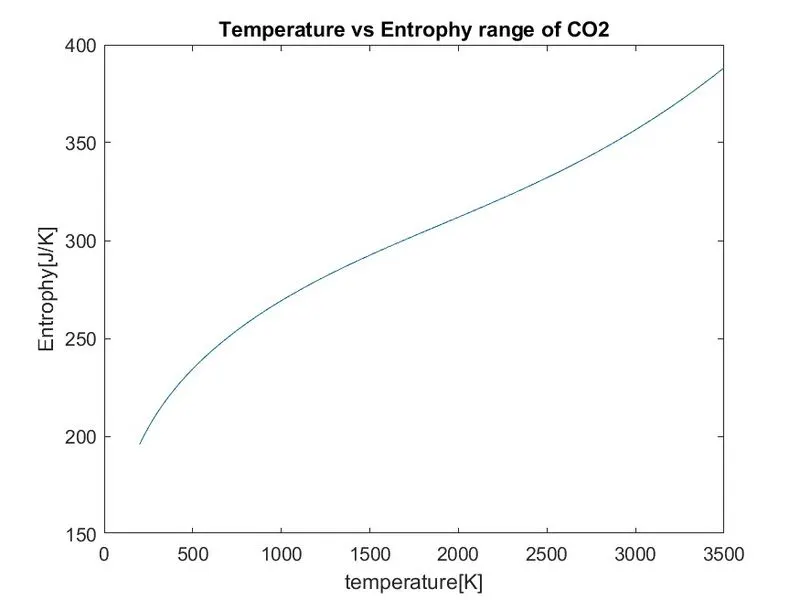
figure (3)
plot(T,S);
xlabel('temperature[K]');
ylabel('Entrophy[J/K]');
title(sprintf('Temperature vs Entrophy range of %s',species));
saveas(figure(3),'Entrophy.jpg');
%saving the plots in different folder
cd ..

%calculating molecular weight
molecular_weight_calc= molecular_weight(species)


end
program for calculating the molecular weight of every species.
function molecular_weight_calc= molecular_weight(species)

elements =['H','C','O','N','A'];

fprintf('molecular weight of ');
fprintf('species');
fprintf(':');
Atomic_weight=[1,12,16,14,40];

molecular_weight_calc=0;

for i=1:length(species);
   for j=1:length(elements);
    if strcmp(species(i),elements(j));
     molecular_weight_calc=molecular_weight_calc+Atomic_weight(j);
        position=j;
    end
end
n=str2num(species(i));
if n>1;
    molecular_weight_calc=molecular_weight_calc+(Atomic_weight(position)*(n-1));


end
end
 fprintf('molecular weight of %s :-',species);
 fprintf('%f',molecular_weight_calc);
 disp(' ');
 end
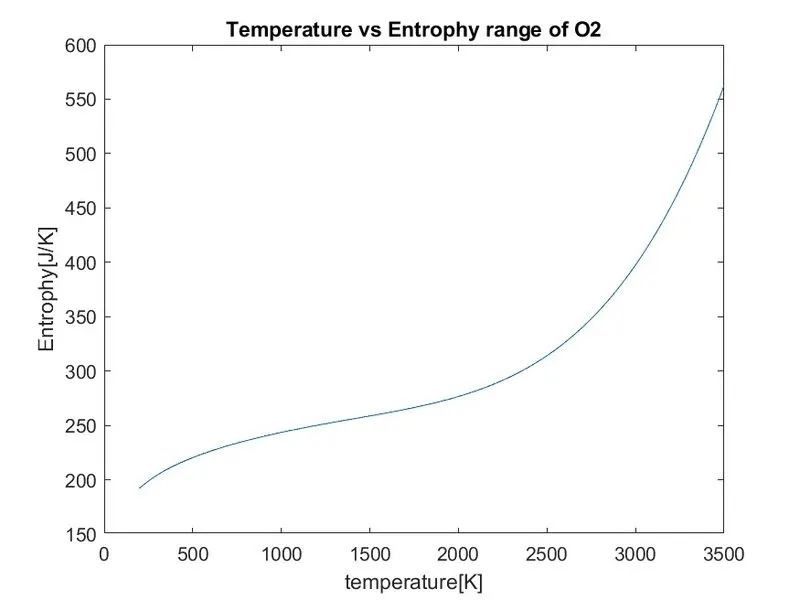
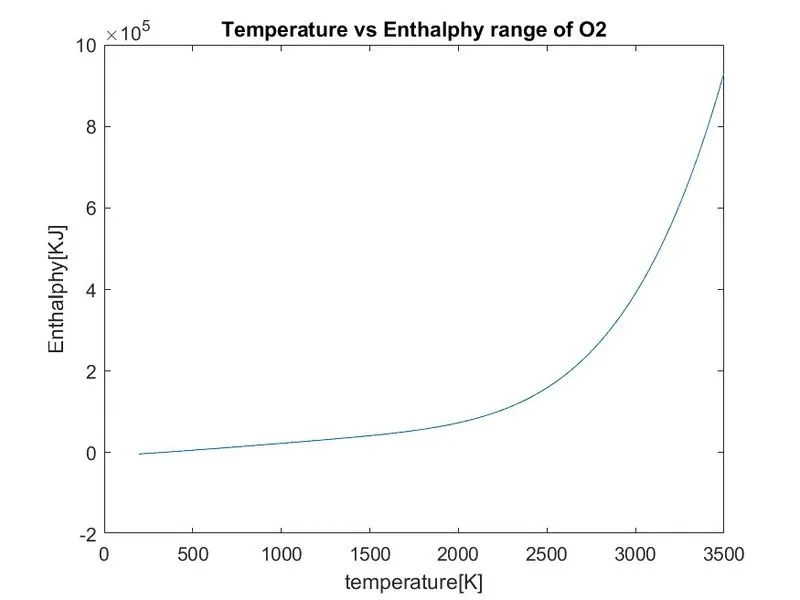
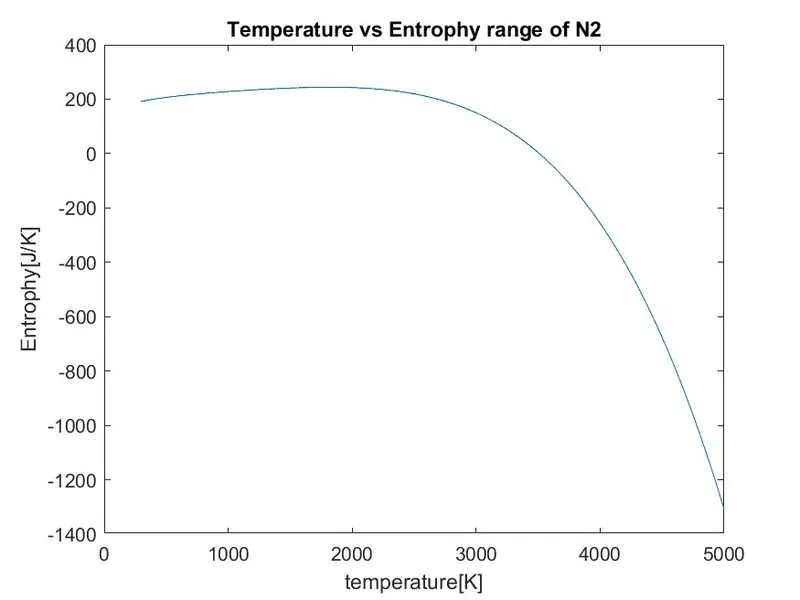
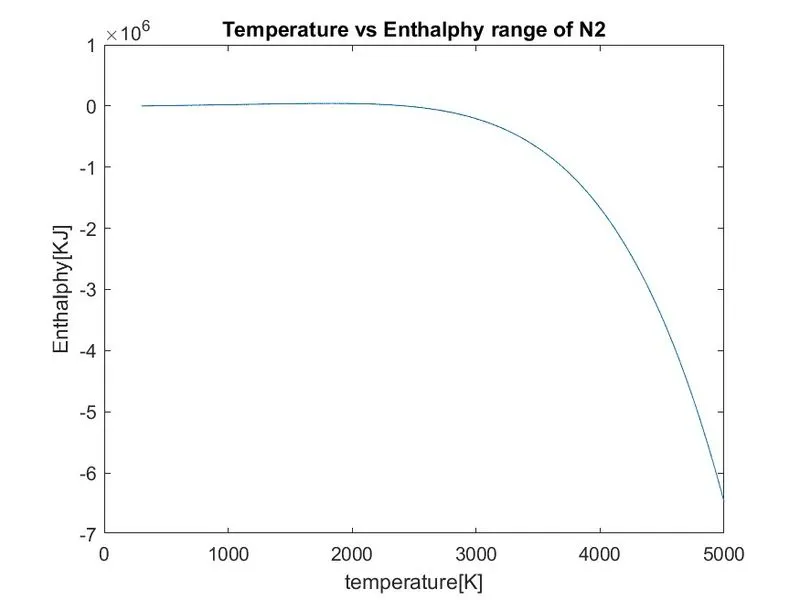
Im attaching the results for your reference below.
FINAL RESULTS
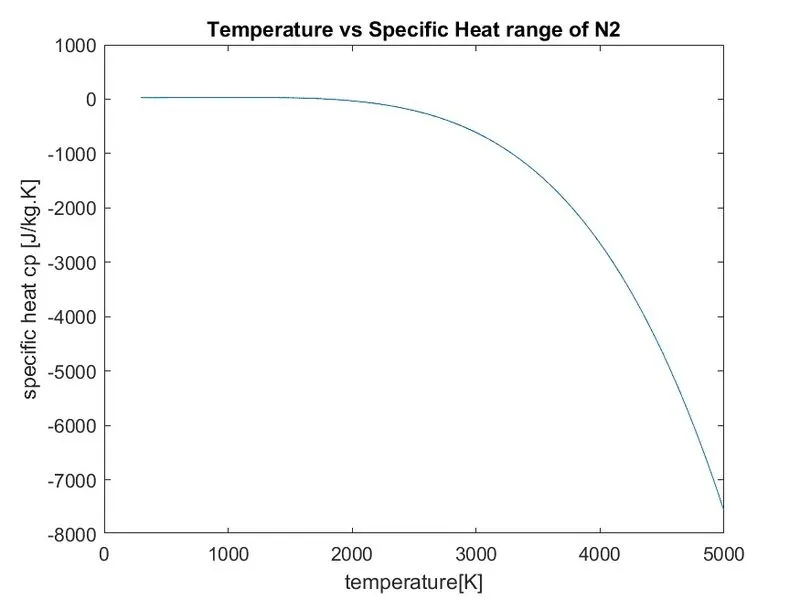
PLOT OF SOME SPECIES IM ATTACHING BELOW FOR YOUR REFRENCE.
PLOT OF 02
PLOT FOR N2
PLOT FOR CO2