Project-1: Modelling an electric Car with Li-ion battery
Aim :
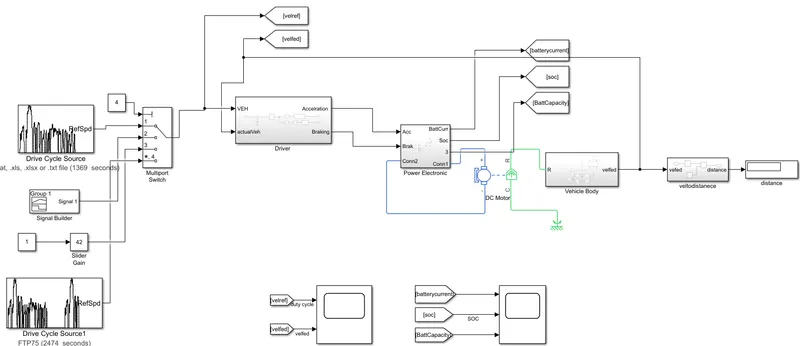
- Create a MATLAB model of an electric car that uses a lithium-ion battery and suitable motor
Objective :
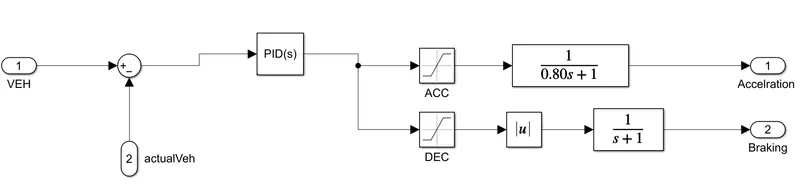
- Implementation of the vehicle control using the PI controller and generating braking and accelerator commands.
EV model with Li-ion battery :
link :https://drive.google.com/file/d/131OJ5eesNxdsvektggEVZF3LN34o3oDB/view?usp=sharing
vehicle body :
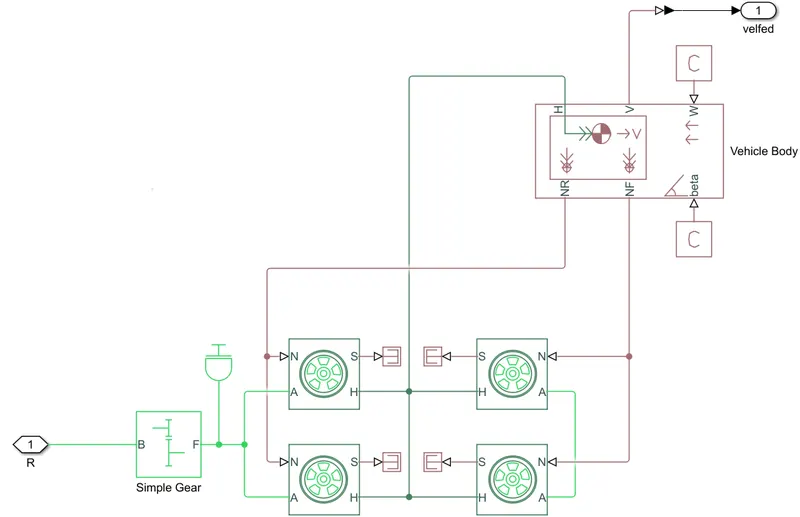
- vehicle modeling by using Newton's second law of motion, the vehicle is modeled as a load by considering various longitudinal forces acting on it.
- the vehicle uses the different parameter as kerb weight (kg),payload(kg),coefficient of rolling resistance,air density(kg/m3),width(m),height(m),drag coefficient were taken from the specification sheet of the car.
- force due to the rolling resistance,Frr = Urr*m*g where U is the coefficient of the rolling resistance
- force due to aerodynamic drag Fad= 0.5 *rho*A*v^2, rho is the air density, A is the frontal area, V is the velocity of the air stream flowing around the body.
- force due to the climb, Fhc = m*g*sin(psi),m is the sum of the kerb weight and payload weight, psi is the angle in radian,g is the acceleration due to gravity.
- tractive force Ft = Frr+Fad+Fhc +Fla+Fva, where Fla is linear acceleration force and Fva is the rotational acceleration.
- traction power Pt = Ft *V
Read the tire data
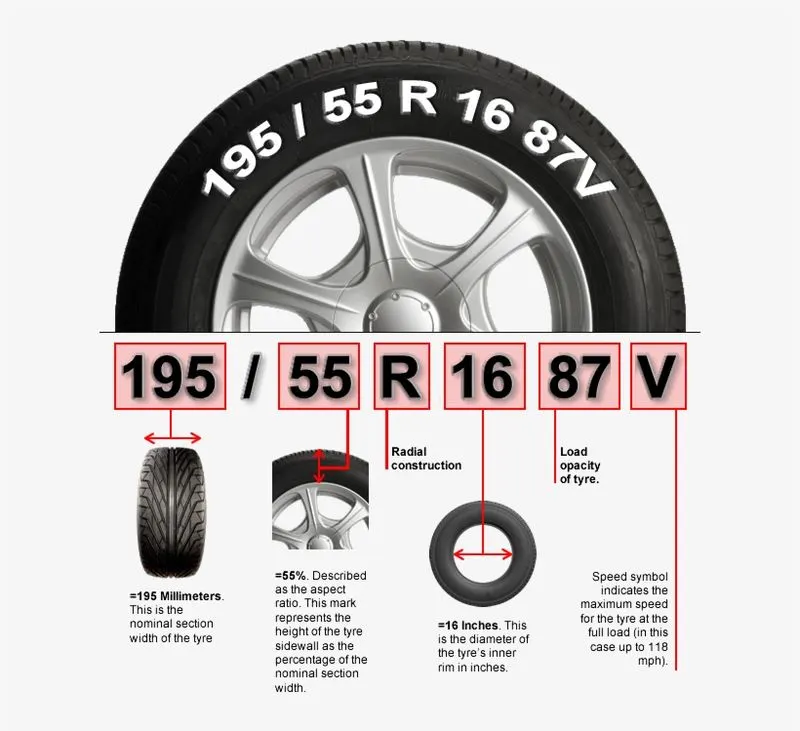
- Total diameter = rim dia +2*height of the sidewall
- gear ratio = Nm*rw*pi/60*Vmax
- Wwheel = (V/r)*G
- The required wheel torque can be calculated from, Treq = FT*rw
wheel dimensions:
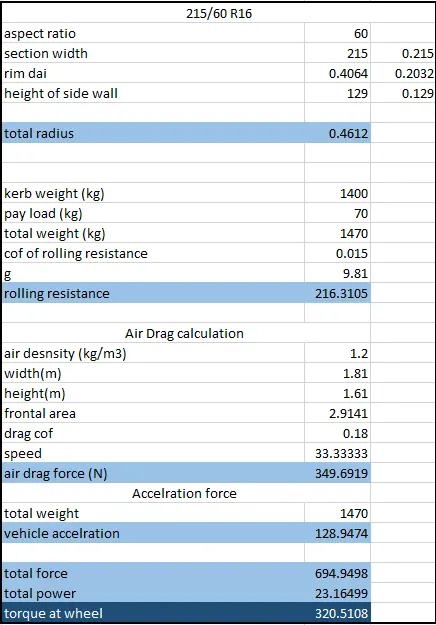
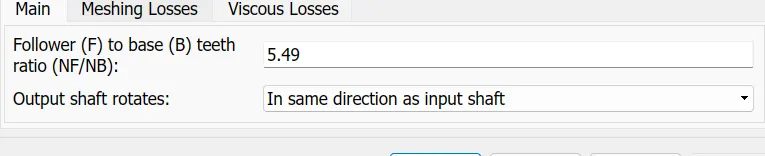
- Gear ratio for above is 5.39 from (evaluated based GR = (Nm*rw*pi)/(30*Vmax))
Vehicle body :
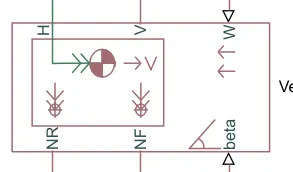
- the block represents the two-axle vehicle body in longitudinal motion. block accounts for body mass, aerodynamic drag, road incline, and weight distribution between axle due to acceleration and road profile
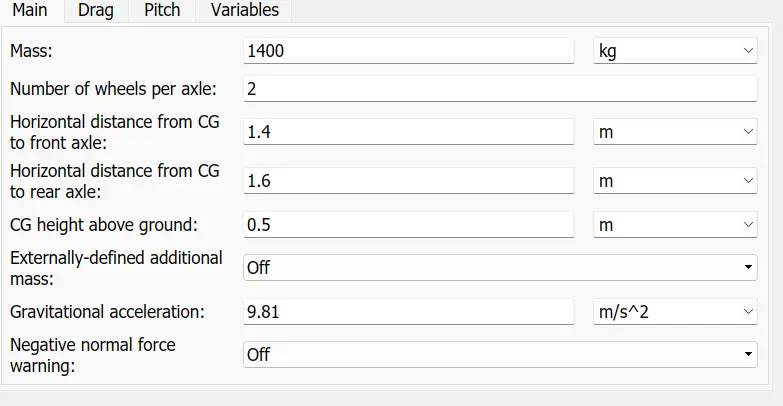
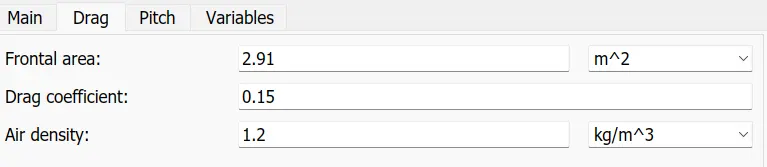
vehicle body parameters:
Tire :
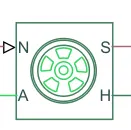
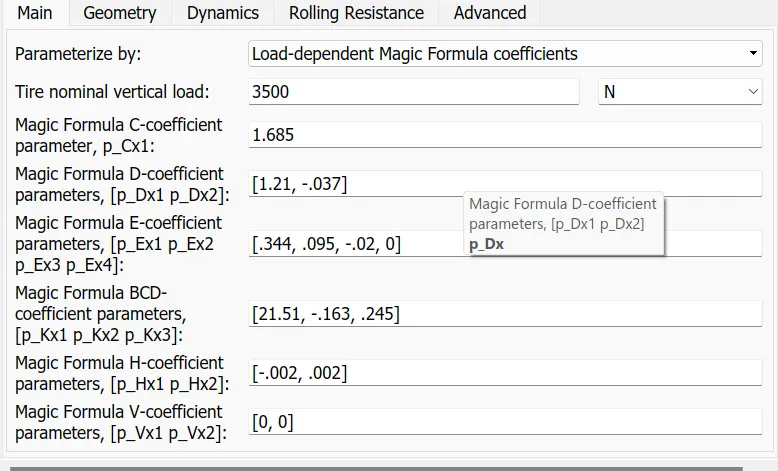
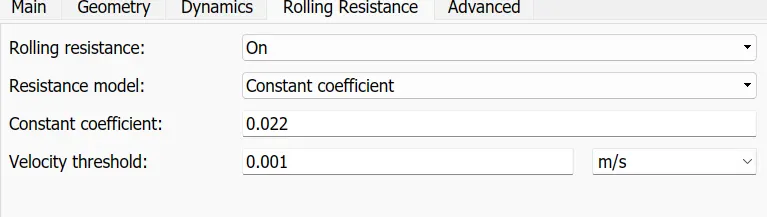
- in the tires the magic formula evaluate forces by peak longitudinal forces acting on the vehicle.The inside parameters are given as :
- the four-wheeler has vertical of w/4 acting on each tire.

Simple gear :
- gear ratio = Nm*rw*pi/60*Vmax
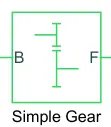
- the gear system is obtained via a simple gear block.it represents a fixed-ratio gear or gearbox.No inertia or compliance is modeled in this block. you can optionally include gear meshing and viscous bearing losses. the gear ratio varied for the reference velocity to match the output
- A lower gear ratio provides a higher top speed. and a higher gear ratio provides faster acceleration.here a low ratio is used compared to max possible values as mentioned by the company where acceleration time to claimed top speed is less
Power Electronics :
Datasheet Battery :
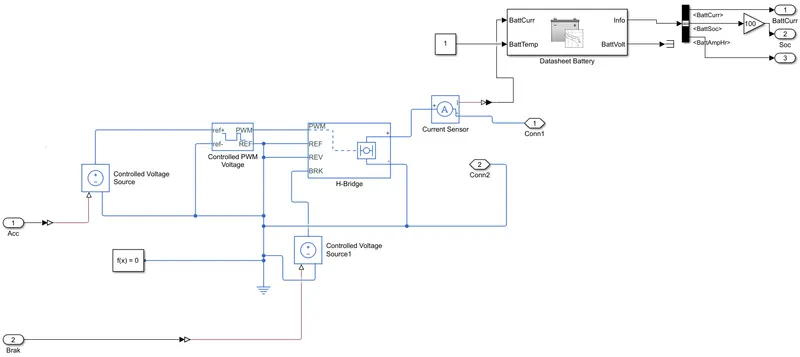
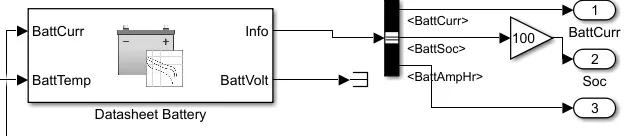
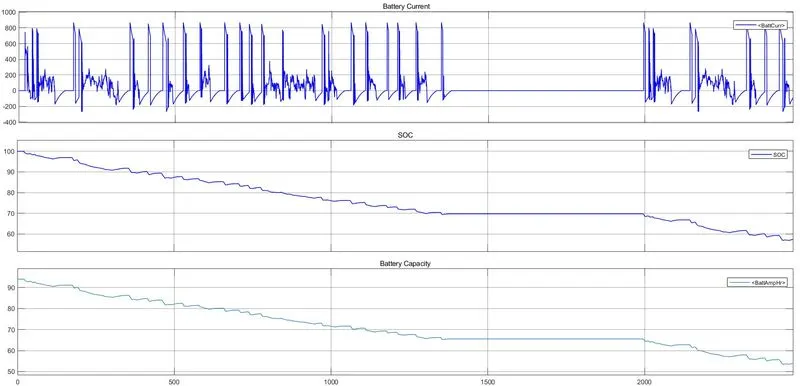
- The battery pack with terminal voltage of 320 V is directly connected to the motor drive.The current is sensed from the motor in the real time and the system is created to measure the SOC when a drive cycle is used.The battery capacity is estimated as a product of the battery voltage and battery capacity which is 94Ah.This is rated capacity but the battery capacity will be bit more.
- To represent a battery system a DC battery block is used which grounded and it receives motor current requirements as an input which is sensed through a current sensor.
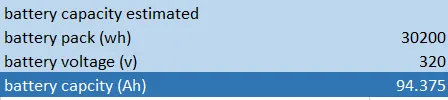
- it is assumed that the nominal voltage of the cell used to make the battery pack is 3.7V.considering all the losses that will incur a battery pack voltage of 347 is assumed above the rated values as is performance mode the vehicle can be operated at 60% peak value.
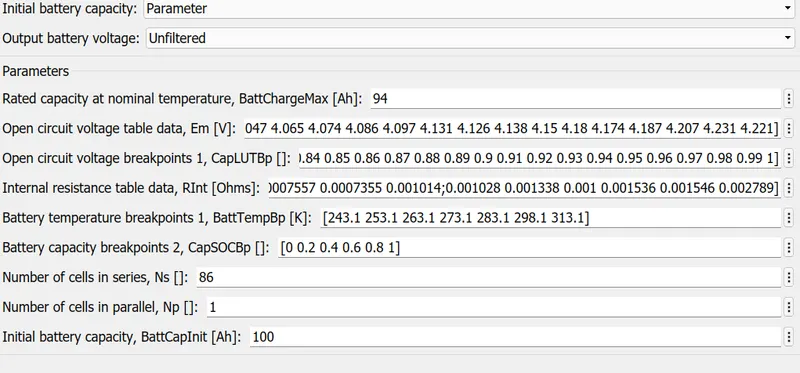
- number of cell connected in series = battery pack voltage/voltage single cell = 320/3.7 = 94.07 approximated 86
- Energy content represented by each series combination = number of cells connected in series *energy of cell
- one cell has capacity of 1.1 Ah Hence the number of parallel strings for required series is 1
- combination used is 86S and 1P
H-Bridge :
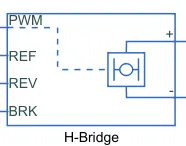
- The voltage to H-bridge gate pulses must be controlled according to reference input for the controlled PWM block us used and it user defined parameters are described below.The power setting is set as internal
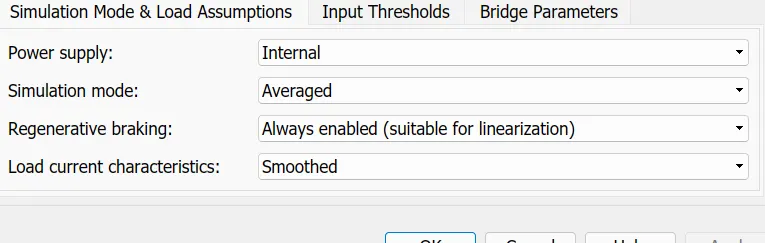
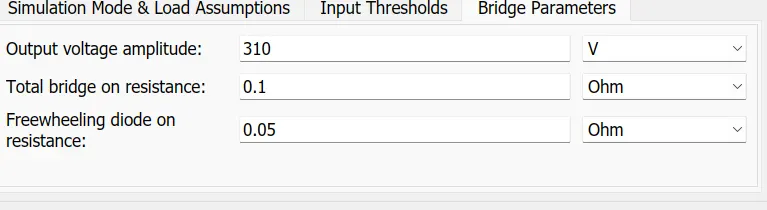
Controlled PWM Voltage :
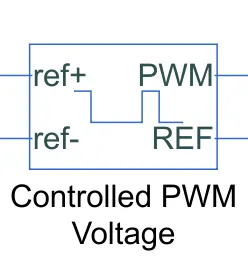
- This block creates a pulse-width modulated (PWM) voltage across the PWM and REF ports

- Switching frequency represents how many times the pulses are given to open and close the h-bridge

- In simscape the negative terminals are grounded via an electrical reference and to main a constant voltage across a physical connected a control voltage source block is used
Current sensor :
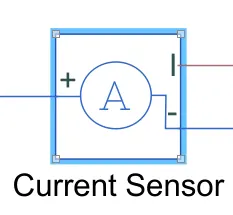
- The Current Sensor block represents an ideal current sensor, that is, a device that converts current measured in any electrical branch into a physical signal proportional to the current.
- Connections + and – are electrical conserving ports through which the sensor is inserted into the circuit. Connection I is a physical signal port that outputs the measurement result.
Controlled voltage source :
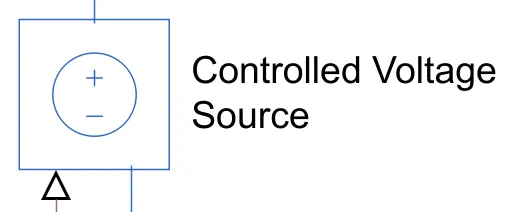
- The Controlled Voltage Source block represents an ideal voltage source that is powerful enough to maintain the specified voltage at its output regardless of the current flowing through the source.
- The output voltage is V = Vs, where Vs is the numerical value presented at the physical signal port.
Driver Block Set :
PID Controller :
| parameter | rise time | overshooting | settling time | steady-state error | stability |
| `K_p` | decrease | increase | small change | decrease | degrade |
| `K_i` | decrease | increase | increase | eliminate | degrade |
| `K_d` | minor change | decrease | decrease | no effect in theroy | improve if Kd small |
General tips that help to improve the design of the PID controller
When you are designing a PID controller for a given system, follow the steps shown below to obtain the desired response.
- Obtain an open-loop response and determine what needs to be improved
- Add a proportional control to improve the rise time
- Add a derivative control to reduce the overshoot
- Add an integral control to reduce the steady-state error
- Adjust each of the gains, , and until you obtain a desired overall response. You can always refer to the table shown in this "PID Tutorial" page to find out which controller controls which characteristics.
Lastly, please keep in mind that you do not need to implement all three controllers (proportional, derivative, and integral) into a single system, if not necessary. For example, if a PI controller meets the given requirements (like the above example), then you don't need to implement a derivative controller on the system. Keep the controller as simple as possible.
Saturation Block :
- the Saturation block Limit input signal to the upper and lower saturation values.
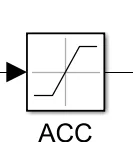
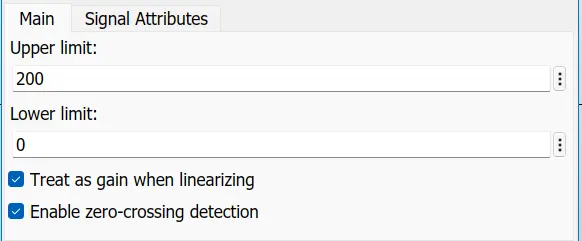
- To genratte the acceleration conditions saturation block used which limits the decelration values
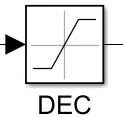
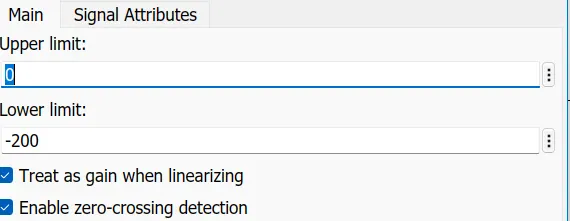
- To genratte the deceleration conditions saturation block used which limits the accelration values
DC-Motor :
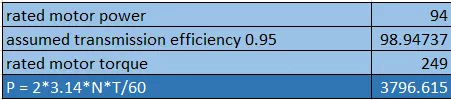
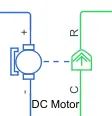
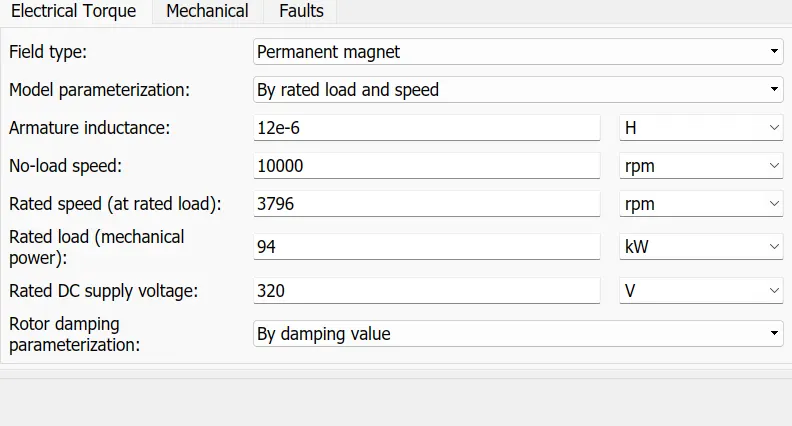
- A permanent magnet DC motor is used as it is intended for LEVs.it exhibits better performance in terms of efficiency fast response,simple structure,high torque,and easier maintenace
- Then,the motor power is calculated from tractive power using motor power,Pm = Pt/nt where not is the efficiency of the transmission.The transmission efficiency is assumed as 95%
- the peak motor power is about 94 kw.
Conversion speed to distance :
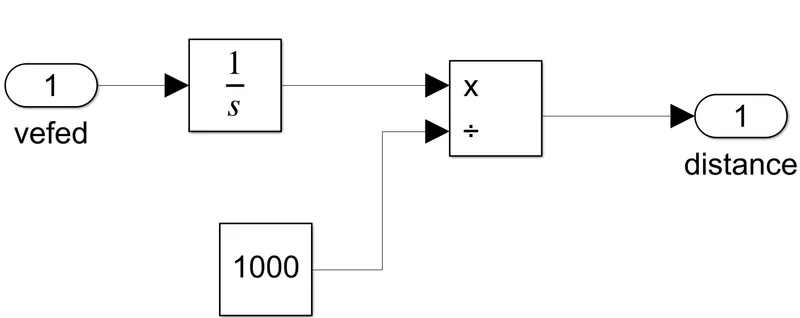
- This above system converts actual velocity of vehicle to get the distance covered by the vehicles.this conversion done by integrating the actual velocity and divided by the 1000 to get the distance in km.
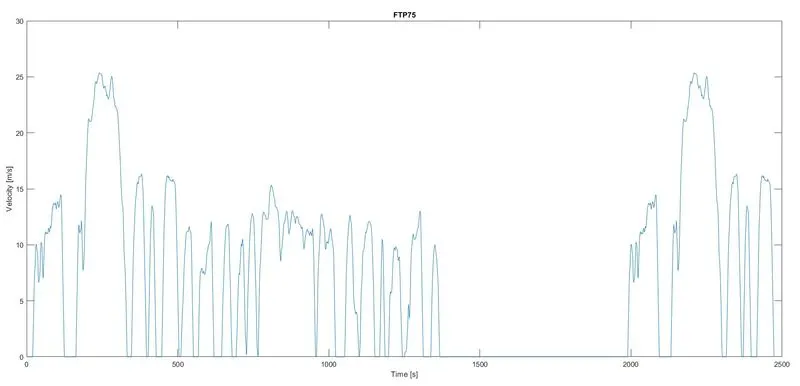
Drive cycle :
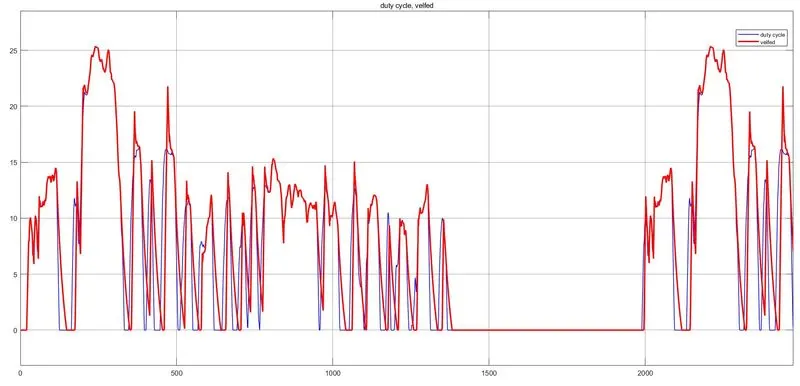
FTP75 drive cycle is used,it runs for 2474 second
Results :
- Drive cycle and actual velocity
- Battery current , SOC ,Battery Capacity
Conclusion:
- We created a MATLAB model of electric car which uses lithium ion battery and suitable motor.