Project 1 Mechanical design of battery pack
MECHANICAL DESIGN OF BATTERY PACK:
Safety and reliability are two major things for large battery packs. While mechanical designing of large battery pack should follow some technical criteria, so that the battery may not fail.
- Mechanical vibration should decrease
- Controlling on high impact force
- Better thermal runway for cooling
- Serviceability and recyclability.
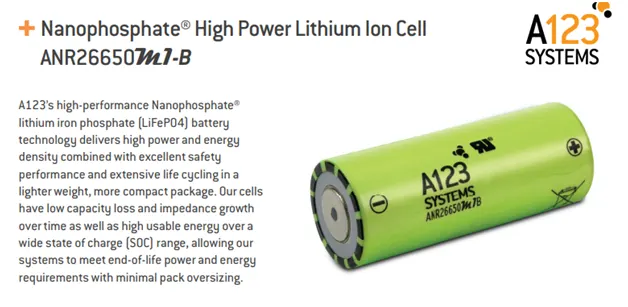
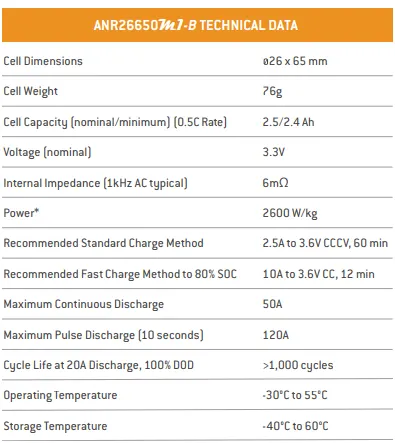
For the designing of 18kWh battery pack, a base model of ANR26650M1B Lithium –Ion cell is used. ANR26650M1B cell consist of lithium iron phosphate chemistry and it is best for use in wide range of temperature and conditions. The ANR26650M1B lithium Ion cell may achieve the following features:
- Stable chemistry
- Faster charging
- Consistent output
- Excellent cycle life
- Superior cost performance.
DIMENSIONS:
APPLICATIONS:
- Energy storage
- UPS
- Communication technologies
- Aerospace
- Industrial equipments
- Medical devices
- Toys
CALCULATIONS AS PER ASSUMPTIONS:
Here, designed a high voltage battery pack for an electric vehicle to achieve its range up to 250 kms. For this calculation, assumptions are made such that the nominal voltage is 145.2V for a series connection.
For a single cell:
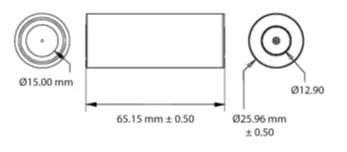
Diameter = 25.96 mm
Length = 65.15 (2.6”)
Mass: 76g
Basically, the value of the volume of the cell is used to find out the total volume of the battery pack.
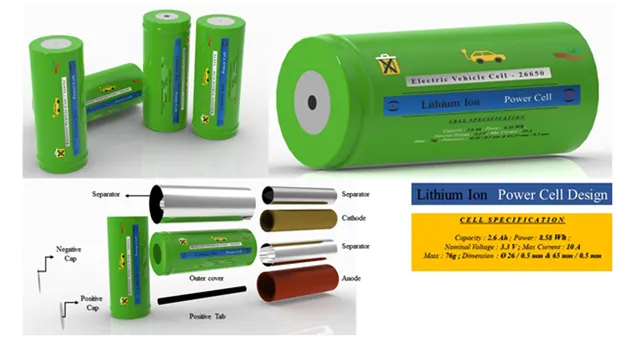
Single cell Energy = Cell capacity(Ah) x Cell Voltage (V)
= 2.6x3.3
= 8.58Wh.
The value of a single cell is used to calculate the total energy of the battery pack.
Volumetric Energy (Wh/m^3) = Single Cell Energy / Volume of each cell
= 8.58Wh/0.03451 m^3
= 248.62 Wh/m^3
Gravimetric Energy (Wh/kg) = Single cell energy / Single cell mass
= 8.58Wh/0.076Kg
= 112.89Wh/kg
CALCULATION OF HIGH VOLTAGE BATTERY PACK:
For designing and calculation of battery pack here, assumptions are made such that to achieve 250Km in 18kWh battery pack. Also, the nominal voltage in 145.2V in series connection.
Vehicle Range = 250Kms
Battery pack capacity = 18.21Kwh
Per km average energy = 18120.96/250 = 72.483 Wh/km
Battery pack total energy = Average energy x km
= 72.483 x 250
= 18120.96Wh
Number of cells connected in series = Nominal voltage of series connection/ Nominal voltage of single cell
=145.2/3.3 = 44
44 cells will be connected in a series connection to provide a proper voltage
Energy for battery pack (Wh) = No.of cells connected in series x Single cell energy
= 44 x 8.58Wh
= 377.52Wh.
Number of cells connected in parallel = Battery pack total energy / Energy for battery pack
= 18120.96/377.52
= 48
48 cells will be connected in parallel to provide a proper capacity power.
Battery pack total energy (wh) = No. of cells connected in parallel x single cell capacity (Ah)
= 48x2.6Ah
= 124.8Ah
The value of battery pack capacity is used for total power required by the vehicle
Total number of cells for battery pack = No. of cells connected in parallel x no. of cells connected in series = 48 x 44 = 2112
2112 cells will be required to make a complete battery pack.
Mass of the battery pack = Total no.of cells for battery pack x Mass of single cell
= 2112 x 0.76kg
= 160.521 Kg
Total volume of the battery pack = Total no of cells for battery pack x Volume of single cell
= 2112 x 0.0345
= 72.89 m^3
Cell Peak current = C rate x Single Cell capacity
= 20 x 2.6
= 52A
Battery pack peak current(A) = Cell peak current x No.of cells connected in parallel
= 52 x 48
= 2496A
Battery pack peak power(W) = Battery pack peak current x voltage of series connection
= 2496 x 145.2
= 362.42W
Cell Continuous current (A) = C rate x single cell capacity
= 10 x 2.6
= 26A
Battery pack continuous current = cell continuous current x No.of cells connected in parallel
= 24 x 48
= 1248A
Battery pack continuous power = Battery pack continuous current x Voltage of series connection
= 1248 x 145.2
= 18120.96 or 18.120Kwh.
BATTERY PACK ARRANGEMENT:
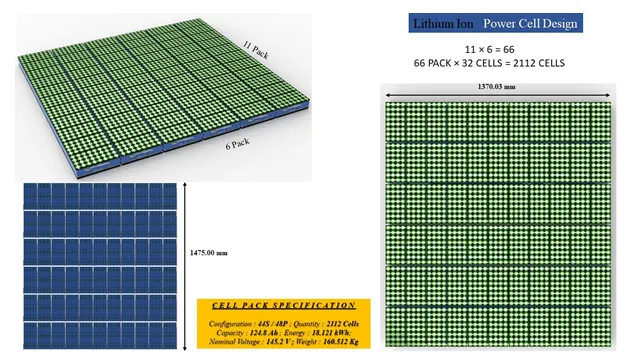
Single Pack: 32 cells with 8S/4P
32 cells x 66 pack = 2112 cells
Then, 2112 cells will have 44S/48P
Package: 44S/48P
Capacity: 8Ah
Voltage: 145.2V
Weight: 160.512Kg
No. of cells: 2112
Power: 18120.96Wh
Cell packaging:
DESIGN OF CELL HOLDER:
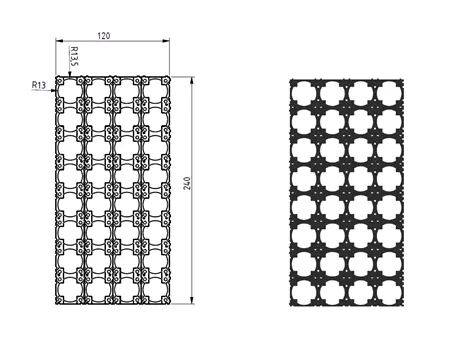
The main function of a battery holder is to keep cells fixed in place safely and securely. It is also used to arrange the cells properly and hence there will be decrease in mechanical vibration and have a better thermal runway in between the cell gaps. Most of the cell holder is made up of polypropylene or nylon bodies rated for 80-100°C.
DESIGN OF PACK COVER:
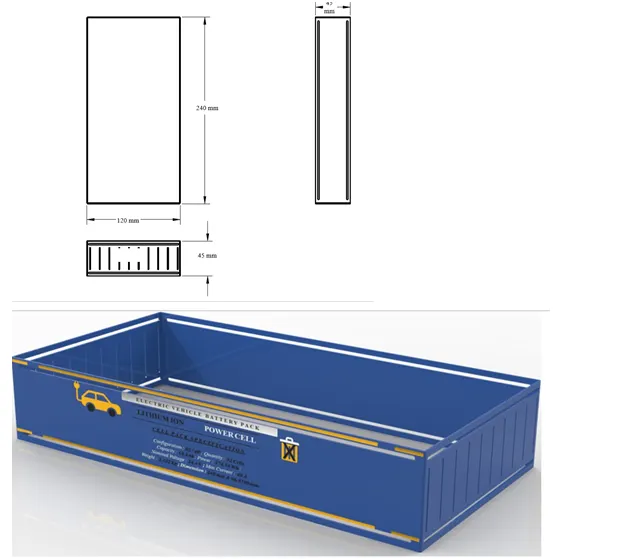
Pack cover is made up of aluminum and the reason behind is to keep battery pack lightweight. The casing/cover thickness is 0.5mm and the design is as shown below.
DESIGN OF LOWER FLOOR CASE FOR BATTERY PACK:
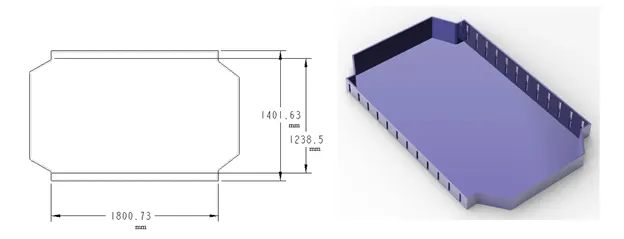
The lower case is a part which is fitted in an electric vehicle for the assembly of the battery pack. A lower case is also made up of aluminum and it has top and bottom cover to cover the battery pack from dust and environmental pollution.
POSITIVE AND NEGATIVE CLIP:
A positive and negative clip is used to connect the battery end cap. Ie.(+) and (-) .
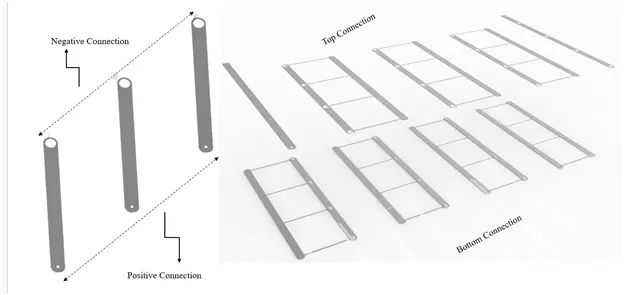
JOINING OF CYLINDRICAL CELL BATTERY PACK:
Cylindrical cells have improved thermal management efficiency because of compact shape, but have low packaging efficiency because of their round cross-section. Here, a positive and negative tab to connect multi cells.
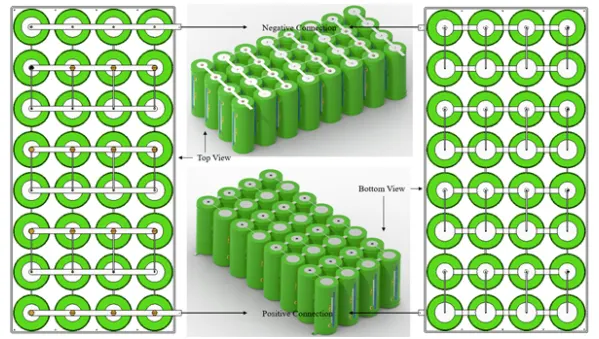
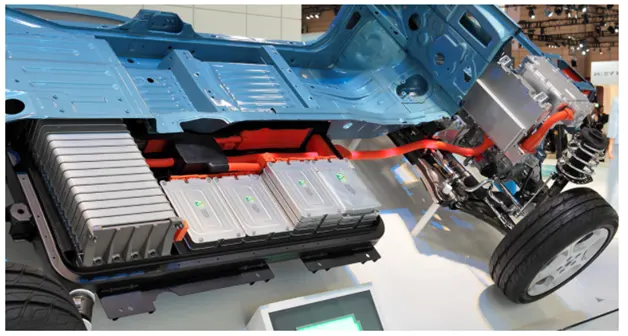
The battery casing has to provide the mechanical and electrical interfaces to the product it is designed to power as well as to continue all the components outlined above. This is how the battery pack will be packed which is manufactured by the companies and constructed in electric vehicle.
REFERENCE:
https://www.batteryspace.com/prod-specs/6610.pdf