Project 1 Mechanical design of battery pack
Mechanical design of battery pack for 18 Kwh
Objective:
Requirement is to prepare design report for detailed battery pack construction using cell ANR26650M1-B for battery pack total capacity of 18Kwh.Report includes design calculation for battery pack from cell to pack level. Also pack construction includes battery module assumption to meet the total number of cell and the total capacity.
Data Sheet for ANR26650M1-B:

Battery Pack calculations:
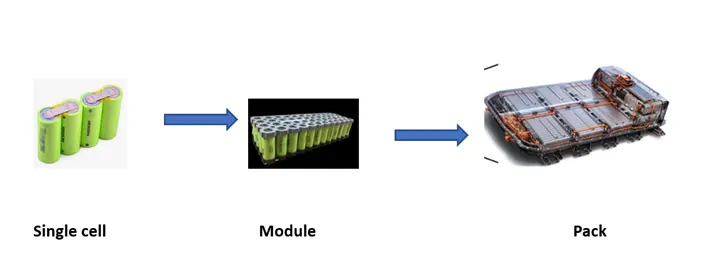
Cell Level:
Nominal Voltage =3.3V
Nominal Cell Capacity = 2.5 Ah
Single cell energy = 8.25 wh (Voltage * capacity)
Pack Level:
For 18000 wh ,
Total Number of cells = 2183 (Total power Required / Single cell energy)
Module Level:
We assume our battery pack voltage should be 250V
Since voltage will add up in series connections
No of series cell* = Total pack voltage Nominal voltage
Therefore, No of cells in series = 76 cells (Total pack voltage/ Nominal voltage)
Also, battery capacity will add up in parallel connections
For energy level of 18000wh battery pack, Battery pack capacity will be = 72 Ah (Total battery pack power/Total voltage)
So,
No of cells in Parallel =29 (Battery pack capacity / Cell Nominal capacity)
So, Battery pack should be 76Series 29 Parallel
Battery pack with 76 series and 19 parallel need to be bring down to module level.Module level will be easy to pack , monitor and safety can be ensure.
Battery Module:
Each module we can plan for 19 series 4 parallel and total cell in each module will be 76 cells in each module.
Total No of Module = 29 Modules
Pack Dimensions and Sizing:
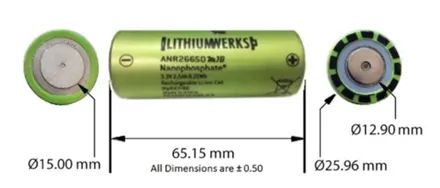
Casing Length (L) = No of cells at series*(cell diameter (26mm) + margin gaps( based on cell diameter 80 to 85mm approx.)
L = (76*30) + 80
L = 2360 mm
Casing Breadth (B) = No of Parallel cell *(cell diameter (26mm) + margin gaps( based on cell diameter 80 to 85mm approx.)
B = (29*30) + 80
B = 950 mm
Total Pack Area occupied = Length *Breadth
Area = 2.4m2
Height of Back:
Height of the battery (H) = 65 (height of the cell) + 30(wires, holders, strips)
Height of the battery = 95 mm
Volume Occupied = L*B*H =0.212m3
Battery pack weight (W) = cell weight*number of cells + weight of accessories
W = 76*2184 + 4.5 = 165.984 + 4.5 = 170.48kg
Battery Pack Construction:
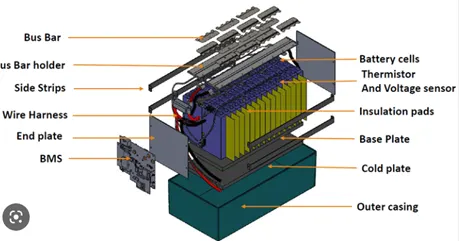
Materials Required:
- Battery cell
- Nickel (tabbing)
- BMS
- PVC shrink wrap
- Insulating paper
- Insulating foam
- Connectors and wires
Construction Steps:
Step 1: Check individual cell voltage and current performance
Step 2: Ensure the Design calculation to fix the cell modules
Step 3: Assemble the ANR26650M1-B Cells
Step 4: Choosing the Right Battery Strips and Spot Weld the Nickel Strips
Step 5: Adding the BMS
Step 6: Install cooling structures for air cooling or liquid cooling
Step 7: Install the battery pack inside the enclosure
Battery Management System:
Battery management system (BMS) is technology dedicated to the oversight of a battery pack, which is an assembly of battery cells, electrically organized in a row x column matrix configuration to enable
delivery of targeted range of voltage and current for a duration of time against expected load scenarios.
The oversight that a BMS provides usually includes:
- Monitoring the battery
- Providing battery protection
- Estimating the battery’s operational state
- Continually optimizing battery performance
- Reporting operational status to external devices
The importance of battery management systems
Functional safety is of the highest importance in a BMS. It is critical during charging and discharging operation, to prevent the voltage, current, and temperature of any cell or module under supervisory control from exceeding defined SOA limits. If limits are exceeded for a length of time, not only is a potentially expensive battery pack compromised, but dangerous thermal runaway conditions could ensue. Moreover, lower voltage threshold limits are also rigorously monitored for the protection of the lithium-ion cells and functional safety. If the Li-ion battery stays in this low-voltage state, copper dendrites could eventually grow on the anode, which can result in elevated self-discharge rates and raise possible safety concerns. The high energy density of lithium-ion powered systems comes at a price that leaves little room for battery management error. Thanks to BMSs, and lithium-ion improvements, this is one of the most successful and safe battery chemistries available today.
Performance of the battery pack is the next highest important feature of a BMS, and this involves electrical and thermal management. To electrically optimize the overall battery capacity, all the cells in the pack are required to be balanced, which implies that the SOC of adjacent cells throughout the assembly are approximately equivalent. This is exceptionally important because not only can optimal battery capacity be realized, but it helps prevent general degradation and reduces potential hotspots from overcharging weak cells. Lithium-ion batteries should avoid discharge below low voltage limits, as this can result in memory effects and significant capacity loss. Electrochemical processes are highly susceptible to temperature, and batteries are no exception. When environmental temperature drops, capacity and available battery energy roll off significantly. Consequently, a BMS may engage an external in-line heater that resides on, say, the liquid cooling system of an electric vehicle battery pack, or turn-on resident heater plates that are installed underneath modules of a pack incorporated within a helicopter or other aircraft. Additionally, since charging of frigid lithium-ion cells is detrimental to battery life performance, it is important to first elevate the battery temperature sufficiently. Most lithium-ion cells cannot be fast-charged when they are less than 5°C and should not be charged at all when they are below 0°C. For optimum performance during typical operational usage, BMS thermal management often ensures that a battery operates within a narrow Goldilocks region of operation (e.g. 30 – 35°C). This safeguards performance, promotes longer life, and fosters a healthy, reliable battery pack.
The benefits of battery management systems
An entire battery energy storage system, often referred to as BESS, could be made up of tens, hundreds, or even thousands of lithium-ion cells strategically packed together, depending on the application. These systems may have a voltage rating of less than 100V, but could be as high as 800V, with pack supply currents ranging as high as 300A or more. Any mismanagement of a high voltage pack could trigger a life-threatening, catastrophic disaster. Consequently, therefore BMSs are absolutely critical to ensure safe operation. The benefits of BMSs can be summarized as follows.
- Functional Safety. Hands down, for large format lithium-ion battery packs, this is particularly prudent and essential. But even smaller formats used in, say, laptops, have been known to catch fire and cause enormous damage. Personal safety of users of products that incorporate lithium-ion powered systems leaves little room for battery management error.
- Life Span and Reliability. Battery pack protection management, electrical and thermal, ensures that all the cells are all used within declared SOA requirements. This delicate oversight ensures the cells are taken care of against aggressive usage and fast charging and discharging cycling, and inevitably results in a stable system that will potentially provide many years of reliable service.
- Performance and Range. BMS battery pack capacity management, where cell-to-cell balancing is employed to equalize the SOC of adjacent cells across the pack assembly, allows optimum battery capacity to be realized. Without this BMS feature to account for variations in self-discharge, charge/discharge cycling, temperature effects, and general aging, a battery pack could eventually render itself useless.
- Diagnostics, Data Collection, and External Communication. Oversight tasks include continuous monitoring of all battery cells, where data logging can be used by itself for diagnostics, but is often purposed to the task for computation to estimate the SOC of all cells in the assembly. This information is leveraged for balancing algorithms, but collectively can be relayed to external devices and displays to indicate the resident energy available, estimate expected range or range/lifetime based on current usage, and provide the state of health of the battery pack.
- Cost and Warranty Reduction. The introduction of a BMS into a BESS adds costs, and battery packs are expensive and potentially hazardous. The more complicated the system, the higher the safety requirements, resulting in the need for more BMS oversight presence. But the protection and preventive maintenance of a BMS regarding functional safety, lifespan and reliability, performance and range, diagnostics, etc. guarantees that it will drive down overall costs, including those related to the warranty.
Conclusion:
Hence ,
- Battery pack of 18Kwh design calculations from cell to module and pack level has been made properly.
- Battery pack material requirement &construction has been laid out.
- Battery management importance and features has been discussed.