Week 1 Understanding Different Battery Chemistry
Part A Lithium-ion Batteries
Introduction :
Lithium-ion (Li-ion) batteries are an important component of energy storage systems used in various applications such as electric vehicles and portable electronics. There are many chemistries of Li-ion battery, but LCO, LMO, NMC, and NCA, LFP ,LTO are commonly used types.
lithium-ion battery or Li-ion battery is a type of rechargeable battery composed of cells in which lithium ions move from the negative electrode through an electrolyte to the positive electrode during discharge and back when charging. Li-ion cells use an intercalated lithium compound as the material at the positive electrode and typically graphite at the negative electrode. Li-ion batteries have a high energy density, no memory effect (other than LFP cells)[9] and low self-discharge.
1.Lithium Cobalt Oxide – LCO
2.Lithium Magnanese Oxide – LMO
3.Lithium Nickel Cobalt Aluminum Oxide (LiNiCoAlO2) — NCA
4.Lithium Nickel Manganese Cobalt Oxide (LiNiMnCoO2) — NMC
5.Lithium Iron Phosphate(LiFePO4) — LFP
6.Lithium Titanate (Li2TiO3) — LTO
Each battery details and characteristics we can see in brief as below.
1.Lithium Cobalt Oxide – LCO:
its high specific energy makes Li-cobalt the popular choice for mobile phones, laptops and digital cameras. The battery consists of a cobalt oxide cathode and a graphite carbon anode. The cathode has a layered structure and during discharge, lithium ions move from the anode to the cathode. The flow reverses on charge. The drawback of Li-cobalt is a relatively short life span, low thermal stability and limited load capabilities (specific power).
Chemical reactions Below:
Cathode:

Anode :


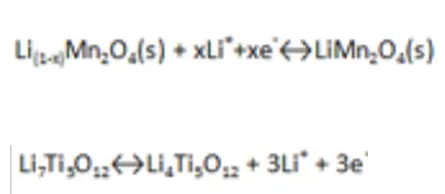
2.Lithium Magnanese Oxide - LMO
Li-ion with manganese spinel was first published in the Materials Research Bulletin in 1983. In 1996, Moli Energy commercialized a Li-ion cell with lithium manganese oxide as cathode material. The architecture forms a three-dimensional spinel structure that improves ion flow on the electrode, which results in lower internal resistance and improved current handling. A further advantage of spinel is high thermal stability and enhanced safety, but the cycle and calendar life are limited.
Chemical reactions Below:

3.Lithium Nickel Cobalt Aluminum Oxide (LiNiCoAlO2) — NCA
One of the most successful Li-ion systems is a cathode combination of nickel-manganese-cobalt (NMC). Similar to Li-manganese, these systems can be tailored to serve as Energy Cells or Power Cells. For example, NMC in an 18650 cell for moderate load condition has a capacity of about 2,800mAh and can deliver 4A to 5A; NMC in the same cell optimized for specific power has a capacity of only about 2,000mAh but delivers a continuous discharge current of 20A. A silicon-based anode will go to 4,000mAh and higher but at reduced loading capability and shorter cycle life. Silicon added to graphite has the drawback that the anode grows and shrinks with charge and discharge, making the cell mechanically unstable.
Chemical reactions Below:

4.Lithium Nickel Manganese Cobalt Oxide (LiNiMnCoO2) — NMC
NMC is a Li-ion battery with a different type of cathode. Unlike LFP, which possesses good capacity and stability, NMC demonstrates an improved cycle life, thermal stability, and energy density. Its layered cathode structure demonstrates a single-phase intercalation process as opposed to olivine structures with two phases. The cathode of NMC consists of Li(NixMnyCoz)O2, where the sum of the molar fractions (x, y, z) is equal to one . The discharge chemistry of NMC is similar to LFP, as they are both Li-ion batteries. It follows the process of lithium oxidation on the anode and reduces at the cathode.
Chemical reactions Below:

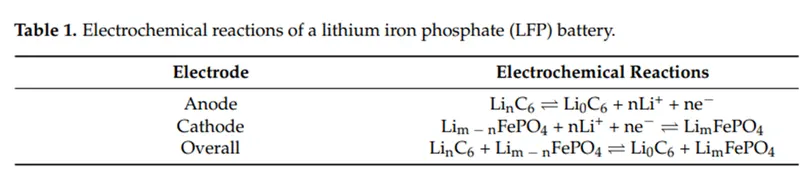
5.Lithium Iron Phosphate(LiFePO4) — LFP
lithium molecules from the negative electrode detach from layered graphene, becoming lithium ions and electrons. The electrons travel out of the battery as lithium ions move across a separator and both integrate into iron phosphates at the positive electrode. During charge, lithium separates from the iron phosphate, generating lithium ions and electrons. The lithium ions and electrons transfer to the positive electrode and integrate into the graphene structure. The reaction occurs from right to left.
Chemical reactions Below:
6.Lithium Titanate (Li2TiO3) — LTO
Batteries with lithium titanate anodes have been known since the 1980s. Li-titanate replaces the graphite in the anode of a typical lithium-ion battery and the material forms into a spinel structure. The cathode can be lithium manganese oxide or NMC. Li-titanate has a nominal cell voltage of 2.40V, can be fast charged and delivers a high discharge current of 10C, or 10 times the rated capacity. The cycle count is said to be higher than that of a regular Li-ion. Li-titanate is safe, has excellent low-temperature discharge characteristics and obtains a capacity of 80 percent at –30°C (–22°F).
Chemical reactions Below:
Part B: Lithium-Ion Batteries Characteristics and Differences:
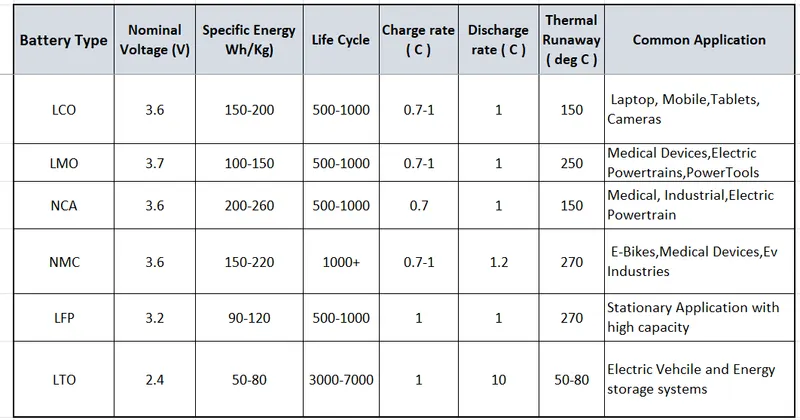
Nominal Voltage: Most of the batteries are very close when it comes to characteristics. LMO has the highest range and LTO has the lowest range in volts.
Cycle life: They differ by a significant amount from each other. LTO battery has the longest life cycle so that it can last longer period of time and it is exactly opposite for the LMO type batteries.
Charge current rate: Higher the charge current, the less time the battery will take to get fully charged. LTO and LTP are highest NCA comes close to its contenders.
Discharge current rate: If we need higher discharge rates and faster charging times we should choose a high rated battery instead. LTO has a discharge rate 10 times higher than the others and it t=is one of the safest batteries.
Thermal runaway: A thermal runaway occurs in situations where an increase in temperature changes the conditions in a way that causes increase in temperature often leading a destructive result. LTO has the highest temperature rating in this and NCA and LCP has its lowest.
Specific energy: The specific energy density can be calculated by integrating from 0 to cut-off. We can obtain the specific energy density in Wh Kg^-1. Lithium ion with cobalt cathodes offer the highest energy densities. These types of applications are cell phones, laptops and digital cameras. Power density indicates how much power a battery can deliver on demand.