Project 1 Mechanical design of battery pack
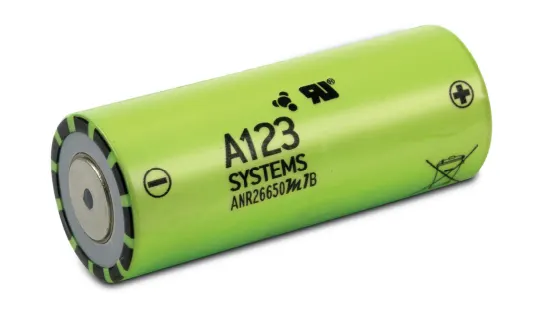
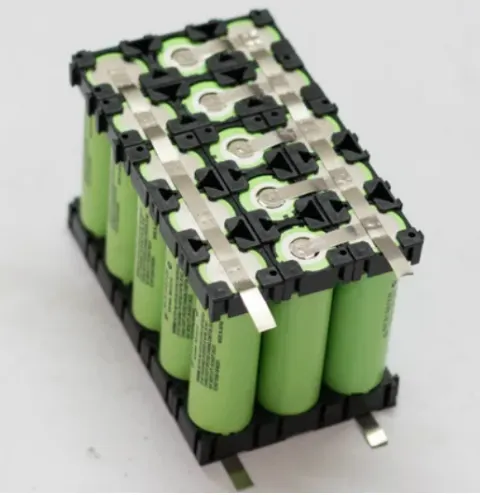
Designing a battery pack(ANR26650M1-B) :
A123’s high-performance Nanophosphate lithium iron phosphate (LiFePO4) battery technology delivers high power and energy density combined with excellent safety performance and extensive life cycling in a lighter weight, more compact package. Our cells have low capacity loss and impedance growth over time as well as high usable energy over a wide state of charge (SOC) range, allowing our systems to meet end-of-life power and energy requirements with minimal pack oversizing.
Applications:
Commercial Solutions:
Advanced lead acid replacement batteries for:
- Datacenter UPS
- Telecom backup
- IT backup
- Autonomously guided vehicle (AGV's)
- Industrial robotics and material handling equipment
- Medical devices
Government Solutions:
- Military vehicles
- Military power grids
- Soldier power
- Directed energy
Grid Solutions:
- Frequency regulation
- Renewables integration
- Reserve capacity
- Transmission and Distribution
Transportaion Solutions:
- Commercial vehicles
- Off-highway vehicles
- Passenger vehicles
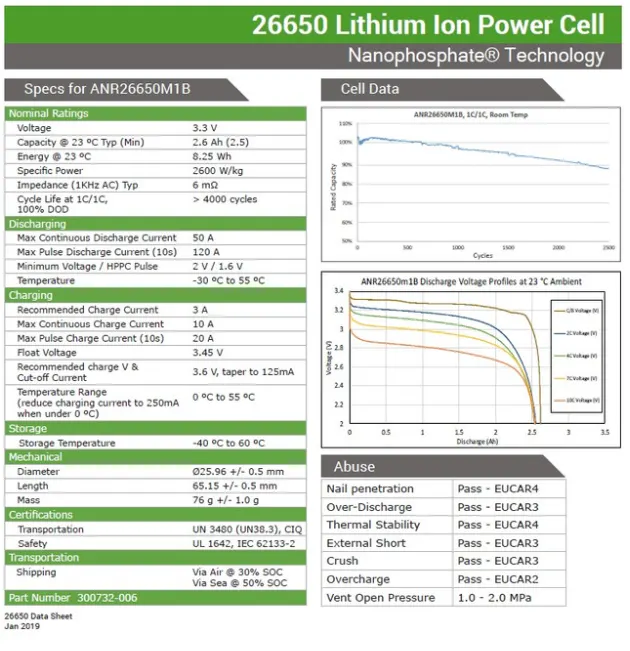
ANR26650M1-B Technical data:
|
Cell Dimensions
|
26 x 65 mm
|
|
Cell Weight
|
76 g |
|
Cell Capacity (nominal/minimum) (0.5C Rate)
|
2.5/2.4 Ah
|
|
Voltage (nominal)
|
3.3 V |
|
Internal Impedance (1kHz AC typical)
|
6mΩ
|
| Power |
2600 W/kg
|
|
Recommended Standard Charge Method
|
2.5A to 3.6V CCCV, 60 min
|
|
Recommended Fast Charge Method to 80% SOC
|
10A to 3.6V CC, 12 min
|
|
Maximum Continuous Discharge
|
50 A |
|
Maximum Pulse Discharge (10 seconds)
|
120 A |
|
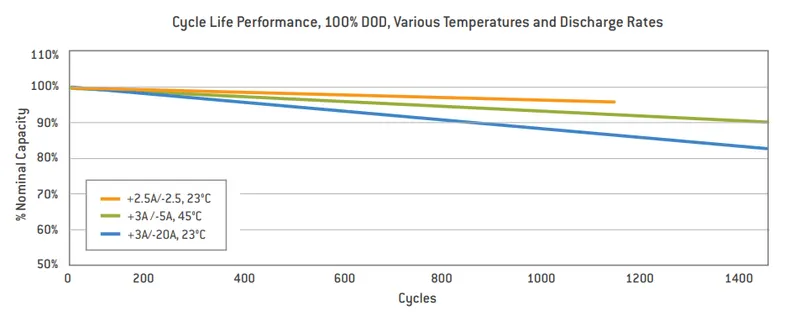
Cycle Life at 20A Discharge, 100% DOD
|
>1,000 cycles
|
|
Operating Temperature
|
-30°C to 55°C
|
| Storage Temperature |
-40°C to 60°C
|
Battery calculations :
Battery energy = 18 kwh
Voltage required = 400V
Energy = 18 kWh
Number of cells = Energy / (nominal voltage*capacity)
N = 18000 / (3.3*2.5)
N = 2182
So we approximately need 2182 cells connected inorder to get 18Kwh of energy.
The next thing to consider is the series parallel connection of a battery.
If we connect cells in series the voltage will increase and the current will remain constant.
And if we connect the cells in parallel the current will increase and the voltage will remain constant.
Total capacity needed
Energy = Voltage * Capacity
18*1000 = 400 * Ah
Capacity = 45 Ah
For a single battery,
Voltage = 3.3V
Capacity = 2.5A
So the total capacity needed is 45Ah.
To find the number of series connection :
Series = Total Voltage / Single cell voltage
= 400/3.3
Series = 121.2 = 122
So we need to connect 122 cells in series.
To find the number of parallel connections :
Parallel = Total capacity / capacity of a single cell
= 45/2.5
Parallel = 18
So we have to connect 18 cells in parallel.
So the total cells to be connected = 122*18 = 2196
So the exact number of cells we are is going to connect is 2196 cells.
Pack Dimension :
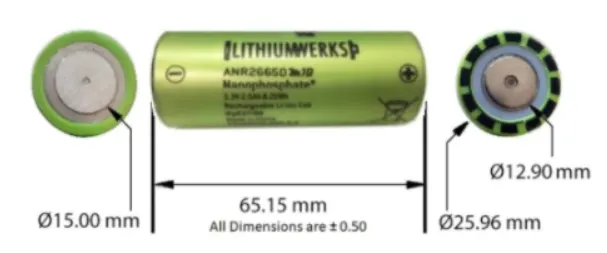
Cell height = 65mm
Cell dia = 26mm
Distance between centre to centre of cell = 30mm
Length of casing (L) = number of cells at series*(cell diameter (26) + margin at both side of cell (4)) + clearance at side (diameter of edged cell + margin)
L = 122*30 + 60
L = 3720 mm
Breadth of casing (B) = number of cells at parallel*(cell diameter (26) + margin at both side of cell (4) + clearance at side (diameter of edged cell + margin)
B = 18*30 + 60
B = 600 mm
Height of casing (H) = 65+35 (Height of cell + margin for wiring ,Cell holders and metal strips)
H = 100 mm
To calculate the weight of the battery :
Cell weight = 76g
Number of the cells = 2182
Battery pack weight (W) = cell weight*number of cells + weight of accessories
W = 76*2182 + 4.5 = 165.8 + 4.5 = 170.3 kg
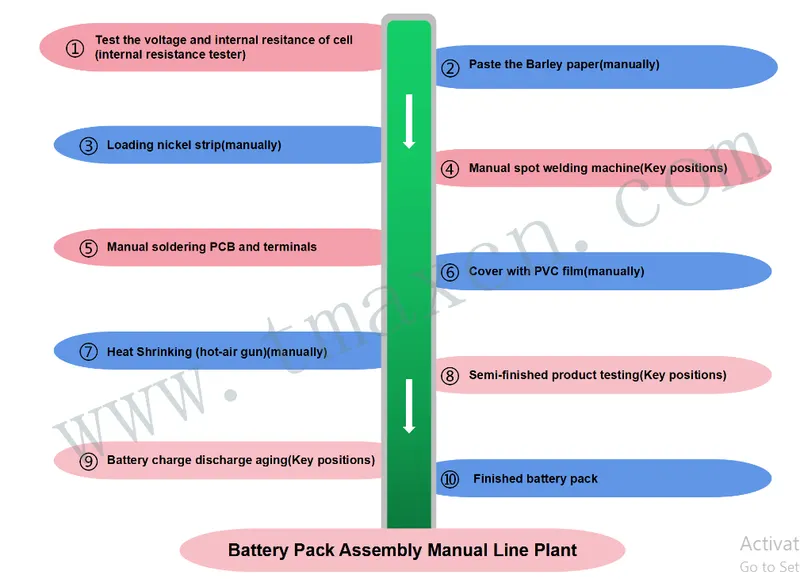
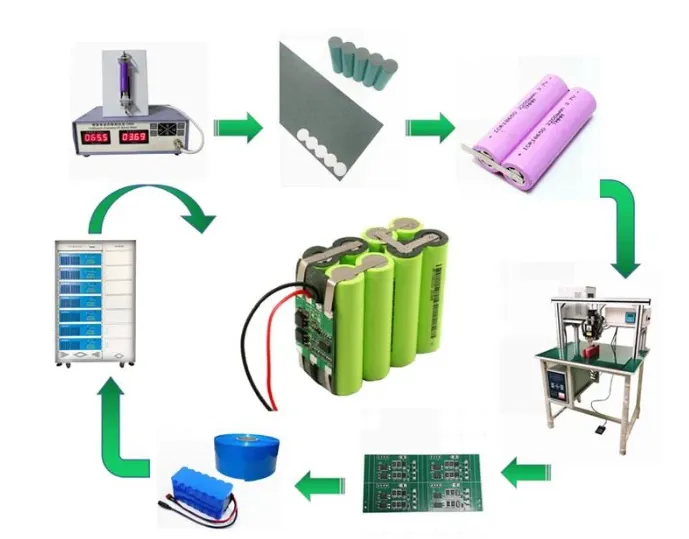
Conclusion :
Thus the battery pack was made and explained in detail.