Project 1 Mechanical design of battery pack
Battery pack capacity: 18 kWh
Cell: ANR26650M1-B
Prepare a detailed battery pack drawing along with its enclosure. State your assumptions.
ABSTRACT:-
- In this project, we are going to calculate the all parameters which are required for the build EV battery pack.
- We are going to use the Cell: ANR26650M1-B for our battery pack.
- In parameters, we will consider all electrical aspects like temperature, Depth of discharge, Operation current, Energy density, Work cycles, Battery capacity, State of Charge (SOC), State of Health (SOH), Ampere-hour (Ah) Capacity.
- We also calculate all geometrical considerations like size, weight, volume, area, etc.
OBJECTIVE:-
- Collecting the data of Cell: ANR26650M1-B from Nanophosphate High Power LithiumIon Cell PDF.
- Calculating all Electrical parameters for 18 kWh Battery Pack.
- Calculating all Physical dimensions for Battery Pack.
- Consider perfect enclosure for dimensions that we calculated for the Battery Pack.
PROCEDURE:-
1) first we have to start with Cell calculation.
2) Then we will do Battery Pack assumptions.
3) After assumptions, we have to do Battery pack calculations.
4) from Cell Dimensions we calculate the surface required for a battery pack.
5) Depending upon the above calculations we build Battery Pack construction.
Followings are the all cell (Cell: ANR26650M1-B) parameters for battery pack:
| ANR26650M1-B TECHNICAL DATA |
| Cell Dimensions | OD-26mm x H-65mm |
| Cell Weight | 76g |
| Cell Capacity (nominal/minimum) (0.5C Rate) | 2.5/2.4 Ah |
| Voltage (nominal) | 3.3V |
| Internal Impedance (1kHz AC typical) | 6mΩ |
| Power* | 2600 W/kg |
| Recommended Standard Charge Method | 2.5A to 3.6V CCCV, 60 min |
| Recommended Fast Charge Method to 80% SOC | 10A to 3.6V CC, 12 min |
| Maximum Continuous Discharge | 50A |
| Maximum Pulse Discharge (10 seconds) | 120A |
| Cycle Life at 20A Discharge, 100% DOD | >1,000 cycles |
| Operating Temperature | -30°C to 55°C |
| Storage Temperature | -40°C to 60°C |
* ~200W as measured by A123 modied HPPC Method @ 23°C, 50% SOC, 10 second discharge
From above all parameters we will calculate further parameters which are used for battery pack construction.
Cycle Life Performance, 100% DOD, Various Temperatures and Discharge Rates of cell
Constant Power Discharge Characteristics at 23°C of cell
2.5C Constant Current Discharge at Various Temperatures
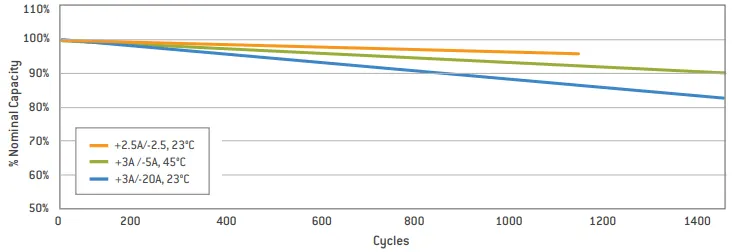
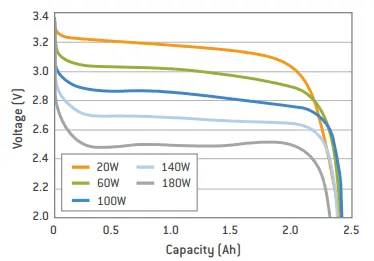
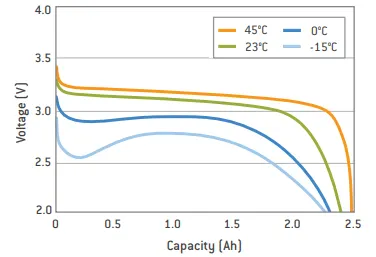
A123’s high-performance Nanophosphate lithium iron phosphate (LiFePO4) battery technology delivers high power and energy density combined with excellent safety performance and extensive life cycling in a lighter weight, more compact package. Our cells have a low capacity loss and impedance growth over time as well as high usable energy over a wide state of charge (SOC) range, allowing our systems to meet end-of-life power and energy requirements with minimal pack oversizing.
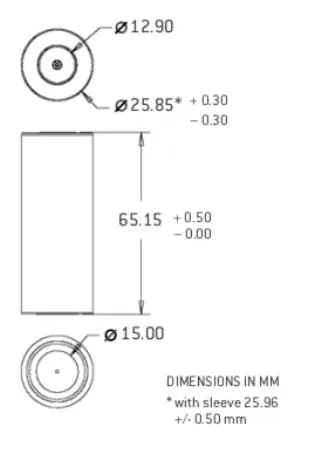
Cell dimensions:-
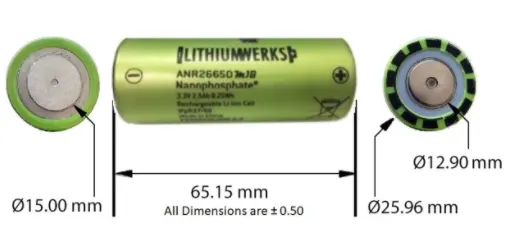
Cell calculation:-
Calculation of the volume of the cell we use the formula of Volume of cylinder.
r=13mm (0.013m)
h=65mm (0.065m)
Volume of the cell: πr2h">πr^2h = 3.14*0.013^2*0.065 = 0.0000344929m^3
The volume of the cell is 0.0000344929m^3
Calculation of the energy of the cell we use the formula of Call Energy
Cell Capacity (Ah)=2.5Ah
Cell Voltage (V)=3.3V
Cell Energy= Cell Capacity (Ah) × Cell Voltage (V) = 2.5 × 3.3 = 8.25 Wh
Cell Energy is 8.25 Wh
Calculation of the energy Density of the cell we use the formula of Call Volumetric energy
Cell Energy= 8.25Wh
Volume of the cell= 0.0000344929m^3
Volumetric energy (kWh/m3) = Cell Energy / Volume of the cell = 8.25 Wh / 0.0000344929m^3 = 2,39,179.6572 kWh/m^3
Single Cell Energy Density is 2,39,179.6572 kWh/m^3
Battery pack calculation:-
Now we have to assume the battery pack:
To get 18 kwh as a output power we have to conside serises and paraller cells to be connected to create the battery pack module of the required capacity.
let us consider 72 V operated motor used in electric vehicle
The total value of voltage is 72V.
since we have power and voltage, we can determine the pack current,
voltage = 72V
power = 18kwh (18000Wh)
current(Ah) = power(Wh) / voltage(V) = 18000 / 72 = 250Ah
The total value of Current is 250Ah.
Since we know the current capacity, the number of cells in parallel and series connection can be determined.
Now we calculated parallel combinations so we can now calculate parallel no of cells required
Total pack current = 250Ah
cell current = 2.5Ah
No. of cells in parallel connections = Total pack current / cell current = 250 / 2.5 = 100 cells
Total No. of cells in parallel connections required are 100 cells.
Now we calculated series combinations so we can now calculate series no of cells required
Total pack voltage = 72V
cell voltage = 3.3V
No. of cells in series connections = Total pack voltage / cell voltage = 72 / 3.3 = 21.82 ~ 22 cells
Total No. of cells in series connections required are 22 cells.
Now we can say that the configuration of our battery pack is 22S 100P which means there are 22 cells in series and 100 cells in parallel connection.
Pack configuration: 22S 100P
Now we calculated parallel and series combinations so we can now calculate total no of cells required
series cells = 22
parallel cells = 100
Total no of cells: Series cells * parallel cells = 22 * 100 = 2200 cells
Total no of cells required are 2200.
Now that have got the number of cells involved in the battery paqck construction we can determine the pack dimensions.
Let us consider, the number of cells connected in series along the length of the battery pack for simple model, By this
assumption we get the length of our battery pack as,
Here we are assuming the gap between cells as 4mm so in order to get this gap we are adding 4mm to the cell diameter 2mm on either sides
Length of battery pack = No. of cell in series connection * (Diameter of single cell + cell spacing) = 22 * (26 + 4) = 660mm
Total Length of battery pack are 660mm (0.66 meters).
Similarly for width, we are assuming the parallel connection along the width of our pack again to keep the design simple.
Width of battery pack = No. of cells in parallel * (Diameter of single cell + cell spacing) = 100 * (26 + 4) = 3000mm
Total Width of battery pack are 3000mm (3 meters).
now that we have length and breadth we need height of the pack, which can be determined by adding the height of cell with the other parameter such as cell holder, metal strip and some space for wiring and cooling functions, we will assume approximately 35mm for all this parameters. So now the heigth of battery pack is,
Height of battery pack = (Height of individual cell + 35) = 65 + 35 = 65 + 35 = 100mm
Total Height of battery pack are 100mm (0.1meters)
so now that we have got the length, breadth and heigth, the area and volume can be determined.
Since we are assuming that our battery pack is in rectangular shape,
Area of battery pack = length of battery pack * width of battery pack = 0.66 * 3 = 1.98m^2
Total Area of battery pack are 1.98m^2.
volume of battery pack = area of battery pack * height of battery pack = 1.98 * 0.1 = 0.198m^3
Total volume of battery pack are 0.198m^3.
For weight of battery pack, (we are considering only the weight of cell and ignoring the holder, metal strips and cover weight)
Weight of battery pack = weight of individual cell * number of cells = 76 * 2200 / 1000 = 167.2Kg
Total Weight of battery pack are 167.2Kg.
Now that we have determined the volume and area of battery pack,
Specific Energy = overall energy of battery pack / Weight of battery pack = 18000 / 167.2 = 107.66kWh/Kg
Total Specific Energy are 107.66kWh/Kg.
Energy Density = overall energy of battery pack / Volume of battery pack = 18000 / 0.198 = 90909.09kWh/m^3
Total Energy Density are 90909.09kWh/m^3
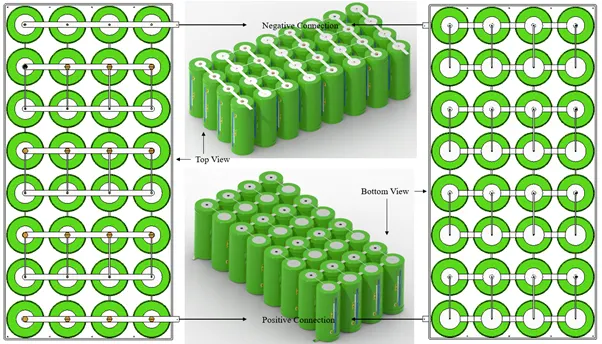
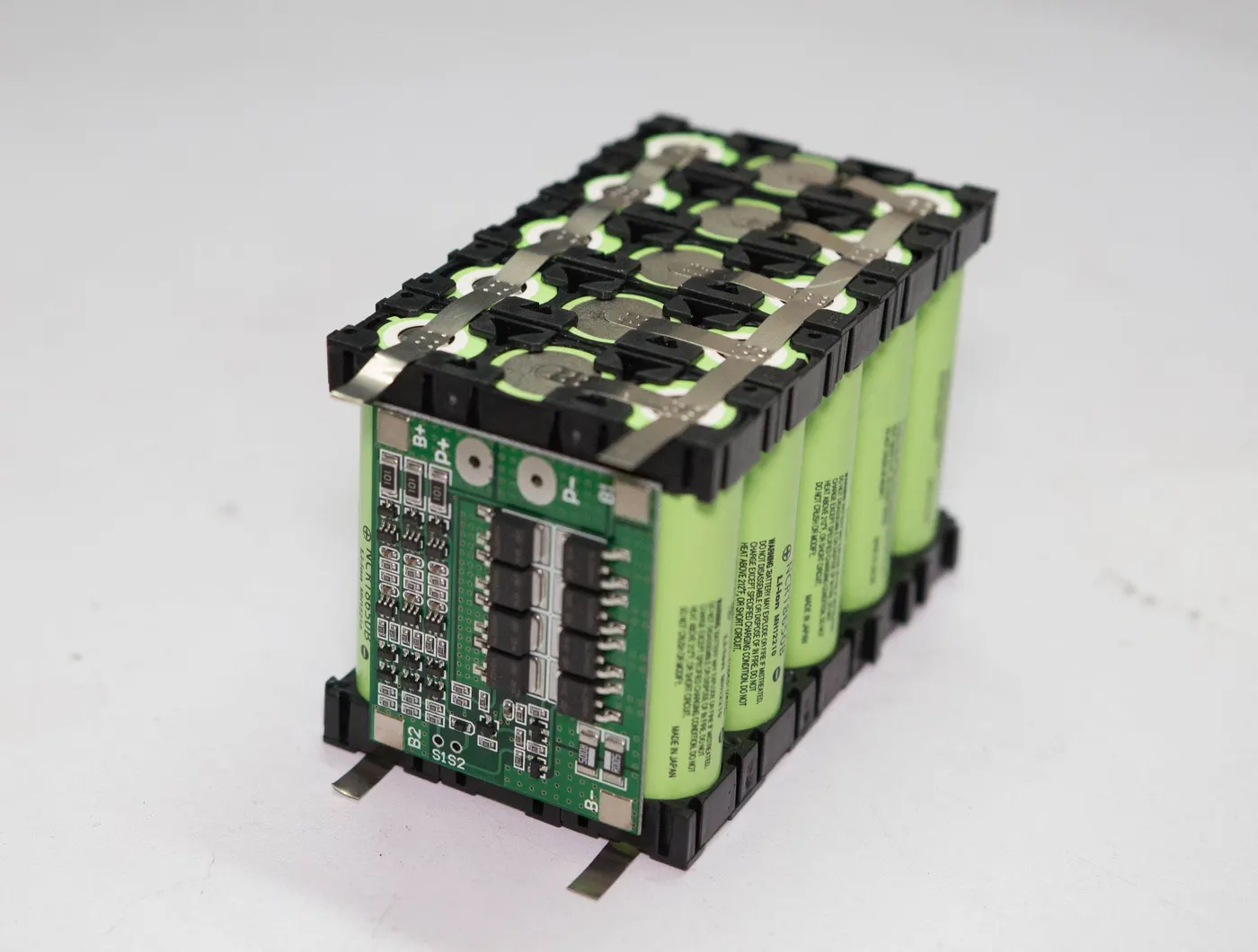
The arrangement of our battery pack will look like the image shown below,
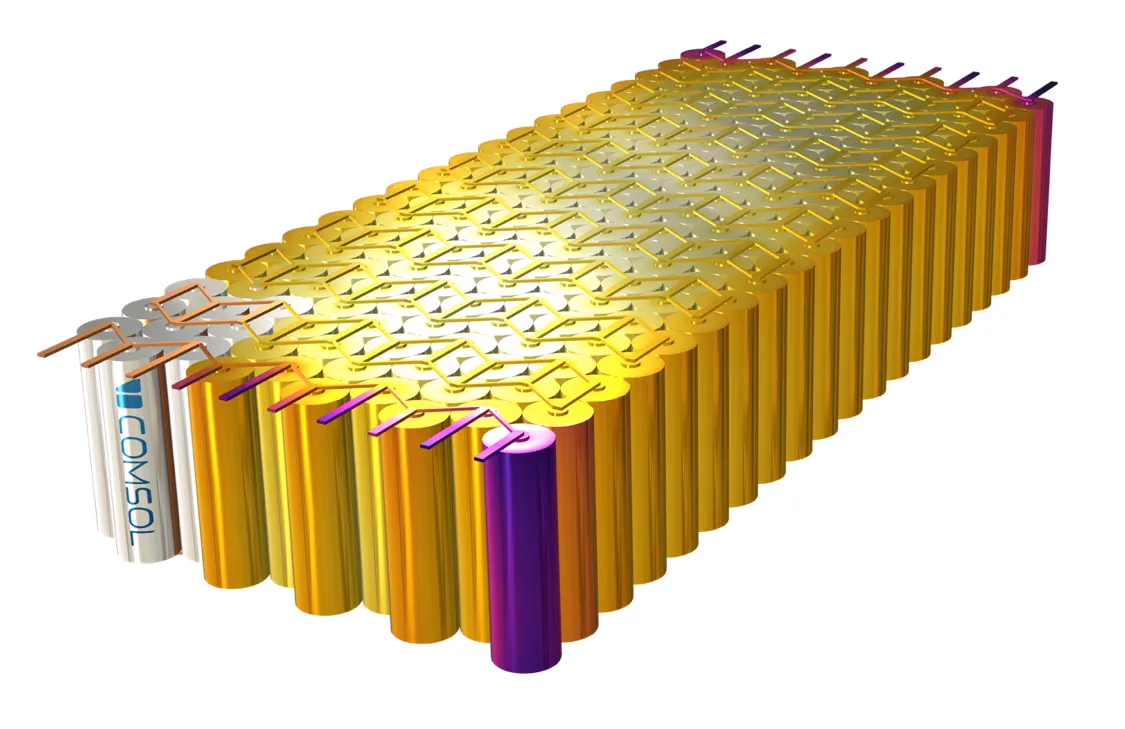
Which is of the rectangular from similar as our case, once the number of cells required and other parameters are calculated
voltage of these cells connected in series, so that all the voltages of the cells lie in the specified range. Also the batch of the cell is verified. this is to ensure that there is no any mismatch in the configurations of cells.
Battery Pack construction:
There are 3 steps for the construction of the battery pack.
1)Battery holding and providing the spacing between the battries.
2)Connecting the battries with the strips (Series or Parallel)
3)making and manifacturing the battery enclosure housing with the thermal managment system and BMS
1)Holding and spacing:
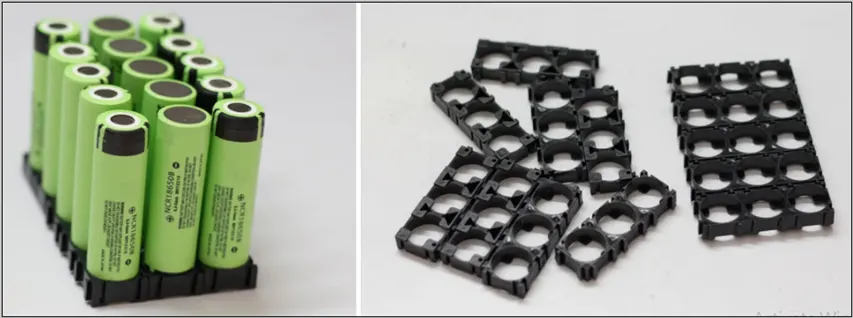
- Each of the cells are now need to be connected so that it could form a big battery module.
- So this holdes are very importatnt to provide the gapping between the battery and holding the battries in the correct manner.
- The cells has a vent at the end cap of the cell.and should not be covered by any mechinical means.Blocking the cell vent and then sufficiently abusing the cell so as to built the pressure in cell.There must be minimum of 1mm spacing between each cells to allow the vent to open under the fault condition.
- Holders will make it easy to palcethe contact plate between the cells.
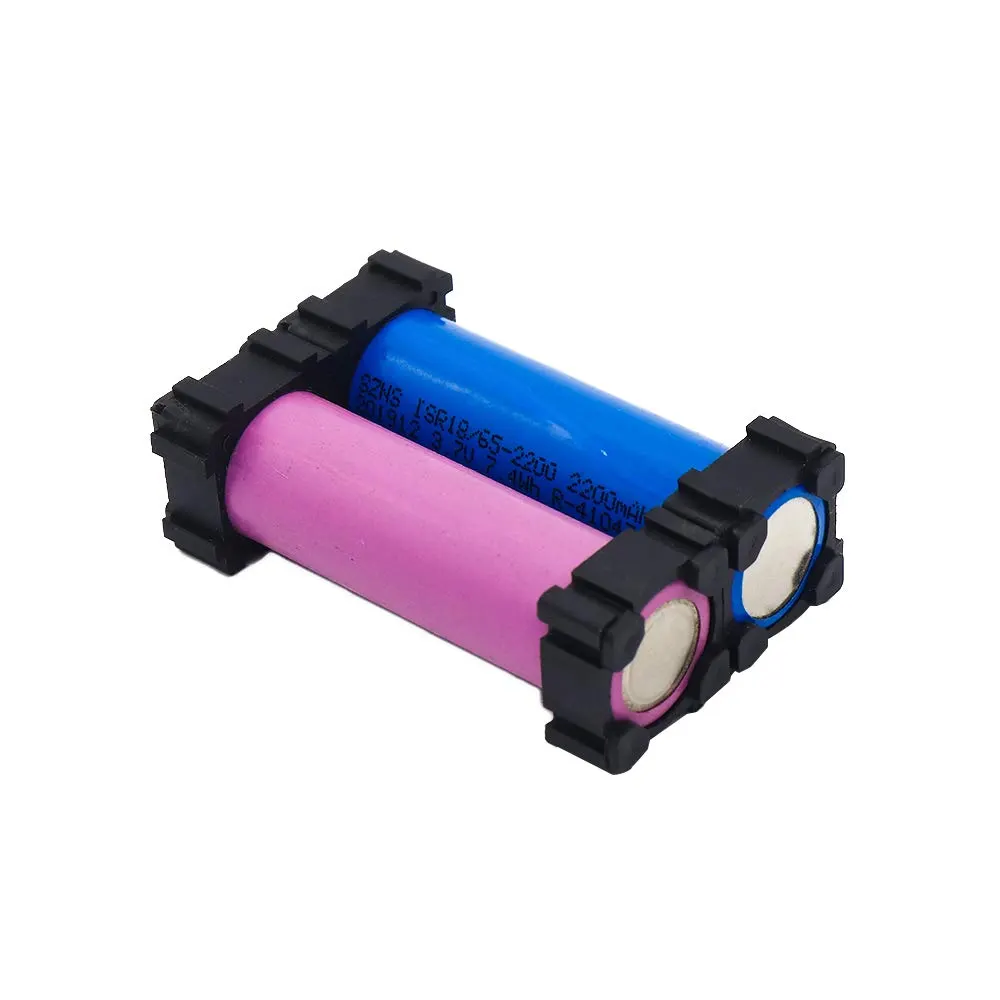
2) Connecting the cells:
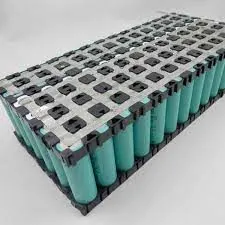

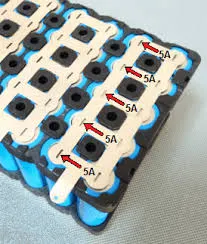
- When the cells are plalced in the holders ,then the cells need to be connect in the proper manner in series or parallel to get the desired results.
- Ususally a nickle strip is used between the cells to make the conatct.

- Nickel strip is generally used in battery building.
- Its due to its efficiency of usage in spot welding and soldering as well its high corrosion resistance over time.
- It has good properties and excellent resistance to many corrosive environments.
- The pure nickel will never get rust after it applied to battery packs.
- It won’t affect the current transfer between batteries.Pure nickel strips are the material you want, but many vendors swap out it for nickel-plated steel strips, which are poorer and have greater resistance – not suitable for most battery projects. 100% pure nickel strip.
- verify all of our strips to assure that you are getting the high-quality pure nickel. It also solder incredibly quickly, so you can weld them onto your existing busbar connections to raise the supply of current you can pull through the busbars. The benefits are nearly limitless!
3)Battery enclosure and thermal managment of battery and BMS
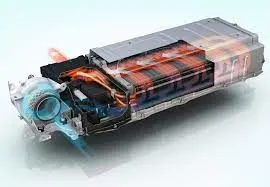
- The battery encolsure is the final protection of the battery.
- So the battery enclose must be very strong and light in weight.
- In the case of any accident the batteries has the tendentcy of catch fire if it get leaked during the car crash,so the battery modle is enclose in a very strong encolsure due to the safety.
- The weight should be less so we can get the best pssible range.
- In this metal housing there is a temperature managment system provided to cool and heat the battries when there is a need to get the best performace of the battries.
- There a several numbers of models connected in series and parallel to build a entire battry pack.
BMS:
A battery management system (BMS) is an electronic system that manages a lithium battery pack and the main functionalities are
1. Monitors all of the parallel groups in the battery pack and disconnect it from the input power source when fully charged
2. Balance all the cells voltage equally
3. Doesn't allow the pack from over-discharged
Conclusion:
A Battery pack of 18kWh is created and its specification are as follows,
| NO | Calculated Parameters | Value Get |
| 1 | Cell Volume | 0.0000344929m^2 |
| 2 | Cell Energy | 8.25Wh |
| 3 | Cell Density | 239179.6572kWh/m^3 |
| 4 | Pack configuration | 22s 100p |
| 5 | Total no of cells | 2200 |
| 6 | Total Voltage | 72V |
| 7 | Total Capacity | 250Ah |
| 8 | Total Energy | 18000WAh |
| 9 | Total volume | 0.198m^3 |
| 10 | Total Energy Density | 90909.09kWh/m^3 |
| 11 | Weight | 167.2kg |
| 12 | Total Height | 100mm |
| 13 | Total Width | 3000mm |
| 14 | Total Length | 660mm |
| 15 | Total Area | 1.98m^2 |