Project 1 Mechanical design of battery pack
Project - Mechanical Design of Battery Pack
Aim: Designing a battery pack
Objective: Battery pack capacity: 18 kWh
Cell: ANR26650M1-B
Prepare a detailed battery pack drawing along with its enclosure. State your assumptions.
Solution: In this challenge, we have to design a battery pack based on the given conditions. Let’s assume our battery pack to be a 200V 18 kWh pack. The battery pack is to be assembled using the ANR26650M1-B cells. A brief description about this cell is:
Nanophosphate is A123 Systems’ patented lithium ion battery cathode active material, originally developed by professor Yet-Ming Chiang and his group at the Massachusetts Institute of Technology (M.I.T).
The Structure of Nanophosphate
Nanophosphate is an engineered nanoscale material with specific structural and chemical properties designed to maximize the performance of lithiumion batteries. Figure 1 schematically illustrates this structure. The image on the left is a cathode electrode, with the aluminum current collector foil covered with Nanophosphate particles. The middle image is the Nanophosphate secondary particle and the image on the right illustrates the primary particles.
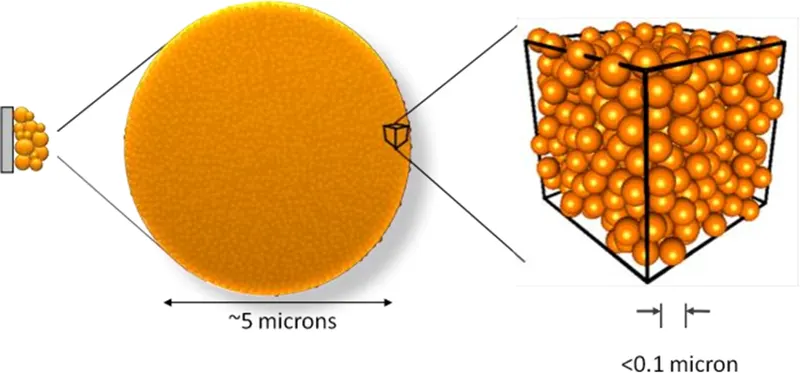
The primary Nanophosphate particles are about one-tenth of a micron in diameter and are agglomerated into much larger secondary particles, which have diameters of a few microns. So, although the primary particle may have a length scale on the order of several tens of nanometres, the 2 secondary particle is on the length scale of microns, making it well above the Environmental Protection Agency (EPA) definition of what is considered a nanomaterial. Micron-sized secondary particles allow the Nanophosphate powder to be handled and processed more easily. This unique electrochemical structure of Nanophosphate enables a number of performance advantages, including higher power, excellent safety, long life and greater usable energy.
Advantages:
Nanophosphate battery technology offers stable chemistry, faster charging, consistent output, excellent cycle life and superior cost performance. It provides the foundation for safe systems while meeting the most demanding customer requirements. Multiple layers of protection are employed at the chemistry, cell and system level to achieve an energy storage solution with superior safety and abuse tolerance compared to metal oxide lithium-ion chemistries.
The cell specs as per its datasheet are given as:
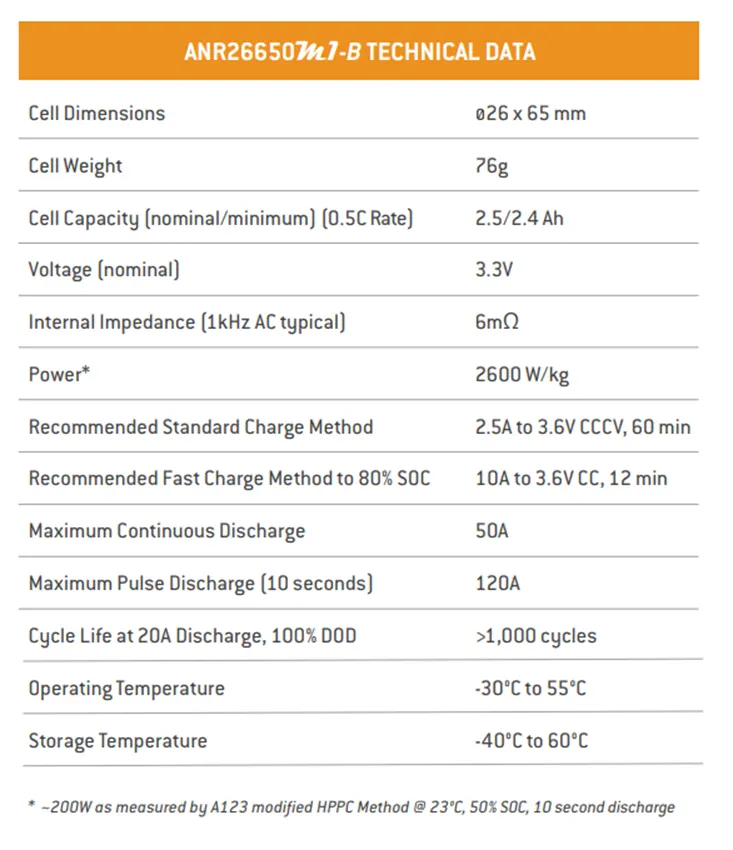
Based on these specs, the number of cells and their configuration can be calculated as:
a. Number of cells in series = Pack voltage/ Individual cell voltage
= 200/3.3
= 61 cells in series
b. Number of cells in parallel = Total pack capacity / Individual cell capacity
= 18000/400 / 2.5
= 18 cells
c. Total number of cells = 61 X 18 = 1098 cells
d. Cell configuration thus is 61s18p
e. The specific energy density of the pack = Energy / Volume
Volume of individual cell = `pi` * r2 * h
= `pi` * .0262 * .065
= 1.38 X 10⁻⁴ m3
Volume of pack = 1098 * volume of individual cell
= 0.1515 m3
Specific energy density of the pack = 18 / 0.1515
= 118.81 kWh/m3
f. Gravimetric energy density = Energy / Weight
Weight of individual cell = 76 g
Weight of pack = 76 * 1098 = 83448 g = 83.45 kg
Gravimetric energy density = 18 / 83.45
= 0.22 kWh/kg
Battery Pack configuration:
A battery pack is a set of any number of (preferably) identical batteries or individual battery cells. They may be configured in a series, parallel or a mixture of both to deliver the desired voltage, capacity, or power density. The term battery pack is often used in reference to cordless tools, radio-controlled hobby toys, and battery electric vehicles.
Components of battery packs include the individual batteries or cells, and the interconnects which provide electrical conductivity between them. Rechargeable battery packs often contain a temperature sensor, which the battery charger uses to detect the end of charging. Interconnects are also found in batteries as they are the part which connects each cell, though batteries are most often only arranged in series strings.
When a pack contains groups of cells in parallel there are differing wiring configurations which take into consideration the electrical balance of the circuit. Battery regulators are sometimes used to keep the voltage of each individual cell below its maximum value during charging so as to allow the weaker batteries to become fully charged, bringing the whole pack back into balance. Active balancing can also be performed by battery balancer devices which can shuttle energy from strong cells to weaker ones in real time for better balance. A well-balanced pack lasts longer and delivers better performance.
For an inline package, cells are selected and stacked with solder in between them. The cells are pressed together and a current pulse generates heat to solder them together and to weld all connections internal to the cell.