Project 1 Mechanical design of battery pack
# AIM
Design battery pack for 18kWh
# OBJECTIVE
Prepare a detailed battery pack drawing along with its enclosure
Battery pack capacity: 18 kWh
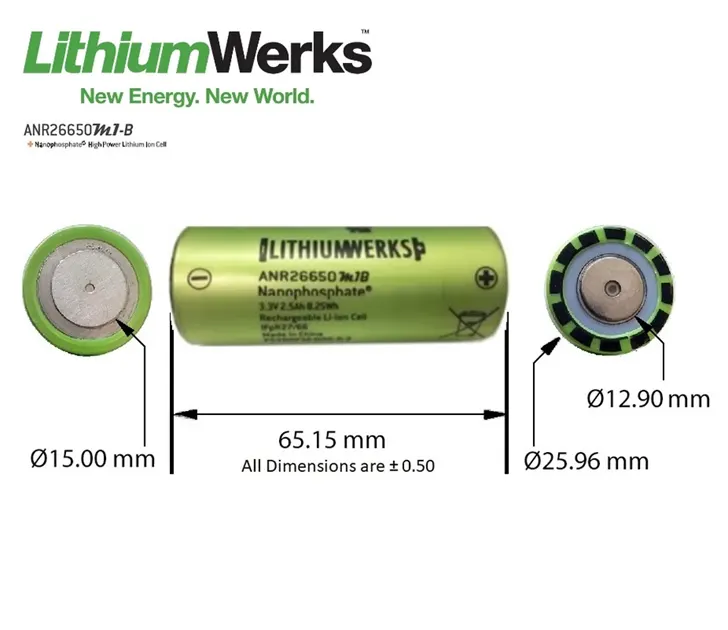
Cell: ANR26650M1-B
# METHODOLOGY:
1) To build the Battery pack for any Electric Vehicle, we have to calculate the first proportion of power then motor power, and depending on that we will model the battery pack so we know how much power we required which is 18kWh.
2) For the 18kWh battery Pack we have to calculate how many cells are parallel and how many cells are in series.
3) After calculation of series and parallel combination we have to calculate the proper Geometry and topology consideration for assembling batteries.
4) After Assembly we need to find a proper enclosure for the battery pack for thermal consideration and other physical damages.
# THEORY:
The high voltage battery is one of the most important components of a battery electric vehicle (BEV). The battery parameters have a significant influence on other components and attributes of the vehicle, like:
- maximum traction motor torque
- maximum regeneration brake torque
- vehicle range
- vehicle total weight
- vehicle price
Pretty much all major aspects of a pure electric vehicle (EV) depend on the parameters of the high voltage battery. For our electric vehicle battery design we are going to start from 4 core input parameters:
- chemistry
- voltage
- average energy consumption of the vehicle on a driving cycle
- vehicle range
A battery consists of one or more electrochemical cells (battery cells) which are converting chemical energy into electrical energy (during discharging) and electrical energy into chemical energy (during charging). The type of elements contained within a battery and the chemical reactions during discharging-charging events define the chemistry of a battery.
A battery cell consists of five major components: electrodes – anode and cathode, separators, terminals, electrolytes, and a case or enclosure. For automotive applications, there are different types of cells used Individual battery cells are grouped into a single mechanical and electrical unit called a battery module. The modules are electrically connected to form a battery pack.
# EXPLANATION
* ANR26650M1-B
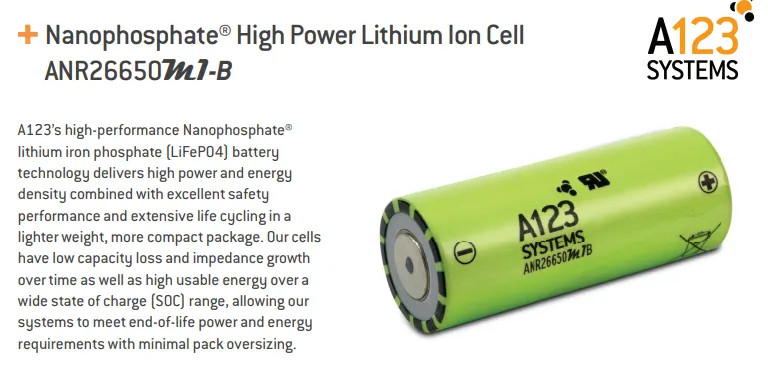
* ANR26650M1-B specification:
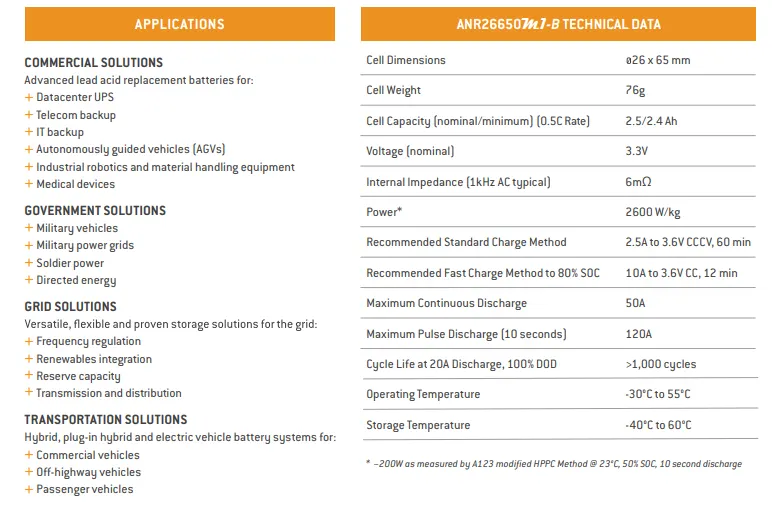
Nominal Rating:
- voltage :3.3 volts
- capacity:2.5Ah
- energy: 8.25Wh
- specific power: 2600W/kg
- impedance(1KHz AC typical): 6 mΩ
- cell type: 26650 lithium-ion power cylindrical cell.
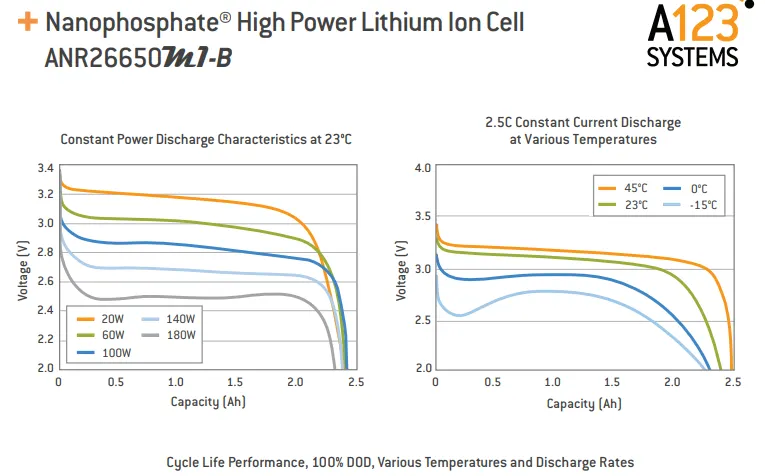
Discharging:
- max.continuous discharage: 50A
- max pulse discharge current > 50% SOC (10sec): 120A
- minumum voltage:2 volts
- temperature: -30 to 55 degree celcious
charging:
- recommended std.charge: 2.5A
- max charge rate:10A
- max pulse charge current<50% SOC (10sec) :25A
- float voltage: 3.45 volts
mechanical parameters:
- diameter: 25.96 +/- 0.5 mm
- length: 65.15+/- 0.5 mm
- mass : 76g
* Calculation as per assumptions: 18 KWh battery pack.
The calculation for designing an 18 KWh battery pack basically 18 KWh is the energy required to achieve the vehicle in its proper range and it depends on the voltage(V) and amp-hr capacity(Ah).
1] single cell energy(Wh) [the value of single cell energy is used to calculate the total energy of the battery pack]:
single cell energy(Wh)= cell capacity(Ah)* cell voltage(V)
= 2.5Ah *3.3V
= 8.25 Wh
2] single cell volume calculation:
single cell volume = pi(r^2)*h
= 3.14(0.013^2)*0.065
= 0.03451 m^3
3] single cell energy density:
A] volumetric energy(Wh/m^3) = single cell energy / volume of each cell
= 8.25Wh / 0.03451 m^3
= 239.0611 Wh/m^3
B] gravimetric energy(Wh/kg) = single cell energy / single cell mass
= 8.25Wh / 0.076 kg
=108.5526 Wh/Kg
Calculation of high voltage battery pack
For the design and calculation of the battery pack here, I assume a vehicle to achieve 200km in 18 KWh battery pack also I assume 145.2 nominal voltage for series connection.
we assume that,
vehicle range = 200 Km
battery pack capacity = 18.1210KWh
now,
4] we will calculate per Km average energy requirement = 18120.96 (Wh)/200 (Km)
= 90.60 Wh/Km
Therefore,
battery pack total energy = average energy * km
= 90.60Wh * 200km
= 18120.96 Wh
let's assume nominal voltage for seres connection= 145.2 V basically this depends upon the motor power, we can decide the value according to the motor.
5] number of cells connected in series = nominal voltage of seres connection/nominal voltage of a single cell
= 145.2V/ 3.3V
= 44 cell
44 cells will be connected in a series connection to provide a proper voltage.
6] energy for battery pack(Wh) = number of cell connected in series * single cell energy
= 44* 8.25Wh
= 363 Wh
7]number of cell connected in parallel = battery pack total energy(Wh)/energy for battery pack(Wh)
= 18120.96 Wh/363 Wh
= 50 cells
50 cells will be connected in a parallel to provide a proper capacity power.
8] battery pack total energy(Wh) = no. of cell connected in parallel * energy for battery pack
= 50* 363 Wh
= 18.150 KWh
9] battery pack capacity(Ah) = no. of cell connected in parallel * single cell capacity(Ah)
= 50*2.5 Ah
= 125 Ah
the value of battery pack capacity is used for the total power required by the vehicle.
10] The total number of cells for battery pack = no. of cells connected in parallel * number of cells connected in series
= 50*44
=2200 cells
2200 cells will be used to make a complete battery pack.
11] mass of battery pack = total number of cell for battery pack * mass of single cell
= 2200 * 0.076 kg
= 167.2 kg
167.2 kg its the total weight of cell connected in parallel and series
12] total volume of the battery pack = total number of cell for battery pack * volume of single cell
= 2200 * 0.0345 m^3
= 75.9 m^3
75.9 m^3 is the volume occupied by the total cells used in the battery pack.
13] cell peak current(A) = C rate(max pulse charge current)* single cell capacity
= 20* 2.5
= 50A
14] battery pack peak current(A) = cell peak current(A) * no. of cell connected in parallel
=50*50
= 2500A
15] battery pack peak power(W) = battery pack peak current(A) * voltage of series connection
= 2500 A * 145.2
= 363 KW
16] cell continuous current(A) = C rate(max continuous charge current)* single cell capacity
= 10* 2.5
= 25A
17] battery pack continuous current(A) = cell continuous current(A) * no. of cell connected in parallel
= 25*50
= 1250 A
18] battery pack continuous power(W) = battery pack continuous current(A) * voltage of series connection
= 1250 A * 145.2
= 181.5 KW
* Details of Cell: ANR26650M1-B:
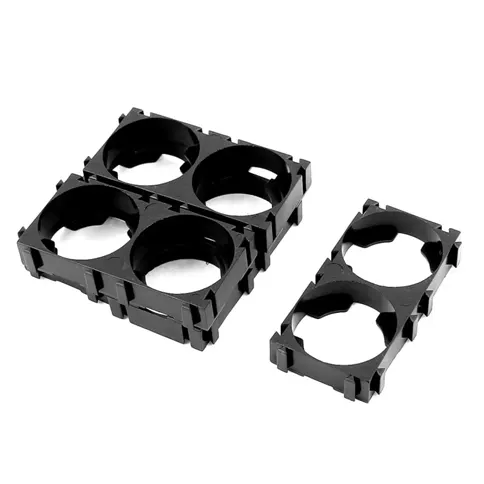
* Battery holder:
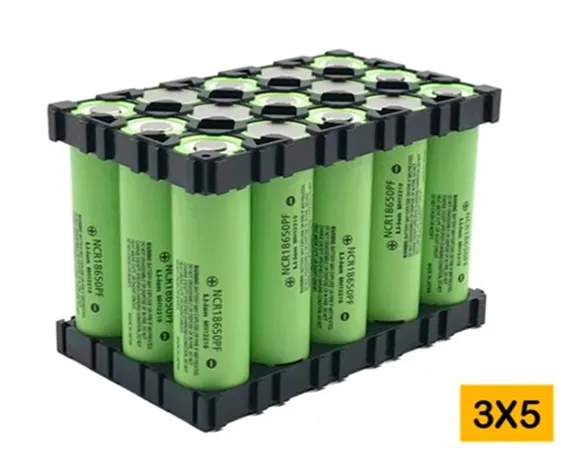
- The main function of a battery holder is to keep cells fixed in place safely and securely also it is used to keep cells in a proper arrangement so that there will be a decrease in mechanical vibration, and a better thermal runway in between the cells gaps.
- Most of the cell holder is made up of polypropylene or nylon bodies rated for 80–100 °C.
* Electric connection:
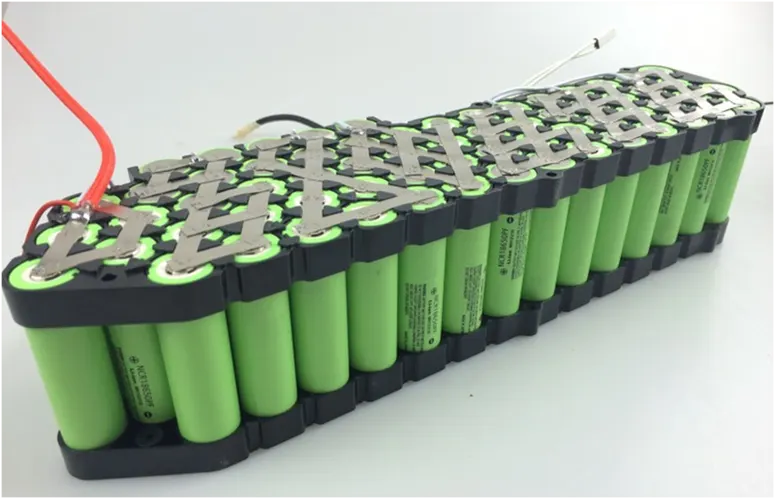
* Nickel Strips
- Nickel strip is generally used in battery building. It's due to its efficiency of usage in spot welding and soldering as well as its high corrosion resistance over time. It has good properties and excellent resistance to many corrosive environments.
- The pure nickel will never get rust after it is applied to battery packs. It won’t affect the current transfer between batteries.
- Pure nickel strips are the material you want, but many vendors swap out it for nickel-plated steel strips, which are poorer and have greater resistance – not suitable for most battery projects.
- 100% pure nickel strip. verify all of our strips to assure that you are getting the high-quality pure nickel.
- It also solders incredibly quickly, so you can weld them onto your existing busbar connections to raise the supply of current you can pull through the busbars. The benefits are nearly limitless.

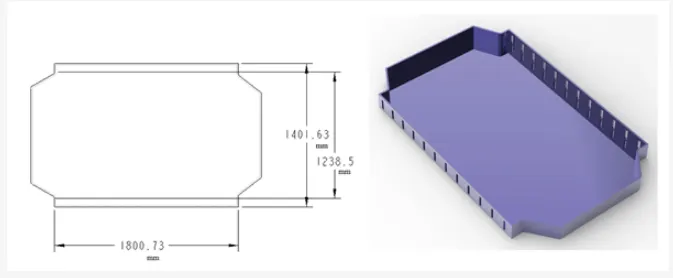
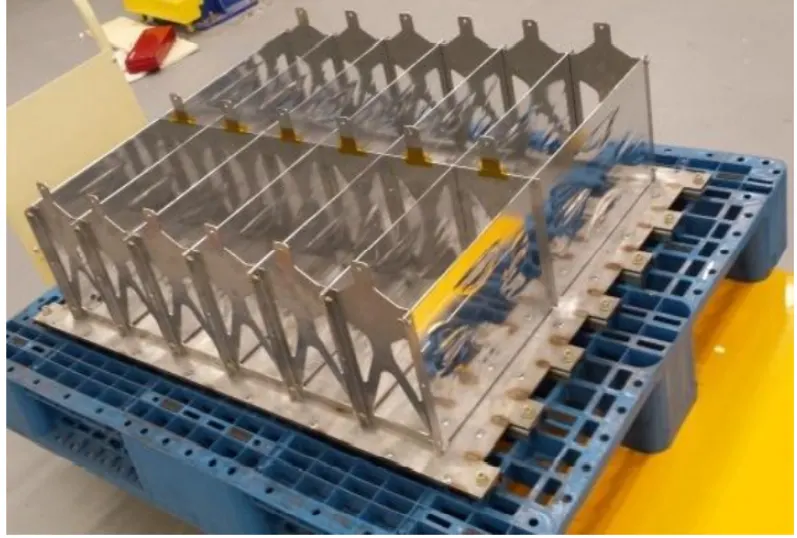
* Design of Lower floor case for battery pack
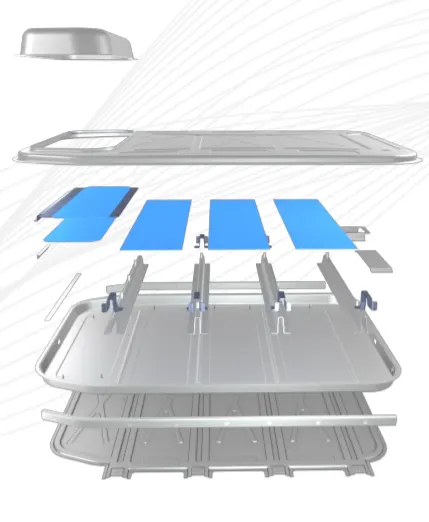
Basically, the lower case is a part that is fitted in an electric vehicle for the assembly of the battery pack. A lower case is also made up of aluminum and it has a top cover and bottom cover to battery pack from dust and environmental pollution.
The design of the lower case is shown
* Positive and Negative Clip
A positive and negative clip is used to connect the battery end cap i.e (+) and (-). Design is shown below:
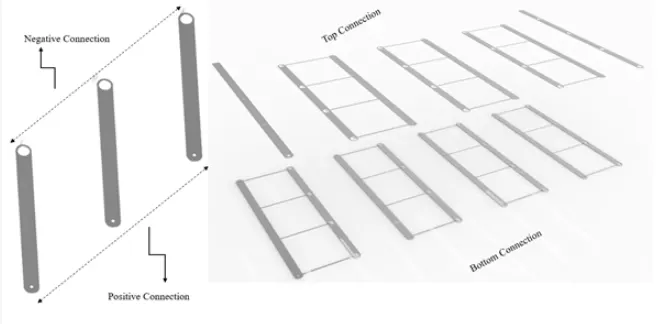
- To make the battery pack, you have to connect the many cells together by means of Nickel strips or thick wire. Generally, Nickel strips are widely used for this.
- In general two types of nickel, strips are available in the market: nickel-plated steel strips and pure nickel strips. I will suggest buying a pure nickel.
- It is a little bit costlier than nickel-plated steel, but it has much lower resistance. Low resistance means, less heat generation during the charging and discharging, which leads to longer useful battery life.
Nickel strips come in different dimensions and lengths.

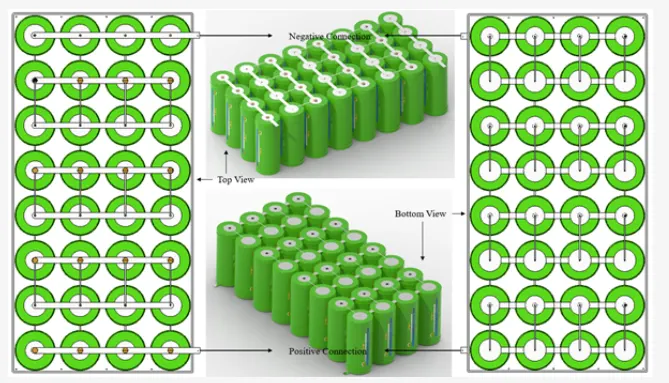
* Joining of Cylindrical Cell Battery Pack
- Cylindrical cells have improved thermal management efficiency because of their compact shape, but have low packaging efficiency because of their round cross-section.
- Here I use a positive and negative tab to connect multi cells.
The suitability of joining methods to build battery packs using cylindrical cells is shown below:
* battery enclosure
Design Benefits
- Up to 50 percent lighter than an equivalent steel design
- Best-in-class mass-energy density at more than 160watt-hours per kilogram, an extremely efficient design for OEMs and Tier 1 battery pack manufacturers.
- Accommodates all battery cell types and is designed particularly for battery electric vehicles with larger power packs such as pick-up trucks, sport utility vehicles, and crossovers.
- Most cost-effective aluminum solution for mass production electric vehicles when compared to aluminum extrusion and casting-intense designs.
- The low price premium on $/kg saved compared to equivalent steel designs at a substantially lower weight.
As we know now
Power (p)= Voltage (v) * Current (i)
3.3 *2.5 =8.25 kw
To get 18kWh, we are assuming 48s 48p
i.e; 50*44 =2200 cells
series connection gives 44*3.3 =145.2 v
parallel connection gives 50* 2.5 =125 A
from this, we can get
145.2* 125 =18.150 kWh energy or capacity.
we design battery packs for 44s and 50p cells along wth battery spacers to hold cells and for their connection nickel strip is used
when cells are connected by a nickel strip spot welding should be used so that cells do not get damaged.
* Battery pack with BMS[battery management system]:
- Battery Management System in electric vehicles is a specially designed electronic circuit that ensures the safety and stability of these battery packs.
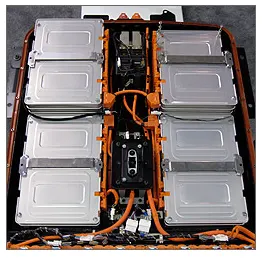
- A battery pack in an electric vehicle is a combination of multiple modules of cells and each module is a collection of individual cells.
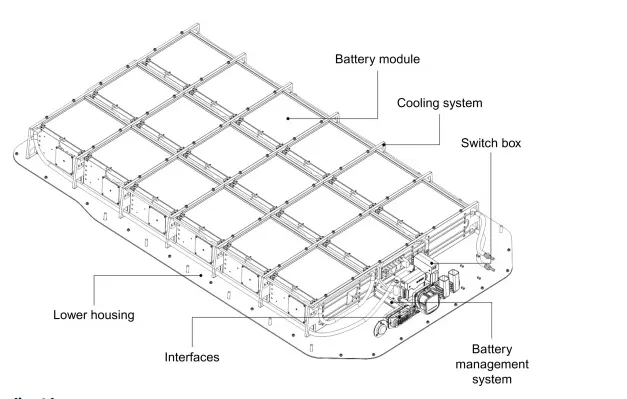
* Final Look
# CONCLUSION
Designed battery pack for 18kWh