Project 1 Mechanical design of battery pack
Objective:
Preparing the detailed battery pack drawing along with its enclosure and also Stating the assumptions of the battery pack for the battery model of Cell: ANR26650M1-B and Battery pack capacity: 18 kWh.
About Cell: Battery cell means the basic electrochemical unit that provides a source of electrical energy by direct conversion of chemical energy and consists of an assembly of electrodes, separators, electrolyte, container, and terminals.
> The battery cell is the smallest unit of the power battery, and is also the energy storage unit. It must have a higher energy density to store as much energy as possible, so that the electric vehicle has a longer range. In addition, the life of the cell is also the most critical factor, any one of the cell damage, will lead to the whole battery pack damage. Battery cell is the basic and soul of whole battery pack. smartpropel select the Top A Electric Vehicle level battery cell, with well know brand,like: Bak,CATL,Sumsung, Pansonic, Sanyo,etc.
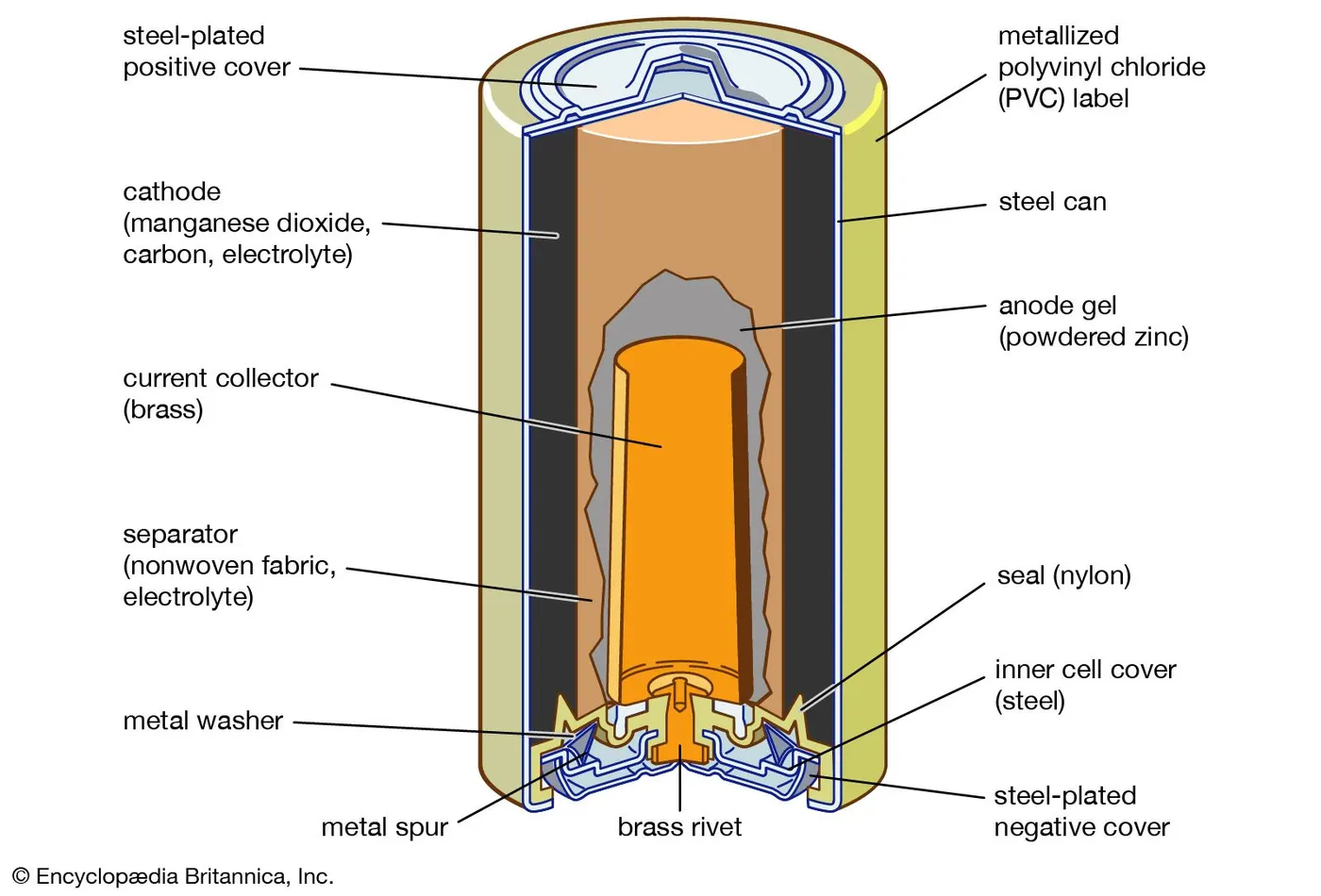
How an Cell Produces:
>Two important parts of any cell are the anode and the cathode. The cathode is a metal that is combined, naturally or in the laboratory, with oxygen—the combination is called an oxide. Iron oxide (rust), although too fragile to use in a battery, is perhaps the most familiar oxide. Some other oxides are actually strong enough to be worked (cut, bent, shaped, molded, and so on) and used in a cell. The anode is a metal that would oxidize if it were allowed to and, other things being equal, is more likely to oxidize than the metal that forms part of the cathode.
>The above process shows how the cell produces and what are the process going to takes places in the industry to manufacture an cell.
About ANR26650M1-B :
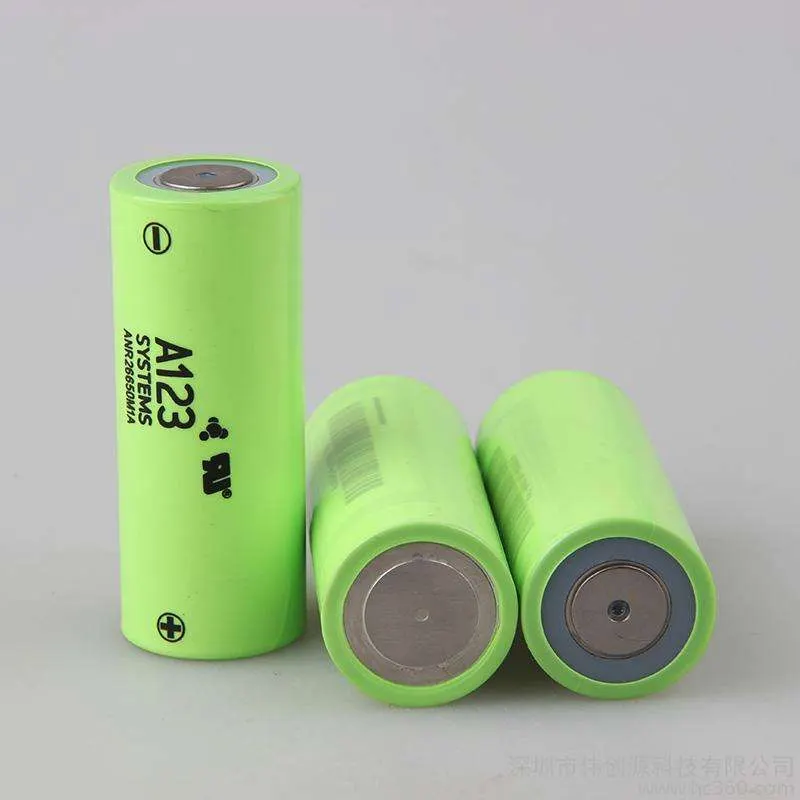
>The ANR26650M1-B is the next generation of A123 Systems’ pioneering 26650 cylindrical cell, now with greater power and energy density and lower impedance. This versatile lithium ion cell is suitable for a wide variety of applications and system designs. Proven performance in the toughest conditions, combining durability, reliability, and safety, the ANR26650 cell offers an excellent combination of price-performance.
>ANR26650M1-B is a high-performance Nanophosphate lithium iron phosphate (LiFePO4) battery technology delivers high power and energy density combined with excellent safety performance and extensive life cycling in a lighter weight, more compact package. Our cells have low capacity loss and impedance growth over time as well as high usable energy over a wide state of charge (SOC) range, allowing our systems to meet end-of-life power and energy requirements with minimal pack oversizing.
Key Features:
>Excellent abuse tolerance and superior cycle life from A123's patented Nanophosphate lithium ion Chemistry
>High power with over 2,600W/kg and 5,800 W/L, 10 seconds, 50%SOC
>High usable energy over a wide state of charge (SOC) range
Applications:
>Advanced lead acid replacement batteries for: Datacenter UPS, Telecom backup, IT backup, Autonomously guided vehicles (AGVs), Industrial robotics and material handling equipment, Medical devices
>Military vehicles, Military power grids, Soldier power, Directed energy
>Versatile, flexible and proven storage solutions for the grid:
>Hybrid, plug-in hybrid and electric vehicle battery systems for: Commercial vehicles, Off-highway vehicles, Passenger vehicles
ANR26650M1-B Technical Data:
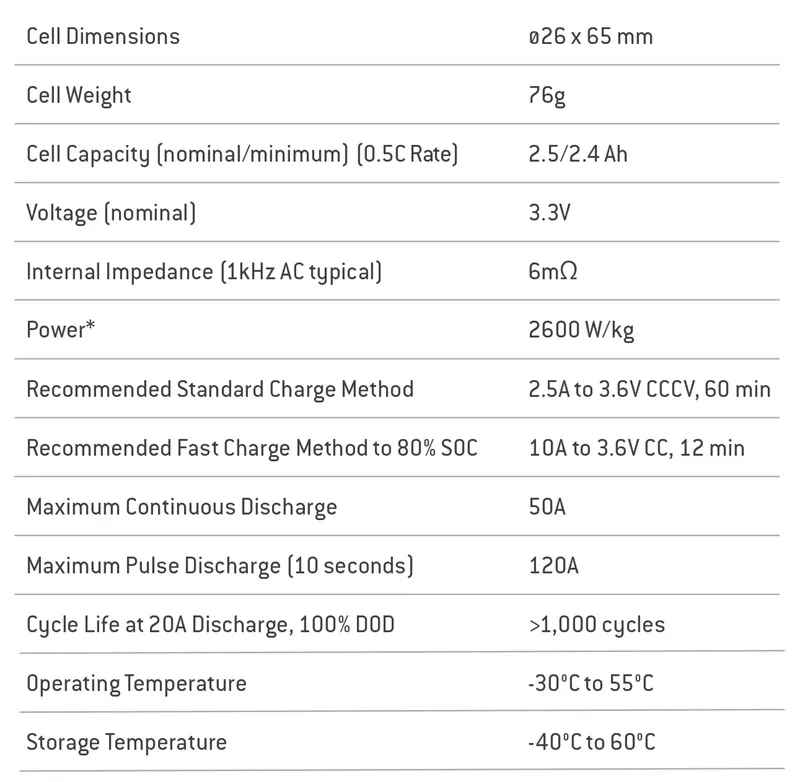
>From the above data we can conculde that the nominal voltage is 3.3 v and cell capacity is 2.5/2.4 Ah,the recommended SOC is 80% in fast charge mode duration of 10A to 3.6 V CC at an time span of 12 min.
>The number of cycles as >1000 and depth of discharge is at 100% and the storage temperature as -40 to 60 degree celcius,if battery goes on behind this temperature the battery gets overheated and damges the battery. But the operating temperature as -30 to 55 degree celcius.
>The below graphs are shows the characteristics of the cell at diiferent conditions like power discharge,current discharge at different temperatures.
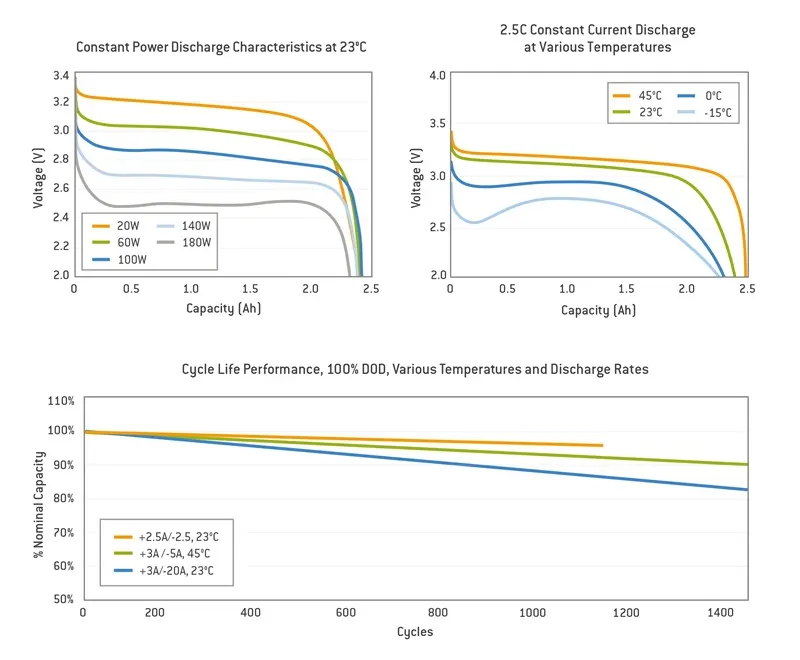
>Here the constant power discharge at 23 Degree celcius and also the changing the power that is by increasing the power at constant temp it decreases the voltage respectively.from 0 to 2.0 Ah the volage and capacity are having littile bit varation bust maintains constant capacity reduces the discharge capacity is at 2.3 Ah
>Here in constant current discharge takes place at different capacities,the temperature from 45 to 14 degrees it reduces the capacity respectively
>In the cycle life performance plot we can conculde that the charging and discharging shows in the form of + ,- ve respectively,if we can change the temperature the other characterisstics are also changes respectively.
Characteristcis of an Lithium iron phosphate (LPF):
>The lithium iron phosphate battery (LiFePO4 battery) or LFP battery (lithium ferrophosphate) is a type of lithium iron phosphate using lithium iron phosphate (LiFePO4) as the cathode material, and a graphtie carbon electrode with a metallic backing as the anode.
>The energy density of an LFP battery is lower than that of other common lithium ion battery types such as Nickel Manganese Cobalt (NMC) and Nickel Cobalt Aluminum (NCA), and also has a lower operating voltage; CATL's LFP batteries are currently at 125 (Wh) per kg, up to possibly 160 Wh/kg with improved packing technology, while BYD's LFP batteries are at 150 Wh/kg, compared to over 300 Wh/kg for the highest NMC batteries.
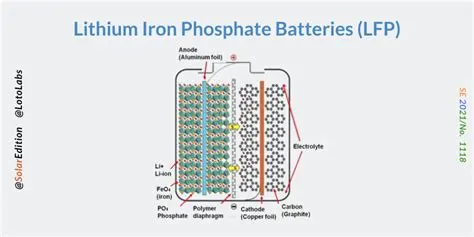
>A Lithium Iron Phosphate battery uses lithium-ion phosphate for the cathode and have graphite carbon electrodes with a metallic backing in the anode. Lithium iron phosphate is made with a solution of ferrous ions, lithium ions, and a phosphate-radical source solution.
>The components are dissolved in a chemical compound and mixed at 90℃ to 180℃ to form lithium iron phosphate. This compound is inserted into the batteries’ cathode end. The battery’s casing is formed on a steel container to hold the electrodes in the anode and cathode efficiently.
>LFP is a naturally occurring mineral that is rich in iron. Its unique characteristics give the cathode a great thermal and chemical stability and make a safe battery. The drawback being that capacity is limited because lithium ions have a hard time moving through this material. As such, LFP particles are often coated in a conductive materials like carbon and have a lower capacity such as 1200mAh for a LFP 18650 (The LiFePO4 battery has also been made into a AA size "14500" that have a capacity of 600 mAh.). The anode is graphite or carbon as in most other 18650 batteries.
Design of ANR26650M1-B Cell:
>Here the above figure tells us that the Height of an cell is 65.15 mm with an allowance of 0.50mm ,the cell contains different diameters as outer dia as 25.96mm,inner dia as 15.00mm and the charging tip as 12.90 mm with an allowances of 0.50mm,weigth is as 26 grms
>The battery needs saftery,design,sizing and some other things are more important to any of the objcet they play the key role for the transport,manfacturing etc.,if we see these aspects in the lithium-ion cell batteries it is diffcult to transport the battery because of the vibrations,exposure of high impact of the forces and thermal ru away.To avoid all these to samll the robust mechanical design are necessary.
Cell Holder dimensions:
> Heigth = 10 mm
> Diameter = 26 mm
> Length = 29 mm
> Width = 29 mm
> Weight = 5 grm
Battery Pack Calculations:
Given Data
Battery Capacity=18 kwh =18000 wh
>From the data sheet of ANR26650M1-B the below values are taken
Nominal voltage = 3.3 V
Cell Capacity = 2.5 Ah
Internal impedence = 6 mcoloumbs
Cell Weight = 76 grm
Cel dimensions = 25*65 = 1625 mm
Operating temperature = -30 to 55 degree celcius
Number of cells (N) = energy/(nominal voltage * capacity)
N=18000/(3.3 *2.5) = 2182 Cells
>Here 2182 cells required for for the 18 kwh energy,now we have to deside how may series and paralle connections needed
>Here we can take 300 V need to run the vehicle
Battery capcity = 18000/300 = 60 Ah
Battery capacity = 60 Ah
No.of series cells (Ns) = Voltage required / nominal voltage of one cell
Ns= 300/3.3=90.9 cells
No .of series cells =91 cells required for 300 volts
No.of Parallel series (Np) = Battery capacity / cell capacity
Np=60/2.5 = 24 cells in parallel
The Total No.of cells = 91S 24P = 91*24 =2184 cells required
Range= Total battery pack capacity/ Energy consumed per 100 km = 18000/60 = 300 km
Single cell capacity = Nominal voltgae of single cell * capacity of single cell = 3.3 * 2.5 = 8 .25 Wh
Capacity of 2184 cells =2184 * 8.25 =18.018 Kwh
Battery Pack Size:
>Here Clearance ,C = 30mm
>Spacing between cells = 5 mm = 91/2=45*5=225 mm
>Diameter = 26 mm
>Height = 65 mm
>Lenght =No.of cells in parallel * Diameter + clearance on both sides +spaing between cells
= 90*26 +2*30 + 225
Length = 2651 mm =2.651 mm
>Breadth = No.of cells in parallel * Diameter +clerance on both sides
= 24 * 26 +60
Breadth = 2064 mm = 2.064 m
>Height =65 + 35 =100 mm
>Weight of battery pack = each cell weight * no.of cells +weight of accessories
each cell weight = 76 g as given i data sheet
no.of cells =2184
accessories = 5
>Weight = 76 * 2184 + 5 = 160 .1 kg
>No.of Modules required for this we split the cells 91S24P into 7S4P is
>no.of modules = 2184 /7*4 = 78 modules required
Battery Pack Assembly:
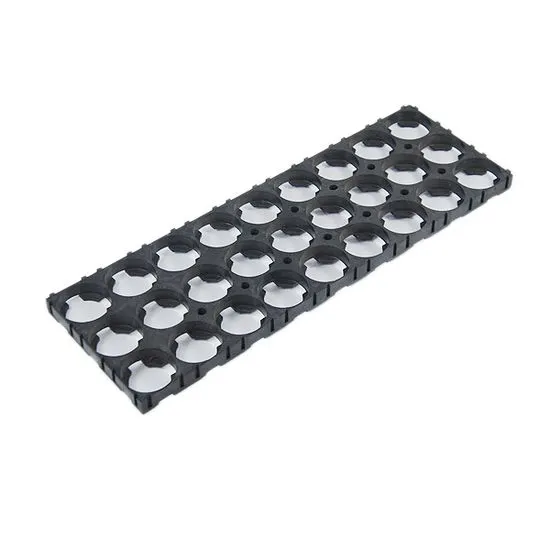
1.Assembling the cell holders together for 91s24p
2.Assembling the all cells together with strips
>Here we are using spot welding process for the assembling of the cells together
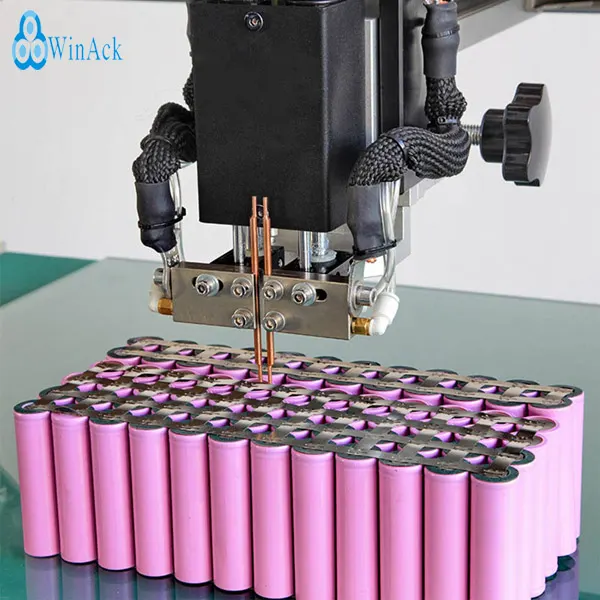
>Spot welding:Spot welding (also known as resistance spot welding) is a resistance welding process. This welding process is used primarily for welding two or more metal sheets together by applying pressure and heat from an electric current to the weld area.It works by contacting copper alloy electrodes to the sheet surfaces, whereby pressure and electric current are applied and heat is generated by the passage of current through resistive materials such as low carbon steels.
>The spot welding electrode material should be such that it can conduct higher electric current as well as it should have enough hardness.
Most commonly, the alloyed copper material is used for making electrodes of spot welding.
- Copper-cadmium (0.5% to 1%) alloy has highest electrical conductivity and has medium strength. So the electrode made of copper-cadmium alloy is used for spot welding of non-ferrous metals.
- Copper-chromium (0.5% to 1%) alloy has little lower electrical conductivity as compared to that of copper-cadmium alloy, but it has very good mechanical strength. So the electrode made of copper-chromium alloy is used for spot welding of low strength steel (like mild steel and low alloy steel).
- Copper metal alloyed with cobalt and beryllium have less electrical conductivity, but its strength is high. Hence this type of electrodes are used for welding of hard materials like stainless steel.
3.Assembling the cells into the cell holders by using nickel strips both up and down sides
>The air cooling given between the cell gaps
4.After the assembly the battery pack looks like this with cell module on both sides.
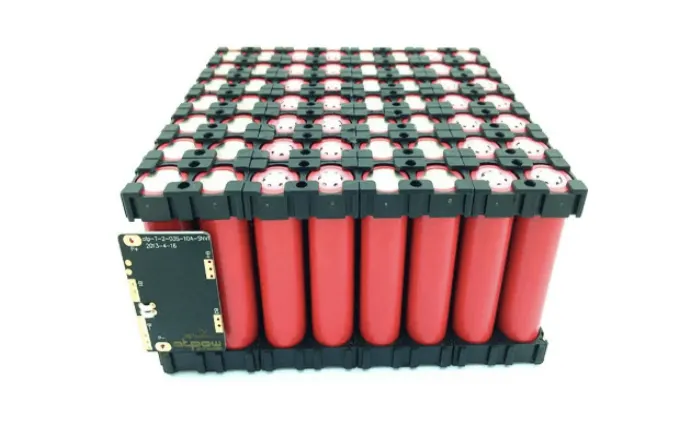
5.Like the above module we need to assemble 76 modules for the complete battery pack which shows below
>This is an final view of an battery management system
> The BMS is observers the states of battery cells in (current,voltage,and temperature) ,also observes the state of charge (SOC) and state of Health (SOH) to estimaes the states of battery cell performance.cell balancing is an another important task carried out by the battery.
Benefits:
>High Energy Density: Compared to other battery technologies, lithium ion batteries have a greater opportunity for increased capacity
>Longer Lasting: Lithium ion batteries last up to 10x longer due to their higher efficiency
>Less Maintenance: Due to their stable chemistry, very little maintenance is required
>Faster Charging: Able to be charged to 100% in as little as 30 minutes
>Safe Disposal: Lithium ion battery disposal is a major selling point. Unlike lead acid batteries, for example, lithium ion batteries don’t leak acid as they decay.
saftey of Lithium-ion cells:
>Like thermal runaway, Lithium-ion cells have a different level of safety depending on the shocks or mechanical treatments they may undergo during their lifetime.The nail penetration test is the most revealing way to qualify the safety of a cell technology.
>The test presented below is performed by perforating a Lithium Ion NMC cell and a Lithium Ion LiFePO4 cell.We find here the same extremely stable behavior of Lithium Iron Phosphate cells while the NMC cell ignites almost immediately.