Project 1 Mechanical design of battery pack
AIM:
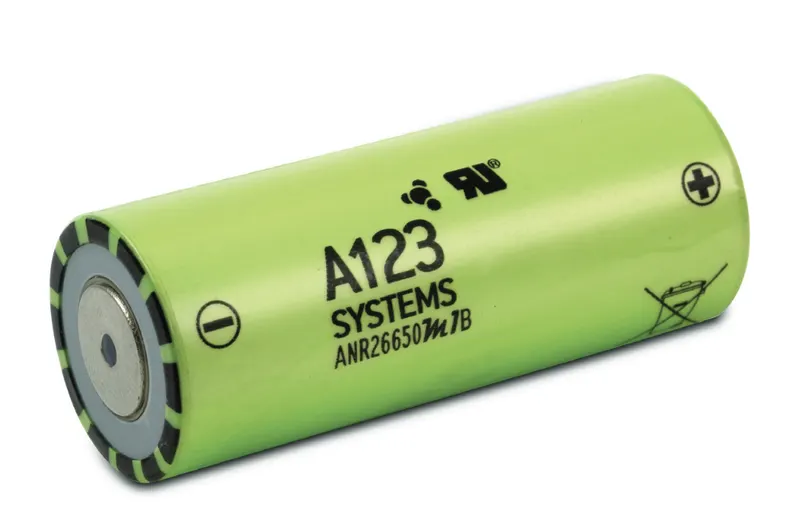
Nanophosphate High Power Lithium Ion Cell
ANR26650M1-B
| A123’s high-performance Nanophosphate lithium iron phosphate (LiFePO4) battery technology delivers high power and energy density combined with excellent safety performance and extensive life cycling in a lighter weight, more compact package. Our cellshave low capacity loss and impedance growthover time as well as high usable energy over a wide state of charge (SOC) range, allowing our systems to meet end-of-life power and energy requirements with minimal pack oversizing. |
 |
|
COMMERCIAL SOLUTIONS
Advanced lead acid replacement batteries for:
+ Datacenter UPS
+ Telecom backup
+ IT backup
+ Autonomously guided vehicles (AGVs)
+ Industrial robotics and material handling equipment
GOVERNMENT SOLUTIONS
+ Military vehicles
+ Military power grids
+ Soldier power
+ Directed energy
GRID SOLUTIONS
+ Frequency regulation
+ Renewables integration
+ Reserve capacity
+ Transmission and distribution
TRANSPORTATION SOLUTIONS
Hybrid, plug-in hybrid and electric vehicle battery systems for:
+ Commercial vehicles
+ Off-highway vehicles
+ Passenger vehicles
These parameters are derived from the data sheet for the A123 Li-ion temperature-dependent battery model.
| Parameter | Value |
|---|---|
|
Nominal voltage (c) |
|
|
Rated capacity |
|
|
Maximum capacity (d) |
|
|
Fully charged voltage (a) |
|
|
Nominal discharge current |
|
|
Internal resistance |
|
|
Capacity at nominal voltage (c) |
|
|
Exponential zone (b) |
[ |
|
Nominal ambient temperature |
|
|
Second ambient temperature |
|
|
Maximum capacity at 0°C (h) |
|
|
Initial discharge voltage at 0°C (e) |
|
|
Voltage at 90% maximum capacity at 0°C (g) |
|
|
Exponential zone at 0°C (f) |
[ |
|
Thermal resistance, cell-to-ambient (estimated) |
|
|
Thermal time constant, cell-to-ambient (estimated) |
|
ANR26650M1-B Specifications
Nominal Ratings
Voltage: 3.3 Volts
Capacity: 2.5 Ah
Energy: 8.25 Wh
Specific Power: 2600 W/kg
Impedance (1KHz AC Typical) 6 mΩ
Cycle Life at 1C/1C, 100% DOD: > 4000 cycles
Cell Type: 26650 Lithium Ion Power Cylindrical Cell
Discharging
Max Continuous Discharage: 50 A
Max Pulse Discharge Current >50% SOC (10s): 120 A
Minimum Voltage: 2 Volts
Temperature: -30ºC to 55ºC
Charging
Recommended Standard Charge: 2.5 Amps
Max Charge Rate: 10 Amps
Max Pulse Charge Current <50% SOC (10s): 25 A
Float Voltage: 3.45 Volts
Recommended charge V & Cut-off Current: 3.6 Volts, taper to 125mA
Temperature
(reduce charging current to 250mA when under 0ºC): 0ºC to 55ºC
Mechanical
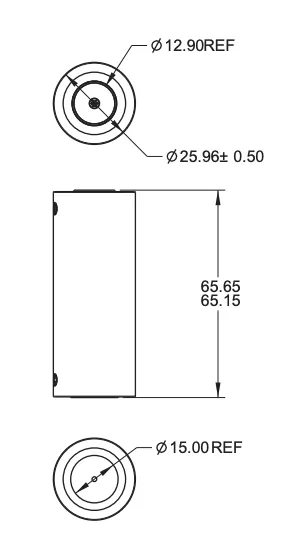
Diameter: Ø25.96 +/- 0.5 mm (1.0")
Length: 65.15 +/- 0.5 mm (2.6")
Mass: 76 g
Certifications
Transportation: UN 3480 (UN38.3), CIQ
Safety: UL 1642, IEC 62133
The LithiumWerks ANR26650M1-B is the next generation of A123 Systems’ pioneering 26650 cylindrical cell, now with greater power and energy density and lower impedance. This versatile lithium ion cell is suitable for a wide variety of applications and system designs. Proven performance in the toughest conditions, combining durability, reliability, and safety, the ANR26650 cell offers an excellent combination of price-performance.
Cylindrical Cell Primary Applications:
- Portable high power devices
- Stationary battery backup systems
- Grid stabilization energy storage systems
- Commercial truck and bus hybrid electric vehicles (HEVs)
Lithium Ion Cell Benefits:
- Power: Over 2,600 W/kg and 5,800 W/L
- Safety: Excellent abuse tolerance and environmentally friendly
- Life: Excellent calendar life, 10X cycle life vs. conventional lithium ion
In the figure, the dashed lines show the discharges curves obtained from the simulation at different ambient temperatures. The model performance is very close to the data sheet results.
CALCULATION:
The required energy for battery is 18KWH

nominal voltage is EQ....(1)
nominal current is EQ.....(2)
multiplying EQ(1x2)

lets take a nominal parameters of 3Sx5P

nameing the above parameters as EQ...........(3&4)
lets us aasume a 48V LI-ion battery
For the 48v battery no of series attached cells is


For the 48v battery no of parrel attached cells is

where Nsm=5 series modules
Npm= 30 parrel modules
hence the total capacity powerWH of the battery is deriverd know
=(Nsm*Npm)*EQ(3*4)

from solving the above equation the resultant value is 18,562.5 Wh and converting to 18KWH
RESULT:
A detailed report and calculation of battery pack drawing along with its enclosure for Cell: ANR26650M1-B make a calculation with regarding Battery pack capacity: 18 kWh with a detailed calculation for the reaching a cell for the energy of 18kwh of power.