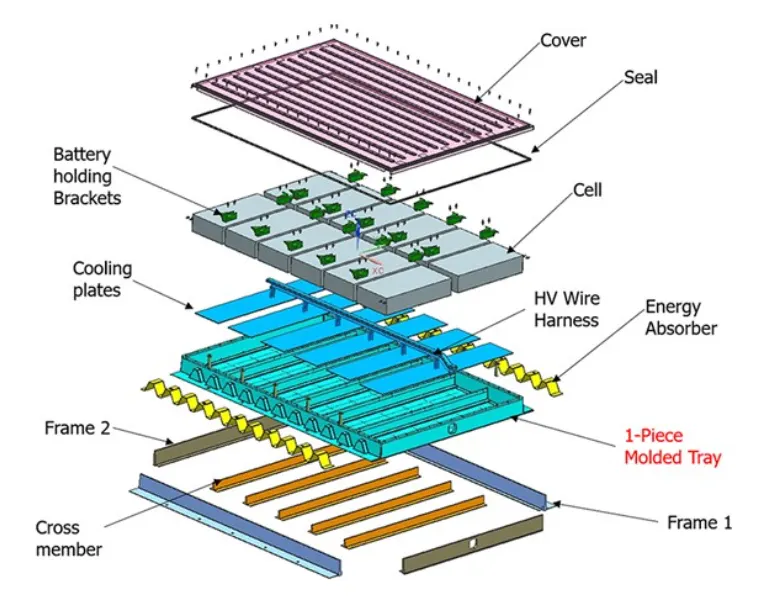
Project 1 Mechanical design of battery pack
1. create a battery capacity of 18kWh
ANR26650M1-B is a Lithium Iron Phosphate battery that has an energy density of 8.25wh and a power density of 4000w/kg. Lithium Iron phosphate battery is able to deliver high current discharge because it has more power density. The cells are inherently safe over a wide range of temperatures and conditions. Whether the application requires outstanding cycle life or stable float reliability, the Lithium Werks’ 26650 cells are suitable for a wide variety of power, pulse, or stand-by applications.
The LithiumWerks ANR26650M1-B is the next generation of A123 Systems’ pioneering 26650 cylindrical cells, now with greater power and energy density and lower impedance. This versatile lithium-ion cell is suitable for a wide variety of applications and system designs. Proven performance in the toughest conditions, combining durability, reliability, and safety, the ANR26650 cell offers an excellent combination of price-performance.
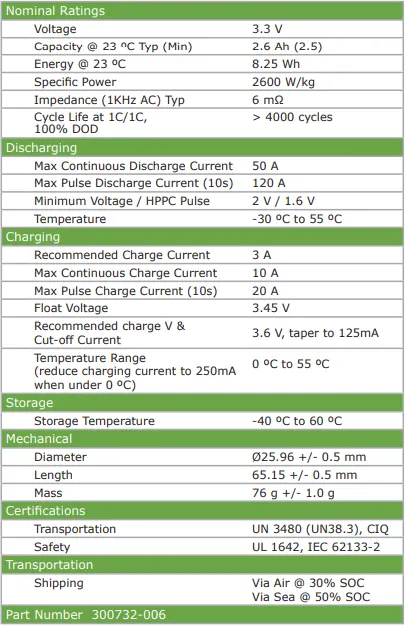
ANR26650M1-B Specifications
Nominal Ratings
Voltage: 3.3 Volts
Capacity: 2.5 Ah
Energy: 8.25 Wh
Specific Power: 2600 W/kg
Impedance (1KHz AC Typical) 6 mΩ
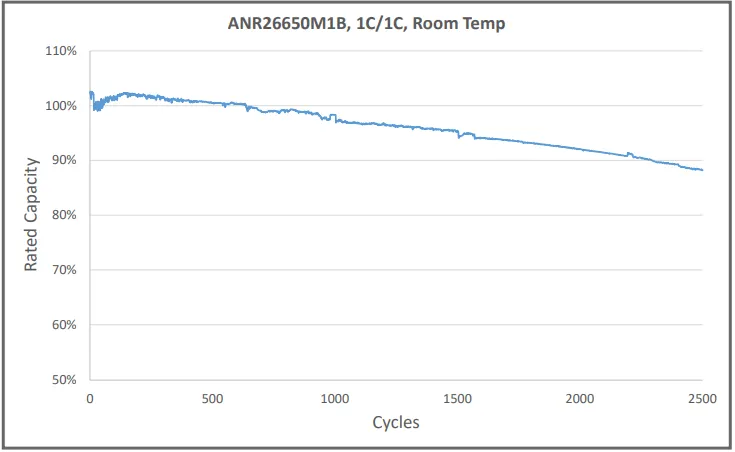
Cycle Life at 1C/1C, 100% DOD: > 4000 cycles
Cell Type: 26650 Lithium Ion Power Cylindrical Cell
Discharging
Max Continuous Discharage: 50 A
Max Pulse Discharge Current >50% SOC (10s): 120 A
Minimum Voltage: 2 Volts
Temperature: -30ºC to 55ºC
Charging
Recommended Standard Charge: 2.5 Amps
Max Charge Rate: 10 Amps
Max Pulse Charge Current <50% SOC (10s): 25 A
Float Voltage: 3.45 Volts
Recommended charge V & Cut-off Current: 3.6 Volts, taper to 125mA
Temperature
(reduce charging current to 250mA when under 0ºC): 0ºC to 55ºC
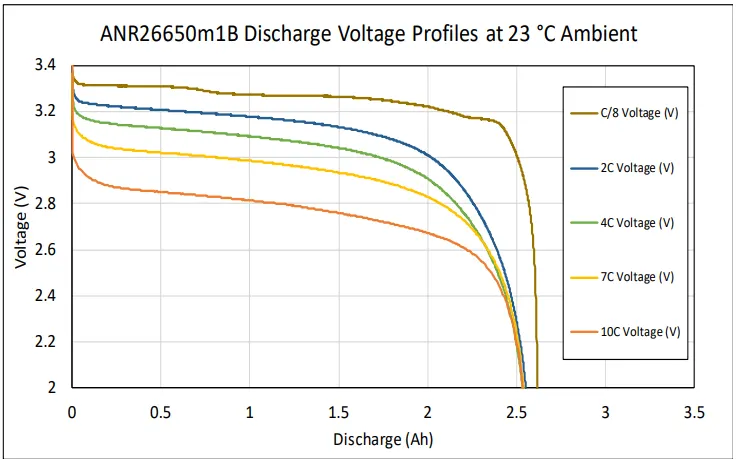
From the above discharge current at different current rate graph, we can predict the battery capacity. The actual battery capacity is 2.6Ah. While discharging at C/8 rate, the usable capacity is around 2.58Ah. The capacity was reduced to 2.5Ah at a higher discharge of 10C rate.
Mechanical design of battery:
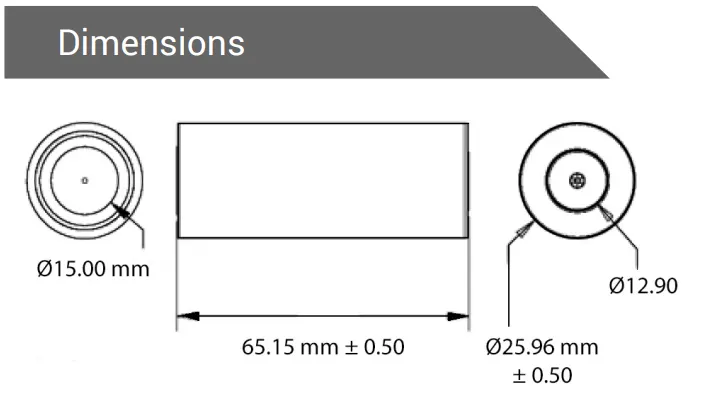
Diameter: Ø25.96 +/- 0.5 mm (1.0")
Length: 65.15 +/- 0.5 mm (2.6")
Mass: 76 g
The volume of the battery: πr2h
=pi*12.98*12.98*65.15
=0.0344836m^3
Design a battery pack of 18kWh.
A standard electric vehicle requires a voltage range from 400V to 800V. Let's assume a voltage range of 450V.
Required capacity= 18,000/450=40Ah
Energy=Voltage*Capacity
=450*40
=18000Wh=18kWh
For 450V battery pack, Voltage increases when the cell is connected in series.
No. of. cells in series= 450/3.3=137 cells connected in series.
Capacity increases when connected in parallel. For 40Ah,
No. of cells in parallel= 40/2.6=16 cells connected in parallel.
Total no of cells required = 137*16= 2192 cells
Mass of battery pack= Total no. of cells* Cell mass
= 2192*0.076
=166.592kg
Volume of the battery pack= Total no. of cells*Cell volume
=2192*0.0344836
=75.58m^3
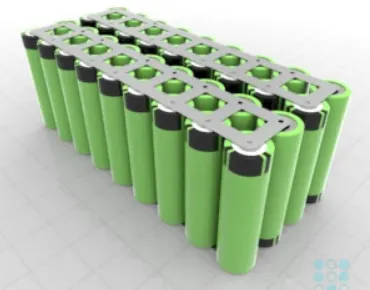
For connecting each cells different types of connectors are used:
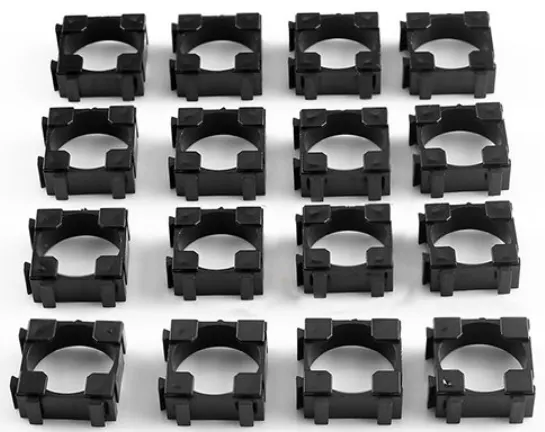
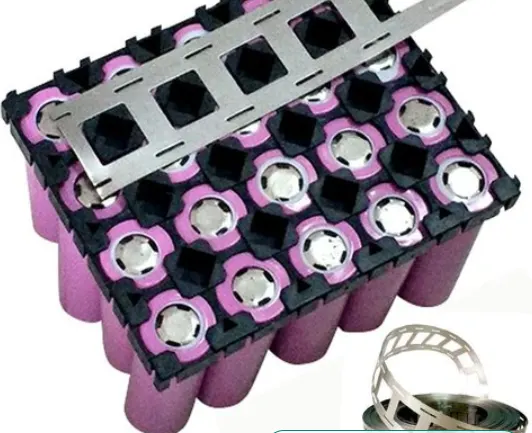
Cell holders are used to hold the battery.
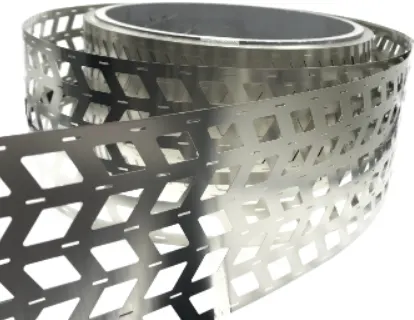
Nickel strip:
To connect the cells in series and parallel nickel is used to joint the terminal of each cells using spot welding
Battery Enclosure:
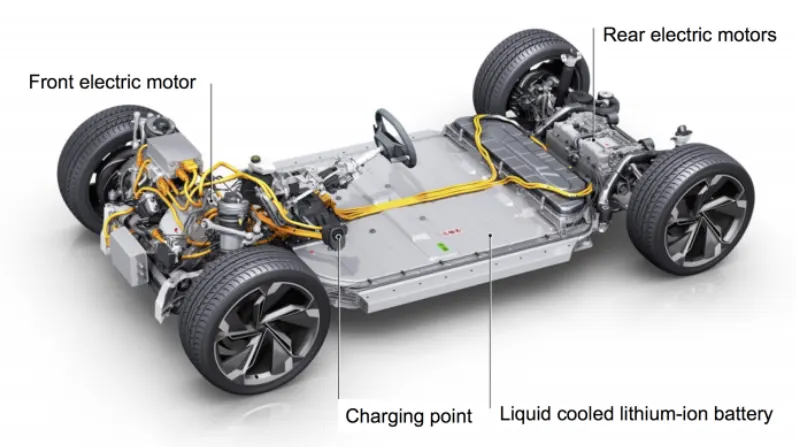
A battery enclosure is a box designed to protect batteries from potential weather and battery mishaps. They can be designed for indoor or outdoor use and may include room for electronics. Specific designs allow for pole, wall, or ground-mounted systems. It prevents accidental damage and short circuit by touching other metal parts of the car. The enclosure should have the capability to resist damage while collision.
The most common battery enclosures are made from plastic materials that are resistant to alkaline solutions and have a high impact strength. Metal housings are sometimes used, but metal requires careful design and assembly to avoid shorting of the cells in the battery pack. Aluminum is not recommended for enclosures because if cell leakage does occur, the electrolyte will react with the aluminum.
Mechanical Properties: The material must have enough ductility, should be strong to avoid deformation, should not relax over time, and should resist wear. The enclosure should be tightly closed to prevent water from entering the battery pack.