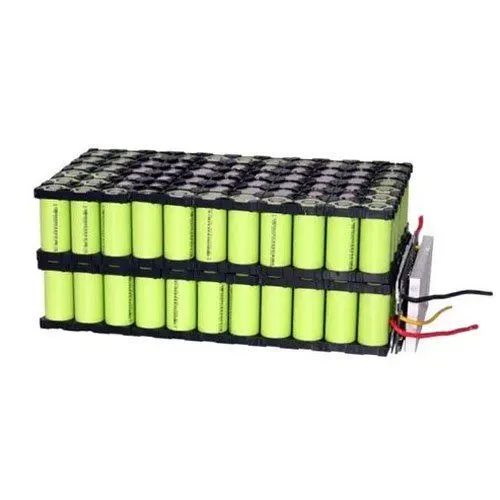
Aim:
To develop a mechanical design of battery pack based on the required energy capacity
Product:
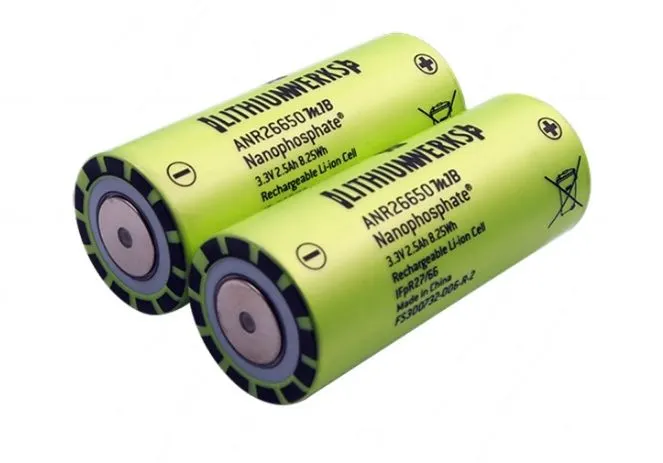
Batteries are a collection of one or more cells whose chemical reactions create a flow of electrons in a circuit. All batteries are made up of three basic components: an anode (the '-' side), a cathode (the '+' side), and some kind of electrolyte (a substance that chemically reacts with the anode and cathode).
when the anode and cathode of a battery is connected to a circuit, a chemical reaction takes place between the anode and the electrolyte. This reaction causes electrons to flow through the circuit and back into the cathode where another chemical reaction takes place. When the material in the cathode or anode is consumed or no longer able to be used in the reaction, the battery is unable to produce electricity.
Battery Pack:
Battery packs are any number of individual batteries arranged in series or parallel to provide the required power to electronic devices. The most typical type of battery used in battery packs is lithium-ion due to its high power density. The application of battery packs is wide-ranging from phones to lawnmowers to automobiles.
Here we are using Lithium Iron Phosphate cells for some considerations.
A123’s high-performance Nanophosphate lithium iron phosphate (LiFePO4) battery technology delivers high power and energy density combined with excellent safety performance and extensive life cycling in a lighter weight, more compact package. Our cells have a low capacity loss and impedance growth over time as well as high usable energy over a wide state of charge (SOC) range, allowing our systems to meet end-of-life power and energy requirements with minimal pack oversizing.
The stages of the battery pack designs are shown below:
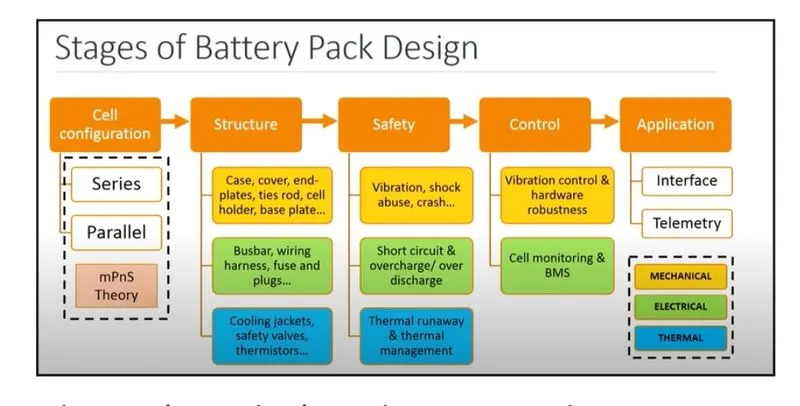
Stages of Battery Pack Design:
The various design elements to be considered while developing a battery pack are as follows:
1. Electrical Design
- Determination of capacity, voltage and current.
- High voltage isolation.
- Short circuit prevention.
- Efficient power delivery.
2. Thermal Design
- Improve pack efficiency.
- Mitigate thermal accidents.
- Increase pack life.
3. Mechanical Design
- Safe structure for extreme conditions.
- Cost, productivity and reliability.
- Ease of assembly and service.
- Aesthetics, compactness and light weight.
4. Battery Management System (BMS) Design
- Maintain cell/pack operating limits.
- Prevent events compromising safety.
- Control thermal systems.
- Communication and logistics.
Calculation:
According to the given criteria we should calculate the capacity 18kwh as per the cell ANR26650M1-B
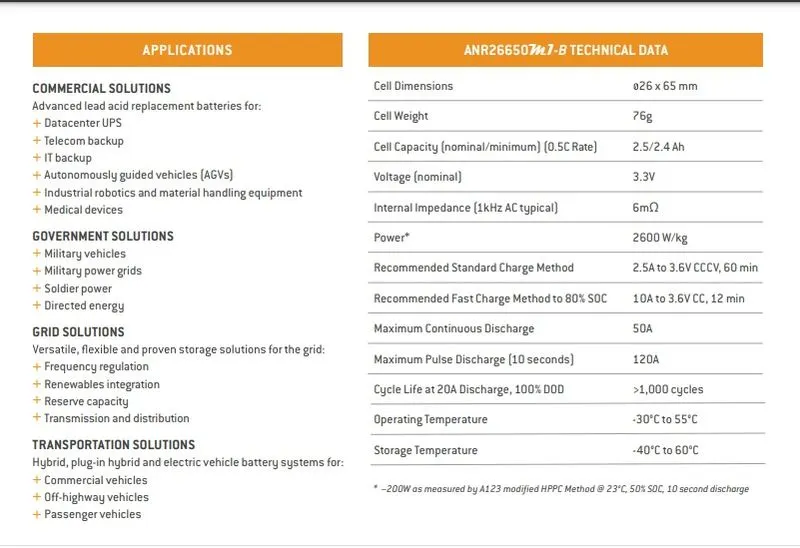
The Cell ANR26650M1-B Datasheet:
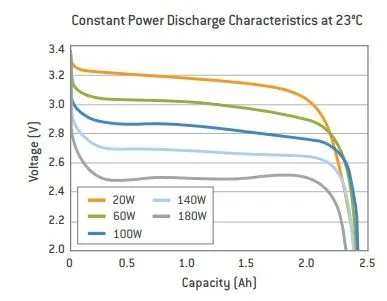
Discharge Characteristics:
Constant Power Discharge at 23'c
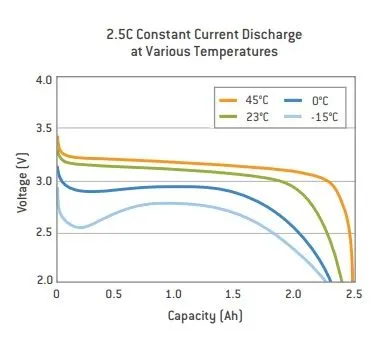
Constant Current discharge at various temperatures:
Life Cycle Performance:
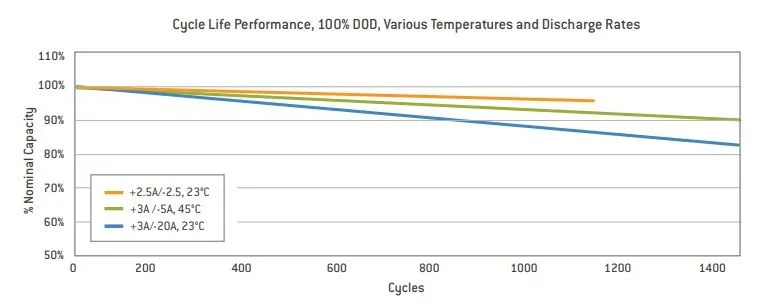
Cell Parameters according to the datasheet:
Cell voltage = 3.3v
Cell capacity = 2.5Ah
Cell Weight = 76g
Cell Diameter = 26mm
Cell Height = 65mm
Let us assume that,
the voltage of the battery pack (Pack Voltage)= 400 V
We know that, P = VI,
hence we can calculate the Pack Capacity as follows:
Pack Capacity = Energy Capacity / Pack Voltage
=(18*10³) / 400
Pack Capacity= 45 Ah
No. of cells in series = Pack Voltage / Cell Voltage
= 400 / 3.3
No. of cells in series = 122 cells
No. of cells in parallel = Pack Capacity / Cell Capacity
= 45/2.5
No. of cells in parallel = 18 cells
Total no. of cells in the battery pack = (No. of cells in series) * (No. of cells in parallel)
= 122* 18
Total no. of cells in the battery pack = 2196 cells
Weight of battery pack = (Total no. of cells in the battery pack) * (Cell Weight)
= (2196*76) / 1000
Weight of battery pack = 166.89 kg
Length of battery pack = (No. of cells in series) * (Cell Diameter)
= 122 0.026
Length of battery pack = 3.172 m
Width of battery pack = (No. of cells in - parallel) * (Cell Diameter)
= 18* 0.026
Width of battery pack = 0.468 m
Area of battery pack = (Length of battery pack) * (Width of battery pack)
= 3.172 * 0.468
Area of battery pack = 1.4845 m²
Volume of battery pack = (Area of battery pack)* (Cell Height)
= 1.4845 * 0.065
Volume of battery pack = 0.0965 m³ = 96.5 litres
Specific Energy Density = Pack Energy Capacity / Weight of battery pack
=(18*10³) / 167
Specific Energy Density =107.78 Wh/kg
Volumetric Energy Density = Pack Energy Capacity / Volume of battery pack
Volumetric Energy Density = 186.53 Wh/L
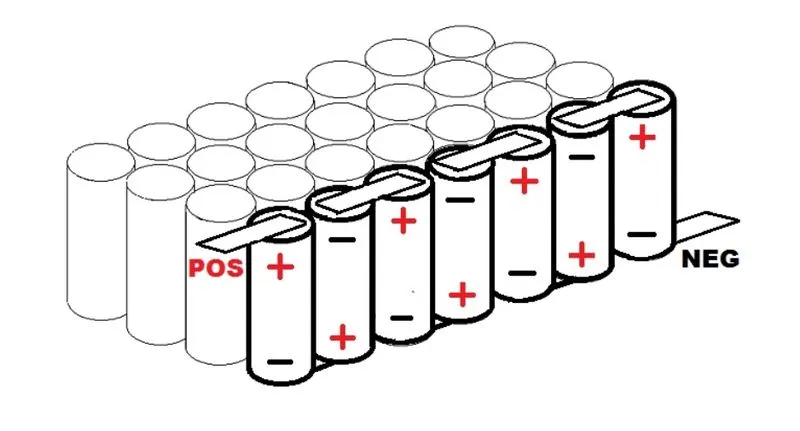
Cells in series connection:
When you connect cells together in series, it doesn't change the amps or the capacity, it only raises the voltage of the pack. Hooking them up in series means that you connect the positive end of one cell (or P-group) to the negative end of the other as shown below.
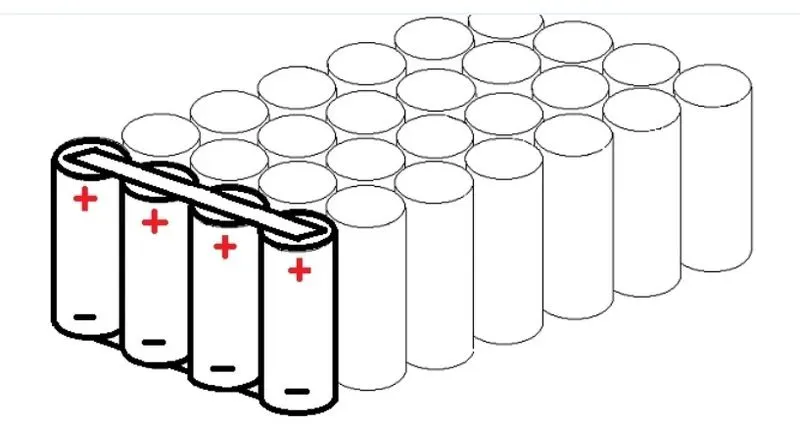
Cells in Parallel connections:
If you take several cells and connect their same-type electrodes in parallel, they all will act as though they are one large cell. Also, when you first connect them to each other, they must be at the same level of charge.
Application used:
COMMERCIAL SOLUTIONS
Advanced lead-acid replacement batteries for:
- Datacenter UPS
- Telecom backup
- IT backup
- Autonomously guided vehicles (AGVs)
- Industrial robotics and material handling equipment
- Medical devices
GOVERNMENT SOLUTIONS
- Military vehicles
- Military power grids
- Soldier power
- Directed energy
GRID SOLUTIONS
- Frequency regulation
- Renewables integration
- Reserve capacity
- Transmission and distribution
TRANSPORTATION SOLUTIONS
Hybrid, plug-in hybrid, and electric vehicle battery systems for:
- Commercial vehicles
- Off-highway vehicles
- Passenger vehicles
Conclusion:
Thus, we have prepared a detailed battery pack successfully which has an 18kwh capacity and includes the cells of ANR26650M1-B.