Mechanical Design of a Battery Pack
Aim - To prepare a detailed battery pack drawing along with its enclosure.
----------------------------------------------------------------------------------------------------------------------------------------------
Governing Equations:
Battery Pack Capacity = Pack Energy (Whr)/ Pack Voltage (V)
Number of cells in series = Pack Voltage / Cell Voltage
Number of cells in parallel = Pack capacity / Cell Capacity
Assumptions - The battery pack voltage is assumed to be 300V.
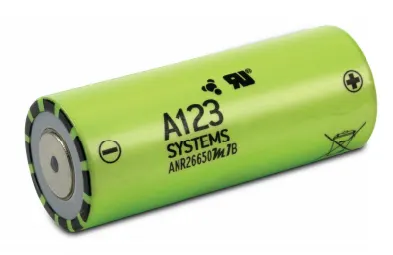
Cell Specifications: Model Number - ANR26650M1-B
ANR26650M1-B is a high-performance Nanophosphate lithium iron phosphate [LiFePo4] battery by A123 works.
| Nominal Ratings | |
| Voltage | 3.3 V |
| Capacity | 2.5 Ah |
| Energy | 8.25 Wh |
| Specific Power | 2600 W/kg |
| Cycle Life at 1C/1C, 100% DOD | > 4000 cycles |
| Cell Type | 26650 Li-Ion Power Cylindrical Cell |
| Discharging | |
| Max Continuous Discharge | 50 A |
| Max Pulse Discharge Current > 50% SOC (10s) | 120 A |
| Minimum Voltage | 2 V |
| Temperature | -30 °C to 55 °C |
| Charging | |
| Recommended Standard Charge | 2.5 A |
| Max Charge Rate | 10 A |
| Max Pulse Charge Current <50% SOC (10s) | 25 A |
| Float Voltage | 3.45 V |
| Mechanical | |
| Diameter | `phi`25.96 +/- 0.5 mm (1.0'') |
| Length | 65.15 +/- 0.5 mm (2.6'') |
| Mass | 76 g |
Battery Pack Specifications:
Pack Energy = 18 kWhr
Pack Voltage = 300 V
Calculations:
Pack Capacity = Pack Voltage / Cell Voltage = 300/3.3 = 60 Ahr
Number of cells in series = Pack Voltage / Cell Voltage = 91
Number of cells in parallel = Pack Capacity / Cell Capacity = 24
`=>` Configuration is 91S24P
Total number of cells = 91 * 24 = 2184 cells.
Cell Electrical Connections:
Internal Connections - Low power cells are usually connected together using nickel strips which are welded to the cell terminals or the case. Soldering is not recommended since the soldering process is apt to apply large, uncontrolled amounts of heat to the battery components which may damage the separators or the vents which are normally made of plastic. Modern computer-controlled resistance welders allow much more precise control of the welding process, both limiting the amount of heat applied to the battery and localising the heat to a small desired area. Welding also provides a stronger, low resistance joint. The interconnecting strips often have complex shapes and profiles which may be stamped out of the flat strip in a progressive die.
External Connections - The type of terminals or connections to the external circuits depend on, the current to be carried, the frequency with which the battery may be connected and disconnected and the design of the circuit to which the battery will be connected.
For low power circuits, gold plated contacts are the terminals of choice for connectors which are subject to frequent insertions. Gold is hard-wearing, it has low contact resistance and doesn't oxidise. Flying leads with spade terminals or snap-on studs are also used for low power applications. Metal tabs are also used on pouch cells.
Terminals for high power applications are usually threaded metal studs to ensure a reliable connection. Safety requirements on high voltage batteries may also dictate shrouded terminals to prevent accidental exposure of the operator to dangerous voltages or of the battery to short circuits. Keyed or terminals or connections are also advisable to prevent connection to incorrect charges or loads.
Spot Welding - Spot welding is one of the oldest and widely used welding methods in the automotive industry. One of the advantages of resistance spot welding is that it does not require filler materials or gases and is easily automated for industrial production applications.
It is a relatively cheap and fast joining process, at the same time a good level of quality control can be achieved. Thin sheets can be perfectly joined but however, spot welding has difficulties producing large nuggets.
Electrical Performance `->` The choice of electrode alloy id determined by the material being welded and the desired weld effect. The most commonly used electrode materials are copper-based alloys. The metallic strips used for battery connections with the help of spot welding are made of a variety of materials.
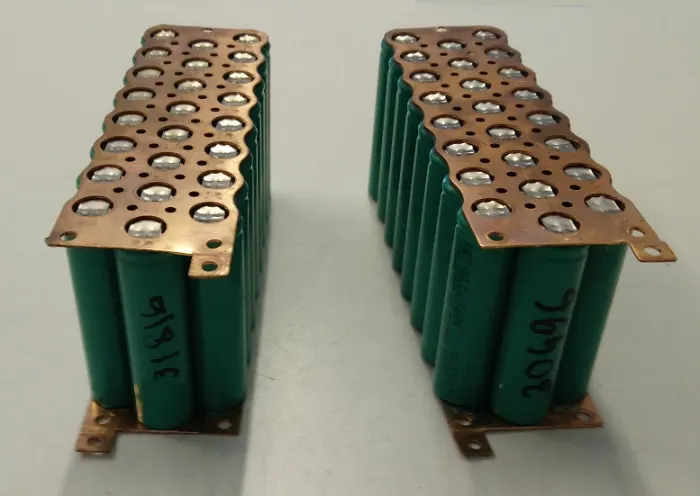
As nickel will spot-weld t the cells quite easily and copper can handle the high current without causing a bad amount of voltage drop. Thus, a copper bus plate with short nickel tab over the cell can be used.
Battery Pack Design:
The design of the outer package or housing of the battery depends to a great extent on the components it has to accommodate and the physical protection it has to provide for them. These components are not just the cells, but also protection devices, electronic circuits, interconnections and connectors which must all be specified before the final battery case can be designed. For high power, high energy batteries robust packaging is required for safety reasons.
Design Options:
1. Alumunium 6061, 10 mm base plate
2. Stainless Steel, 5 mm base plate
3. Stainless Steel, 4 mm base plate
Inner Dimensions of Pack:
|
Length of Pack = (no of cells in series * cell diameter) + (no of cells in series -1) * 4mm + 10mm = (91 * 25.96) + (91-1)*4 + 10 = 2700 mm Breadth of Pack = (no of cells in parallel * cell diameter) + (no of cells in parallel)-1 *4mm + 10mm = (24 - 25.96) + (24-1)*4 + 10 = 720 mm Height of Pack = Height of cells + 2 * 1mm of bus plate + space for ventilation = 65.15 + 2*1 + 2.85 = 70mm |
Outer Dimension of Pack (10 mm Al Plate)
|
Length = 2700 + 20 = 2720mm Breadth = 720 + 20 = 740mm Height = 70 + 20 = 90mm Volume = `V_0 - V_i` = (2720*740*90) - (2700*720*70) = 45072000 `mm^3` Density = 0.0027 g/`mm^3` Mass = Volume * Density = 45072000 * 0.0027 = 1,21,694.4 grams = 121.7 kg |
Outer Dimension of Pack (5 mm SS)
|
Length = 2700 + 10 = 2710mm Breadth = 720 + 10 = 730mm Height = 70 + 10 = 80mm Volume = `V_0 - V_i` = (2710*730*80) - (2700*720*70) = 22184000 `mm^3` Density = 0.008 g/`mm^3` Mass = Volume * Density = 22184000 * 0.008 = 1,77,472 grams = 177.5 kg |
Outer Dimension of (Pack (4 mm SS)
|
Length = 2700 + 8 = 2708mm Breadth = 720 + 8 = 728mm Height = 70 + 8 = 78mm Volume = `V_0 - V_i` = (2708*728*78) - (2700*720*70) = 17691072 `mm^3` Density = 0.008 g/`mm^3` Mass = Volume * Density = 17691072 * 0.008 = 1,41,528.576 grams = 141.5 kg |
On observing the above options for battery pack design, the SS plate design with 4 mm thickness is most suitable because its weight is just slightly more than the aluminium plate but it saves a lot of space being 4 mm thick as compares to the aluminium plate which is 10 mm thick.
Result:
Battery Pack Dimensions:
Internal = 2700mm * 720mm * 70mm
External = 2708mm * 7208mm * 78mm
Pack Material = Stainless Steel (with 4 mm thickness) and insulation sheet between the pack and the copper bus plate.
Cell Connections = Copper bus plate with spot welding
Pack Configuration :
|
91S24P ANR26650M1-B Energy = 18 kWhr Voltage = 300 V Capacity = 60 Ahr |