Project 1 Mechanical design of battery pack
Battery pack capacity: 18 kWh
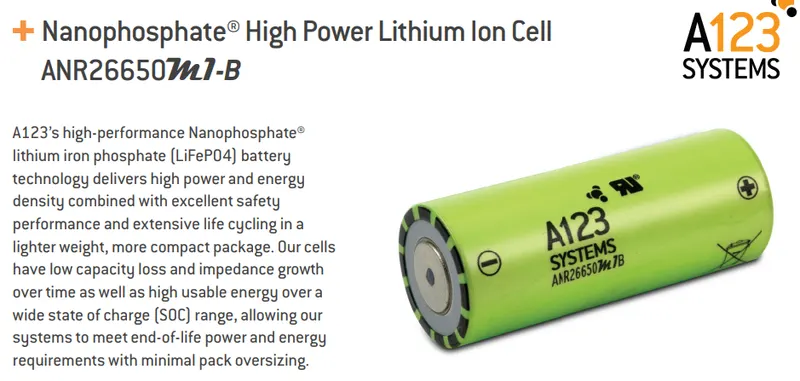
Cell: ANR26650M1-B
INTRODUCTION:
A battery is an electrochemical device that can store energy in the form of chemical energy. It translates to electric energy when the battery is connected in a circuit due to the flow of electrons because of the specific placement of chemicals. It was invented by Alessandro Volta, whereas Gaston Plante invented the rechargeable battery.
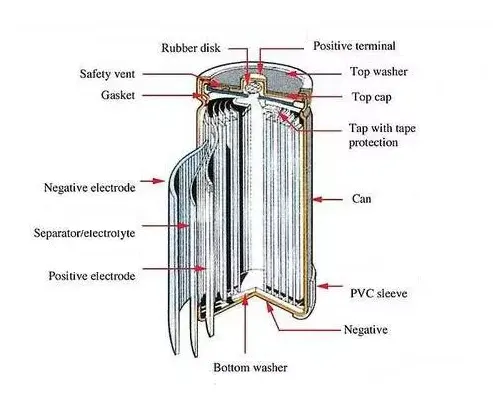
The battery consists of three elements: the negative side, the positive side, and electrolyte (the chemical which reacts with both sides), as shown in the image below. The electrolyte is used as an electron transportation medium between the anode and cathode.
It works due to electrochemical reactions called oxidation and reduction. In this reaction, electrons flow from one side to another side when the external circuit is connected to the anode and cathode.
A battery is made up of an anode, cathode, separator, electrolyte, and two current collectors (positive and negative). The anode and cathode store the lithium. The electrolyte carries positively charged lithium ions from the anode to the cathode and vice versa through the separator. The movement of the lithium ions creates free electrons in the anode which creates a charge at the positive current collector. The electrical current then flows from the current collector through a device being powered (cell phone, computer, etc ) to the negative current collector The separator blocks the flow of electrons inside the battery
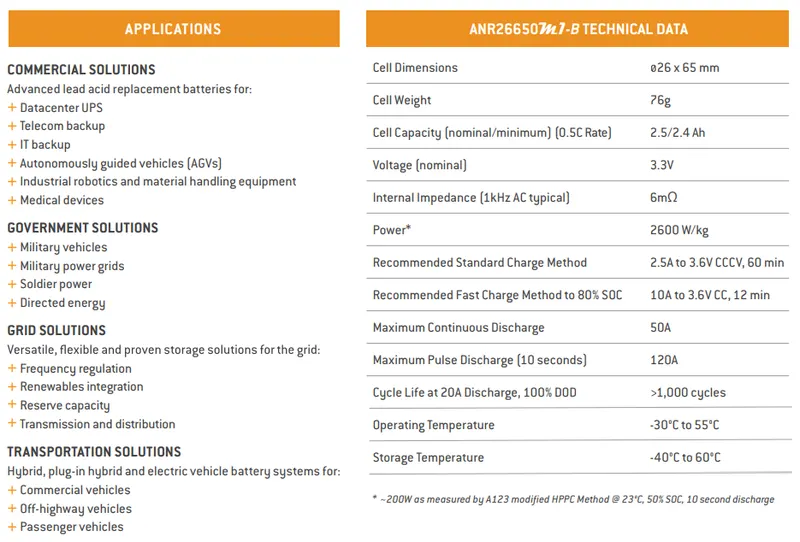
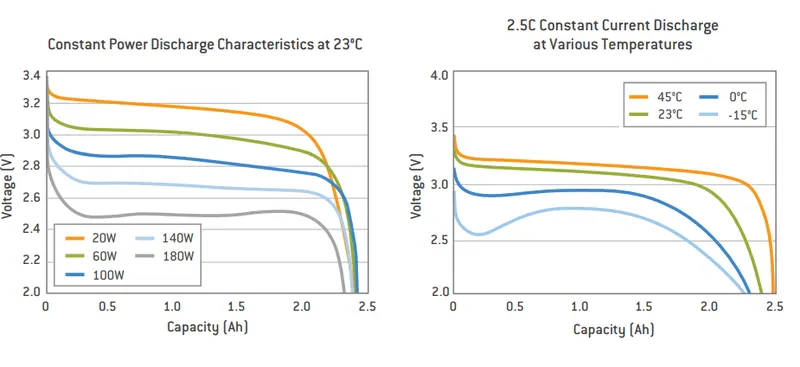
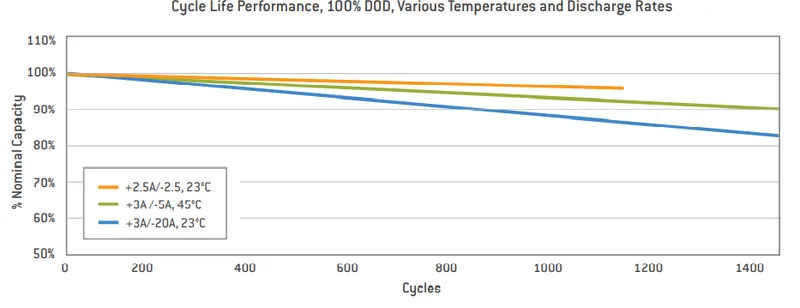
These are the graphs related to the cell regarding the performance of the Battery.
This high-performance Nanophosphate lithium iron phosphate (LiFePO4) battery technology delivers high power and energy density combined with excellent safety performance and extensive life cycling in a lighter weight, more compact package. Our cells have low capacity loss and impedance growth over time as well as high usable energy over a wide state of charge (SOC) range, allowing our systems to meet end-of-life power and energy requirements with minimal pack oversizing.
Applications of the battery.
There are various applications of Lithium-ion cells
1. COMMERCIAL SOLUTIONS
This is a large-scale application for the battery where high power is required.
*Datacenter UPS
*Telecom backup
*IT backup
*Autonomously guided vehicles
*Industrial robotic and material handling equipment
2. GOVERNMENT SOLUTIONS
*Military vehicles
*military power grids
3. GRID SOLUTIONS
*Frequency regulation
*Renewable integration
*REverse capacity
*Transmission and distribution
4. TRANSPORTATION SOLUTIONS
*Plug-in hybrid vehicles, hybrid cars, electric vehicles
*Commercial vehicles
*Off-highway vehicles
*passenger vehicles.
The performance of the cell is given in the datasheet that is referred to for this project.
These images show the power discharge, current discharge, and the life cycle of the cells used for the battery pack
BATTERY PACK DESIGN:
The purpose of a battery pack is to provide a convenient integrated power source for portable applications. The advantages of using
custom designs are outlined in the section on Benefits of Custom Packs. The pack may fulfil several functions: -
1. It enables higher voltage or higher capacity batteries to be built up from low voltage, low capacity cells.
2. It houses a cell or a bank of cells together with the associated interconnections in a single convenient pack.
3. It accommodates any necessary monitoring and electronic protection devices or circuits within the pack.
4. It can accommodate additional circuitry such as indicator lights, heaters, cooling ducts and solar panels.
5. It matches and meshes with the cavity in the product which the battery is intended to power providing both electrical and
mechanical interfaces.
6. It can provide unique electrical and mechanical interfaces to ensure compatibility both of the battery with the intended product and the charger with the battery.
Following Factors are considered while we design a battery pack:
1. Cylindrical battery cells
Clamshell battery designs are suitable for increased energy storage and usually involve cylindrical cell types, which are normally fixed in place using adhesives. With Bayblend® FR3040 EV PC+ABS blend, the curing of the adhesives can be completed in just five seconds. This, in turn, significantly speeds up battery module assembly.
This Bayblend® product also offers high ductility and great processability, making it an excellent choice for designing parts with tight tolerances fit for mass assembly.
2. Prismatic battery cells
In prismatic cell types, Bayblend® is typically used for busbar holders due to its properties. This is especially suitable for heavy-duty e-vehicles such as electric buses and electric trucks. For designs requiring long-term vibration tests, the flame-retardant Bayblend® FR3010 PC+ABS blend is a viable solution.
3. Pouch battery cells
Due to their geometry, pouch cell types are easy to fit into tight spaces, but battery packaging designs must also account for swelling during charge and discharge cycles. Frames must also satisfy the need for precision molding.
To provide the stiffness that pouch cell types may require, we offer mineral-filled products with Bayblend® that show good ductility and great flame-retardant performance.
Why use battery packs?
Battery cells are like eggs. Cells come in fixed voltages and capacities. If you need more voltage, you can deal with multiples of the cell voltage. You can't get half an egg, and you can't get half a cell, at least in voltage. Cell capacities do vary, particularly with a supplier like PowerStream that has a great variety of cell sizes available, but voltages don't. All NiCad or NiMH cells are 1.2 volts nominal, lead acid is 2.0 volts nominal and the various lithium technologies are about 3.6 volts per cell. If you need more voltage you have to add them in series, if you need less voltage you need some kind of voltage regulator or DC/DC converter.
If you need more current than a single cell can supply you may need to put cells in parallel. If you need more capacity to give longer run time you may also put cells in parallel.
Many times the physical configuration makes it more attractive to use many small cells rather than a few large cells, since a large block is harder to fit than several small subunits.
Geometry and Topology Considerations for Assembling Batteries
There are an infinite variety of battery pack combinations. Here are the most popular:
Case 1: Ladder, linear, F type, or radial
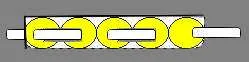
Note that the straps will both come off the top when there are an even number of cells, and one off the top, the other off the bottom when there is an odd number of cells. With a connector and heat shrink wrap they look like this:
The size of a ladder pack is D x nD x H where D is the diameter of the cell, n is the number of cells, and H is the height of the cells.
Case 2: Multi-row cells
There are two ways to start packing them. One could be called the cubic, and the other face centered cubic, or nested.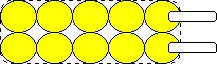
Cubic packing is in neat rows. The size of such a pack is nD x mD x H, where n is the number of cells in a row, m is the number of rows, D is the cell diameter, and H is the cell height.
Case 3: Face centered "cubic"

Face centered cubic packing is nested to take up less room. Calculating the size takes a little geometry, which follows: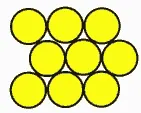
The size is L x W x H where
L = (n +½)D
W = [0.866(p-1)+1] D
H=H
p is the number of rows wide.
Case 4: FCC with alternating long and short rows
If there are alternating long and short rows, such as the 3,4,3 ten cell pack, the formulas are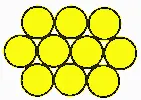
L = mD
W = [0.866(p-1)+1] D
H = H
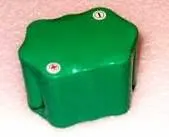
Where m is the number of cells in the longest layer, and p is the number of layers. With heat shrink it looks like this:
Case 5: Fixed channel width optimization
What if you have a fixed width channel and want to stagger the cells to maximize the number of cells per unit width? Pull out your high school geometry book, this is trickier!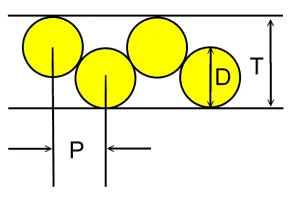
The distance P between the cells of Diameter D in a channel with height T is P = sqrt (2TD-T^2)
So if you have 18mm diameter batteries fitting into a 25.4mm channel, the distance between the cells is 16.8mm. In this case you can fit in an extra cell for every 15 cells, or save 1.2 mm of width per cell.
Case 6: Packing cells in a tube, 3 cells.
For a 3 cell pack, you can put the cells in a tube
The diameter of the outer circle is 2.16 D.
Case 7: Packing cells in a tube, 4 cells.
For a four cell pack in a circular tube
The diameter of the circumscribing circle is 2.41 D.
For example, with AA cells the diameter is 14.2 mm, so three would fit into a tube 30.7 mm in diameter, and four would fit in a tube 34.22 mm in diameter. Of course you will want to expand this slightly to account for up to 0.5 mm variation in cell diameters.
Case 8: Packing cells in a tube, up to 91 cells
| Cylindrical batteries in a tube of diameter "D" | Approximate diameter of the circumscribing circle | Scheme |
| 2 Cells | 2D | Side by side |
| 3 Cells | 2.16D | Triangle |
| 4 Cells | 2.414 D | Square |
| 5 Cells | 2.70 | Pentagon |
| 5 Cells | 3D | Square with one inside |
| 6 Cells | 3D | Hexagon |
| 7 Cells | 3D | Hexagon with one inside |
| 8 Cells | 3.305D | Heptagon with one inside |
| 9 Cells | 3.62D | Octagon with one inside |
| 10 Cells | 4.4D | Pentagon with 5 more cells symmetrically arranged around he outside |
| 10 Cells | 3.92D | Nonagon with one inside |
| 11 Cells | 4D | Nonagon with two inside |
| 12 Cells | 4D | Nonagon with three inside |
| 13 Cells | 4.24D | Decagon with three inside |
| 14 Cells | 4.4D | Decagon with four inside |
| 15 Cells | 4.55D | Undecagon with four inside |
| 16 Cells | 4.9D | Dodecagon with four inside |
| 19 Cells | 5D | Hexagonal close packed |
| 37 Cells | 7D | Hexagonal close packed |
| 61 cells | 9D | Hexagonal close packed |
| 91 Cells | 11D | Hexagonal close packed |
Case 9: Linear, or L-type, or Axial
This is a stack of cells end to end.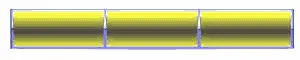
These packs are usually constructed by standing two cells side-by-side, and welding a nickel strip across the terminals, as in the ladder pack. The cells are then bent end to end by bending the nickel connecting strip in a "U" shape. Allow a thickness increase of ½ to 1 mm per junction for this.