Project 1 Mechanical design of battery pack
Aim: -
To Prepare a detailed battery pack drawing along with its enclosure.
Objectives: -
- Study Cell used for Battery pack.
- Calculate the Electrical Parameters use for Making 18kWh Battery.
- Design a detailed battery pack drawing along with its enclosure.
Methodology: -
- To study Battery or cell, we take help of battery ANR26650M1-B Datasheet from which we can get cell parameters and used this parameter for future calculations.
- For Designing battery pack, we have to calculate energy and power of the battery, so first we calculate Power from current and voltage, and then energy.
- To design battery pack, we have to arrange these batteries in series and parallel combination and according to that a drawing of battery enclosure is form and battery pack is created.
Theory: -
Objective 1: - Study Cell used for Battery pack.
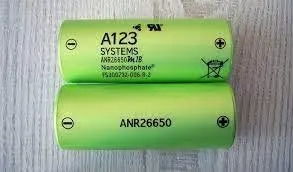
Cell- ANR26650M1-B
A123’s high-performance Nano phosphate® lithium iron phosphate (LiFePO4) battery technology delivers high power and energy density combined with excellent safety performance and extensive life cycling in a lighter weight, more compact package. Our cells have low-capacity loss and impedance growth over time as well as high usable energy over a wide state of charge (SOC) range, allowing our systems to meet end-of-life power and energy requirements with minimal pack oversizing.
APPLICATIONS
COMMERCIAL SOLUTIONS
Advanced lead acid replacement batteries for:
- Datacentre UPS
- Telecom backup
- IT backup
- Autonomously guided vehicles (AGVs)
- Industrial robotics and material handling equipment
- Medical Devices
GOVERNMENT SOLUTIONS
- Military vehicles
- Military power grids
- Soldier power
- Directed energy
GRID SOLUTION
Versatile, flexible and proven storage solutions for the grid:
- Frequency regulation
- Renewable’s integration
- Reserve capacity
- Transmission and distribution
TRANSPORTATION SOLUTIONS
Hybrid, plug-in hybrid and electric vehicle battery systems for:
- Commercial vehicles
- Off-highway vehicles
- Passenger vehicles
ANR26650M1-B Technical Data:
|
Cell Dimension |
26 x 65 mm |
|
Cell Weight |
76g |
|
Cell Capacity (Nominal/Minimum) (0.5C Rate) |
2.5/2.4 Ah |
|
Voltage (nominal) |
3.3 V |
|
Internal Impedance |
6 mΩ |
|
Power |
2600 W/kg |
|
Recommended Standard Charge Method |
2.5A to 3.6V CCCV, 60 min |
|
Recommended Fast charge Method to 80% SOC |
10A to 3.6V CC, 12 min |
|
Maximum Continue Discharge |
50A |
|
Maximum Pulse Discharge (10 sec) |
120A |
|
Cycle Life at 20A Discharge, 100% DOD |
>1000 Cycle |
|
Operation Temperature |
-30֯ C to 55֯ C |
|
Storage Temperature |
-40֯ C to 60֯ C |
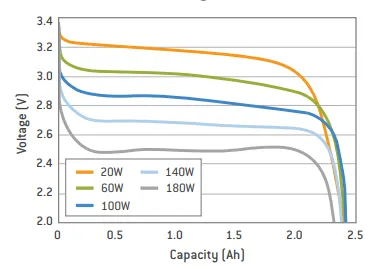
Constant Power Discharge Characteristics at 23֯ C: -
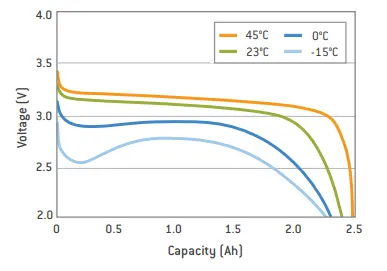
Constant Current Discharge at various temperature: -
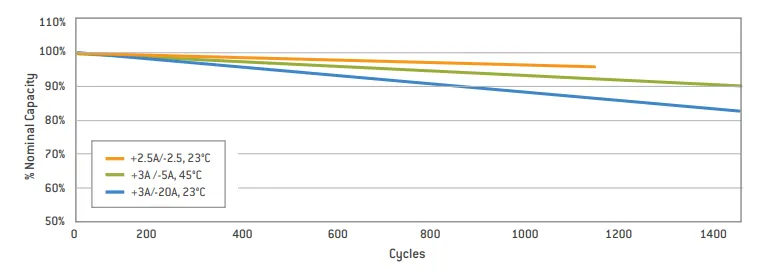
Cycle Life Performance, 100% DOD, Various Temperature and Discharge Rates: -
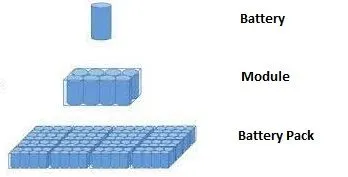
Cell – The cell is a device which converts Chemical energy into Electric energy.

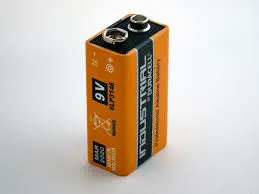
Battery – Combination of Two or more no. of cells is called as battery. These cells are connected either in series or in parallel combination.
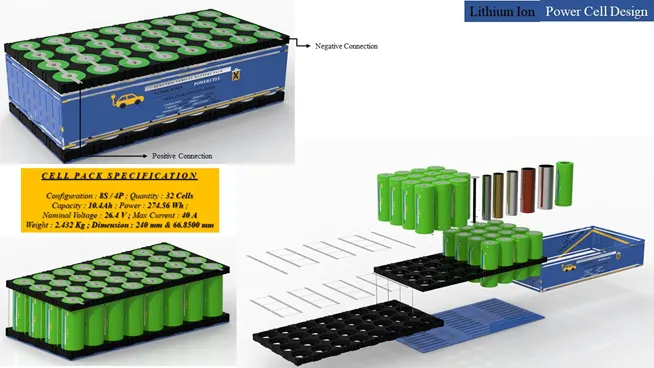
Module – The combination of no. of batteries together forms a module. These batteries are connected together via a connector which is solder strips. In the module a Battery management system (BMS) installed which protects the cells from damage due to overcharging, Temperature and other factors.

Battery Pack – No. of battery modules form a Battery Pack in which identical batteries are connected together, they may be configured in series, parallel or a mixture of both to deliver the desired voltage, capacity or Power density.
Objective 2: - Calculate the Electrical Parameters use for Making 18kWh Battery.
Assumptions: -
Battery Energy – 18kWh
Electrical Parameters-
Calculations as per assumptions of 18 kWh battery pack, basically 18kWh is energy required to achieve the vehicle its power range. It is depending upon the voltage (V) parameter and ampere-hour (Ah) capacity.
The cell capacity (Ah) of single cell = 2.5 Ah
The cell Voltage (V) of single cell = 3.3 The cell capacity (Ah) of single cell = 2.5 Ah
Therefore, the value of energy of single cell is calculi using,
Single cell Energy (Wh) = Cell Capacity (Ah) x Cell Voltage (V)
Single cell Energy (Wh) = 2.5 x 3.3
Single cell Energy (Wh) = 8.25 Wh.
From this we can calculate no. of cells required to manage 18 kWh Energy
Therefore, the no. of cell are = 18 kWh / 8.25 Wh
No. of cells are 2182.
We need minimum 2182 no. of cells to get 18 kWh energy, Now based on that we need to decide configuration i.e., series & parallel.
In series configuration the capacity of battery remains the same and voltage increases due to summation of all individual cell in series.
In parallel configuration the voltage of battery remains the same and capacity of the battery increases.
Voltage Rating of Battery: -
For Series configuration let us assume that 138 V at one leg,
So, No. of cells in series are 138/3.3 = 41.81 = 42
Battery Capacity: -
For parallel configuration we assume that capacity should be 130 Ah
Therefore, No. of Parallel legs are 130/2.5 = 52
Battery Pack Energy: -
Current Capacity x Voltage
130 x 138.6
18018 Wh = 18.018 kWh
Therefore, our battery module configuration would be 42S52P
Current supplied by the Battery: -
We have already calculated battery capacity which is 130 Ah means it is going to supply 130 A current per hour, which be consider as C rate.
Internal Resistance of Battery: -
The entire resistance encountered by a current as if it flows through a battery from the negative terminal to positive terminal is known as internal resistance of battery.
Objective 3: - Design a detailed battery pack drawing along with its enclosure.
To design battery enclosure, we have to consider Mechanical Parameters.
Mechanical Parameters: -
- Battery Dimensions:
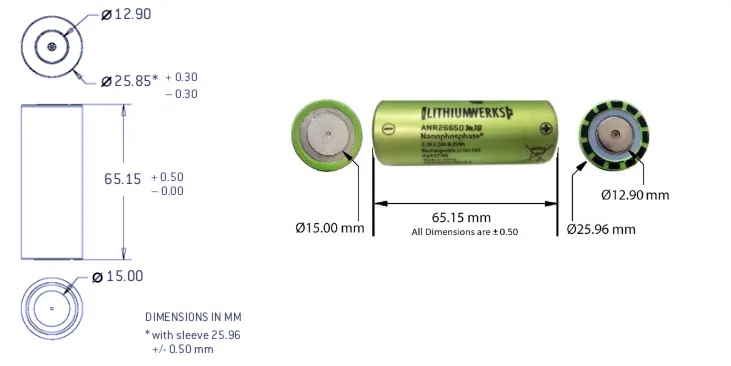
Diameter = 26mm
Length or Width = 65mm
Mass = 76g
ANR26650 cell has 26 mm Diameter and 65 mm height. By knowing this parameter, we can calculate the size of the casing required which is used for battery pack.
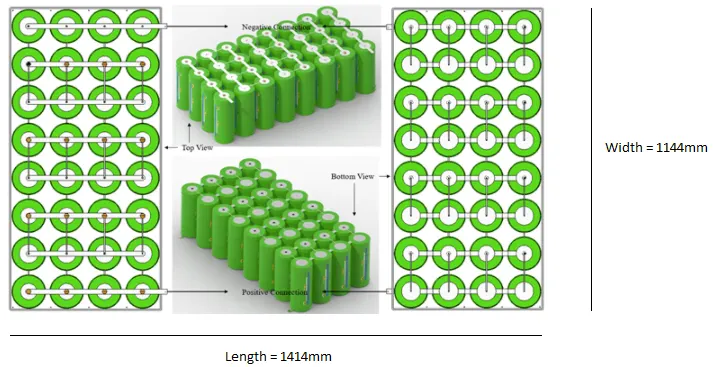
Length of Casing (L) = No. of cells in Parallel * cell diameter + space between two adjacent cells + outer hard casing
L = 52 * 26mm + 52mm + 10mm
L = 1414 mm
Width of Casing (W) = No. of cells Series * cell diameter + space between two adjacent cells + outer hard casing
W = 42 * 26mm + 42mm + 10mm
W = 1144 mm
Height of Casing (H) = Height of the single cell only i.e., 65mm + hard casing
Height = 65mm + 10mm
Height = 75mm
Weight of battery pack = No. of cells * weight of single cell + casing weight
Weight = 2182 * 76g + 1000g
Weight = 165847 g = 166.84 kg
Nickel Strips: -
Nickel Strips is generally used in battery building. It’s due to it’s efficiency of usage in spot welding & soldering. Also it has good properties and excellent resistance to many corrosive environment. The pure nickel will never get rust after it applied to battery pack & it won’t affect the current transfer between batteries.

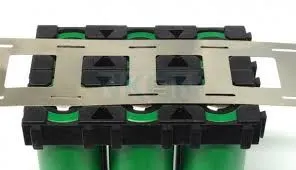
Design of cell Holder: -
The main battery holder is to keep cells fixed in place safely and securely also it is used to keep cells in a proper arrangement so that there will be a decrease in mechanical vibration, and have a better thermal runaway in between the cell gaps. Most of the cell holder is made up of polypropylene or nylon bodies rated for 80-100 ֯C
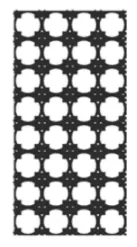

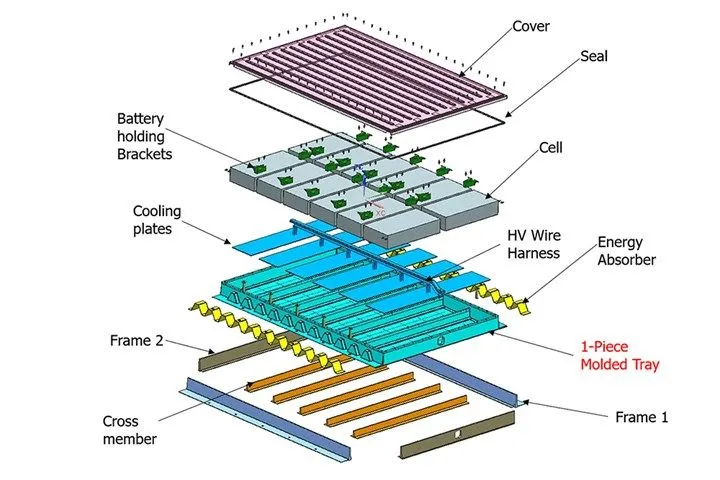
Design of Pack: -
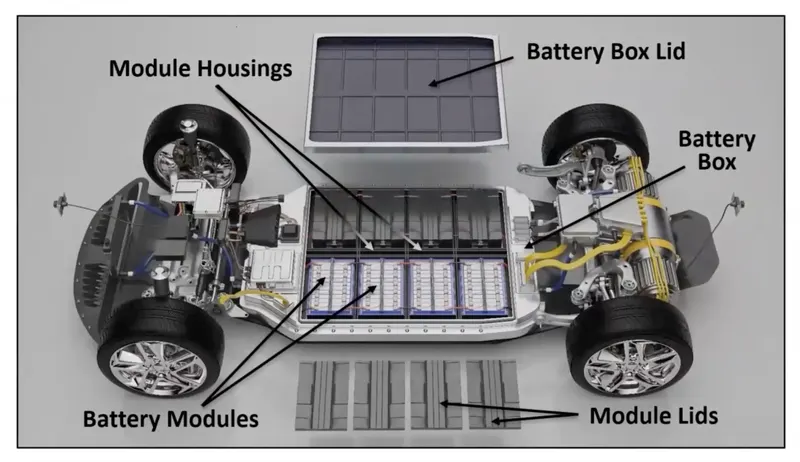
Basically pack cover is made up of Aluminium and the reasone behind is to keep battery pack for lightweight. The casing/cover thickness is 0.5 mm and design as follow.
Conclusion: -
| Parameter | Value |
| Cell Voltage | 3.3 V |
| Cell Capacity (Nominal/Minimum) (0.5C rate) | 2.5/2.4 Ah |
| Internal Resistance | 6 moh |
| Voltage | 138.6 V |
| Current Capacity | 130 A |
| Power or Energy | 18.018 kWh |
| Series Cell | 42 |
| Parallel Cell | 52 |
| Total Cell | 2182 |
| Length | 1414 mm |
| Width | 1144 mm |
| Height | 75 mm |
| Weight | 166.84 kg |