Project 1 Mechanical design of battery pack
Aim :
To design a battery pack of capacity 18kWh using ANR26650m1-B cell.
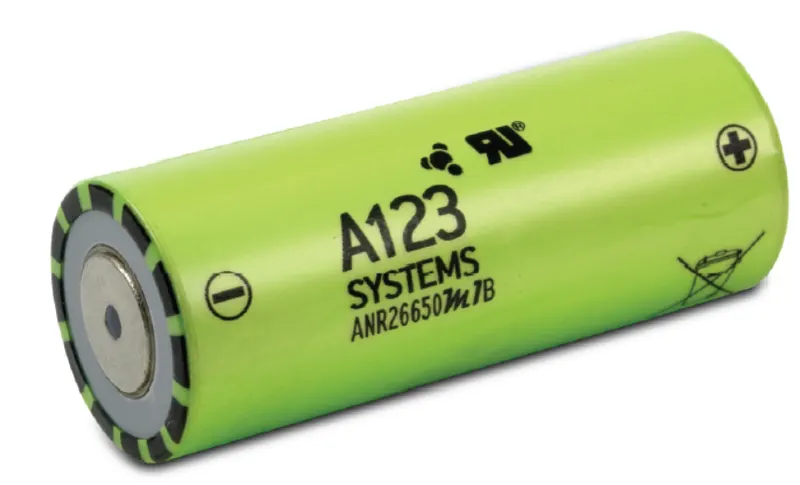
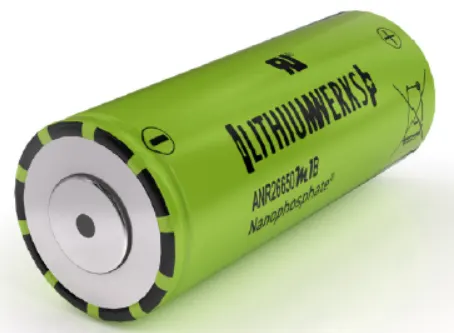
The above picture shows the ANR26650m1-B cell from different manufacturers.
Cell Chemistry of ANR26650m1-B:
Its a high performance Nanophosphate lithium iron phosphate(LiFePO4) battery technology delivers high power and energy density combined with excellent safety performance and exensive life cycling in a lighter weight, more compact package.
A lithium iron phosphate (LFP) battery is a type of lithium-ion battery that is capable of charging and discharging at high speeds compared to other types of batteries. It is a rechargeable battery consisting of LiFePO4 as its cathode material; hence the name.
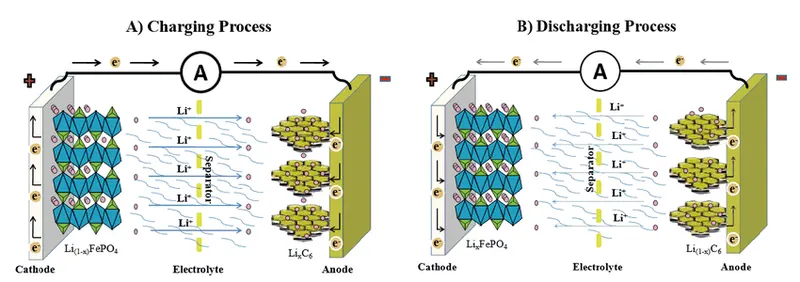
Dimensions of ANR26650m1-B:
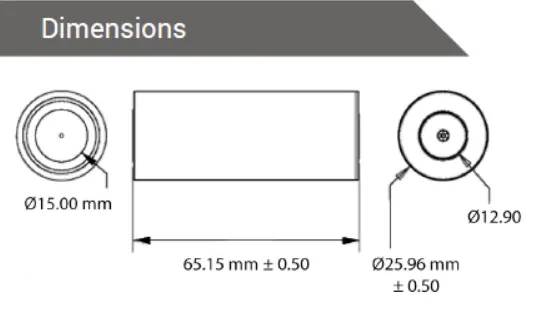
From the cell name itself we can get to know the dimensions of the battery using naming conventions
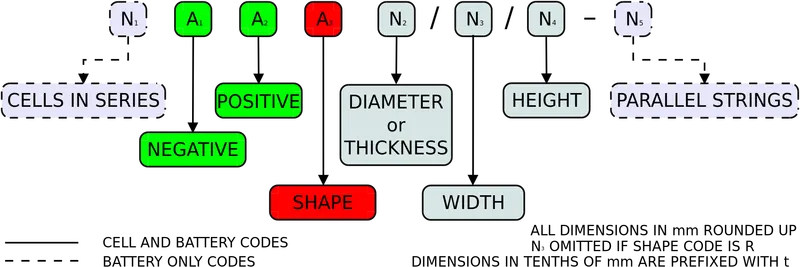
R - cylindrical in shape
26 - max diameter of the cell in mm
65 - max length of the cell in mm.
Applications :
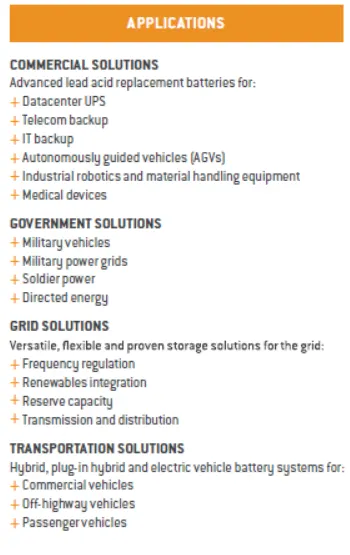
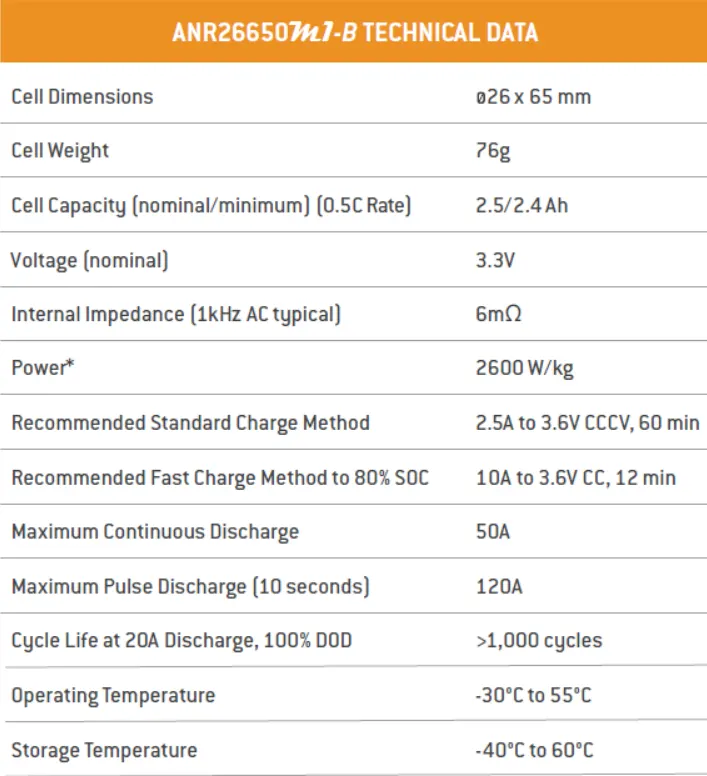
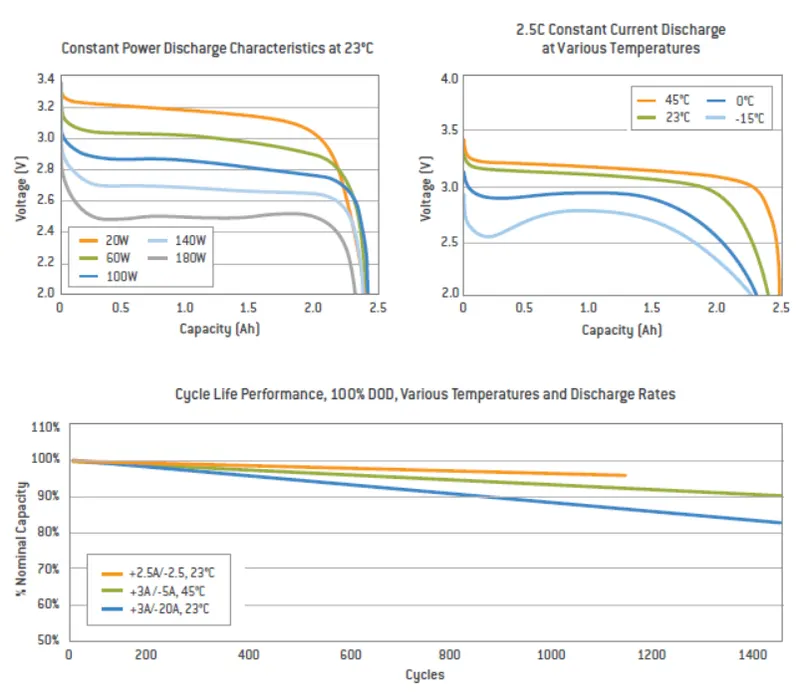
From the above datasheet of ANR26650m1-B from A123 systems,
Cell Radius(r) = 0.013m
Cell height(h) = 0.065m
Cell capacity = 2.5/2.4Ah
Wt of Cell =76 g = 0.076kg
Nominal Voltage = 3.3V.
Cell Calculations:
1) Cell volume = pi*r*r*h
= 3.14*0.013*0.013*0.065
= 3.45 X 10^-5 m3.
Cell Volume = 3.45 X 10^-5 m3.
2) Cell Energy (Wh) = Cell capacity (Ah) * Cell voltage (V)
= 2.5*3.3 = 8.25 Wh.
Cell Energy = 8.25 Wh.
3) Cell Energy Density:
Gravimetric Energy density (Wh/kg) = Cell energy/ cell weight
= 8.25*0.076 = 108.55 Wh/kg.
Gravimetric Energy density = 108.55 Wh/kg.
Volumetric Energy density (Wh/m3) = Cell energy/ Cell Volume
= 825 /3.45 X 10^-5 = 235.72 kWh/m3.
Volumetric Energy density = 235.72 kWh/m3.
Battery Pack:
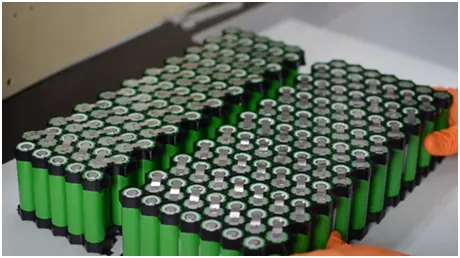
A battery pack is a set of any number of (preferably) identical batteries or individual battery cells. They may be configured in a series, parallel or a mixture of both to deliver the desired voltage, capacity, or power density. The term battery pack is often used in reference to cordless tools, radio-controlled hobby toys, and battery electric vehicles.
Components of battery packs include the individual batteries or cells, and the interconnects which provide electrical conductivity between them. Rechargeable battery packs often contain a temperature sensor, which the battery charger uses to detect the end of charging. Interconnects are also found in batteries as they are the part which connects each cell, though batteries are most often only arranged in series strings.
When a pack contains groups of cells in parallel there are differing wiring configurations which take into consideration the electrical balance of the circuit. Battery regulators are sometimes used to keep the voltage of each individual cell below its maximum value during charging so as to allow the weaker batteries to become fully charged, bringing the whole pack back into balance. Active balancing can also be performed by battery balancer devices which can shuttle energy from strong cells to weaker ones in real time for better balance. A well-balanced pack lasts longer and delivers better performance.
To make a battery pack of 18kWh using ANR26650m1-B,
Series Configuration:
let us consider the voltage of the battery pack to be 150 V
then, No of cells to be connected in series = 150V/3.3 V = 45.45 ~ 46 cells.
Parallel Configuration:
let us consider the total capacity of the battery pack to be 120Ah
then, No of cells to be connected in Parallel = 120Ah/2.5Ah = 48 cells.
if we connect a 46s48p configuration,
Total power of Battery pack = 120 Ah * 150V = 18000 wh =18kWh
Thus meeting the requirement.
Total no of cells needed for the above battery pack = 46*48 = 2208 cells.
Battery Pack voltage: 150V
Battery pack capacity: 120Ah
Mass of Battery pack = No of cells * mass of the cell
= 2208 * 0.076 kg = 170Kg approx
Total Volume of battery pack = No of cells * cell volume
= 2208* 3.45 X 10^-5 = 7617.6 X 10^-5 m3.
Gravimetric Energy density of Battery pack = 18000 wh / 170 kg
= 105.9 Wh/kg
Volumetric energy density of Battery pack = 18000 Wh / 7617.6 X 10^-5 m3
= 2.363 X 10^5 Wh/m3.
The main purpose of a battery pack is
- to enable high voltage or higher capacity batteries to be built up from low voltage and low capacity cells.
- to house a cell or bank of cells together with the associated interconnections in a single convinient package.
- to accomodate all neccessary monitoring an electronic protection devices.
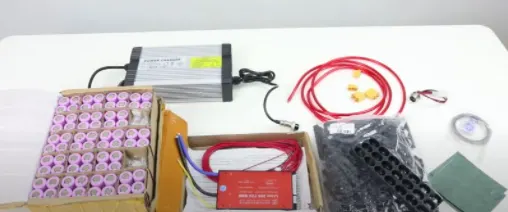
Materials required to construct a battery pack are
- Battery cell
- Nickel or other tabbing
- PCB/PCM/BMS
- PVC shrink wrap
- Insulating paper (barley paper)
- Insulating foam
- Connectors and wires
Steps to construct a Battery pack:
We need to join the connectors. Connectors are of two types
- square type - consumes more space
- hexagonal type - for high energy density battery pack.
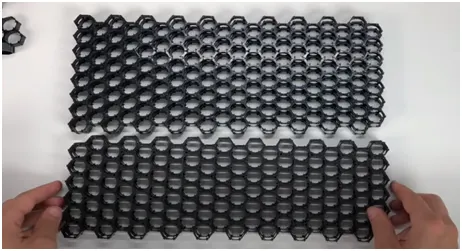
Insert the cells inside these connectors with positive and negative poles kept alternatively in adjacent rows.
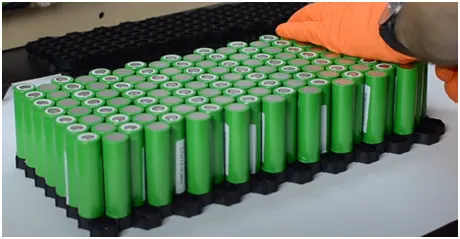
Spot welding with nickel strips to make series connection between the cells as shown in the figure below,
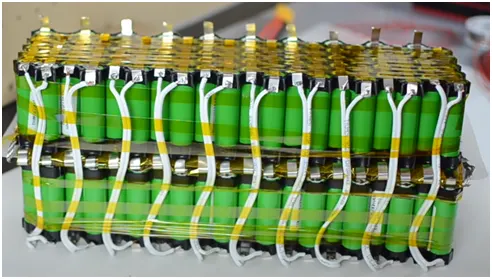
After making the series connections, strings are connected in parallel, which constitutes a module.
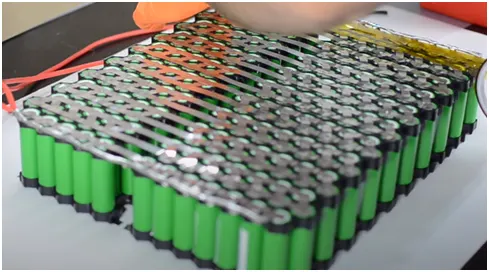
More such a modules are connected in series or parallel as per the requirement.
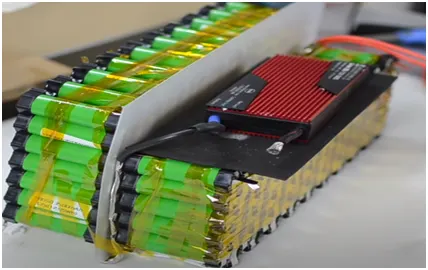
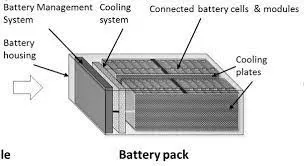
Battery pack with BMS installed
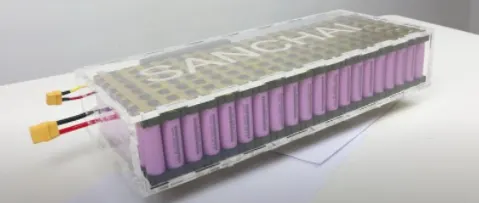
Complete enclosure of a Battery pack
Conclusion:
The mechanical aspects of designing a battery pack is explained in steps and the calculations for series and parallel configurations also discussed in detail.