Project 1 - Interfacing a 16*2 LCD with Arduino using I2C protocol
AIM :
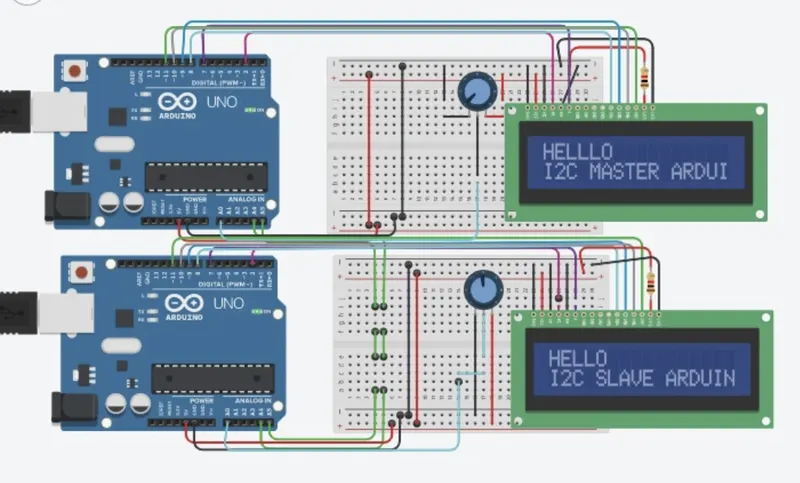
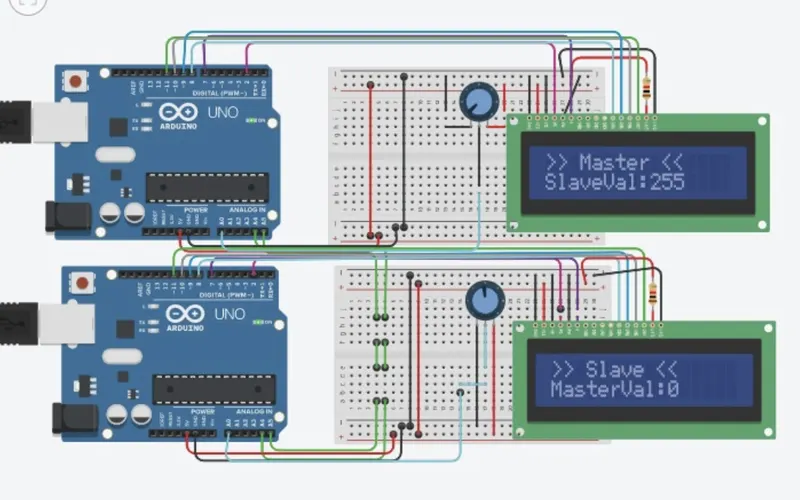
To implementing the Code for “Interfacing a 16*2 LCD with two Arduino’s (one for Master and one for Slave) using Inter-Integrated Circuit (I2C) communication protocol” by sending the message to LCD using I2C communication protocol and display the message on LCD screen.
CODE :
- lcd.begin
- lcd.setCursor
- lcd.print
- Serial.begin
- Wire.begin
- int
PROGRAM:
Master code :-
#include<Wire.h>

#include<LiquidCrystal.h>

LiquidCrystal lcd(2, 7, 8, 9, 10, 11); //Define LCD Module Pins (RS,EN,D4,D5,D6,D7)
void setup()
{

lcd.begin(16,2); //Initilize LCD display

lcd.setCursor(0,0); //Sets Cursor at first line of Display

lcd.print("HELLLO"); //Prints CIRCUIT DIGEST in LCD

lcd.setCursor(0,1); //Sets Cursor at second line of Display

lcd.print("I2C MASTER ARDUINO"); //Prints I2C ARDUINO in LCD

delay(5000); //Delay for 5 seconds
lcd.
clear(); //Clears LCD display

Serial.begin(9600); //Begins Serial Communication at 9600 baud rate

Wire.begin(); //Begins I2C communication at pin (A4,A5)

}
void loop()
{

Wire.requestFrom(8,1); // request 1 byte from slave arduino (8)

byte MasterReceive = Wire.read(); // receive a byte from the slave arduino and store in MasterReceive

int potvalue = analogRead(A0); // Reads analog value from POT (0-5V)

byte MasterSend = map(potvalue,0,1023,0,127); //Convert digital value (0 to 1023) to (0 to 127)
Wire.beginTransmission(8); // start transmit to slave arduino (8)

Wire.write(MasterSend); // sends one byte converted POT value to slave
Wire.endTransmission(); // stop transmitting

lcd.setCursor(0,0); //Sets Currsor at line one of LCD

lcd.print(">> Master <<"); //Prints >> Master << at LCD

lcd.setCursor(0,1); //Sets Cursor at line two of LCD

lcd.print("SlaveVal:"); //Prints SlaveVal: in LCD

lcd.print(MasterReceive); //Prints MasterReceive in LCD received from Slave
Serial.println("Master Received From Slave"); //Prints in Serial Monitor
Serial.println(MasterReceive);

delay(500);

lcd.clear();
}
Slave :-
#include<Wire.h> //Library for I2C Communication functions

#include<LiquidCrystal.h> //Library for LCD display function

LiquidCrystal lcd(2, 7, 8, 9, 10, 11); //Define LCD Module Pins (RS,EN,D4,D5,D6,D7)
byte SlaveReceived = 0;
void setup()
{
lcd.begin(16,2); //Initilize LCD display

lcd.setCursor(0,0); //Sets Cursor at first line of Display

lcd.print("HELLO"); //Prints CIRCUIT DIGEST in LCD

lcd.setCursor(0,1); //Sets Cursor at second line of Display

lcd.print("I2C SLAVE ARDUINO"); //Prints I2C ARDUINO in LCD

delay(5000); //Delay for 5 seconds

lcd.clear(); //Clears LCD display

Serial.begin(9600); //Begins Serial Communication at 9600 baud rate

Wire.begin(8); //Begins I2C communication with Slave Address as 8 at pin (A4,A5)

Wire.onReceive(receiveEvent); //Function call when Slave receives value from master

}
void loop(void)

{

lcd.setCursor(0,0); //Sets Currsor at line one of LCD

lcd.print(">> Slave <<"); //Prints >> Slave << at LCD

lcd.setCursor(0,1); //Sets Cursor at line two of LCD

lcd.print("MasterVal:"); //Prints MasterVal: in LCD

lcd.print(SlaveReceived); //Prints SlaveReceived value in LCD received from Master
Serial.println("Slave Received From Master:"); //Prints in Serial Monitor
Serial.println(SlaveReceived);

delay(500);

lcd.clear();
}
void receiveEvent (int howMany) //This Function is called when Slave receives value from master

{

SlaveReceived = Wire.read(); //Used to read value received from master and store in variable SlaveReceived

}
RESULT: