Project 1 Hood
Hood design
Aim: - The main objective of this project is the surface modeling of a car Hood using Siemens NX12. This project attempts a design idea for hood BIW that satisfies the manufacturing and functional requirements, as well as EURO NCAP standards.
The objective of this project –
- To understand the importance as well as components of a car hood.
- To learn basic tools, command features, surface modeling, and its application.
- To understand and learn about the industrial approach how to design the hood of a car using siemens NX cad.
- To calculate the moment of inertia using section modulus along the Y-plane.
- What is Hood?
The Hood or Bonnet is one of the essential components of a car at the front portion, used to decorate the car and to add a luxurious look. The shape of the bonnet is to be made aerodynamic to minimize drag. Bonnet is used as a shield/cover to access the parts such as the radiator, engine, and many other components, hence the design is made in such a way that it can be easily accessible.
The hood is also considered another type of door in the automobile as it consists of an outer panel and an inner panel. The inner panel provides the strength to the hood and all the machining processes, joining processes, or reinforcement (welding, riveting, holes, embossing, etc.) is done on the inner panel. And all the other parts like the hinge assembly, and striker latch, are attached to the inner panel. The outer panel functions as the metal cover. The outer panel is a Class A surface in which no machining or welding is done. The outer panel and inner are joined with the Hemming process.
- Components of Hood
Hood components are:
- Outer Panel
- Inner Panel
- Hinge
- Latch
- Reinforcement
- Outer Panel - A car hood panel is one of the most important components of the BIW (body in white), it is considered as the closure sheet-metal component. The outer panel has the aesthetic look to it but on its own is very weak and not capable of handling force during impact. Most automobile hood outer panels are made of traditional steel plates, and their quality does not meet the needs of lightweight development. For this reason, it is necessary to obtain lightweight effects through the application of automotive aluminum sheets. The most widely used car aluminum alloys in the market are deformed aluminum alloys 6111, 6016, and 5182. The production process of the outer panel of the hood mainly includes blanking, deep drawing, trimming, turnup, and side turn-up. Among them, deep drawing is a key process to ensure the quality of parts.
- Inner Panel
The inner panel of the hood is not visible to the customer, but this is the engineering feature of the outer panel. The hood panel is required to have a high initial reaction force against the impact exerted on the hood in order to enhance the energy absorption capacity. The hood is further required to minimize a reduction of a reaction force by deformation in a collision. A hood inner panel according includes an inner panel main body forming part of a hood of a vehicle, a front bead provided on the inner panel main body and extending along a vehicle width direction, and a rear bead provided on the inner panel main body, located on a rear side of the front bead and extending along the vehicle width direction. The front bead includes a center portion in the vehicle width direction that is curved toward the front of the vehicle and located in front of each end portion in the vehicle width direction, and the rear bead includes a center portion in the vehicle width direction that is curved toward a back of the vehicle and located behind each end portion in the vehicle width direction.
- Hinge - A hinge is a machine element that connects two bodies allowing angular movement about a fixed axis of rotation, all the while preventing translations and rotations on the remaining two axes. A hinge can be considered as a journal bearing with only one degree of freedom where a shaft is rotating in a hole. Hinges only allow one rotation, either yawing (the most common), pitching, or rolling. Hinges are jointed and flexible device that is attached to any swinging part. Hinges are mechanical bearings that are used to connect two swinging objects or points to one another and give them the freedom to move relative to each other. Hinges have limited movement, allowing the joint to move only at one angle and restricting the other movements of swinging parts.
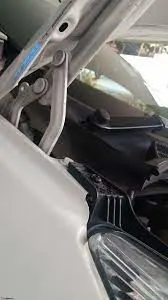
- Latch – Latches are mechanical components that allow the temporary joining of parts that are moving relative to each other. They are actuated to release the coupling and allow the two parts to separate. Latches are mostly seen on doors and enclosure openings. They are also used in devices such as seat belts, clamps, straps, and objects with retractable parts. Different designs feature various methods of actuation, holding style, and mounting. The hood latch is an extremely simple latch. When the hood is closed, the latch slides over what is called a catch, and spring covers the latch to keep it snug. When we pull the knob inside the car to open the hood, the hood latch cable opens the latch, allowing it to bypass the catch and open.
- Reinforcement – Reinforcement is defined as strengthening something that is weak or adding some strength by adding more material to the weak spot. Reinforcement in automobiles is done to strengthen the surfaces so that they can bear the load if a collision occurs. The reinforcement surfaces are also provided to attach the hinge and latch to the hood's inner panel. Reinforcement is done at the embosses of the hinge and the latch. A 1.5mm of sheet metal is provided at these parts as direct forces act on these.
- Latch Trajectory
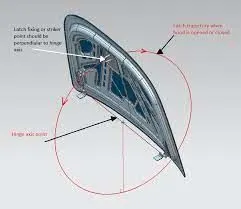
The latch trajectory helps us to fix the striker at the proper place in the hood. Taking the center of the axis of the hinge, a circle is drawn taking the striker distance as the radius. It is positioned tangent so that perpendicularity is obtained. The circle is the direction of the opening or closing of the hood. Ensure proper opening and closing of the hood latch trajectory is required so that the striker is in its correct position.
- Mastic Data
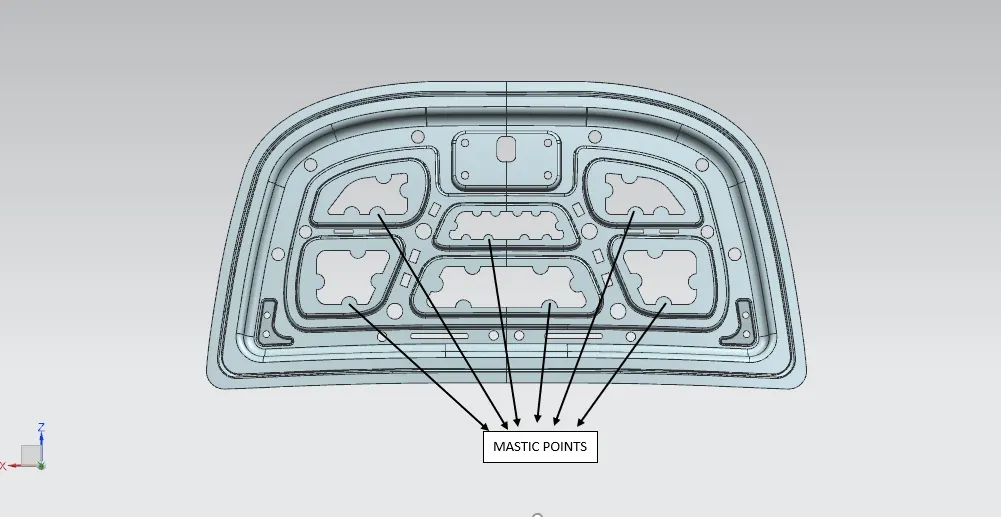
The hood's inner and outer panels are joined together by hemming but then also we use mastic sealant to properly seal all the area of the hood. This seal is done to reduce the NVH (noise, vibration, and hindrance) and to provide a waterproof seal. A sealant in liquid form is applied to the inner panel at the proper areas so that it seals the complete hood. The Mastic sealant or the Mastic point is an elastic compound that behaves like a rubber. The mastic points are defined on the hood inner panel where the hood can easily deform. They help the hood's outer panel to come back to its original shape after it gets deformed. The mastic has an influence area of 80mm. The sealant areas are drawn while designing the inner panel and while designing these points the thing to be considered is that they cover all the area of the hood so that no area is left otherwise while in the moving condition it will produce some NVH.
- Emboss
Sheet metal embossing is a stamping process for producing raised or sunken designs or reliefs in sheet metal. This process can be made by means of matched male and female roller dies, or by passing a sheet or a strip of metal between rolls of the desired pattern. It is often combined with foil stamping to create a shiny, 3D effect. The metal sheet embossing operation is commonly accomplished with a combination of heat and pressure on the sheet metal, depending on what type of embossing is required.
- Deep Drawing
Deep drawing is a sheet metal forming process in which a sheet metal blank is radially drawn into a forming die by the mechanical action of a punch. It is thus a shape transformation process with material retention. The process is considered a "deep" drawing when the depth of the drawn part exceeds its diameter. This is achieved by redrawing the part through a series of dies. The flange region (sheet metal in the die shoulder area) experiences radial drawing stress and tangential compressive stress due to the material retention property. These compressive stresses (hoop stresses) result in flange wrinkles (wrinkles of the first order). Wrinkles can be prevented by using a blank holder, the function of which is to facilitate controlled material flow into the die radius.
- Hemming
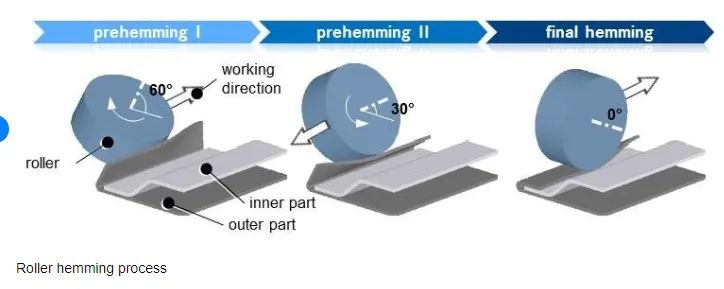
Hemming is a metalworking process in which a sheet metal is folded over onto itself. Normally hemming operations are used to connect parts together, improve the appearance of a part, and reinforce part edges. Hemming between the inner and outer panels is used to join the inner and outer panels and used instead of spot welding as surfaces cannot be joined with the welding process. Hem flanges are protected by a sealant to prevent crevice corrosion of the sandwiched metal. In principle, the hemming technique produces sufficiently strong mechanical joints around the periphery of closure panels When force is applied during the hemming process there may be a change of shape which is examined, and relaxation is given in those areas to decrease the stress concentration.
Design consideration
The car bonnet is an important component that is utilized for several purposes at the front. It gives access to the engine compartment which enables the repair and maintenance of many parts namely the car engine, radiator, etc. Therefore, the bonnet must be designed in a suitable manner, and it should minimize the hindrances from the disturbance caused by the external environment on the hood and its components below it. When the car is in running condition, the resisting forces from the air act on the hood. Therefore, the design of the bonnet should be made aerodynamic to reduce air resistance.
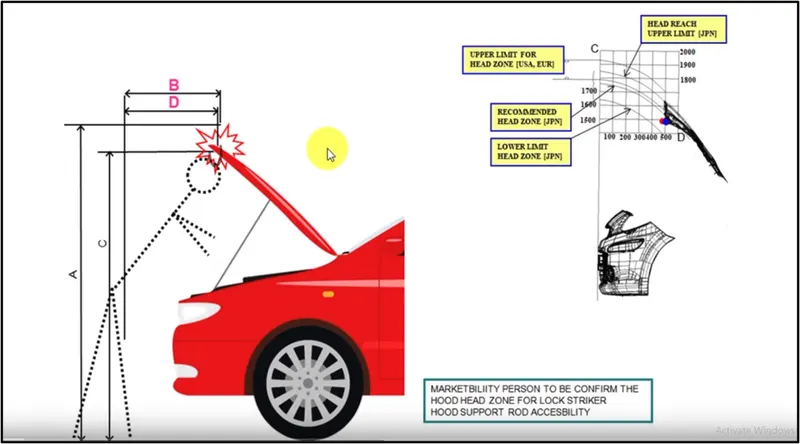
Head Impact Zone – According to recent surveys lots of pedestrians lost their lives and are severely getting their heads damaged during the accident. The pedestrian is adults, children, cyclist, or others. So, to keep these things in mind the hood design is done in such a way that it injured the pedestrian as less as possible. According to different regions, head zones are defined by considering the average heights of pedestrians. The below image shows American, European, and Japanese head zone standards. The opening angle of the hood is also decided as per predefined standards.
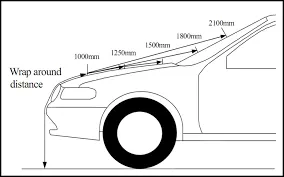
Wrap-around distance is the trace of points received on the front structure when one end of the flexible tape of the required length is held at the ground reference line and the other end is in contact with the front structure.
When a child hits on a hood his head will fall between 1000 to 1500 mm area whereas. When an adult hits on a hood his head will fall between 1500 to 2100 mm.
EURO NCAP Test
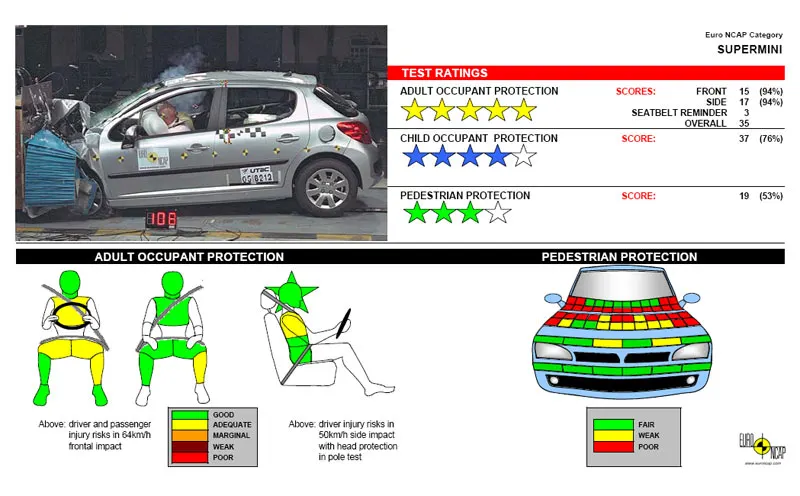
EURO NCAP Test is performed to check the safety of pedestrians by considering head impact, leg impact, etc.
As per NCAP Head impact criteria should be below 1000 to have a moderate injury. The hood designer's aim is to develop a hood having a major green zone.
After a test, points are allocated to the impact portion (which shows the color code at impact areas), and accordingly, a pedestrian safety rating is assigned to the vehicle. The below Image shows different color zones for pedestrian safety.
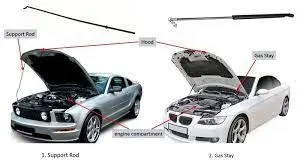
Gas Stay or Support Rod – The gas stays, or support rod helps to keep the hood open. While designing the hood the position of the support rod should be considered in both open and closed positions. While in a close position the support rod should rest in such a way it doesn’t touch any other component, and if touches any part, then vibration will be produced, and it will also create noise. And, in the open position, it should be such that it can easily withstand the load of the hood.
Opening of Hood – When the hood opens there should be a space of 15 to 30 mm so that the fingers can place in that space to lift the hood.
Other parameters –
Thickness of hood
Outer panel = .75mm
Inner panel = .75mm
Reinforcement = 1.5mm
Relief in the rear and front sections of the inner and outer panels for hemming.
The gap between the inner and outer panel for hemming
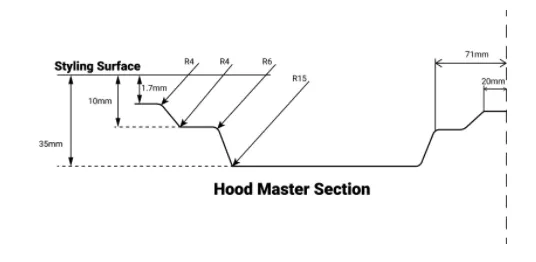
Hood design model in NX12
Work part to be offsetted
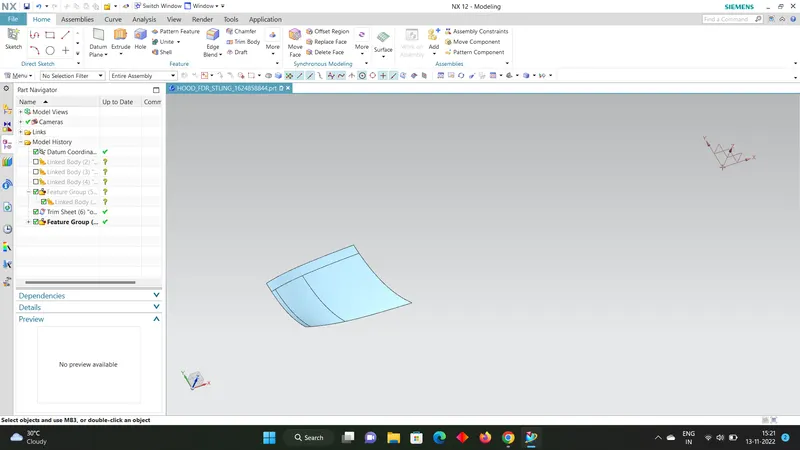
First flange made out of offsetting surface work part and trimming sheet.
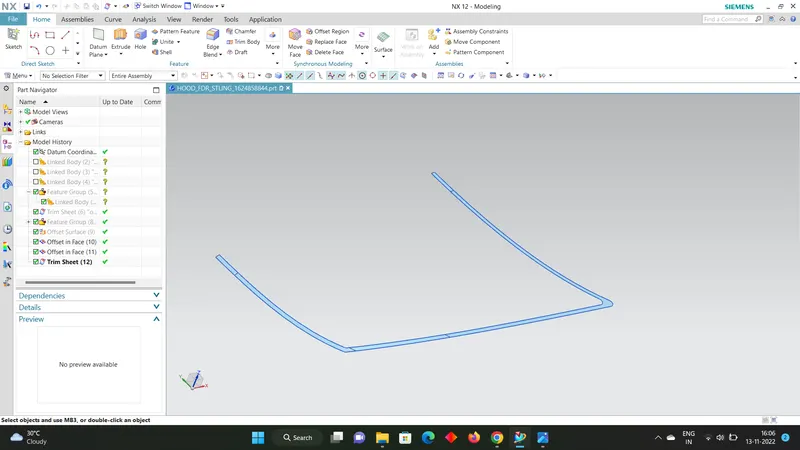
Second flange made out of offsetting surface and trimming sheet.
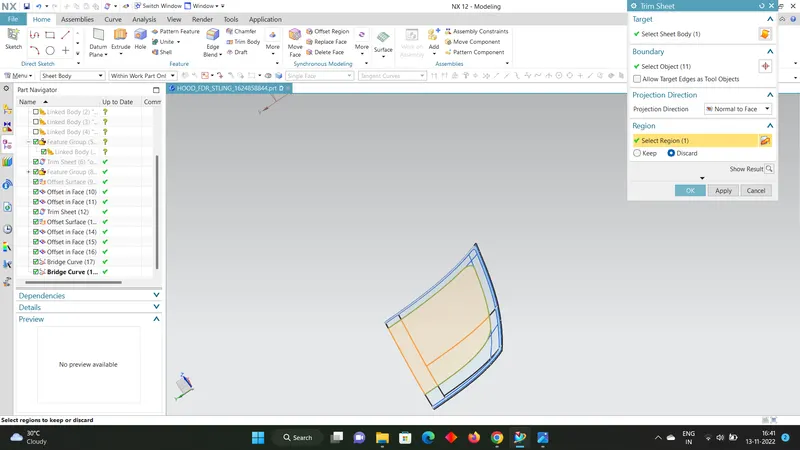
First emboss is made by law extension followed by trim and extend
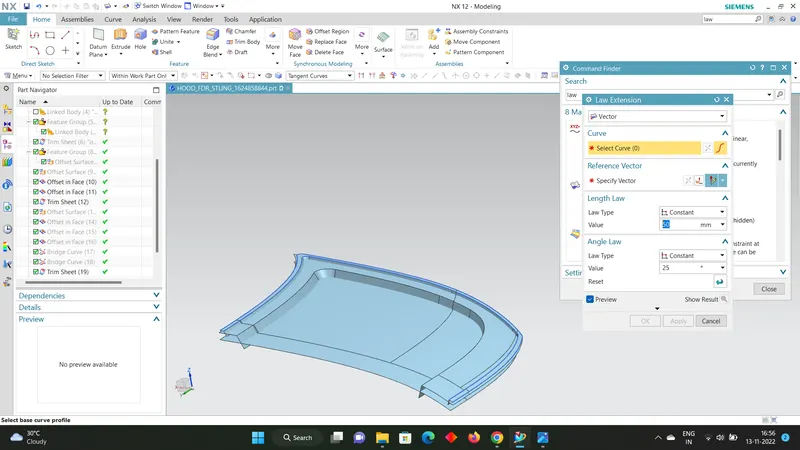
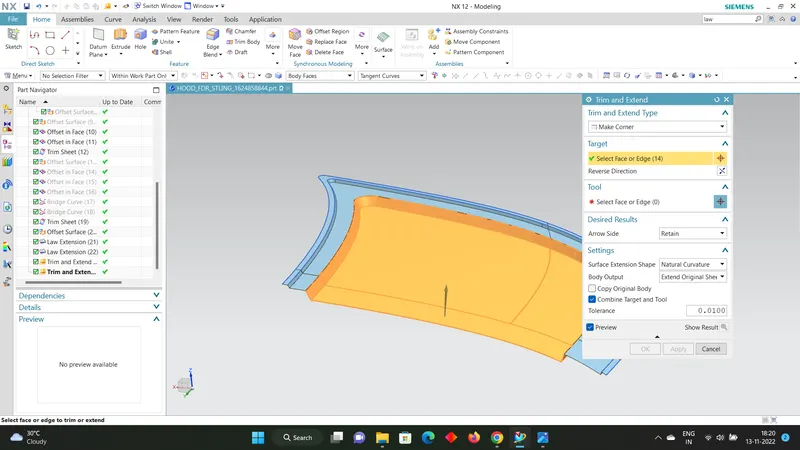
Edge blending is performed
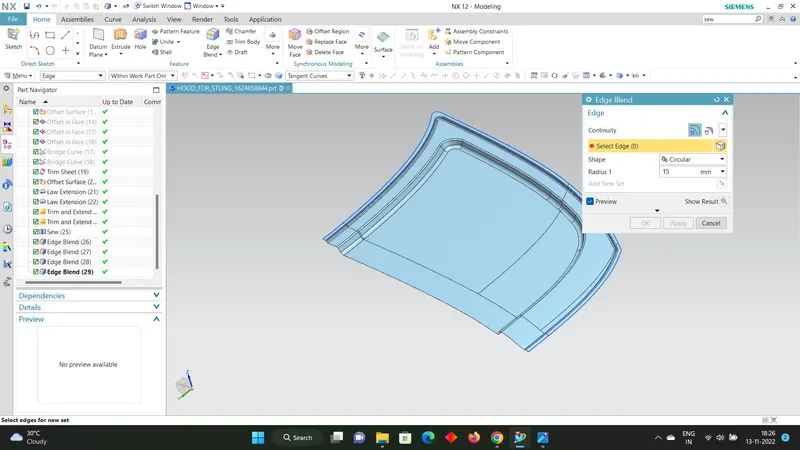
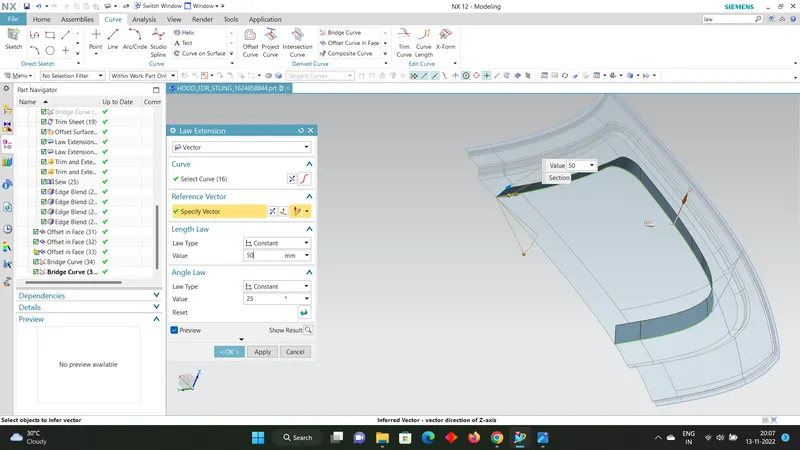
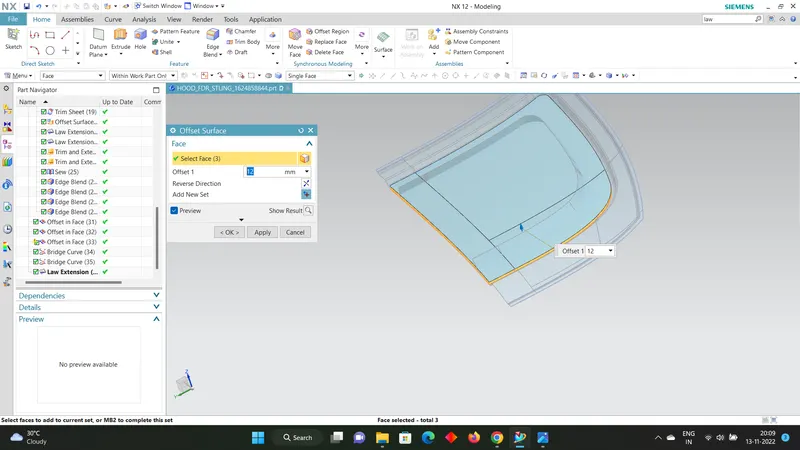
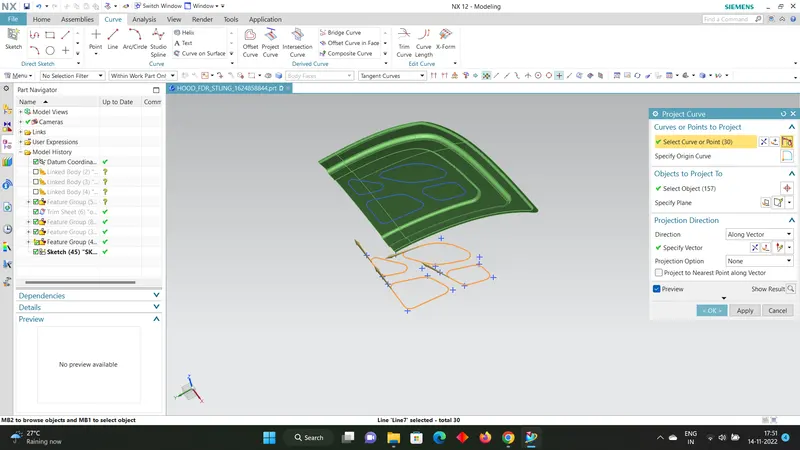
Curves to create embosses are sketched and projected.
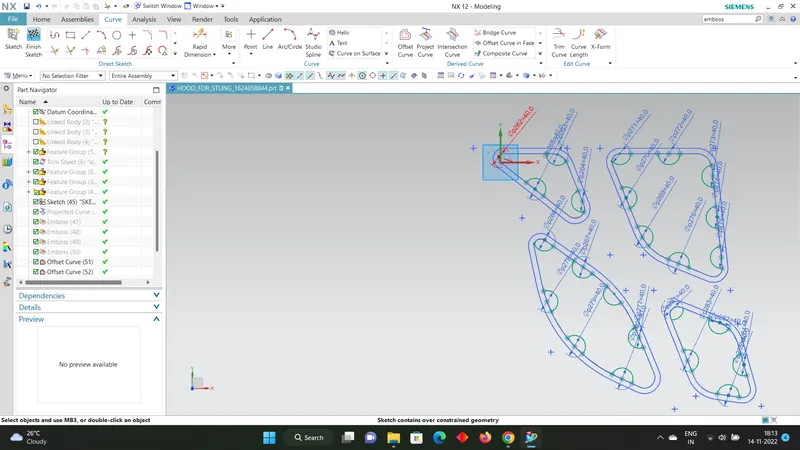
Mastic points are created based on criteria.
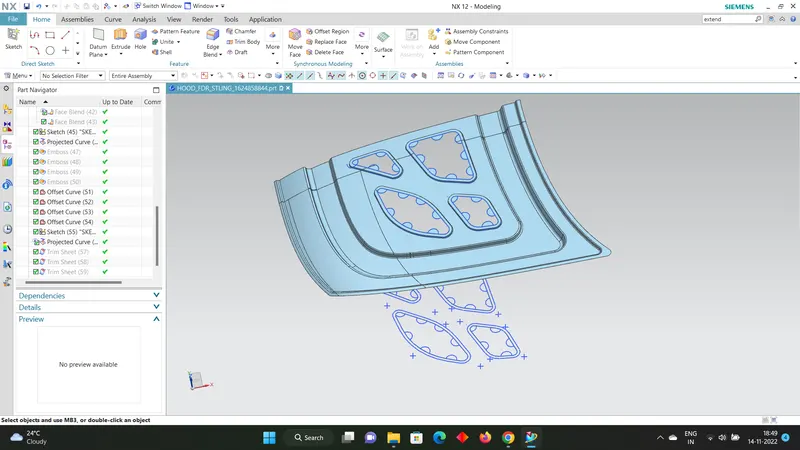
Latch reinforcement created
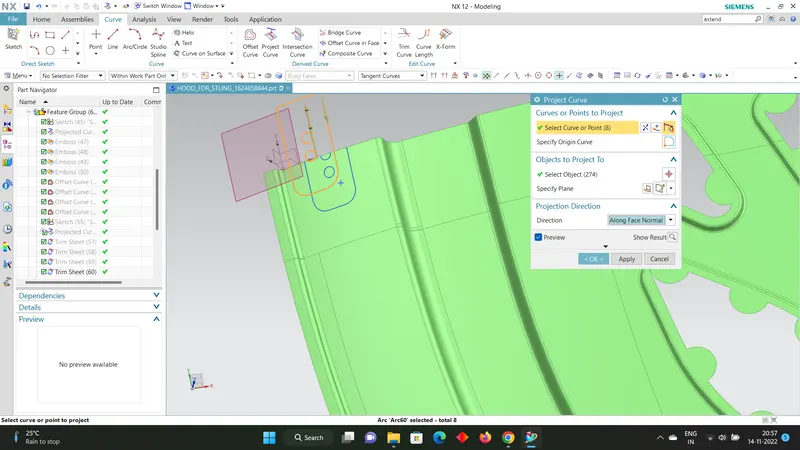
Other, front inner panel embosses are created.
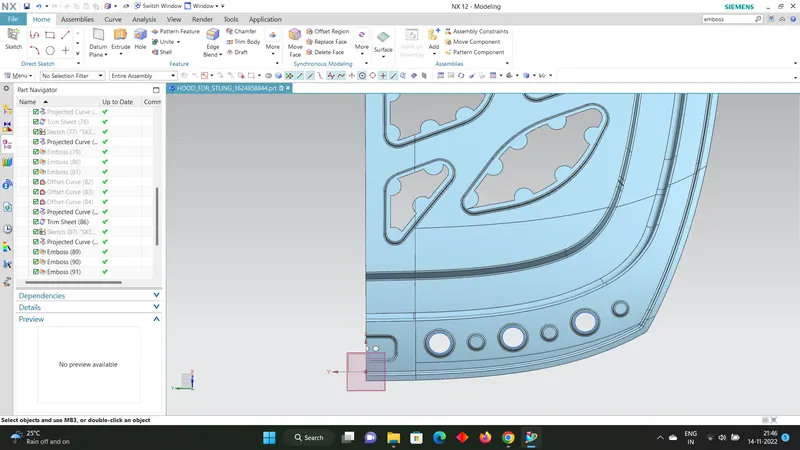
Hinge reinforcement.
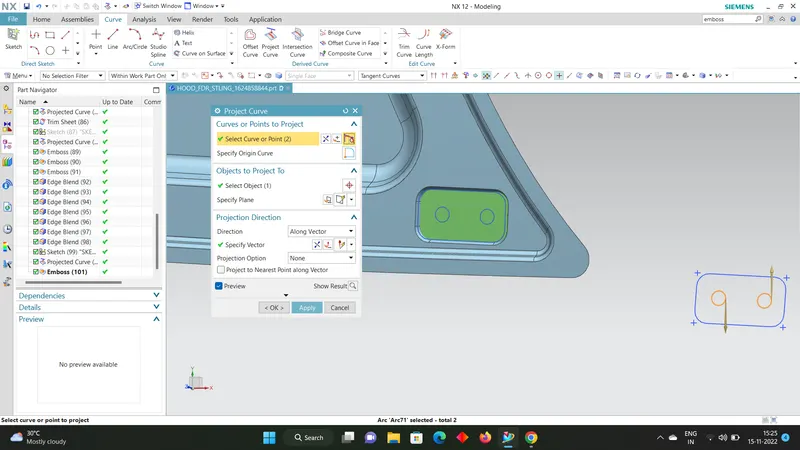
Holes around the inner panel are created for strength and weight reduction.
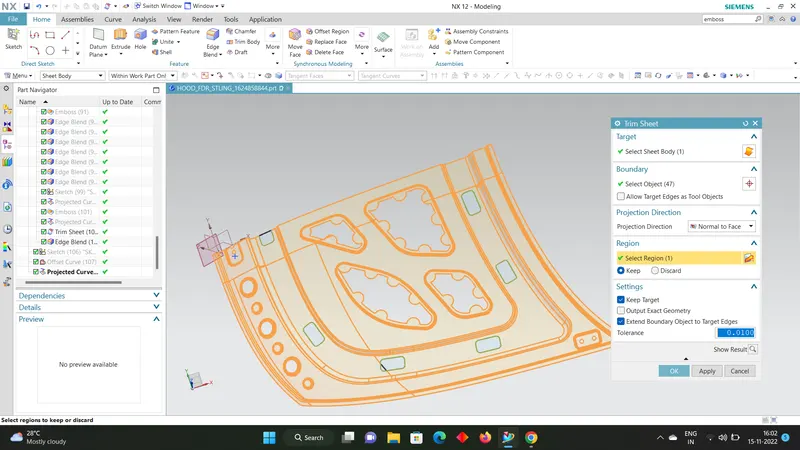
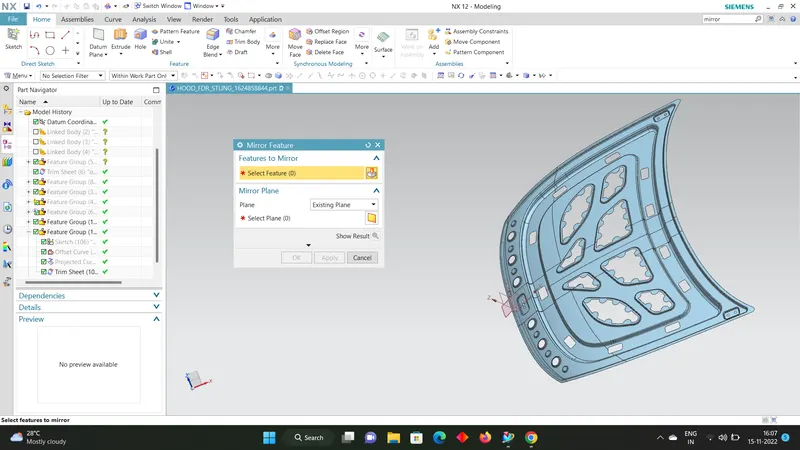
The mirror feature is performed to replicate the other half.
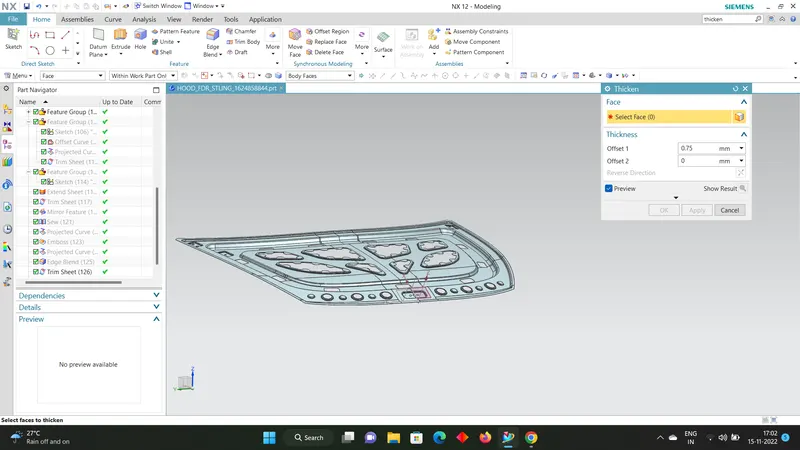
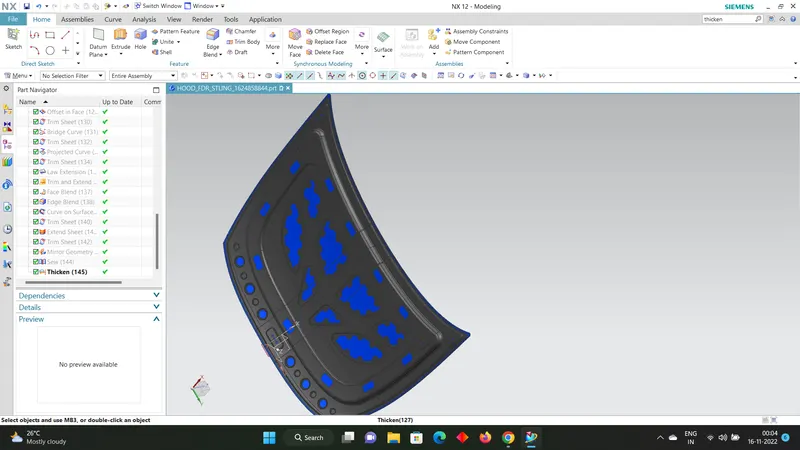
Thickening is performed on the inner panel to 0.75mm
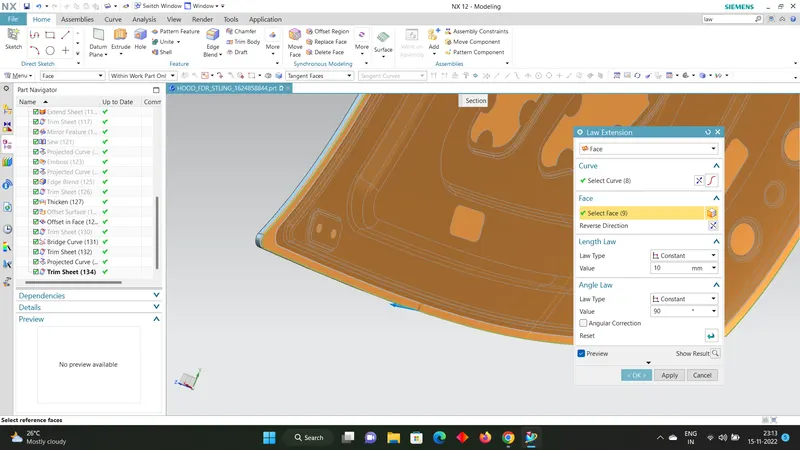
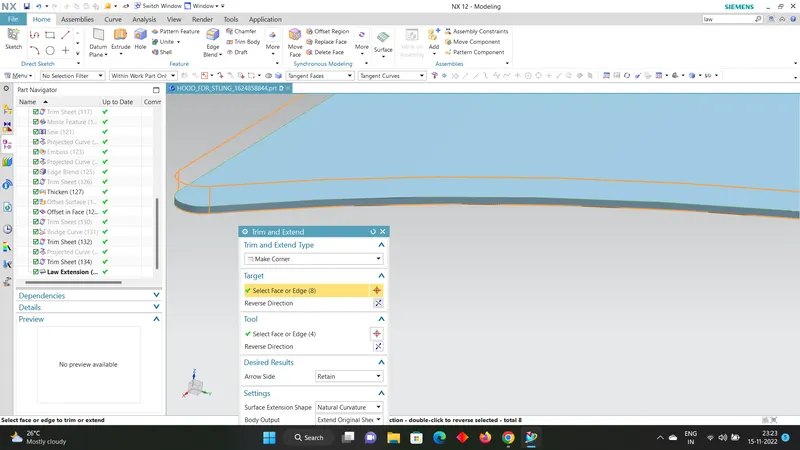
Law extension followed by trim and extend to perform hemming.
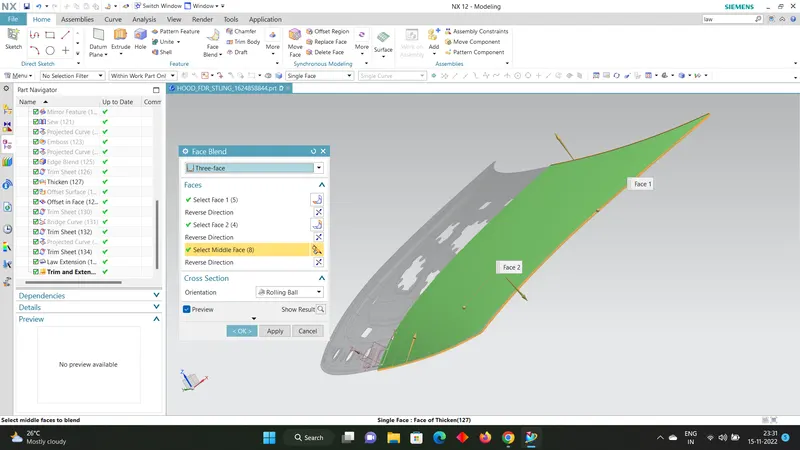
Three-face face blending on the hem surface.
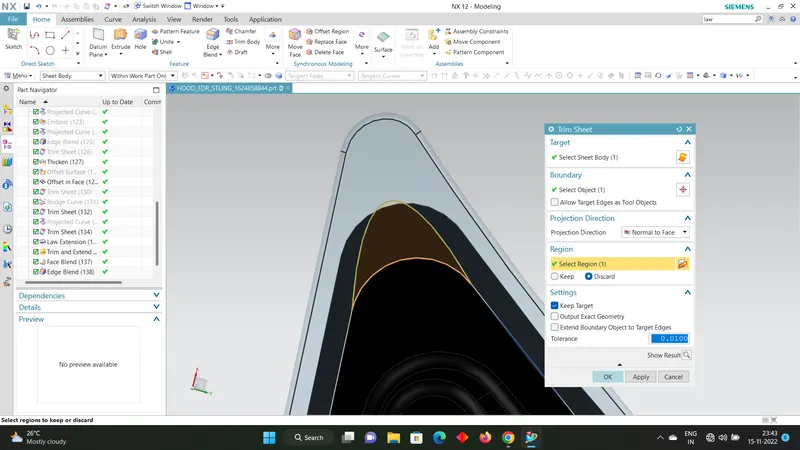
Hem edge correction.
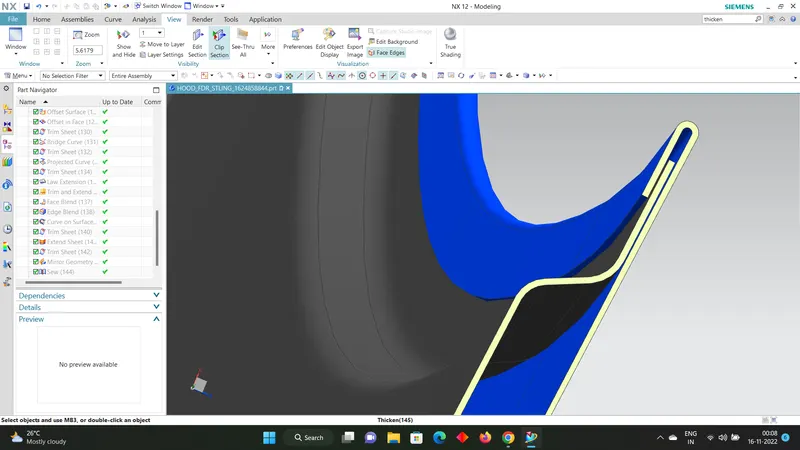
Hem examined in cross-section.
The complete model of both inner panel and outer panel after hemming.
Examining the section Modulus.
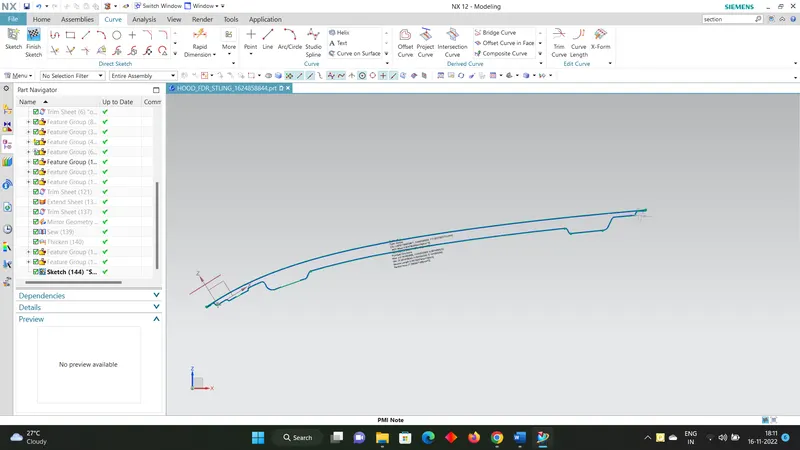
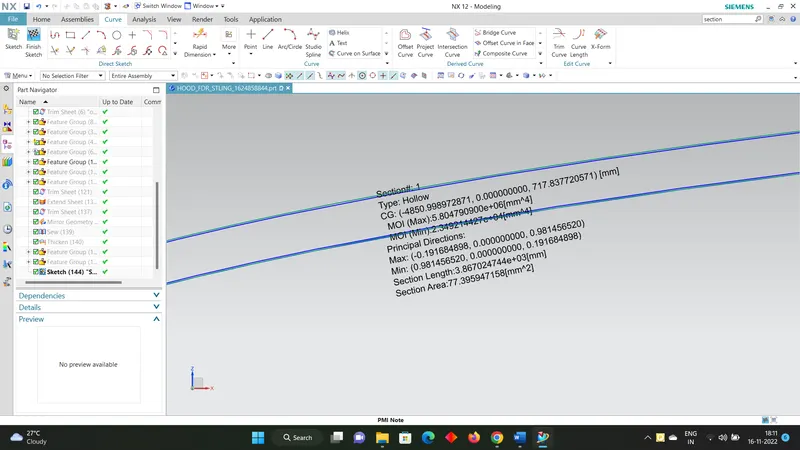
Result: The hood is designed successfully using the given parameters and section modulus analyzed.