Project 1 - Design Enterprise Security Model
Project 1- Design Enterprise Security Model
Purpose of Project:
-
Introduction detail about the task and include the bank security infrastructure.
-
Express the details of security model were using for bank infrastructure.
-
Express the real-time scenario online banking and background working security boundary.
-
List the checklist for security model design at both customer and bank authorities.
Introduction:
Designing an enterprise security model involves creating a comprehensive and robust framework to protect an organization's information assets, networks, systems, and users from security threats and vulnerabilities. The security model should be designed based on the organization's specific requirements, risk tolerance, and industry regulations, and should take into consideration the latest best practices and technologies in the field of cybersecurity.
The enterprise security model typically consists of multiple layers of security controls that work together to create a defense-in-depth approach. Each layer of security provides a different level of protection and helps to mitigate various types of security risks.
About Task:
In this project need to design the security model for bank sector infrastructure which customer to enjoy its banking services online with a facility to access its banking website on the internet. All the devices in the model need to hardening every week and keep report the device along from their mechanism and maintenance
What is Enterprise security?
Answer: Enterprise security refers to the measures, strategies, and practices implemented by an organization to protect its information technology (IT) assets, data, and systems from unauthorized access, data breaches, cyber-attacks, and other security threats. It encompasses a broad range of security controls, policies, technologies, and best practices that are designed to ensure the confidentiality, integrity, and availability of an organization's information and IT resources.
What is Security Model?
Answer: A security model, also known as a security architecture or security framework, is a structured approach or design that outlines how an organization's security measures are implemented and integrated to protect its IT assets and data. It serves as a blueprint for designing, implementing, and managing an organization's security posture.
Block Diagram of Bank security Model:
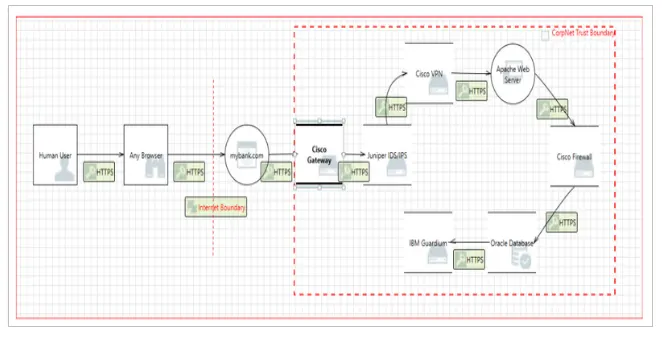
Fig 1:
About Hardware and infrastructure were used in the bank security model
In this bank security model here use some device were protection, privacy, monitoring, data storage, safe-guard the transaction and some operations include in this security model. In this security model there is some lists of devices were included they are,
-
Cisco Gateway.
-
Juniper IDS/IPS.
-
Cisco VPN.
-
Apache2 Web Application Server.
-
Cisco Firewall.
-
Oracle Database.
-
IBM Guardium.
A). Cisco Gateway:
A Cisco gateway is a networking device produced by Cisco Systems that acts as an interface between different networks. It facilitates the transmission and receipt of data between networks, such as connecting legacy analogue or digital telephony systems to IP-based communication networks for Voice over IP (VoIP) communication. Cisco gateways are widely used in enterprise networks, service provider networks, and data centres for seamless network connectivity and communication.
B). Juniper IDS/IPS:
Juniper IDS/IPS refers to Intrusion Detection System (IDS) and Intrusion Prevention System (IPS) solutions offered by Juniper Networks, a leading provider of networking and cybersecurity solutions. IDS and IPS are security technologies used to detect and prevent unauthorized or malicious activities in computer networks.
-
Intrusion Detection System (IDS): An IDS is a security solution that monitors network traffic for signs of potential security breaches or suspicious activities. It analyses network traffic and compares it against known patterns of attack or abnormal behaviour to identify potential security incidents. IDS solutions can operate in either passive or inline mode. In passive mode, IDS only monitors traffic and generates alerts, while in inline mode, IDS can actively block or prevent suspicious traffic from entering the network.
-
Intrusion Prevention System (IPS): An IPS is a security solution that goes beyond IDS by not only detecting potential security incidents but also taking active measures to prevent them. IPS solutions can automatically block or drop suspicious traffic, reset connections, or apply other security policies to prevent malicious activities from reaching their intended targets. IPS can operate in inline mode and actively block or prevent malicious traffic from entering the network, providing an additional layer of security compared to IDS.
Juniper offers various IDS/IPS solutions as part of its security product portfolio, including Juniper Secure Intrusion Detection and Prevention System (IDP) and Juniper Advanced Threat Prevention (ATP). These solutions provide advanced threat detection and prevention capabilities, including signature-based detection, anomaly-based detection, behavior-based detection, and advanced threat intelligence, to help organizations detect and prevent known and unknown threats in their networks.
Juniper IDS/IPS solutions are typically deployed in enterprise networks, data centers, service provider networks, and other critical network environments to protect against a wide range of cyber threats, such as malware, viruses, intrusions, and other malicious activities. They are typically managed and configured by network security professionals with expertise in Juniper networking technologies and cybersecurity best practices.
C). Cisco VPN:
Cisco VPN (Virtual Private Network) is a networking technology that provides secure remote access to private networks over the public internet. It allows authorized users to establish a secure connection to a private network, such as a corporate network or a data centre, from remote locations. Cisco VPN solutions offer encrypted communication and authentication mechanisms to protect the confidentiality, integrity, and availability of data transmitted over the internet. They provide secure access to network resources, such as applications, data, and services, while ensuring that data is protected from unauthorized access and interception.
D). Apache2 Web Application Server:
Apache2 is a widely used open-source web server software that provides the infrastructure for hosting and serving web applications. It is one of the most popular web servers in the world, known for its stability, scalability, and flexibility. Apache2 can host dynamic web applications written in various programming languages, such as PHP, Python, and Ruby, and it supports a wide range of web protocols, including HTTP, HTTPS, and WebSocket. Apache2 also provides advanced features for load balancing, caching, and security, making it a popular choice for hosting web applications in both small and large-scale environments.
E). Cisco Firewall:
A Cisco Firewall is a network security device that acts as a barrier between internal and external networks, filtering incoming and outgoing network traffic based on predefined security policies. It helps protect networks from unauthorized access, data breaches, and other security threats. Cisco Firewalls use various security techniques, such as stateful packet inspection, application-level filtering, virtual private network (VPN) support, and intrusion prevention, to enforce security policies and ensure that only authorized traffic is allowed to pass through. Cisco Firewalls are commonly used in enterprise networks, data centers, and service provider networks to provide network security and protect against a wide range of cyber threats.
F). Oracle Database:
Oracle Database is a popular relational database management system (RDBMS) developed by Oracle Corporation. It is widely used in enterprise environments to store, manage, and retrieve structured data for business applications. Oracle Database supports various data models, including relational, object-relational, and XML, and it provides advanced features for data security, scalability, and performance, such as data encryption, backup and recovery, partitioning, and query optimization. Oracle Database is known for its robustness, scalability, and high availability, making it a popular choice for large-scale and mission-critical databases in organizations across different industries.
G ). IBM Guardium:
IBM Guardium is a comprehensive data security platform that provides real-time monitoring, analysis, and protection of sensitive data across enterprise data environments, including databases, data warehouses, big data platforms, and file systems. IBM Guardium helps organizations identify and protect sensitive data from unauthorized access, data breaches, and insider threats. It offers features such as database activity monitoring, data classification, vulnerability assessment, and real-time alerting to detect and prevent data security incidents. IBM Guardium also provides data masking, encryption, and tokenization capabilities to help organizations protect data at rest, in motion, and in use, ensuring the confidentiality, integrity, and availability of sensitive information.
Real-time Scenario Or Procedures of Security Model for Online Banking:
In every online transaction or financial information through online banking process there is some security protocols were followed by the bank to secure database and other financial works of the customer those who access the online banking in any device and browser.
There is step by step protocol were bank followed in security model,
When user uses their device login into online banking account with biometric like fingerprint, User ID, Pin or Password. Then following steps are taken inside that model according to the hardware na infrastructure used in the above security model.
Step 1: Inside the security model boundary the Cisco Gateway is used as bridge to connect the several devices while process the secure transaction. After the authentication is finish then the gateway is processing the request in secure manner to database in bank. The Connected devices with Cisco gateway are VPN, IPS/IDS, Web-server, firewall, database, etc. to secure network of online bank transaction.
Step 2: The Juniper IPS/IDS where monitor activities while user access the online banking. It is used to analysis ID and Password with account details of responsible user while access transaction. If any malicious activity is happened it’s tried detect the activity and block unknown access.
Step 3: After Juniper IPS/IDS is approve the authentication and authorization traffic then Cisco VPN is used to encrypt those public messages as private code is process when the web-server application is identifying the message to transaction in the bank network. The Encryption is protecting message transaction in between end-to-end device where include in security model
Step 4: The apache2 web-server application is receive the encrypted message from VPN where analysis user (costumer) needs like banking transaction and finical information. The web-server is decrypting the user needs and transfer request from VPN because the message gets decrypt in web-server to identify the user needs
Step 5: The Cisco Firewall is getting the authentication access from Cisco Gateway, it is used to identify the inside and outside traffic from online banking security network. The firewall analysis the authentication and authorization data of user check and block any unknown person or malicious threat is takes place to steal the finical information of particular costumer who access the banking at online sector.
Step 6: The Oracle Database receive the transaction message from firewall analysis the traffic inside and outside the network. The user (costumer) allows to access to database check finical information and transaction in online banking due to secure policies in security model.
Step 7: The IBM Guardium is handled overall security policies inside the security model on online banking. reducing the risk of malicious attacks. Banks can also use it to create a secure environment for customers to access their accounts and perform other banking activities.
Security-Checklist for Online Banking Security Model
Security-Checklist on Bank Security Side as in Security Model:
-
Security Policies and Procedures: Establish clear security policies and procedures for all staff members, including access to sensitive information, data storage, and password protection.
-
Regularly test systems: Test systems regularly to ensure that they are secure and up-to-date.
-
Maintain Policies: Follow the regular policies from the government side approval for security concerns.
-
Use encryption: Encrypt data to protect sensitive information.
-
Implement anti-virus and malware protection: Install and regularly update anti-virus and malware protection software.
-
Monitor systems for threats: Monitor systems for any potential threats and take appropriate action
-
Regular Update the Patches of components: The Security components where keep check at regular up-to-date. Because of avoid the bugs in later version of components.
-
Monitor security logs: Monitor security logs for suspicious activity and take appropriate action.
-
Establish access control: Create policies and procedures to control physical and logical access to systems, networks, and bank data.
-
Firewalls and Intrusion Prevention: Establish and enforce policies to protect the bank from unauthorized access from the Internet.
-
Educate employees: Educate employees on security protocols and procedures.
-
Implement disaster recovery plans: Develop disaster recovery plans to ensure that the bank can quickly recover from any cyber-attacks or natural disasters.
-
Establish a data backup and recovery plan: Create a data backup and recovery plan to ensure that any lost data can be recovered in a timely manner.
-
Implement authentication protocols: Establish authentication protocols for users to access systems, networks, and data
Security-Checklist of online banking from User side:
-
Make sure the operating system and web browser are up-to-date.
-
Do not share the password or account details with anyone like known and unknown persons or in any other unknown websites.
-
Use two-factor authentication for additional security.
-
Never click on links or open attachments in emails purporting to be from your bank.
-
Use a secure connection when conducting online banking.
-
Use a secure device like computer or mobile to access online banking.
-
Set up a strong password according to password guidance for the online banking account.
-
Always log out after using online banking.
-
Install a reliable antivirus and anti-malware software.
-
Monitor the account regularly and look out for suspicious activity.