Project 1 - Design and Develop an IOT-based Wireless Wearable Health Monitoring System
“StarBerry” is a wireless health monitoring product designed and developed for monitoring physiological parameters such as ECG, Heart Rate, Pulse Oximetry, Blood Pressure and Body Temperature.
Primarily, IoT which is Internet of things, refers to the network of physical objects embedded with software, sensors and network connectivity that enables these objects to collect and exchange of data. So, by the application of IoT on health monitoring, a system is developed that is called as Wearable health monitoring system. WHMS are systems that are automated and can continuously monitor patients along with real-time data analysis. It uses an array of sensors that are integrated into the clothing or may be attached on skin surface that can detect, monitor, analyse and transmit signals to remote monitoring and analysis station wirelessly.
Specification of physiological parameters are demonstrated in the table:
|
S.No. |
Physiological Parameters |
Specifications |
|
1. |
Electrocardiography (ECG) |
Frequency: 0.5Hz-100 Hz Amplitude: 0.25-1mV |
|
2. |
Heart Rate (HR) |
40-220 beats per minute |
|
3. |
Respiratory rate (RR) |
2-50 breaths per min Frequency: 0.05Hz-10Hz |
|
4. |
Temperature |
2.7V to 3.3V |
|
5. |
Blood Pressure |
−2.5 mV/V (−7.5–2.5 mV/V) |
Sensors used should be selected under following criteria:
- Should be high in accuracy.
- Can maintain Stability under abnormal condition.
- Withstand any environmental condition.
- Able to detect smallest increment.
- With low power consumption.
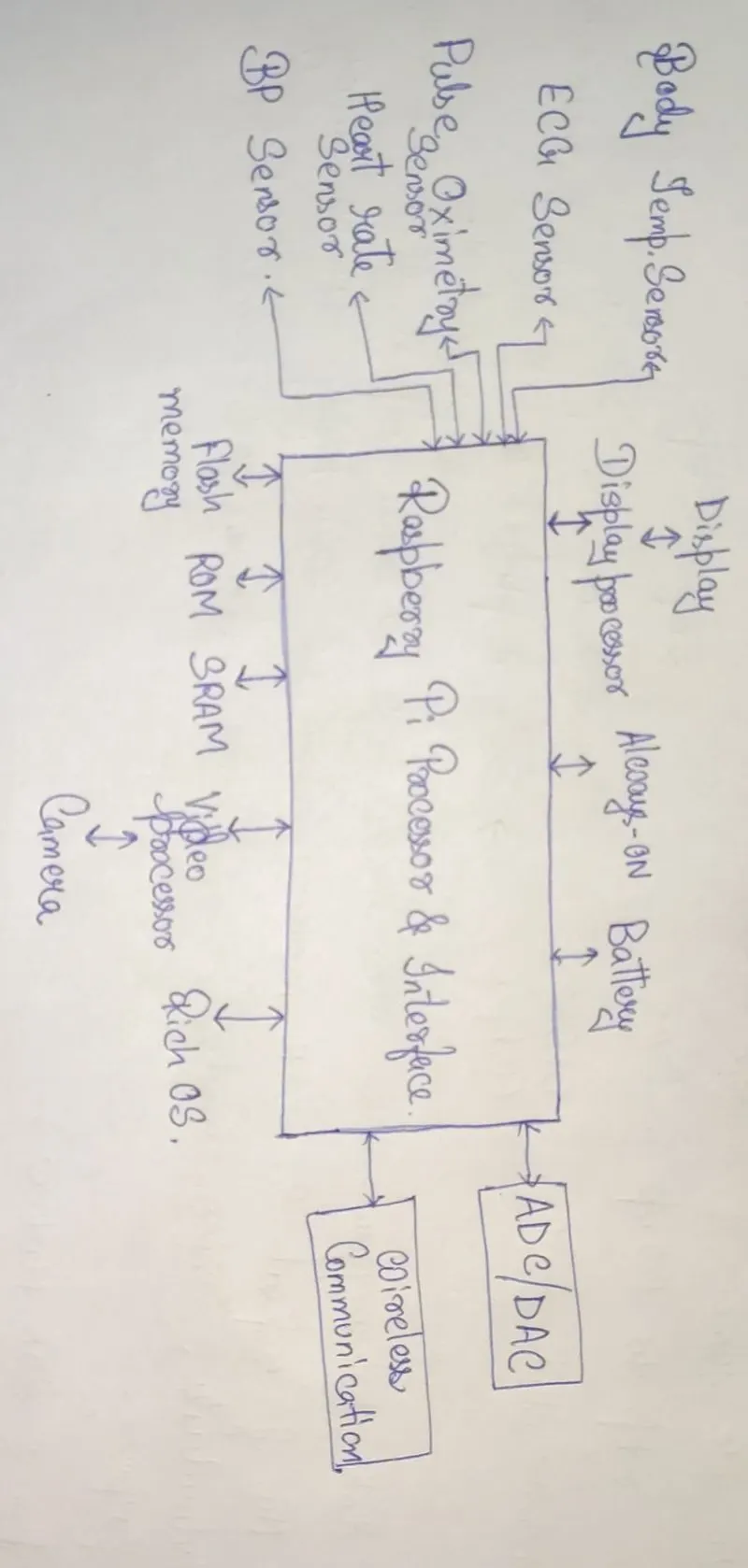 Fig.-1
Amazingly illuminated in the above block diagram the IoT devices to acquire the physiological parameters, it uses Raspberry Pi processor with the connected features like–
- Many sensors are attached to the processor such as ECG sensor, Heart Rate sensor, Pulse Oximetry, Blood Pressure and Body Temperature sensor.
- For the processing of each sensor, it has battery and its charger to regulate voltage and all, along with ADC/DAC, ROM, Flash memory, video processor with rich Operating System.
- It runs its own application and uses wireless connection to transfer and receive data
- Made in such a way that it should be always-on with instant wake and should be working in background along with low power consumption.
- Capability to recognize gesture/voice overall hands-free.
- Also display processor to display and store the data.
Basic architecture of WHMS is shown in steps:
STEP 1- Wearable sensors- integrated into the clothing or skin surface that acquire vital signals.
STEP 2- Wearable hardware- it acquires and processes the signals and wirelessly transmission of data is done.
STEP 3- Remote monitoring station- the station receives and display the data and algorithms would be followed to classify the health status. Consequently, feedback will be given to the wearer and monitoring hospital or to the doctor.
*Fig-2 in attachment*
Requirements to design the wireless wearable health monitoring system are -
- Smart textiles and textile sensors- the foremost thing is to design textiles with advance features which are to be made breathable, waterproof, windproof and accordingly respond to the changing needs of the wearer. It can sense, react according to the vicinity conditions. These textiles will be integrated with microelectronics called as wearable electronics, controlled by switches that are sewn into the products using printing or embroidery method. *Fig-3 and 4*
- Conducting fibres – as textile materials have low electric conductivity so conductive components (metal or carbon) have to been added in production stages in the products using techniques like sewing, coating or stitching.
- Dry electrode- as it doesn’t use gel which has great benefits as no skin rashes with user comfortable based material with no issue in degradation of signal quality. Electrode used is Ag-AgCl (Silver-Silver Chloride).
- Network connection- now to connect everything, connection is required that can be fulfilled by multipoint communication, for which star topology is much used.
As in star topology, all devices connected via hub/switch are centrally controlled with maximum connection of seven devices and well it’s not too expensive.*Fig-5*
Not to mention, there is Mesh topology, in which workstations are interconnected to each other with no fear of failure. Although its not much preferred due to its high cost.
-
Network communication- Now a wireless network communication is setup via few essential components
- Machine-to-machine (M2M)- also known as internet of devices, are networking of the machines or the devices. Needed for monitoring, remote control and data exchange. Made up of elements such as sensors for collecting and monitor data, embedded hardware, actuators, communication and analysis.*Fig-6*
- RFID (Radio frequency identification) or internet of objects – RFID tag is a facilitate, cheap, disposable smart card with microchip for storing ID and antenna for communication. It automatically identifies and tracks tags attached to the objects.*Fig-7*
- WSN (Wireless sensor network)/ Internet of sensors – wirelessly connected network sensors to monitor and collect the physical conditions of the vicinity.*Fig-8*
- Mainly it will follow OSI model layer-
- Physical layer
- Data link layer
- Network layer
- Transport layer
- Session layer
- Presentation layer
- Application layer.
(Sender goes from 7th to 1st whereas receiver goes from 1st to 7th layer)*Fig-9*
- Many network devices are introduced to develop a WHMS:
- NIC (Network Interface card)- This card mainly connect the host devices to network media and can be supported in the motherboard itself.
- Routers- as it is highly intelligent device with the functions of all other devices (switches, bridges, hubs and repeaters). It helps in regeneration of signals, with multiple connectivity, amazing data management and majorly used in WANs.
- Gateway- It allows flow of data from one network to another.
- Firewall- For network security and access rights, it prevents cyber-attacks.*Fig-10*
- And also, Raspberry Pi, a small-board computer with python programming language is used. *Fig-11*
- Now, the client-server architecture model is designed which is a computing model where server will host, deliver and manages all the resources and services requested by the client. It is done in star topology.*Fig-12*
- And Client-server conversation is done using Sockets programming by means of API’S.*Fig-13*
- Along with that, TCP/IP protocols are followed. TCP is Transmission control protocol that is very connection-oriented protocol. It gives guaranteed delivery of data along with maintaining the sequence. A point-to-point connection with high connection setup.*Fig-14*
IP address is an address that identified the source and destination of system in network. However, IP address of source and destination needs to be known. It follows 32-bit with four numbers separated by dot format, numbers can be from 0 to 255.
E.g.- 10.2.110.255.
As a better version of IP address had to developed due to storage issue, IPv4 is upgraded to IPv6, which permit 128-bit addressing.
-
Google cloud platform be used for cloud computing service. With the features of data management or data manipulation, simplifies data storage, computing as well as configuration with combination of either hardware and software based resources and services. It provide public cloud infrastructure and platform as a service. Along with cloud storage and database as a service. Fog computing is done to bring the cloud closer to the devices for rapid data processing.*attached*
- Well, through Google drive, data are stored and retrieved whenever needed. Its very convenient method.
-
By the help of a specific application known as Wireless body area network (WBAN), monitoring the health of the person is done.
-
WBAN consists of: (depicted in the diagram)
- Sensor nodes- It sense and collects the data. As sensor will pick the lot other disturbing noise too, signal need to be conditioned so signal conditioning is used.
Signal conditioning is a device that alters raw analog signals and modify it to provide essential signals for data acquisition.
Then the conditioned signal will be digitized and minimally processed. Along with this, other requirements like battery requirements, cooling requirements of the sensors would be taken care.
There is a DAC (Digital-analog converter) which is an actuator.
Sensor also will be having GPS, which will help to know the exact location.
Now through the wireless transceiver, data will be transmitted to the coordinator and as wireless transceiver is bi-directional, it can send and receive data.
- Sink node or coordinator- Data will be received through wireless transceiver. Data is in digital so processing can be done.
- Remote monitoring station- In this, there is application services/ software will be running on the computer. It can store and display data and functions will be carried accordingly.*Fig-15*
-
Lets take a scenario in which a patient has sudden increase in pulse and electric activity of heart,
- The ECG sensor placed on the patient’s body will sense the change and would send the collected data through wireless transceiver.
- As wireless transceiver is bi-directional, it will receive data and processing can be done in microcontroller/ coordinator.
- Further, the processed data will be transferred via wireless transceiver to the remote monitoring station to analyse and display the data. The data will also be transmitted to all the other devices connected through the sensor.
- Accordingly, steps would be taken to cure the patient. Either command would be given to the sensor and if needed ambulance/doctor will be send for the patient. This is how treatment will be done.*Fig-16*
-
Similarly , if there are 10 users connected to the hospital, data of all the users will be collected to the database via wireless transceiver and will be sent to the hospital for analysing and further processes.
There can be chances of false alarm, so various terms been developed for devices to be familiar with. Like if its normal blood pressure level- “GREEN”, and if little rise/low in blood pressure level- “ORANGE”, well if there will be severe condition then “RED”.*Fig-17*
-
So at time of emergency situation, device is programmed to send “RED” to the connected users, on clicking it the whole result will be shown. Accordingly, treatment will be configured.
While to run this whole system, security of the system is very essential. For that Firewall is introduced for network security and also for rights to access into the system. No outsider can access the data which prevents the system from any cyber-attacks.
To run the system, batteries are needed and for working of the battery, energy is required, so Mechanical energy harvesting method is followed where mechanical energy is converted into electrical energy with the help of either by vibration like mechanical stress, pressure or strain from the surface of the sensor or by the movement of fluid.
As for disease diagnosis, it’s necessary to visit hospital as well as stay in hospital throughout the treatment resulting in high cost. So, healthcare industry has shown rapid growth and technological advancement has now made possible the monitoring and diagnosis of various diseases using miniaturized devices. Following are few applications of IoT in healthcare-
- Efficient disease diagnosis
- Personal care for paediatric and elderly patients
- Health ad fitness management
- Reduced healthcare cost
- Improved patient safety.
Procedure needs to be followed to launch the product in the market are-
- First of all, we should know the purpose of making the product and it should meet the users’ needs along with its value in the market.
- Test the product before introducing to the market.
- We need to create strict guidelines for the brand.
- Validation is required.
- Secure the essential details.
- Keep an idea of the competitors.
- Grow network and spread awareness about the product.
- Patent and copyright certification are must.
- And look for the right time to launch the product.