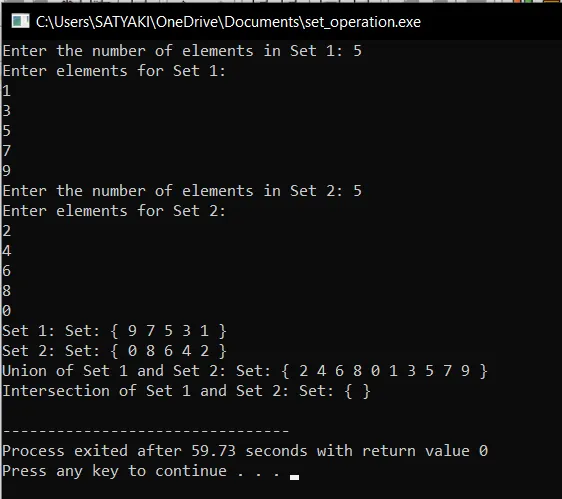
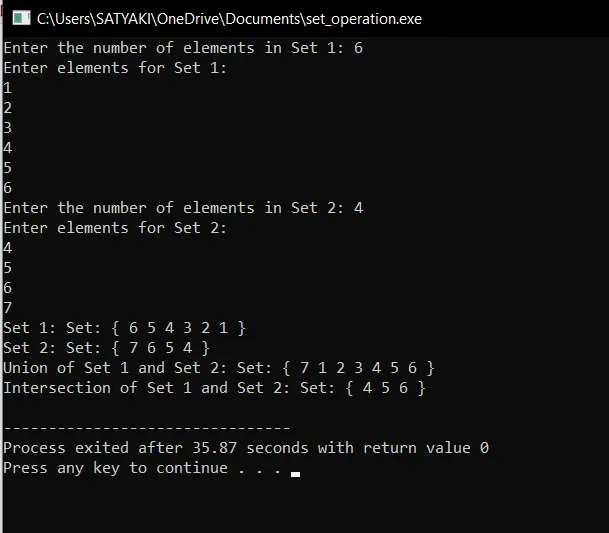
Project 1 - Creation of user defined data type to implement the user interfaces for working with ‘Set’ (Mathematical Set theory) using Linked List
Program Code:
#include <stdio.h>
#include <stdlib.h>
#include <stdbool.h>
struct Node {
int data;
struct Node* next;
};
struct Set {
struct Node* head;
};
// Function to create a new node
struct Node* createNode(int data) {
struct Node* newNode = (struct Node*)malloc(sizeof(struct Node));
if (newNode == NULL) {
printf("Memory allocation failed\n");
exit(EXIT_FAILURE);
}
newNode->data = data;
newNode->next = NULL;
return newNode;
}
// Function to create an empty set
struct Set* createSet() {
struct Set* newSet = (struct Set*)malloc(sizeof(struct Set));
if (newSet == NULL) {
printf("Memory allocation failed\n");
exit(EXIT_FAILURE);
}
newSet->head = NULL;
return newSet;
}
// Function to check if the set is empty
bool isEmpty(struct Set* set) {
return set->head == NULL;
}
// Function to check if an element exists in the set
bool contains(struct Set* set, int element) {
struct Node* current = set->head;
while (current != NULL) {
if (current->data == element) {
return true;
}
current = current->next;
}
return false;
}
// Function to add an element to the set
void addElement(struct Set* set, int element) {
if (!contains(set, element)) {
struct Node* newNode = createNode(element);
newNode->next = set->head;
set->head = newNode;
}
}
// Function to perform union of two sets
struct Set* unionSet(struct Set* set1, struct Set* set2) {
struct Set* resultSet = createSet();
struct Node* current = set1->head;
while (current != NULL) {
addElement(resultSet, current->data);
current = current->next;
}
current = set2->head;
while (current != NULL) {
addElement(resultSet, current->data);
current = current->next;
}
return resultSet;
}
// Function to perform intersection of two sets
struct Set* intersectionSet(struct Set* set1, struct Set* set2) {
struct Set* resultSet = createSet();
struct Node* current = set1->head;
while (current != NULL) {
if (contains(set2, current->data)) {
addElement(resultSet, current->data);
}
current = current->next;
}
return resultSet;
}
// Function to display the elements of a set
void display(struct Set* set) {
struct Node* current = set->head;
printf("Set: { ");
while (current != NULL) {
printf("%d ", current->data);
current = current->next;
}
printf("}\n");
}
// Function to free the memory allocated for the set
void freeSet(struct Set* set) {
struct Node* current = set->head;
while (current != NULL) {
struct Node* temp = current;
current = current->next;
free(temp);
}
free(set);
}
// Main function
int main() {
struct Set* set1 = createSet();
struct Set* set2 = createSet();
int element, size1, size2;
printf("Enter the number of elements in Set 1: ");
scanf("%d", &size1);
printf("Enter elements for Set 1:\n");
for (int i = 0; i < size1; ++i) {
scanf("%d", &element);
addElement(set1, element);
}
printf("Enter the number of elements in Set 2: ");
scanf("%d", &size2);
printf("Enter elements for Set 2:\n");
for (int i = 0; i < size2; ++i) {
scanf("%d", &element);
addElement(set2, element);
}
printf("Set 1: ");
display(set1);
printf("Set 2: ");
display(set2);
struct Set* unionResult = unionSet(set1, set2);
printf("Union of Set 1 and Set 2: ");
display(unionResult);
struct Set* intersectionResult = intersectionSet(set1, set2);
printf("Intersection of Set 1 and Set 2: ");
display(intersectionResult);
// Free allocated memory
freeSet(set1);
freeSet(set2);
freeSet(unionResult);
freeSet(intersectionResult);
return 0;
}
Output: