Project 1_Comparative study of different storey buildings for Seismic forces
Answer 1)
Factors influencing the dynamic characteristics of a building:-
i. Buildings oscillate during earthquake shaking, the oscillation causes inertia force to be induced in the building.
ii. The intensity & duration of oscillation & the amount of inertia force induced in a building, called their dynamic characteristics in addition to the characteristics of earthquake shaking itself.
iii. The important dynamic characteristics of buildings are modes of oscillation & damping. A mode of oscillation of a building is defined by associated natural period & deformation Shape in which it oscillates.
iv. Every building has a number of natural frequencies at which it offers minimum resistance to shaking induced by external effects & internal effects.
v. Each of these natural frequencies & the associated deformation shape of building constitute a natural moe of oscillation.
vi. The mode of oscillation with the smallest natural frequency is called fundamental mode, the associated natural period (T1) is called the fundamental natural period.
vii. Regular buildings held at their base from translation in three directions, have two fundamental translational natural periods, Tx1 & Ty1, associated with its horizontal translational oscillation along X & Y direction, respectively & one fundamental rotational natural period To, associated with its rotation about an axis parallel to Z axis.
Answer 2)
Factors influencing the natural period of a building:-
i. Structural Elements Sizes
ii. Material Properties
Grade of Concrete
Grade of Reinforcement
iii. Loading
Dead load
Live load
Answer 3)
Factors influencing the mode shape of Oscillations:-
i. Mode shape of oscillation associated with a natural period of a building is the deformed shape of the building when shaken at the natural period
ii. For a building there are infinite numbers of natural period. But, in the matematical modelling of building, usually the building is discretizes into a no. of elements.
iii. The junction of these elements are called nodes each node is free to translate in all the three cartesian direction & rotate about the three cartesian axes. Hence, if the no. of nodes of discretization is N, then there would be 6N modes of oscillation & associated with these are 6N natural periods & mode shapes of Oscillation.
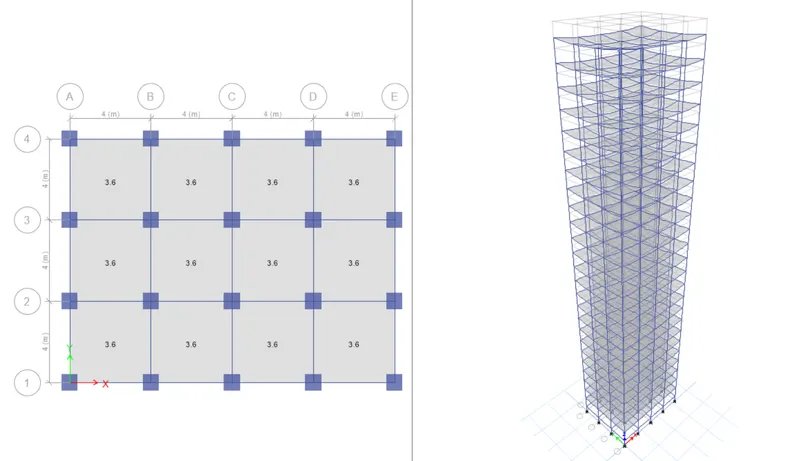
AIM:- To create the RCC model of 2Storey, 5Storey, 10Storey & 25Storey buildings, or compare its natural period of time.
Procedure:-
i. Open new file in Etaab software
Create grids in X & Y direction
No. of storey
ii. Define Material properties which are going to used in RCC building
Grade of Concrete
Rebar
iii. Define the sections
Frame section such as Columns & Beams
Shell section such as Slab
iv. Load Combination
Live load
Dead load
Seismic load
Super dead load such as wall load
v. After define of load combination & material properties
Create columns at intersection point between the grid, take command as quick columns draw.
Create beams at grid line, take command as quick beam draw
vi. Selection of Columns, Beams & Slab to provide load in each elements
Bldg A
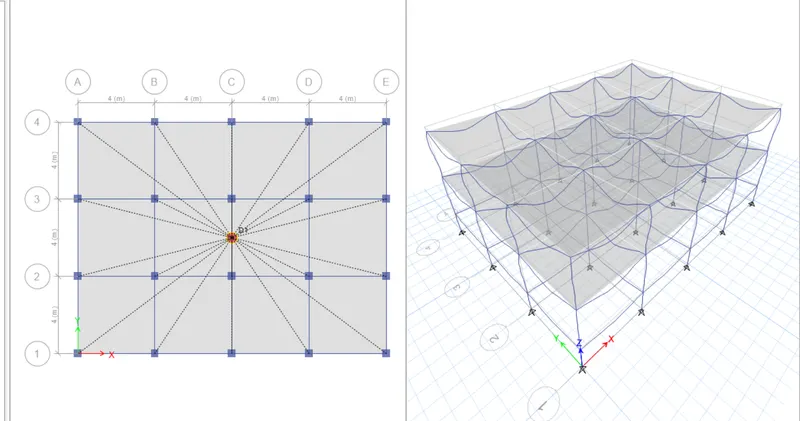
Bldg B
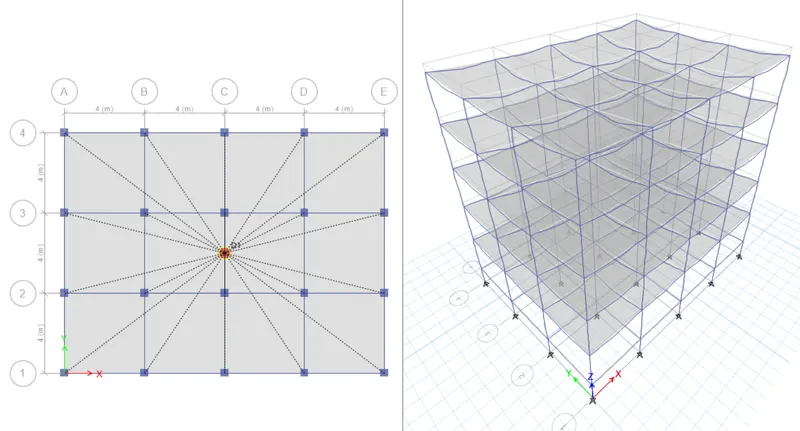
Bldg C
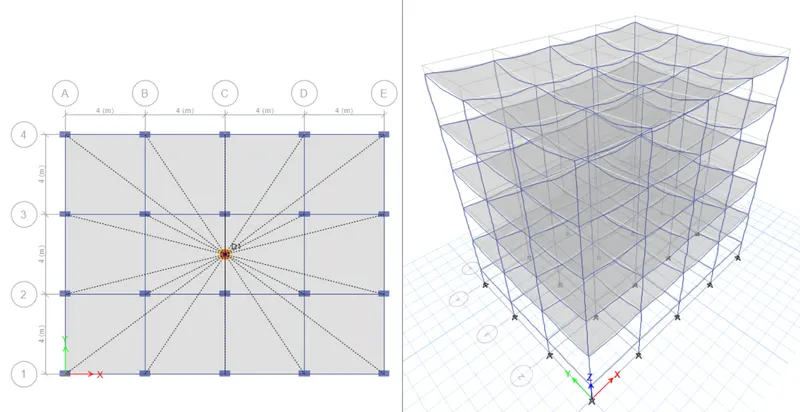
Bldg D
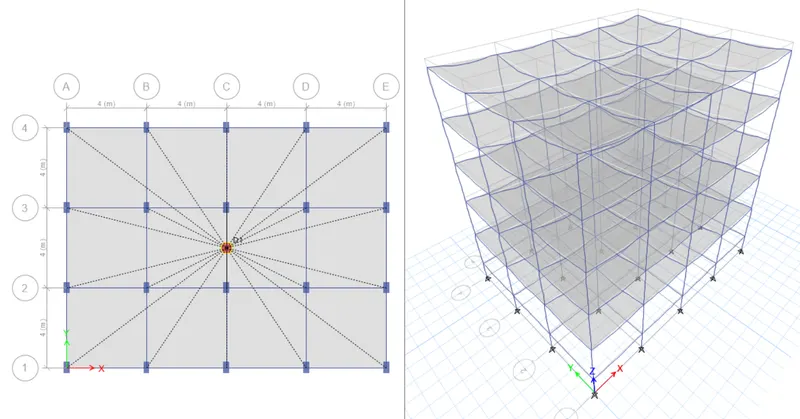
Bldg E
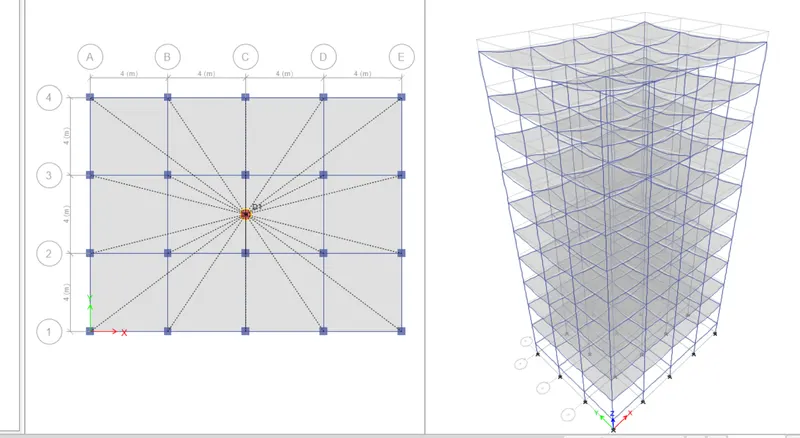
Bldg F
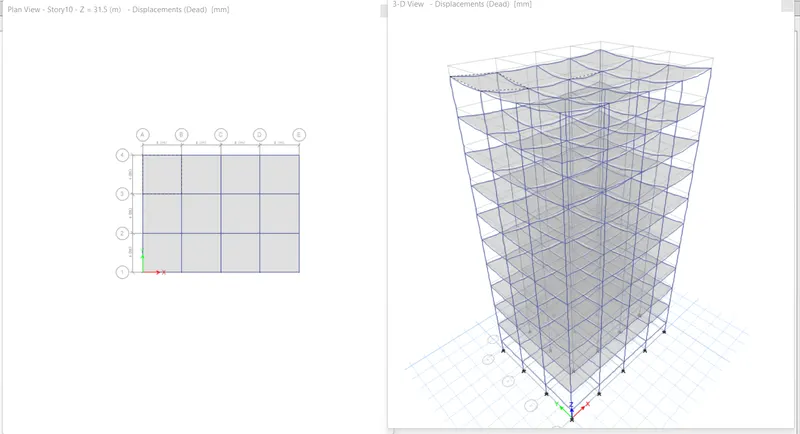
Bldg G
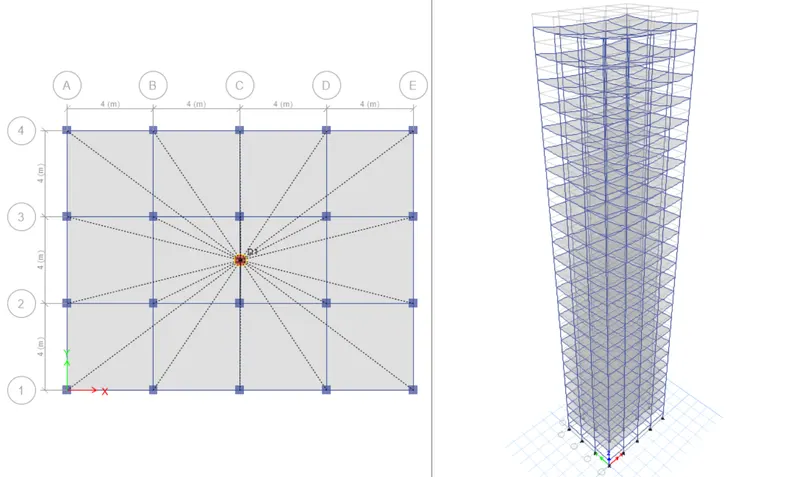
Bldg H
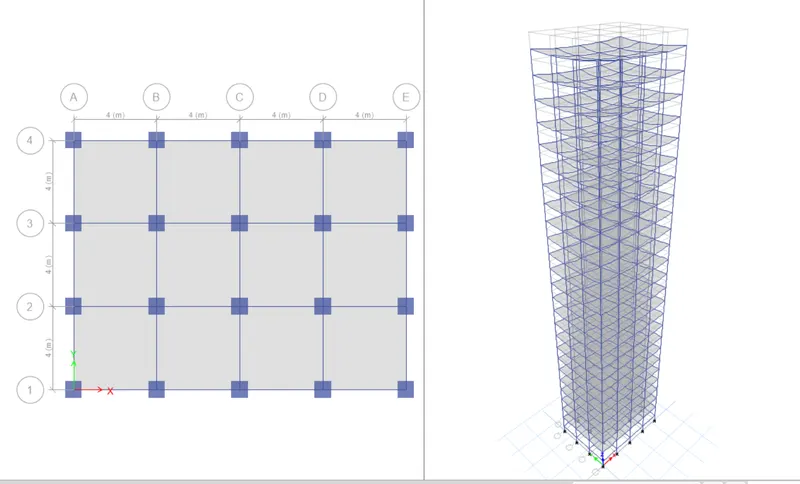
Bldg J
Bldg K
Result:- 1) Effect of Stiffness on time period
Bldg:- E F G H
Sec:- 1.7 1.735 4.167 4.416
Conclusion:- Varying Columns size is more stable than uniform columns size
Uniform Column size increases the time period
2) Effect of time period on uniform loading
Bldg:- G H K
Sec:- 4.167 4.416 4.435
Conclusion:- Since there is uniform increase in live load are provided thus, there is no any significant change in time period.
If we provide non-uniform loading in stories then it will directly effect in the time period.
Since, mass is directly proportional to the lateral forces & thus, it will increses the time period.
3) Effect of building height
Bldg:- A B F H
Sec:- 0.5 1.036 1.735 4.416
Conclusion:- Since, building height is directly proportional to the time period.
If building height is increases then it will increases the time period.
4) Effect of Columns Orientation
Bldg:- B C D
Sec:- 1.036 1.145 1.12
Conclusion:- Since, in bldg D the displacement is more than 2.35 in EQx, & less than 2 in EQy direction.
5) Effect of flexural stiffness of structural elements on mode shapes
Bldg B:- Time period
Flexural Siffness:- zero 2.627Sec
Flexural Stiffness:- Regular 1.036Sec
Effect of axial stiffness of vertical members on mode shapes
Bldg H:- Time period
Axial cross section area:- zero 5.996Sec
Axial cross section area:- Regular 4.416Sec
Effect of degree of fixty at column base
Bldg H:- Time period
Fixed base:- 0.941Sec
Pinned(Regular):- 1.036Sec