Project 1
SOLUTION :
Batteries achieve the desired operating voltage by connecting several cells in series; each cell adds its voltage potential to derive at the total terminal voltage. Parallel connection attains higher capacity by adding up the total ampere-hour (Ah). Some packs may consist of a combination of series and parallel connections.
Most battery chemistries lend themselves to series and parallel connection. It is important to use the same battery type with equal voltage and capacity (Ah).A weaker cell would cause an imbalance.
Series Connection
Portable equipment needing higher voltages use battery packs with two or more cells connected in series. Figure shows a battery pack with four 3.6V Li-ion cells in series, also known as 4S, to produce 14.4V nominal. In comparison, a six-cell lead acid string with 2V/cell will generate 12V, and four alkaline with 1.5V/cell will give 6V.

Series connection of four cells (4s)[1]
Adding cells in a string increases the voltage; the capacity remains the same.
Parallel Connection
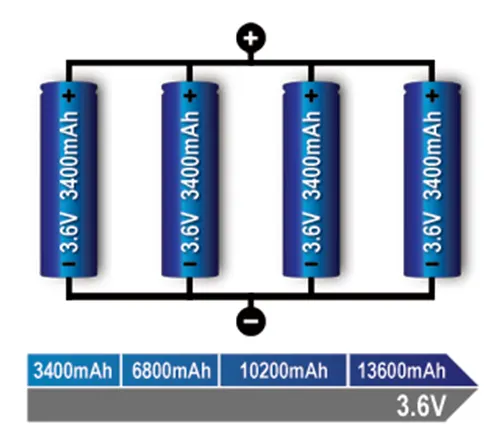
If higher currents are needed and larger cells are not available or do not fit the design constraint, one or more cells can be connected in parallel. Most battery chemistries allow parallel configurations with little side effect. Figure 4 illustrates four cells connected in parallel in a P4 arrangement. The nominal voltage of the illustrated pack remains at 3.60V, but the capacity (Ah) and runtime are increased fourfold.
Figure 4: Parallel connection of four cells (4p)[1]
We know for number of cells in series = Rated motor voltage/nominal cell voltage
We know for number of cells in parallel = Motor continuous current/nominal cell capacity
Given parameters are,
Nominal voltage is 3.6V
Motor voltage is 120V
Power is 150KW
Nominal cell capacity is 3500mAh
For number of cells in series = Rated motor voltage/nominal cell voltage
= 120V/3.6V
= 33.33
For number of cells in parallel = Motor continuous current/nominal cell capacity
We need to find out motor continuous current so by OHM’s LAW,
P = V*I
I = P/V
I = 150KW/120V
I = 1.25Kamps
For number of cells in parallel = Motor continuous current/nominal cell capacity
= 1.25Kamps/3.5
= 0.357K
= 357
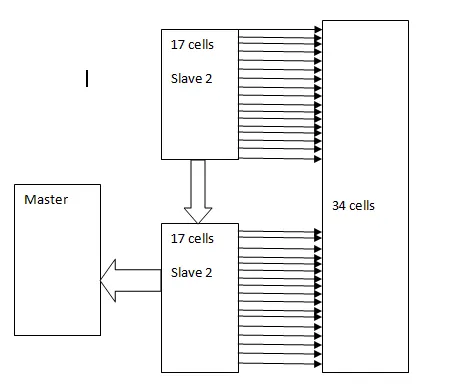
Here we using Master Slave topology because, which uses less than 18 number of cells in series.
. Generally this topology used in 4 Wheeler and in large energy storage system.
. All these AFE's called Slaves, all these slaves are going to be communicate through microcontroller to sent all the data's what it is fetching.
. Pros are * Scalability is possible and
* Can read more than 18 cells
. Cons are * Implementation is difficult when compared to centralised
* Limitation number of slaves are connected in series