Project 1
Skill-lync Project 1
Aim: The objective of this assignment is to generate a representative mid-surface for the given component and generate an FE mesh that meets the specified quality criteria.
Procedure: The mesh is generated through the following sequence of steps: -
- The geometry is imported into the ANSA workspace in the following state.
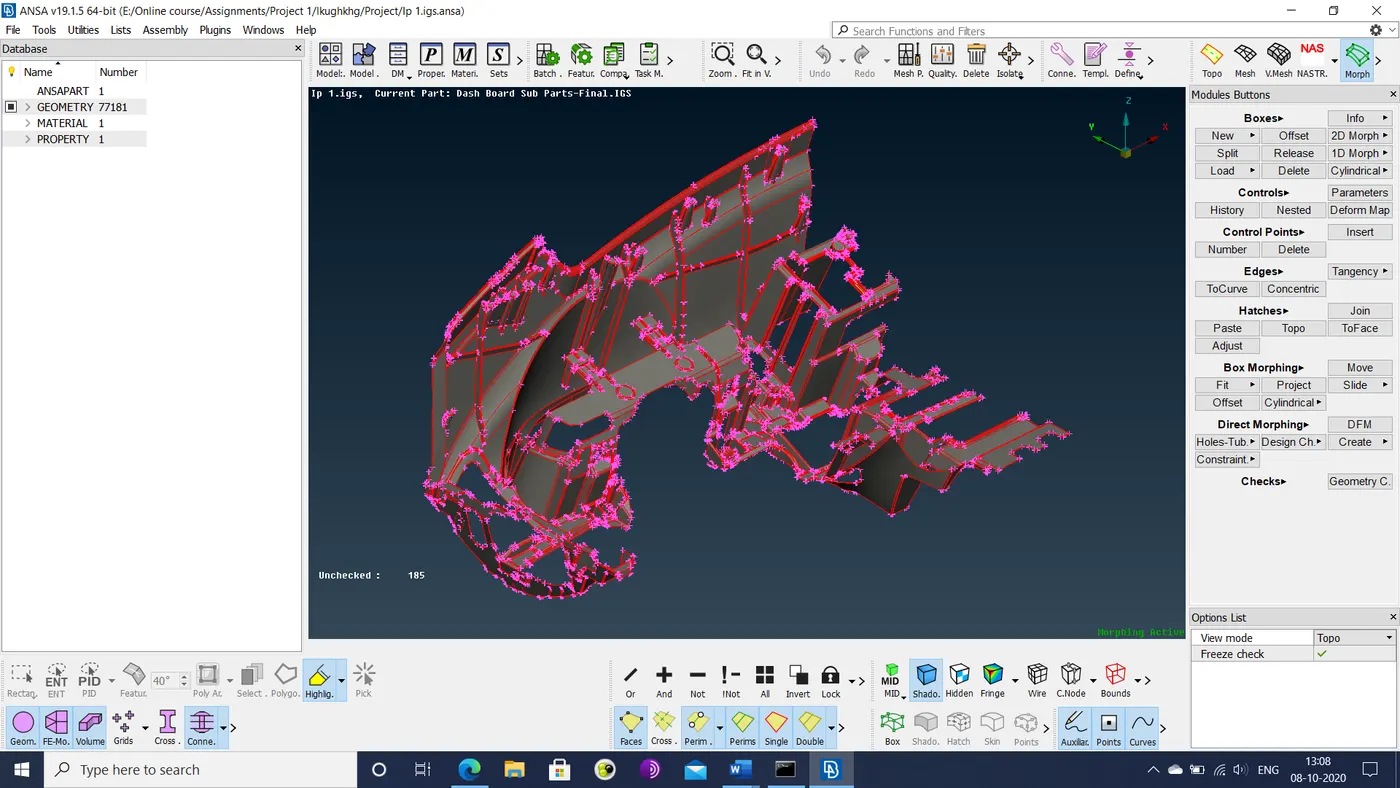
Figure 1: Imported geometry
- The geometry is then fixed using the topo option. The geometry is then checked for remaining errors.
- Some errors could not be fixed either by the topo or auto-fix option. These errors required deleting and recreating entire faces.
- Mid-surface for the geometry is generated via the offset and middle option at appropriate sections. The individual mid-surfaces are assigned their respective thicknesses as part IDs.
- The mid surface for the locating studs are represented as perpendicular planes, as shown below.
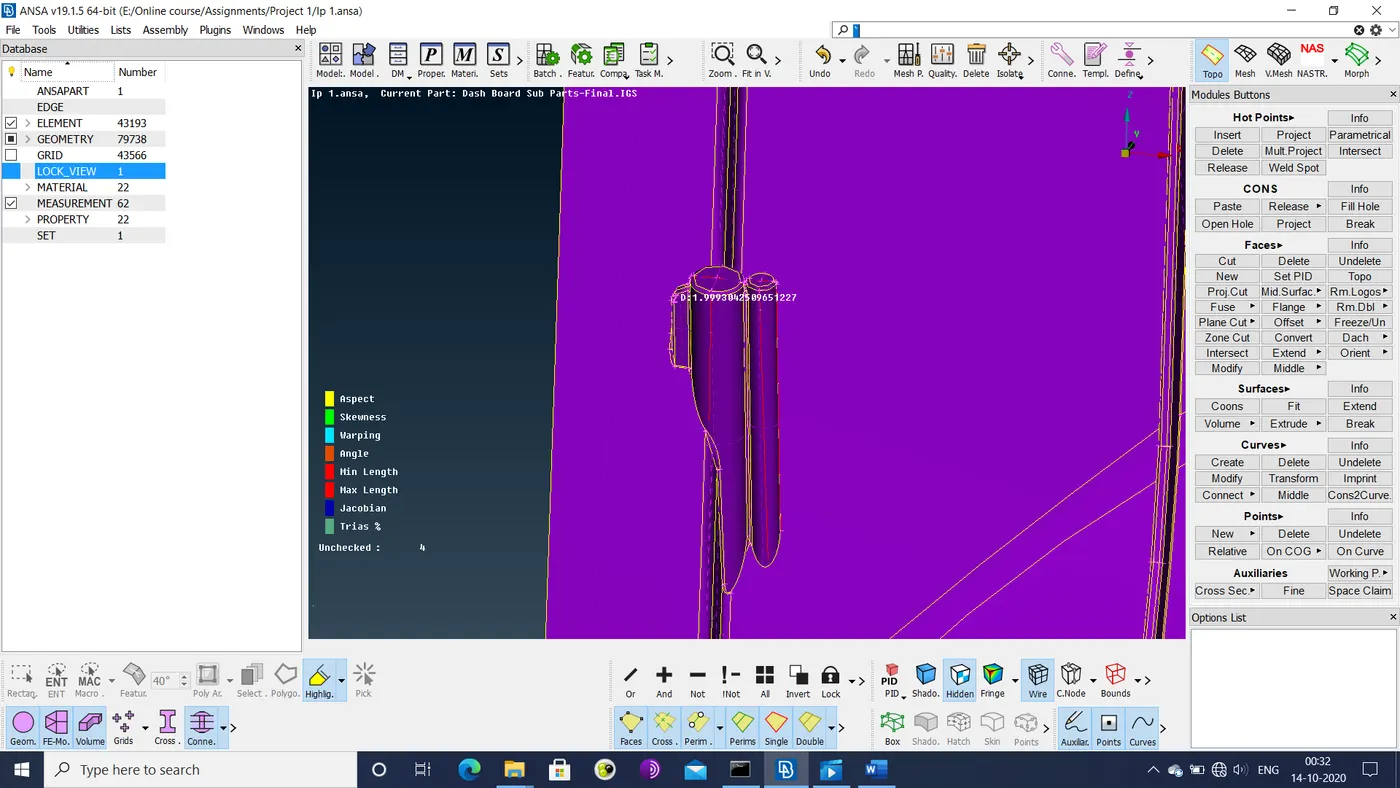
Figure 2: Locating stud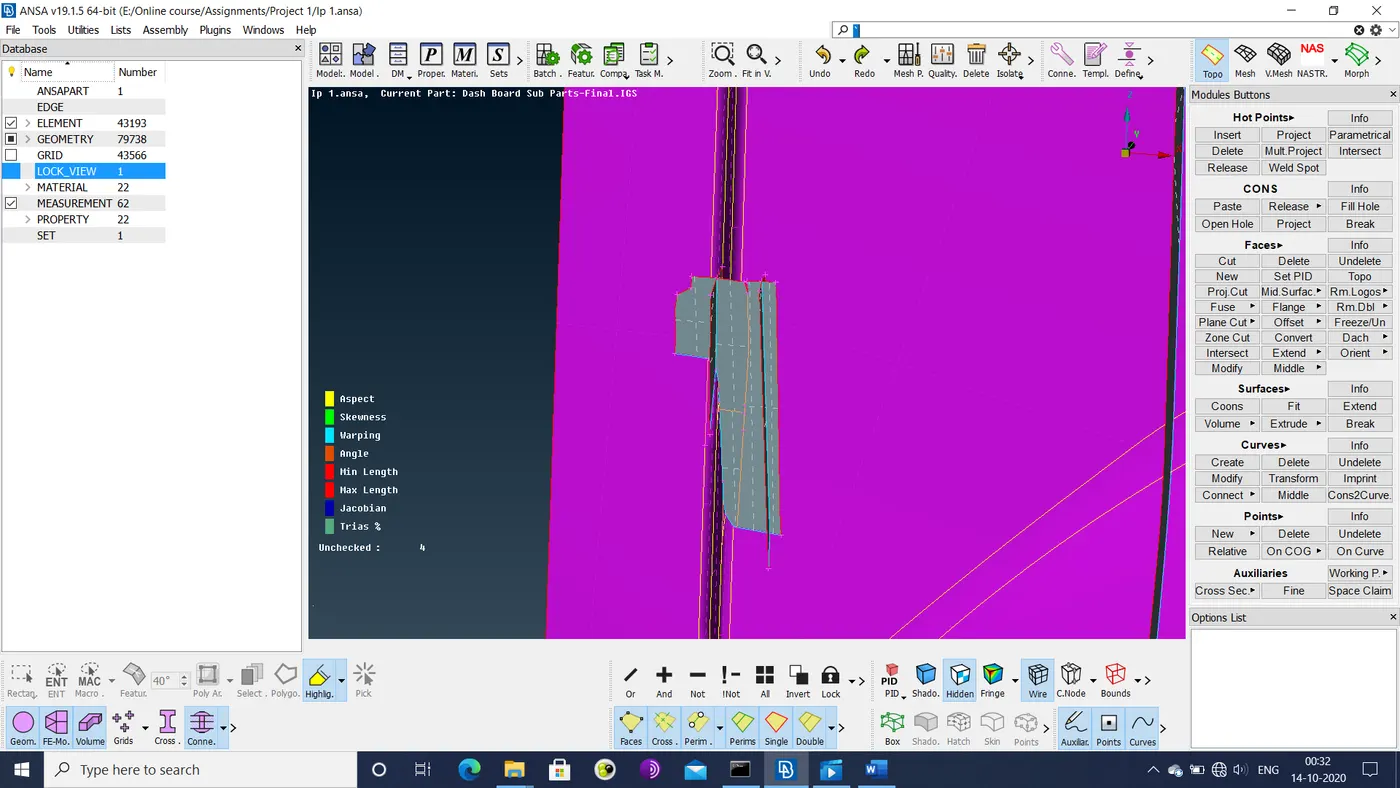
Figure 3: Stud mid surface
- A cylindrical section of the region was represented as a smaller cylinder, as shown below.
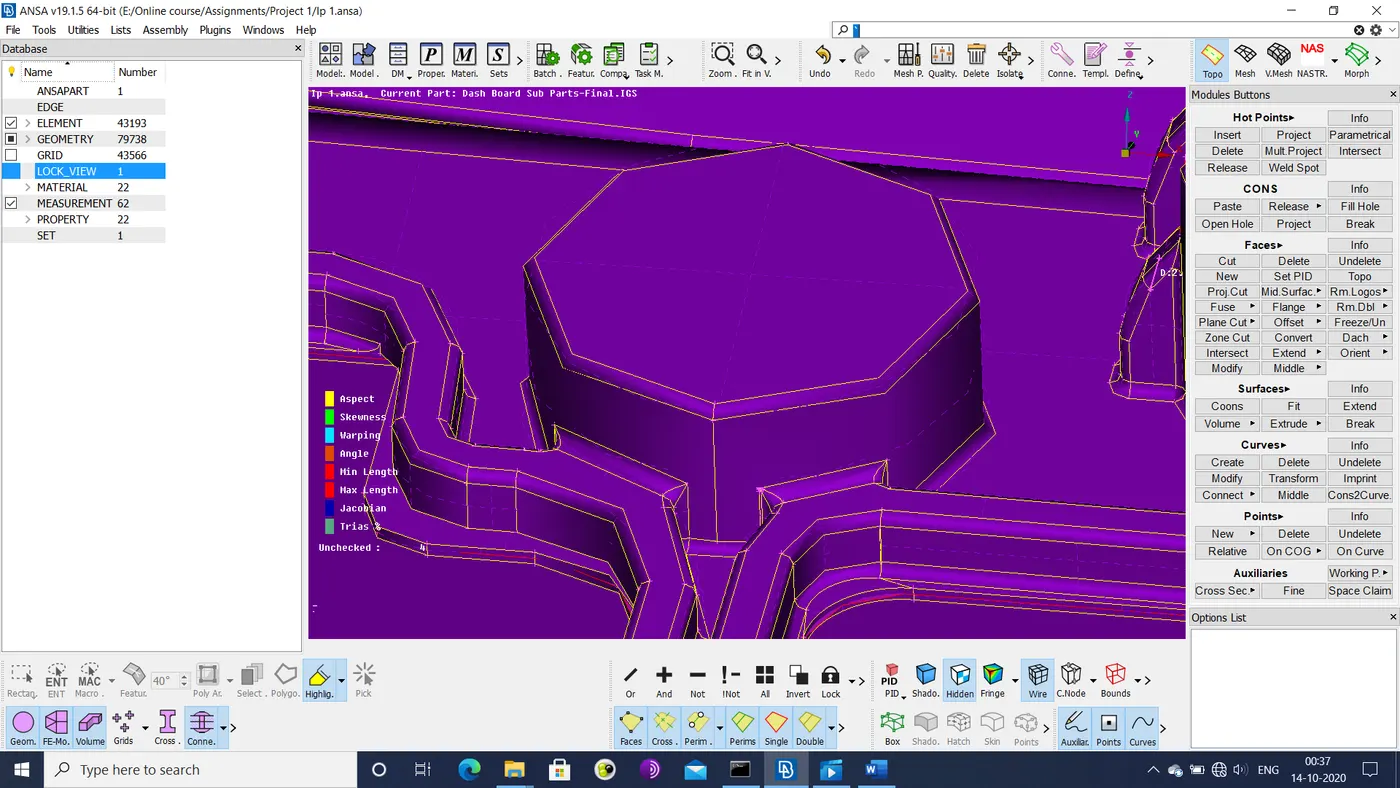
Figure 4: Cylinder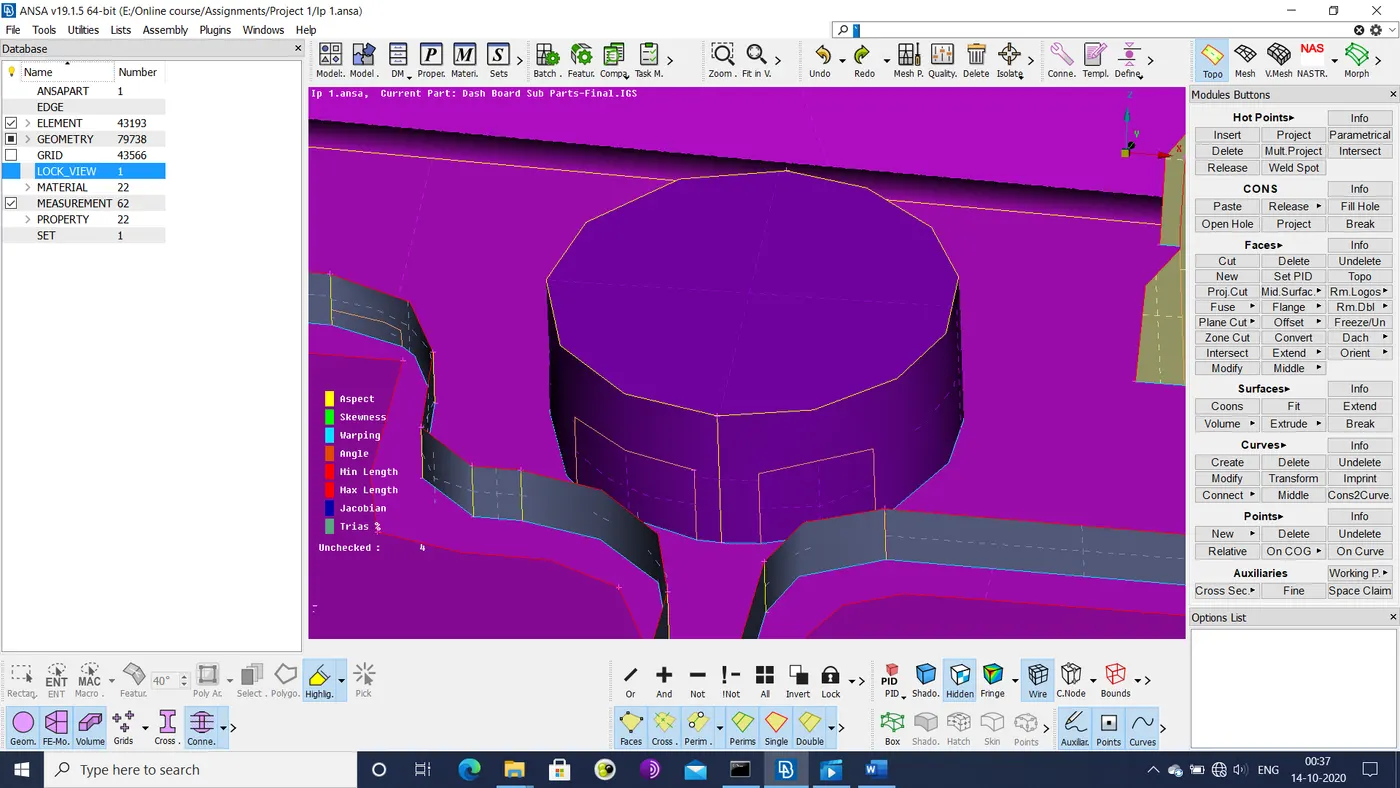
Figure 5: Cylinder mid-surface
- The following mesh quality criteria are set for the component.
|
S.No |
Quality Criteria |
Value |
|
1 |
Target/Average length |
4 |
|
2 |
Minimum Length |
2 |
|
3 |
Maximum Length |
6 |
|
4 |
Aspect |
3 |
|
5 |
Warpage |
15 |
|
6 |
Skewness |
45 |
|
7 |
Jacobian |
0.7 |
|
8 |
Minimum Quad Angle |
45 |
|
9 |
Maximum Quad Angle |
135 |
|
10 |
Minimum Tria Angle |
30 |
|
11 |
Maximum Tria Angle |
120 |
|
10 |
Tria Percentage |
15 |
- The entire mid-surface generated is meshed using the mesh generation>batch>visible option, in order to defeature the mid-surface and generate the appropriate mesh in a single step.
- The mesh is improved in areas failing the quality criteria via reconstruction, quad splitting, smoothing and other options. Mesh flow is improved in other areas by reducing the number of triangular elements.
Learning outcomes: The project has been a test of the understanding of mid-surfaces and mesh generation for the same. These required the use of techniques practiced in previous assignments, with alternative methods in some cases for more efficiency.
- The geometry of the given component was too complex and large to generate the mid-surface and mesh via the mid-surface>casting option. So mid-surface generation took the greatest amount of time, as it had to be done manually for the main body, ribs and locating studs.
- Mesh generation took the shortest amount of time, owing to the batch mesh option that defeatured the geometry as well as generated an appropriate mesh.
- Defeaturing done by the batch mesh option was not the best possible one. However, the overall mesh flow was adequate due to a lack of sections without a mostly rectangular profile. So, manual defeaturing was minimal.
- Many of the elements that failed the quality criteria were located at the ribs and stud locations. As with week 4’s assignment, these elements could not be fixed. This is due to the fact that intersections between planes will inevitably create regions that cannot be defeatured in any manner.
- Any remaining off elements were fixed by splitting these elements (always quads) into triangular elements.
Conclusion: The given component had a representative mid-surface generated and meshed appropriately. The whole assignment was completed using appropriate methods that took the minimal amount of time and with adequate quality.
Google drive link: https://drive.google.com/file/d/1UdMr7JFiHbay5lGXxqfcFlMBrxdmrfoP/view?usp=sharing