Project 1
Solution-
Steps involved in solving the problem
- The
iostreamandfstreamheader files are included for input/output operations.
#include <iostream>
#include <fstream>
using namespace std;
- The
mainfunction is defined, which is the entry point of the program.
int main() {
    // Code goes here
    return 0;
}
- The user is prompted to enter the number of rows and columns for the arrays
commodities,vendors, andresult.
int rows, cols;
cout << "Enter the number of rows and columns: ";
cin >> rows >> cols;
- Memory is dynamically allocated for the arrays using nested loops and
newoperator.
int** commodities = new int*[rows];
for (int i = 0; i < rows; i++) {
    commodities[i] = new int[cols];
}

double** vendors = new double*[rows];
for (int i = 0; i < rows; i++) {
    vendors[i] = new double[cols];
}

double** result = new double*[rows];
for (int i = 0; i < rows; i++) {
    result[i] = new double[cols];
}
- A
do-whileloop is used to display a menu of options for the user to input data, until they choose to exit the program.
int choice;
do {
    cout << "Menu:\n";
    cout << "1. Enter commodities to be purchased\n";
    cout << "2. Enter vendor quotations\n";
    cout << "3. Exit\n";
    cout << "Enter your choice: ";
    cin >> choice;

    switch (choice) {
        case 1:
            // Code to input commodities data
            break;

        case 2:
            // Code to input vendor data
            break;

        case 3:
            // Code to exit program
            break;

        default:
            cout << "Invalid choice. Please try again.\n";
            break;
    }
} while (choice != 3);
- Inside the
do-whileloop, each case statement is left blank for now, as we have not yet implemented the code to input data.
case 1:
    // Code to input commodities data
    break;

case 2:
    // Code to input vendor data
    break;

case 3:
    // Code to exit program
    break;
- If the user chooses to save the data to a file, the
ofstreamclass is used to write the data to a file named "data.txt".
ofstream outfile("data.txt");
if (outfile.is_open()) {
    // Code to write data to file
    outfile.close();
} else {
    cout << "Error: Unable to open file.\n";
}
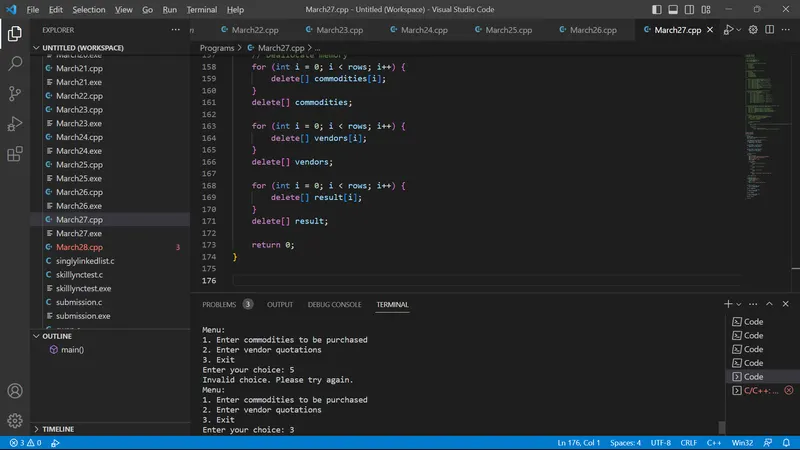
- Memory is deallocated using nested loops and the
deleteoperator.
for (int i = 0; i < rows; i++) {
    delete[] commodities[i];
}
delete[] commodities;

for (int i = 0; i < rows; i++) {
    delete[] vendors[i];
}
delete[] vendors;

for (int i = 0; i < rows; i++) {
    delete[] result[i];
}
delete[] result;
- The
mainfunction returns 0 to indicate successful completion of the program.
return 0;
Overall, this program demonstrates the basics of dynamically allocating memory for multi-dimensional arrays, displaying a menu of options for user input, writing data