Project 1
AIM:
Develop a double-acting actuator model using Simscape Multibody and Simscape components. The mechanical system of the cylinder needs to be built using Simscape Multibody library components / blocks, and the hydraulic system needs to be modelled using Simscape library physical components.
An Actuator:
An Actuator is machanical component of a machine which is responsible for moving or controlling mechanism or system,for example by opening a valve. an actuator requires a control device(controlled by control signal) & source of energy.
Types of Actuators:
1)Electrical actuator
Used in the electric motors such as DC motors,AC motors,Stepper motors and solenoids.
2)Pneumatic actuator
Use compressed air as the driving force.
3)Hydraulic actuator
Use hydraulic fluid to amplify the controlled command signal.
Introduction to Hydraulic Motors:
Hydraulic systems are used to control and transmit power. A pump driven by a prime mover such as an electric motor creates a flow of fluid, in which the pressure, direction and rate of flow are controlled by valves. An actuator is used to convert the energy of fluid back into the mechanical power. The amount of output power developed depends upon the flow rate, the pressure drop across the actuator and its overall
efficiency. Thus, hydraulic actuators are devices used to convert pressure energy of the fluid into mechanical energy.
Depending on the type of actuation, hydraulic actuators are classified as follows:
1. Linear actuator: For linear actuation (hydraulic cylinders).
2. Rotary actuator: For rotary actuation (hydraulic motor).
3. Semi-rotary actuator: For limited angle of actuation (semi-rotary actuator).
Hydraulic linear actuators, as their name implies, provide motion in a straight line. The total movement is a finite amount determined by the construction of the unit. They are usually referred to as cylinders, rams and jacks. All these items are synonymous in general use, although ram is sometimes intended to mean a single-acting cylinder and jack often refers to a cylinder used for lifting. The function of hydraulic cylinder is to convert hydraulic power into linear mechanical force or motion. Hydraulic cylinders extend and retract a piston rod to provide a push or pull force to drive the external load along a straight-line path.
Continuous angular movement is achieved by rotary actuators, more generally known as a hydraulic motor. Semi-rotary actuators are capable of limited angular movements that can be several complete revolutions but 360 degree or less is more usual.
Hydraulic cylinders are of the following types:
- Single-acting cylinders.
- Double-acting cylinders.
- Telescopic cylinders.
- Tandem cylinders.
SINGLE ACTING CYLINDER
• It consist of piston inside a cylindrical housing called as barrel.
• On one end is attached a rod, which can reciprocate.
• At the opposite end, there is a port for the entrance and exit of the oil.
• They produce force only in one direction by hydraulic pressure acting on the piston.
• The return of the spring is not done hydraulically, it is either done by gravity or spring.
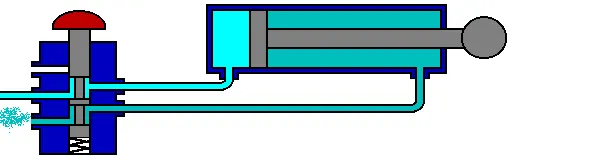
DOUBLE ACTING CYLINDER
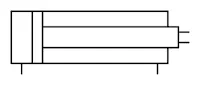
Hydraulic symbol of double acting hydraulic cylinder:
• A double acting cylinder with piston on both sides is a cylinder with a rod extending from both the ends .
• The application involves in a process where work can be done by both the ends of the cylinder, thereby making the cylinder more productive .
• Double rod cylinder can withstand higher side loads because they have an extra bearing on each rod to withstand the loading.
TELESCOPIC CYLINDER
• They generally consist a nest of tubes and operate on the displacement principle.
• The tubes are supported by bearing rings, the innermost set of which have grooves or channels to allow the fluid flow.
• The front bearing assembly on each section includes seals and wiper rings.
• Stop rings limit the movement of each section, thus preventing the separation.
• For a given input flow rate, the speed of operation increases in steps as each successive section reaches the end of its stroke. Similarly, for a specific pressure, the load shifting capacity decreases for each of the successive section.
TANDEM CYLINDER
• A tandem cylinder is used in application where a large amount of force is required to be applied from a small diameter cylinder.
• Pressure is applied to both the pistons, resulting in a increased force because of a large area.
• The only drawback is that this cylinders must be longer than a standard cylinder to achieve an equal speed because the flow must go to both the pistons simultaneously.
Simscape multibody model for Double acting actuator:
Used Simscape Physical Components & Simulink Library Blocks:
world frame
mechanism configuration
solver configuration
translational multibody interface
simulink ps converter
ps simulink converter
ps constant
ps subtract
scope
signal builder
gain
compare to constant
saturation dynamic
constant
transfer function
------------------------------------
rigid transform
prismatic joint
cylindrical solid
extrude solid
--------------------------------------
translational mechanical converter
mechanical translational reference
isothermal liquid properties(IL)
pressure source(IL)
reservoir(IL)
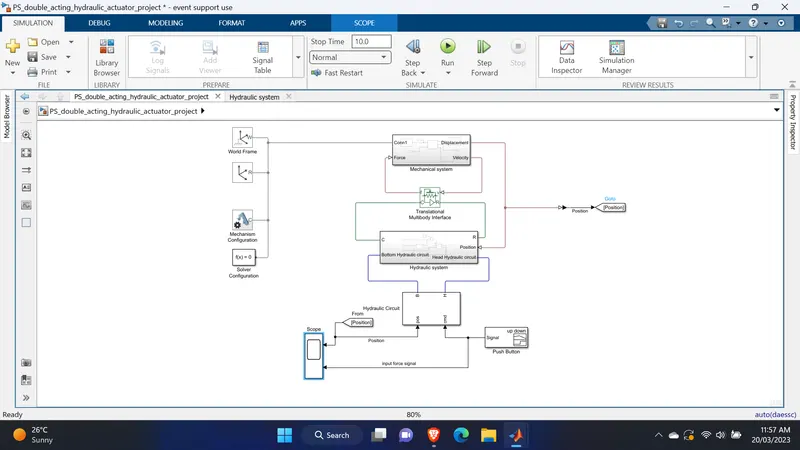
Required Simulink simscape multibody model:
Mechanical subsystem:
Cylinder assembly:
Cylinder base:
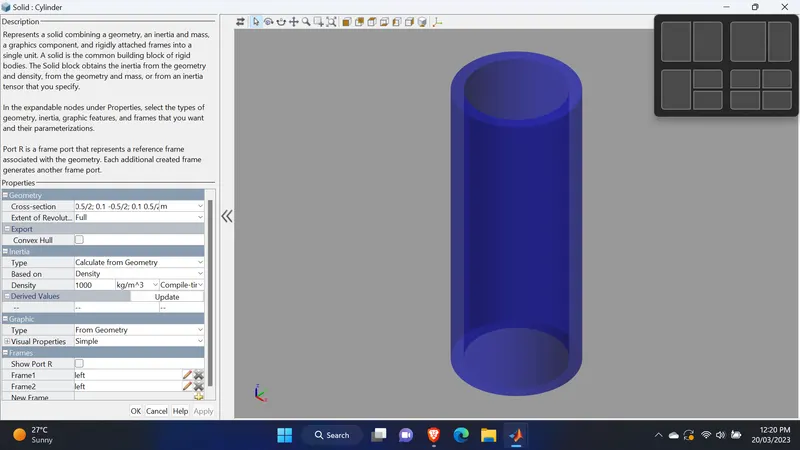
Cylinder barrel:
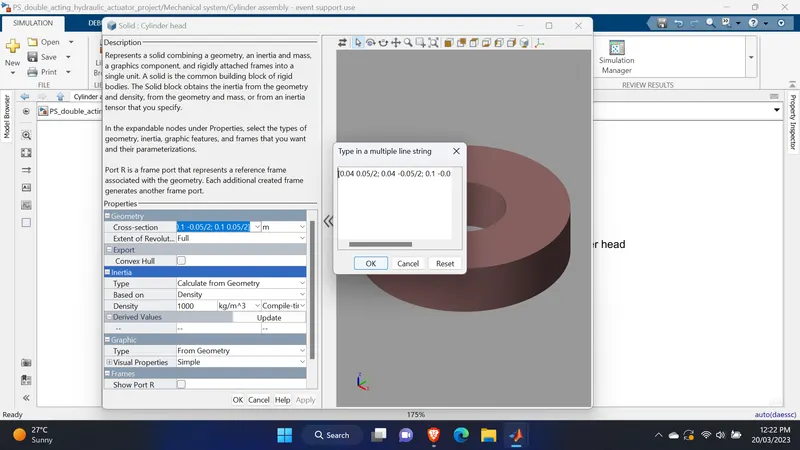
Cylinder head:
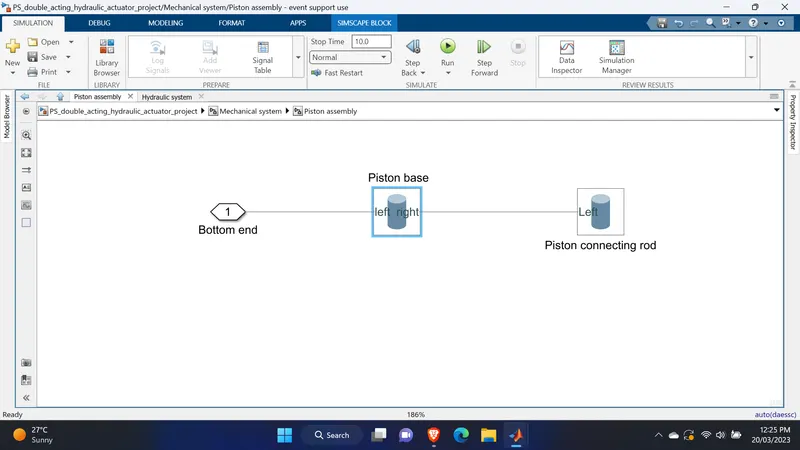
Piston Assembly:
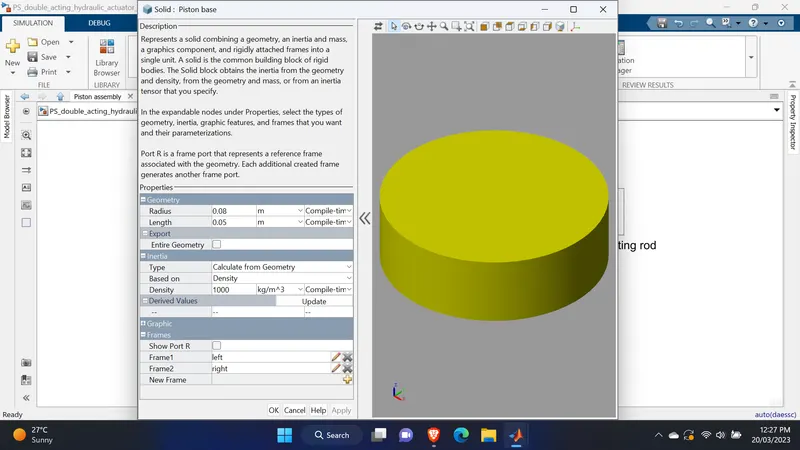
Piston base:
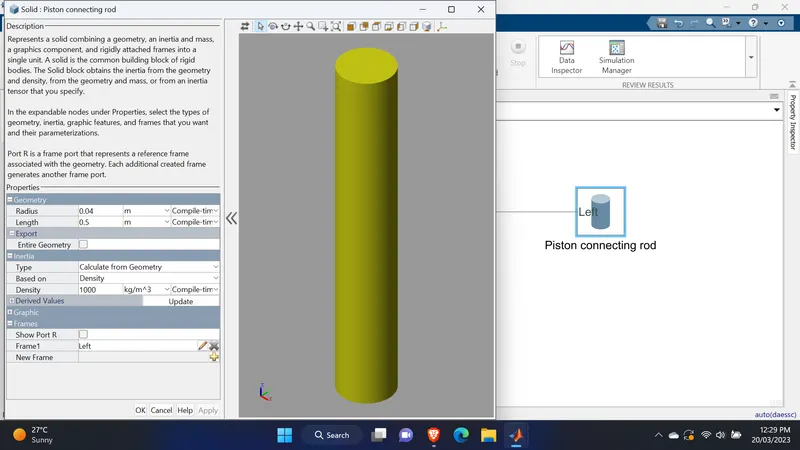
Piston connecting rod:
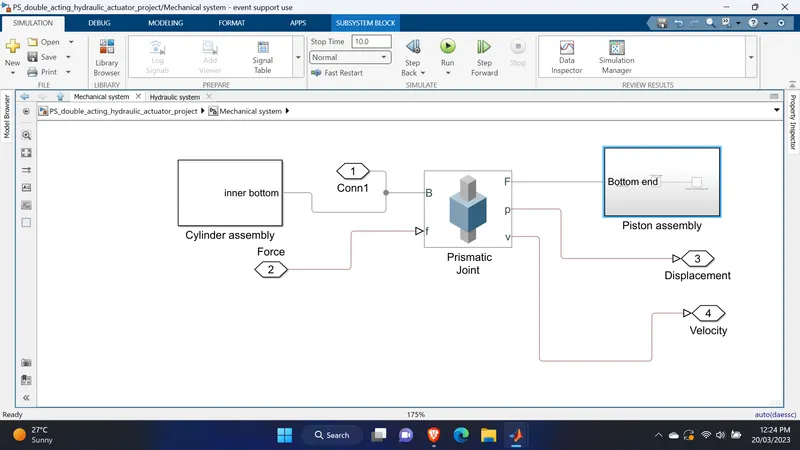
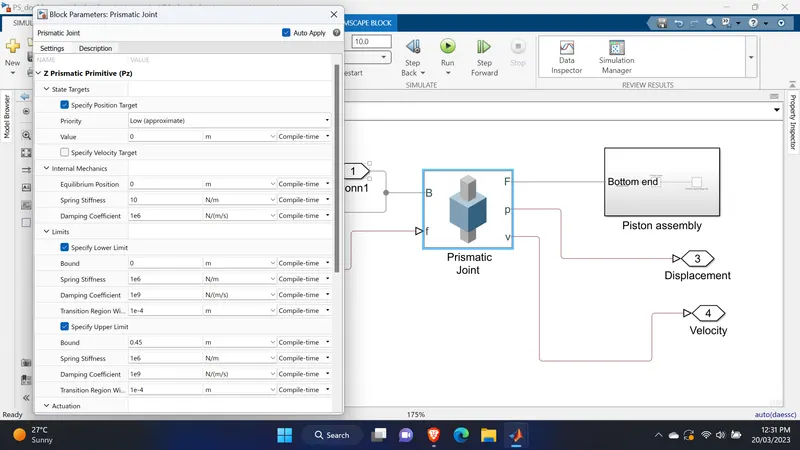
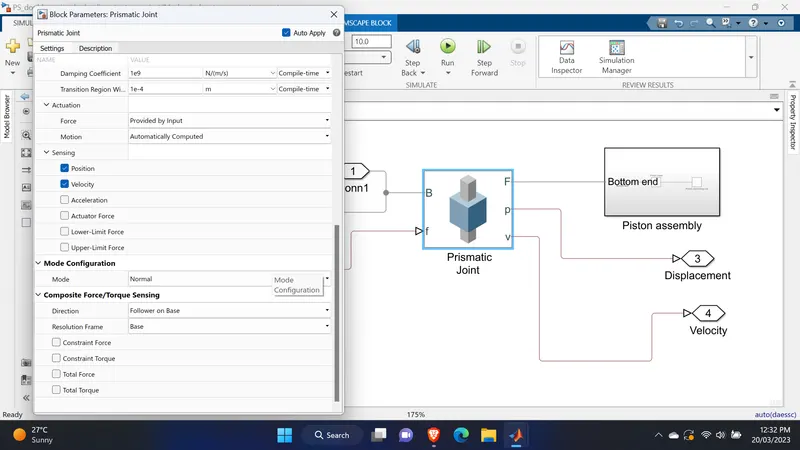
Prismatic joint:
Hydraulic subsystem:
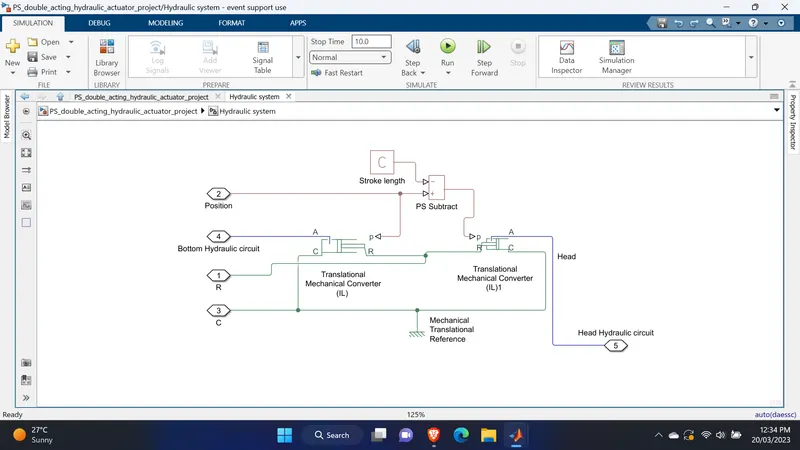
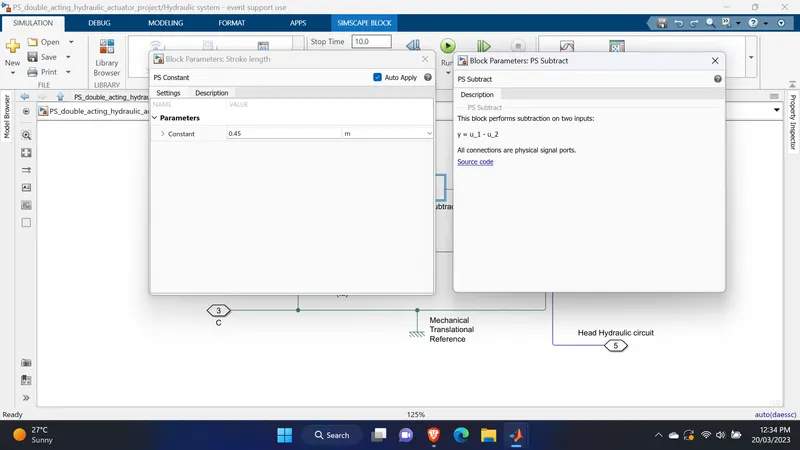
Stroke length:
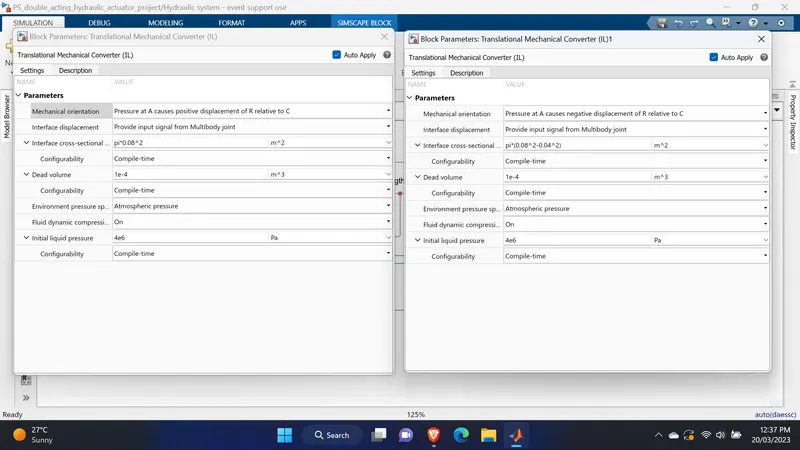
Translational mechanical converter:
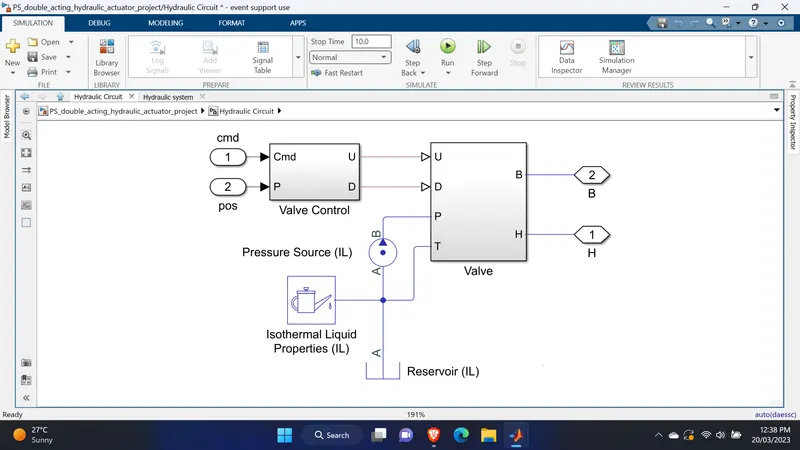
Hydraulic Circuit:
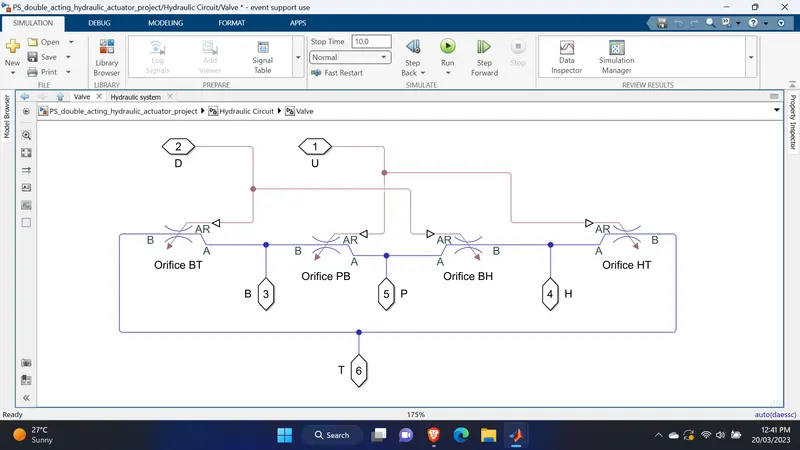
Valve:
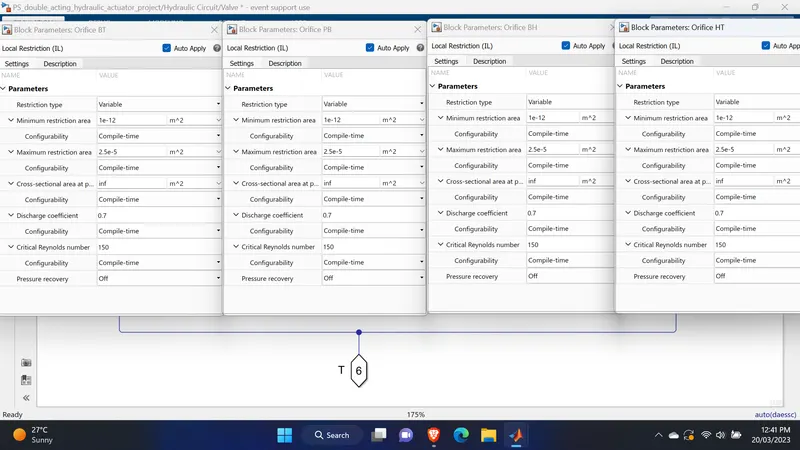
Valve control:
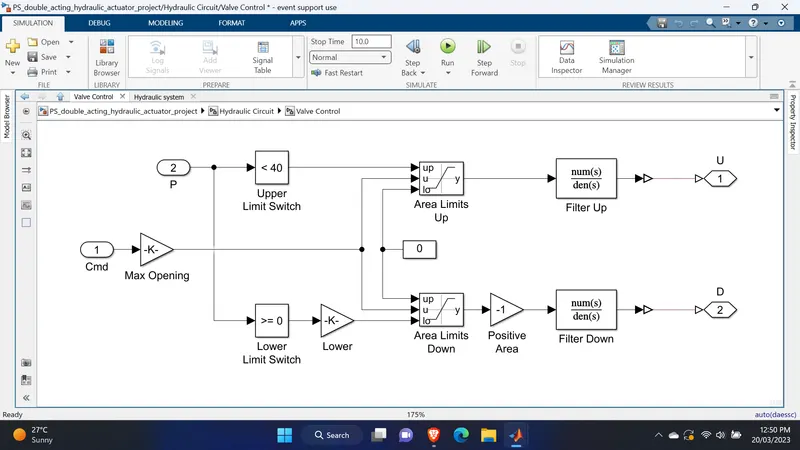
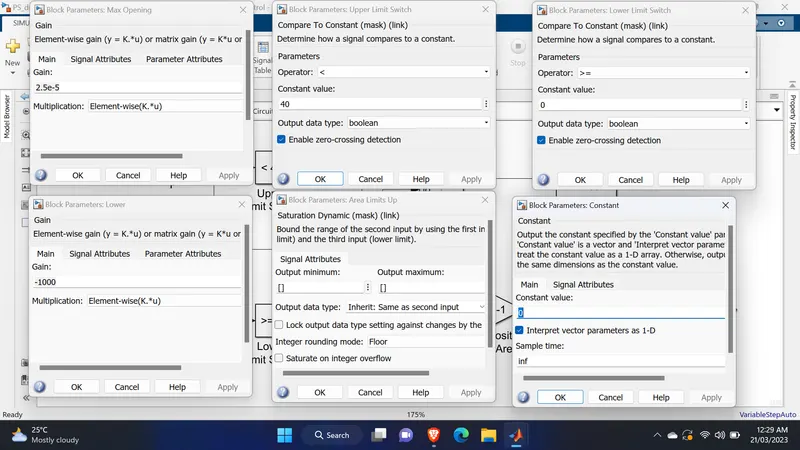
Blocks and transfer fcn used in Valve control:
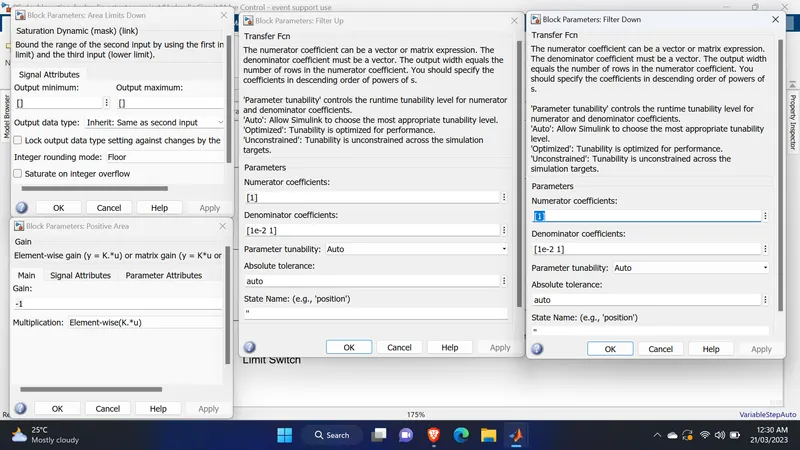
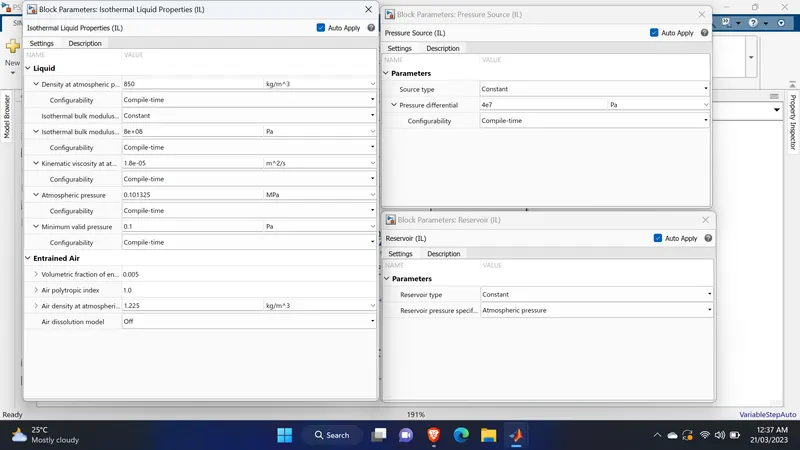
Pressure source,isothermal liquid & reservoir parameters:
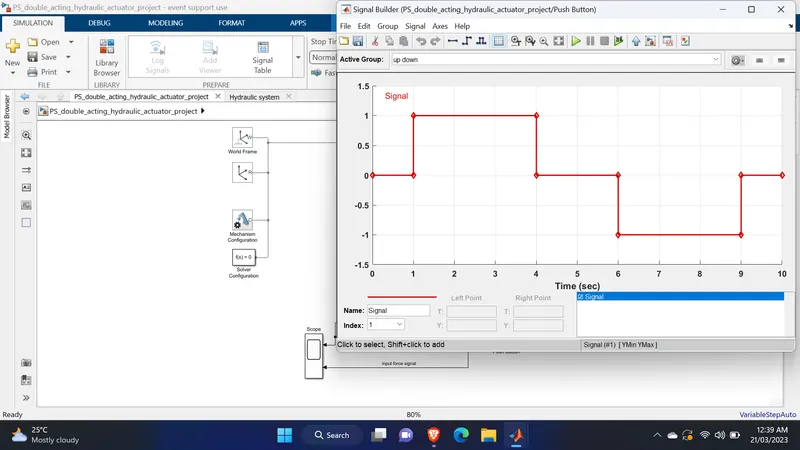
Signal builder:
Explanation:
Took the necessary Simscape multibody physical components & simulink blocks to build the model.
Used the default physical components for simscape multibody like, world frame,mechanics explorer,solver configuration.
Used reference frame.
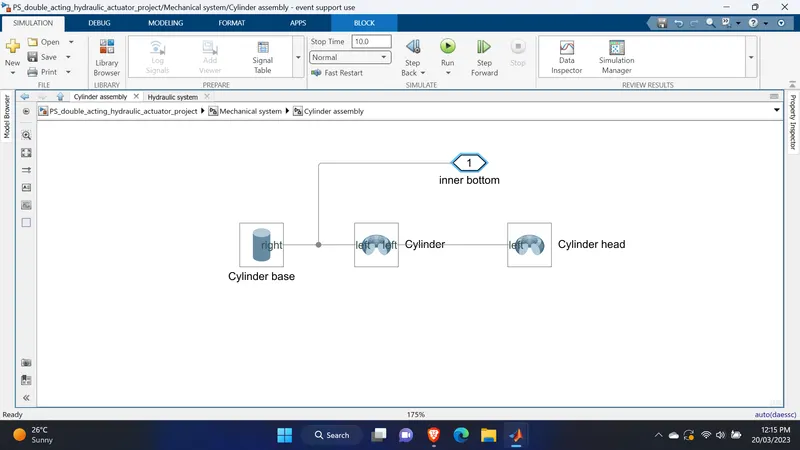
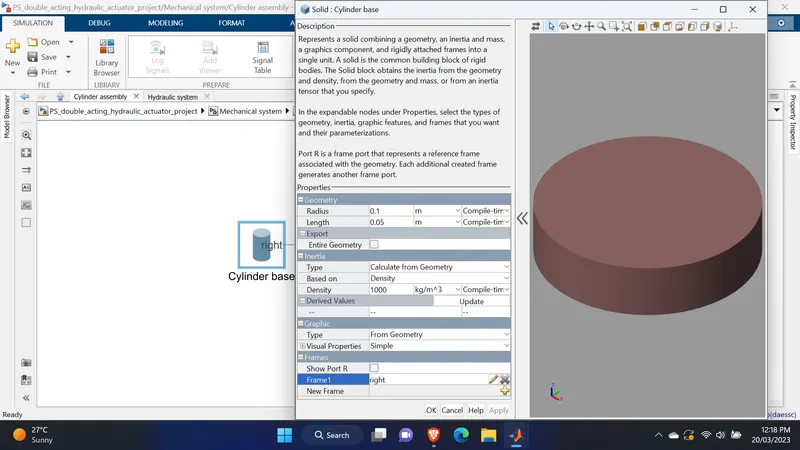
Built the cylinder & piston model and used prismatic joint for translational movement. connected the ports in order to move the piston.
Modelled the hydraulic system model used by translational mechanical converter & applied constant value for the stroke length as 0.45 M.
Used translational multibody reference to connect the mechanical subsystem & hydraulic subsystem.
modelled hydraulic circuit.
used signal builder block for the input force signal.
ran the simulation for 10 seconds.
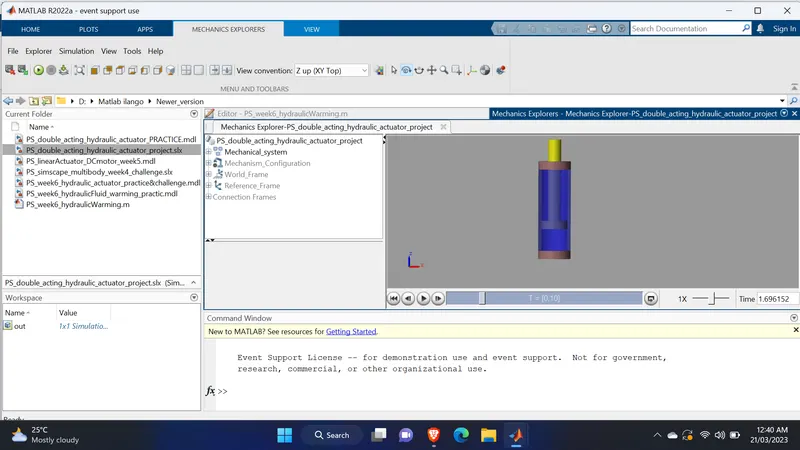
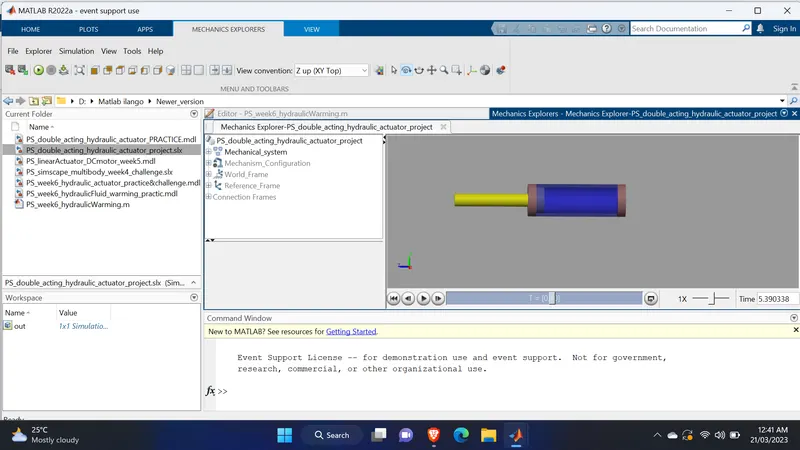
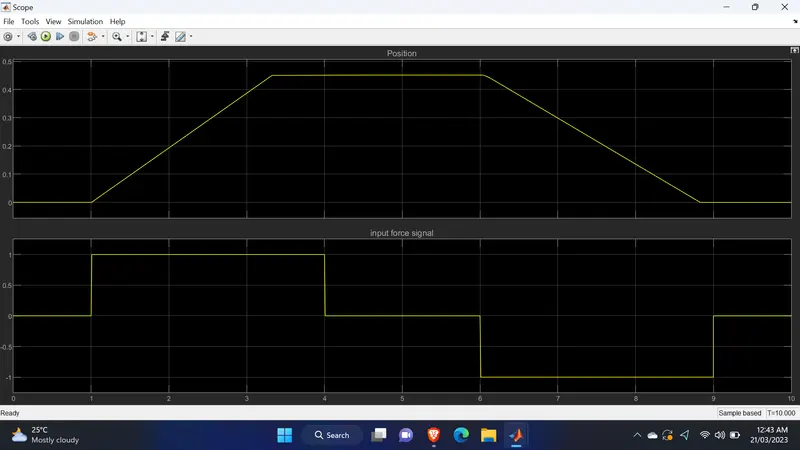
obtained the results in the scope block and the mechanics explorer & attached the results.
Scope Result:
Mechanics explorer double acting actuator movement: