Project 1
% Initialization File
% Initialization file for loading the variables for the Conventional vehicle simulation model
% Vehicle Parameters
M = 1500; % Vehicle weight [kg]
Cr = 0.015; % Rolling resistance coefficient
Rw = 0.35; % Rolling radius [m]
Cd = 0.33; % Drag coefficient
Af = 2; % Frontal area [m2]
rhoa = 1.225; % Air density [kg/m3]
Vwind = 0; % Wind velocity [kmph]
g = 9.81; % Gravitational acceleration [m/s2]
theta = 0; % Slope [deg]
myu_road_tire = 1; % Coefficient of friction between tire - road interface
Tm = 150 ; %Motor torque
efft = 0.8; %Transmission efficiency
ratio = 2.45; %Total ratio
% Vehicle top speed
Vveh = sqrt((efft*ratio/Rw*Tm - Cr*M*g)*2/rhoa/Af/Cd);
Vveh_kmph = 18/5*Vveh;
%% Power for top speed
Fload = 0.5*rhoa*Cd*Af*(Vveh+Vwind)^2 + Cr*M*g*cosd(theta) + M*g*sind(theta); %Road load in N
Pload = Fload*Vveh/1000; % Road load power in KW
%%% Powertrain speed
omegam = ratio*Vveh/Rw;
omega_rmp = omegam*30/pi;
%% Powertrain Parameters
FDR = 3.73; % Final Drive Ratio / Diff Ratio
DiffEff = 0.99; % Differential efficiency (assumed independent of operating conditions)
NumGear = 4; % Number of gears in transmission
TransGear = [1:NumGear]; % Transmission Gears
TransRatio = [3.06, 1.62, 1, 0.7]; % Corresponding Transmission ratios
TransEff = 0.90; % Transmission efficiency (assumed independent of operating conditions)
TC_SR = [0, .5, .6, .7, .8, .87, .92, .94, .96, .97, 1]; % Torque Converter Speed Ratio (Matlab default) -> TurbSpd/PumpSpd
TC_TR = [2.232, 1.5462, 1.4058, 1.2746, 1.1528, 1.0732, 1.0192, 1, 1, 1, 1]; % Torque Converter Torque Ratio (Matlab default) ->
TurbTrq/PumpTrq
TC_Cf = 1e-4 * [.72558, .66322, .63463, .59042, .51331, .4144, .29287, .22444, .12186, .04386, 0]; % Torque Converter Capacity
Factor (Matlab default) -> PumpTrq/PumpSpd^2 [Nm/rpm^2]
load Vehicle_Data/Engine_data_1_9L_Saturn_95kW
load Vehicle_Data/Trans_Shift_map
%% Driver Parameters
Kp = 10; % P gain for driver PI model
Ki = 1; % I gain for driver PI model
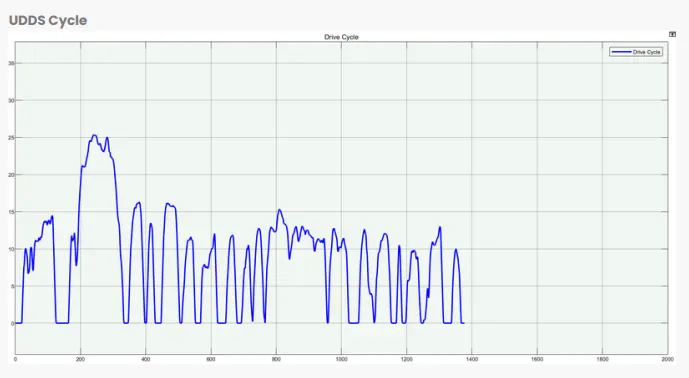
Drive_Cycle_Select = 1; % Drive cycle selection
% Drive cycle values in m/s
if Drive_Cycle_Select == 1
load DriveCycles/UDDS;
elseif Drive_Cycle_Select == 2
load DriveCycles/HWFET;
elseif Drive_Cycle_Select == 3
load DriveCycles/FTP;
elseif Drive_Cycle_Select == 4
load DriveCycles/US06;
elseif Drive_Cycle_Select == 5
load DriveCycles/NEDC;
elseif Drive_Cycle_Select == 6
load DriveCycles/WLTP;
end
time_end = cyc_time(end);
vel_end = cyc_vel(end);
Vehicle Model
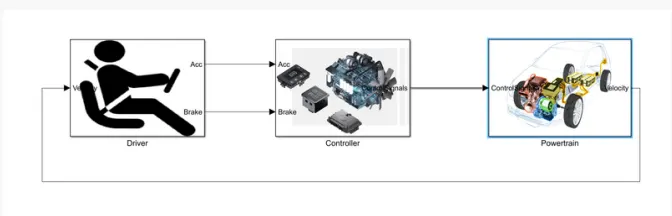
Driver Model:
A driver model is a mathematical model which replicates the functionality of a driver( controlling , monitoring and
stabilizing a vehicle )during various maneuvers . In this case, it a PI controller is a basic PI controller that generates
accelerator and brake pedal outputs to match the desired and actual vehicle speeds.
Controller Model:
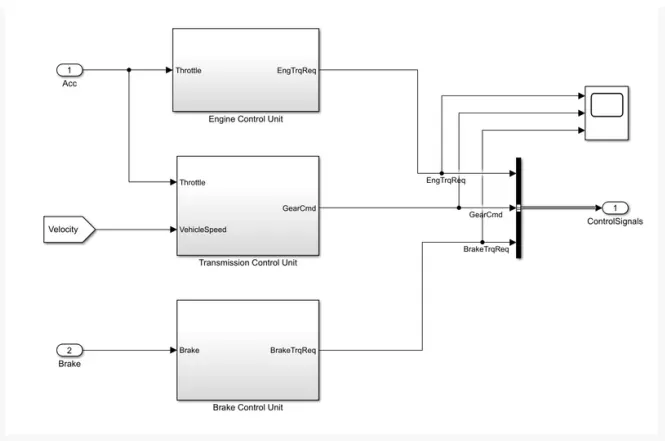
The Controller block represents the electronic controls units. It is based on the driver inputs, it generates desired engine
torque, desired transmission gear and desired brake torque. These inputs are fed to the ‘Powertrain’ block which
represents the drivetrain of the vehicle.
Engine Control Unit:
Idle Speed Controller
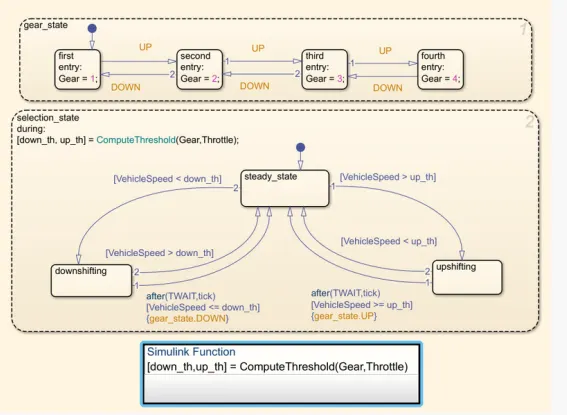
Transmission Control Unit
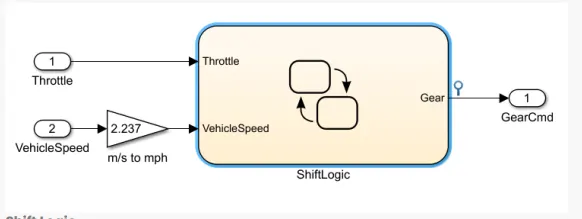
Shift Logic
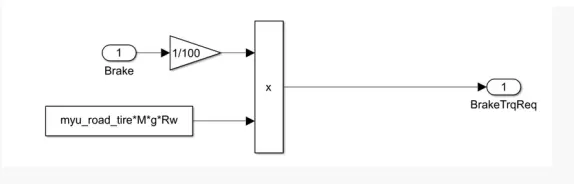
Brake Control Unit
Powertrain Unit
Objective of powertrain modeling is to analyse the powertrain for various drive cycles & vehicle target performances to
decide, Traction Motor sizing (Motor nominal & peak torque and current, RPM, Operating Points at various loads &
speeds, motor Power, motor efficiency & motor regeneration energy possibilities etc.)
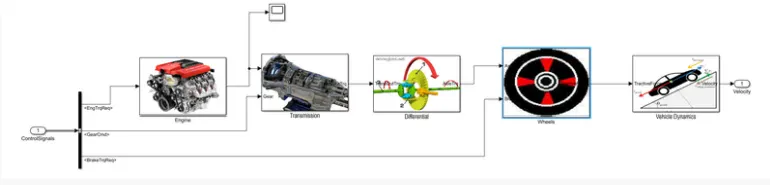
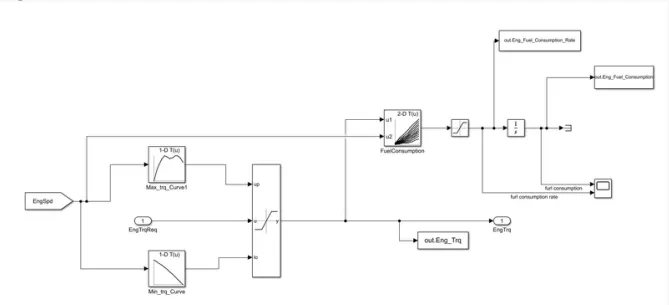
Engine
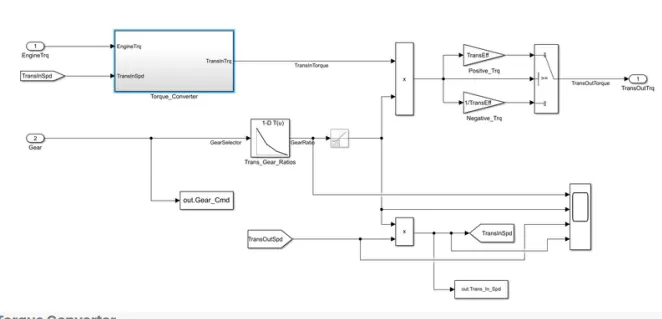
Transmission
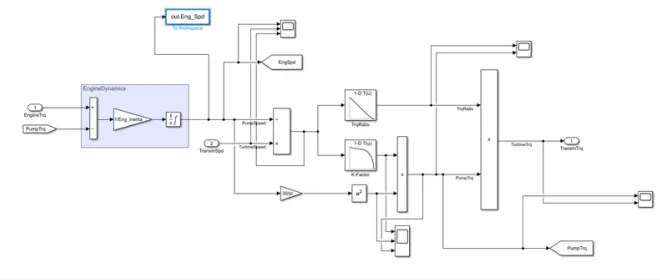
Torque Converter
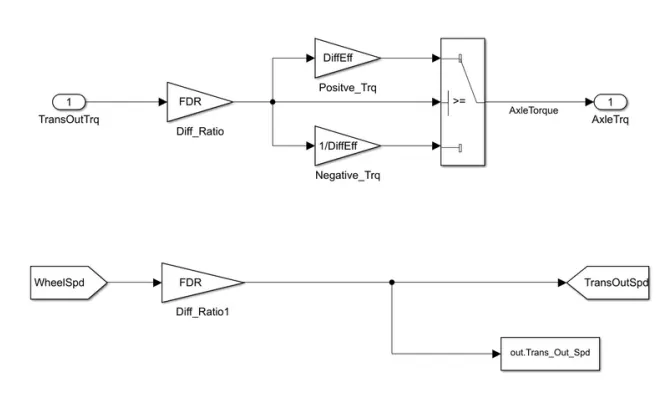
Differential
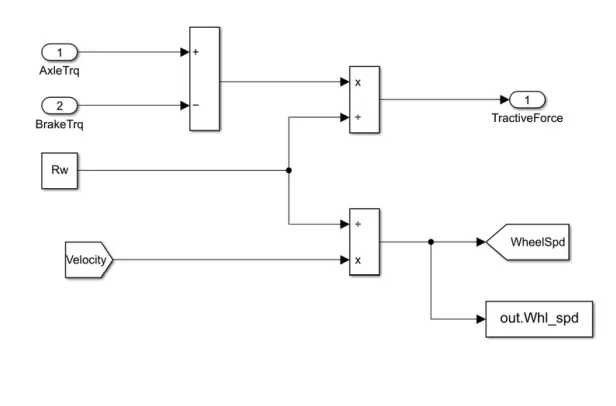
Wheels
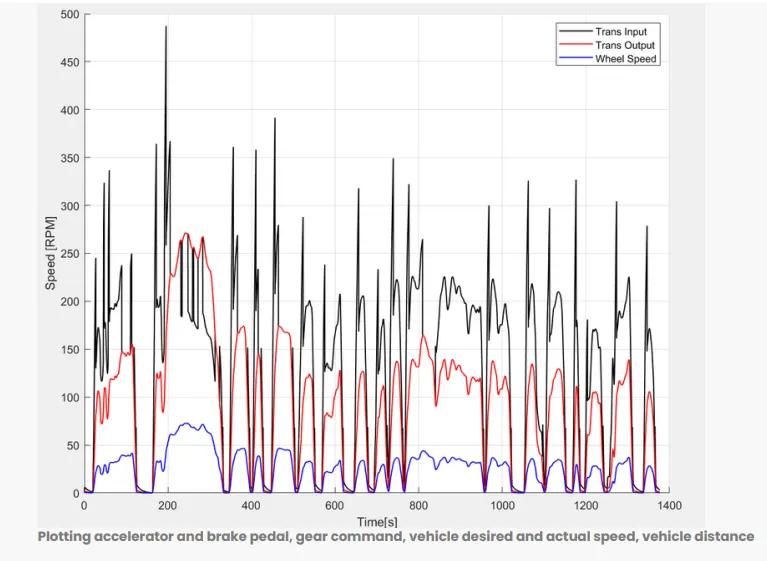
RESULTS :
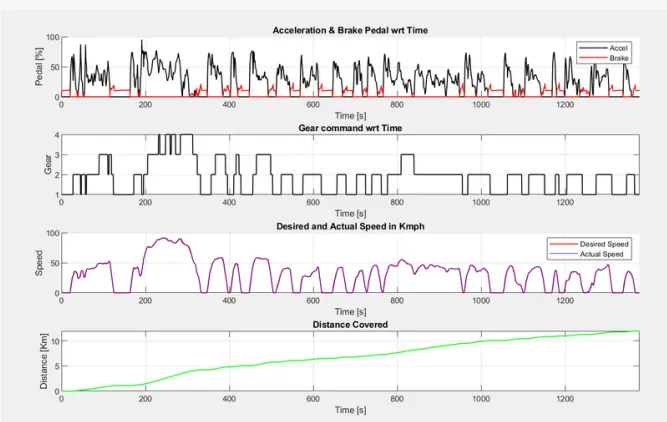
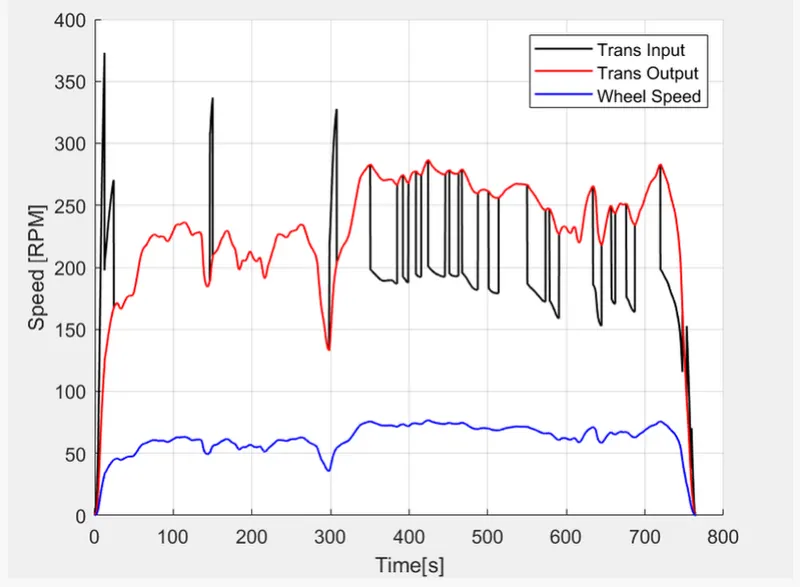
Plotting time trace for engine transmission input & output speed and wheel speed :
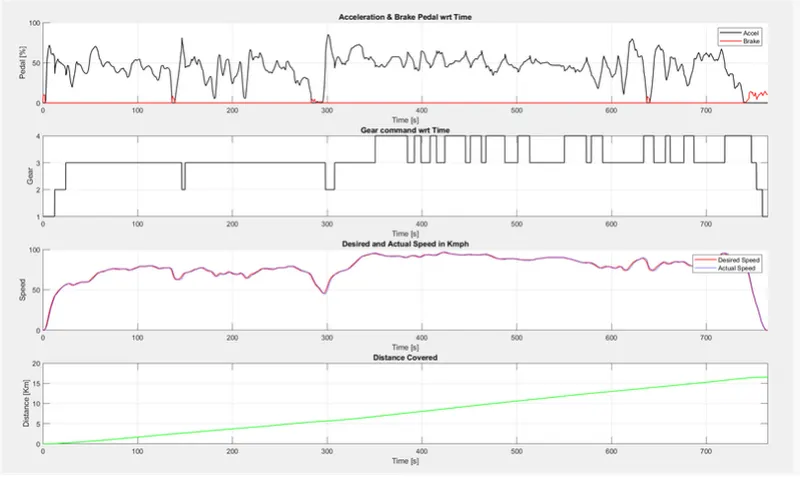
plotting accelerator and brake pedal, gear command, vehicle desired and actual speed, vehicle distance
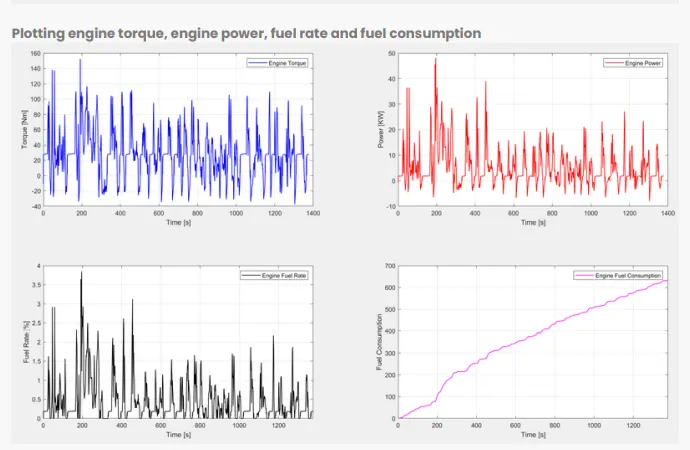
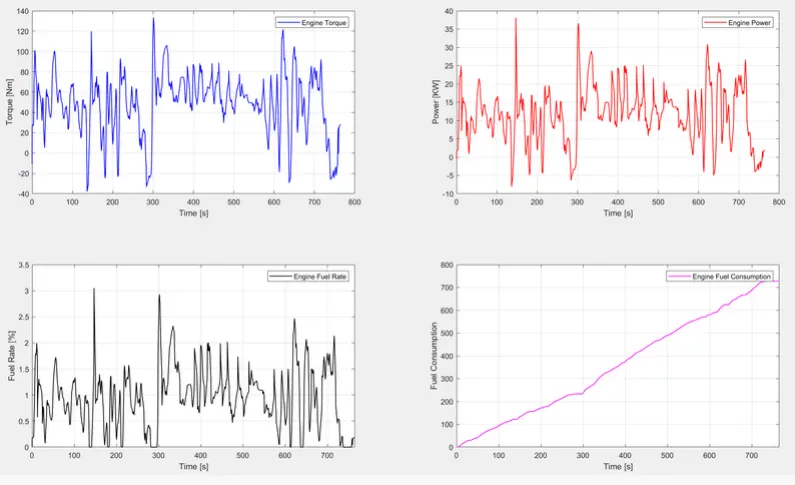
Plotting engine torque, engine power, fuel rate and fuel consumption
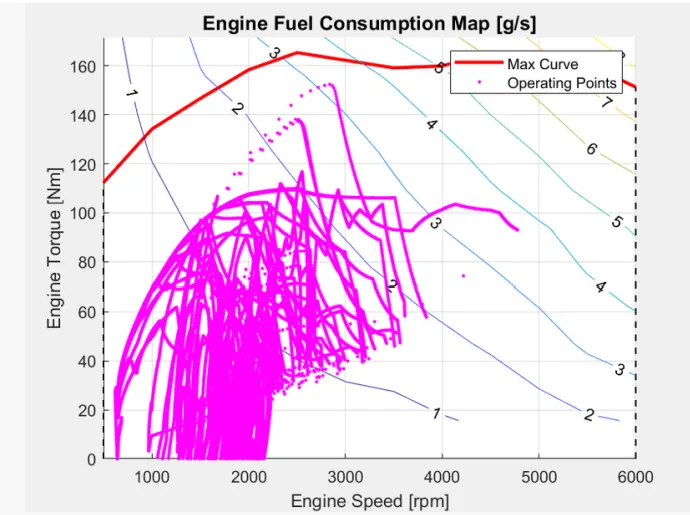
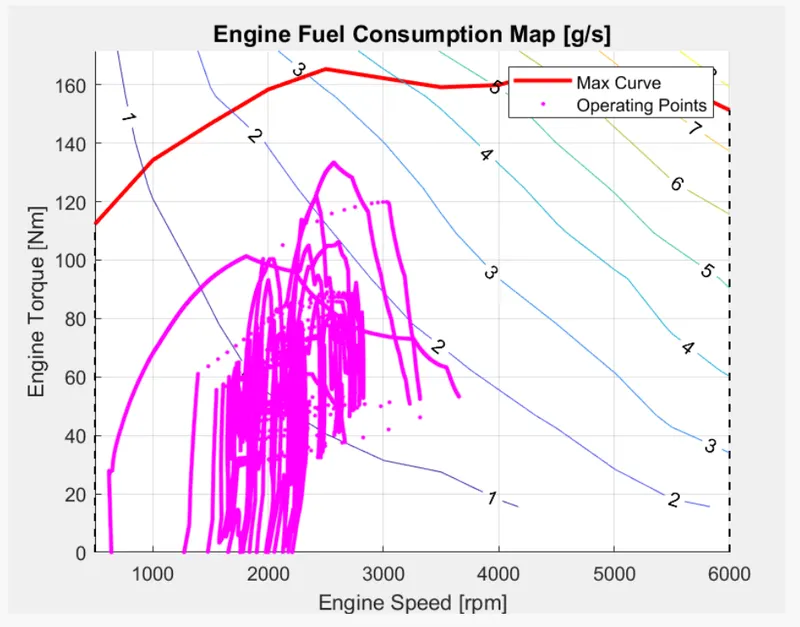
Plotting engine operating points on engine fuel map
Plotting time trace for engine transmission input & output speed and wheel speed
Plotting accelerator and brake pedal, gear command, vehicle desired and actual speed, vehicle distance
Plotting engine torque, engine power, fuel rate and fuel consumption
Plotting engine operating points on engine fuel map
Observations:
fuel economy numbers (kmpl) for UDDS and HWFET cycle :
UDDS -> 13.63 km/litre
HWFET -> 16.3072 km/litre
The fuel economy numbers shows that highway fuel economy is higer than the city fuel economy. Form the graph of
acceleration and brake pedal it is clearly observed that there is a lot more braking and idling in UDDS than in the HWFET.
Hence highway fuel economy , maximum and mean speeds are higher in HWFET. Also, the fuel consumption and fuel
rate are higher in HWFET due to higher maximum and mean speeds and lesser disruptions.
Power consumption and Engine torque:
Power consumption and Engine torque are more in the UDDS compared to HWFET cycle because it has too many starts
and stops compared to
HWFET. More power is required when starting from rest and more torque is required to overcome static friction.
Accelerator, brake pedal and gear shifting:
For UDDS, the accelerator and the brake pedal have more fluctuations due to frequent starts and stops. But in HWFET, the
brake pedal fluctuations are almost near to the zero line as there are no frequent stops or disruptions.
UDDS cycle mostly runs on 1st, 2nd gears, and 3rd and 4th are rarely used as it is not possible to achieve high speeds in
city traffic. In the HWFET cycle, the vehicle mostly runs on 3rd, 4th gears as it will be moving at high speeds. 1st, 2nd
gears are used rarely and only when braking is required.
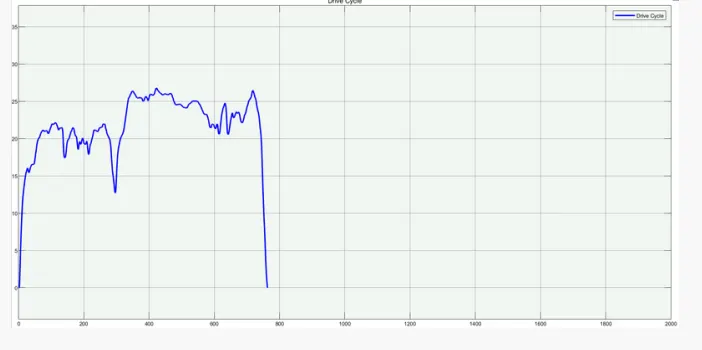
vehicle speeds(maximum and mean speeds) are higher in HWFET compared to UDDS. UDDS has more fluctuations in
the speed due to frequent braking.
The distance travelled in the given time will be high in HWFET than UDDS in a given time as there are no disruptions like
frequient braking due to city traffic.