Project 1
This method for form-finding and analysis of hyperelastic tensegrity structures based on a special strut finite element and unconstrained nonlinear programming. The strut element can function as a hyperelastic truss element with an initial cut in its undeformed length or as a strut element that shows constant force irrespectively of its nodal displacements. For the hyperelastic strut element, the invariants of the Right Cauchy-Green deformation tensor are written in terms of the element's nodal displacements and the cut in the element's undeformed length. The structure's total potential energy is expressed as function of its nodal displacements and the cuts in the elements’ undeformed lengths. The minimization of this function is a nonlinear programming problem where the displacements are the unknowns.
The form-finding procedure is performed by a static analysis where the stiffness matrix maybe singular along the path to equilibrium without causing convergence problems. The mathematical model includes the element's cross-sectional deformation while the element moves in space, fully modelling its three-dimensional character. The constraint for incompressibility is satisfied exactly, eliminating the need for a penalty or augmented Lagrangian method.
Structural analysis is the process of calculating and determining the effects of loads and internal forces on a structure, building or object.
The membrane structures are a really special in analysis requirement , which is the consequence of their virtually zero bending stiffness and also lack compression strength. Hence, the stability loss occurs due to local buckling immediately even at low compression stresss, which implies tension in the whole membrane. Therefore, if compression occurs, a special treatment has to be performed in the implemented codes.
The geometric non - linearities of the tensile structures are accounted in the form- finding phase and equilibrium of the form is attained. However, material properties were not accounted during the form - finding stage.
Key concerns that are dealt in the structural analysis phase are as follows
- Material properties
- External loads
- Compresssion requirements of the structure
- Wrinking of membrane structures
- Analysis of supporting members
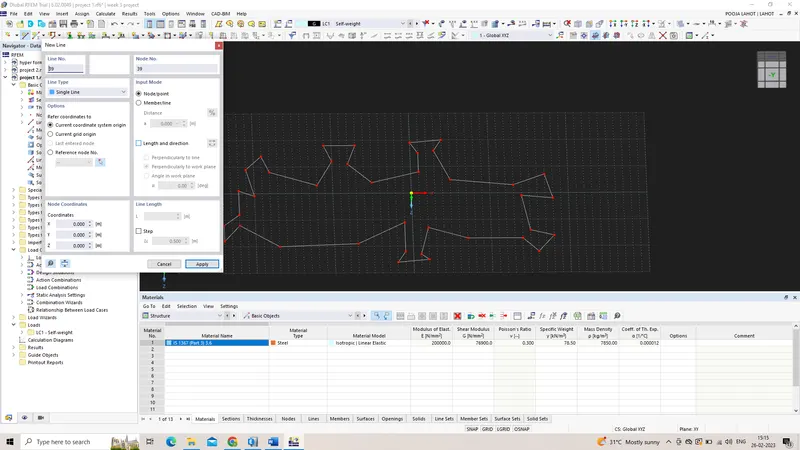
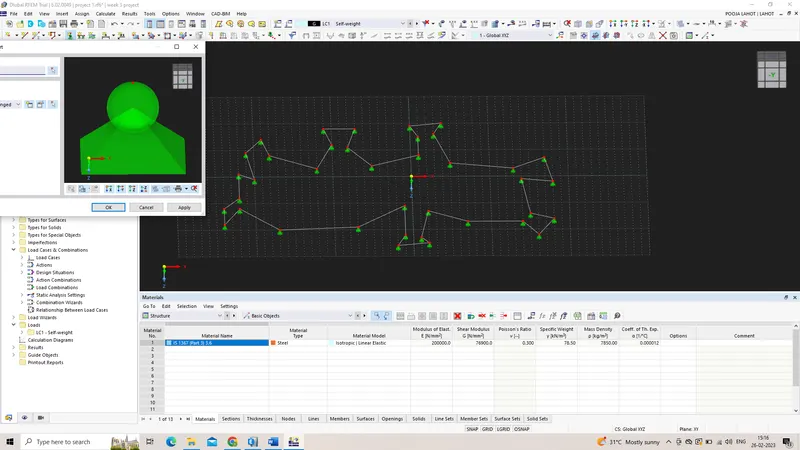
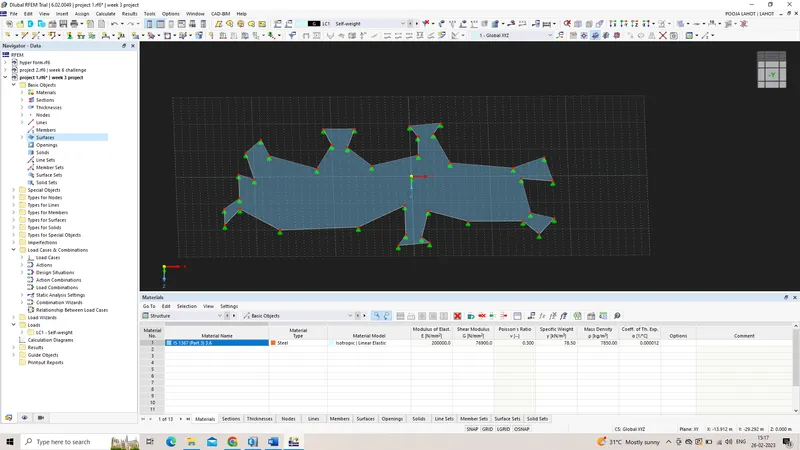
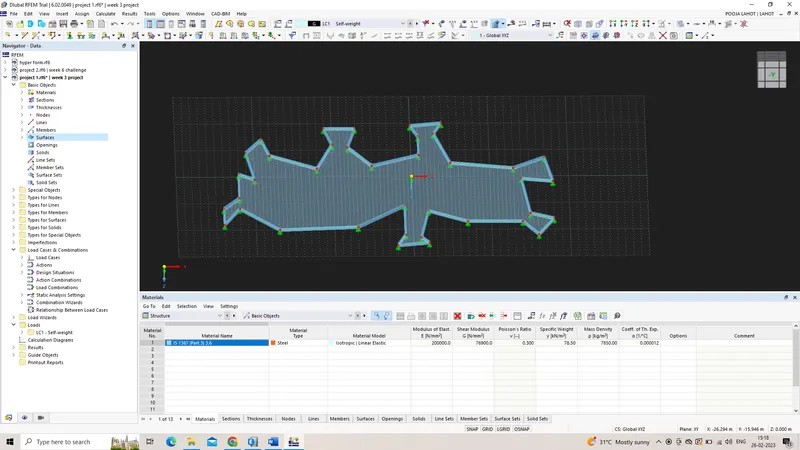
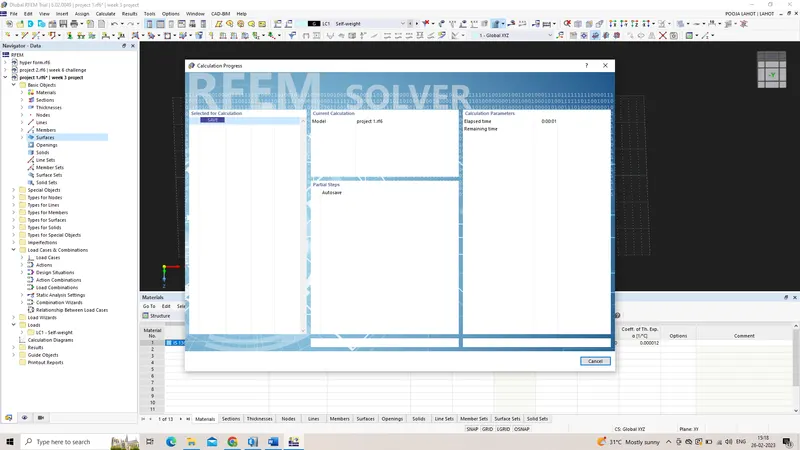
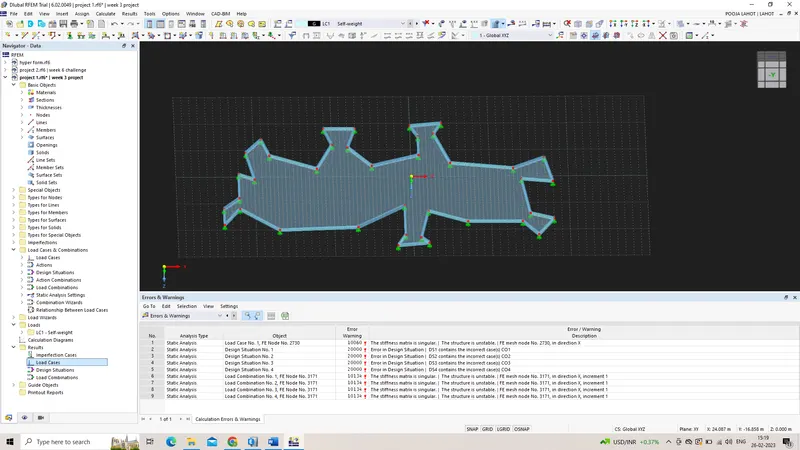
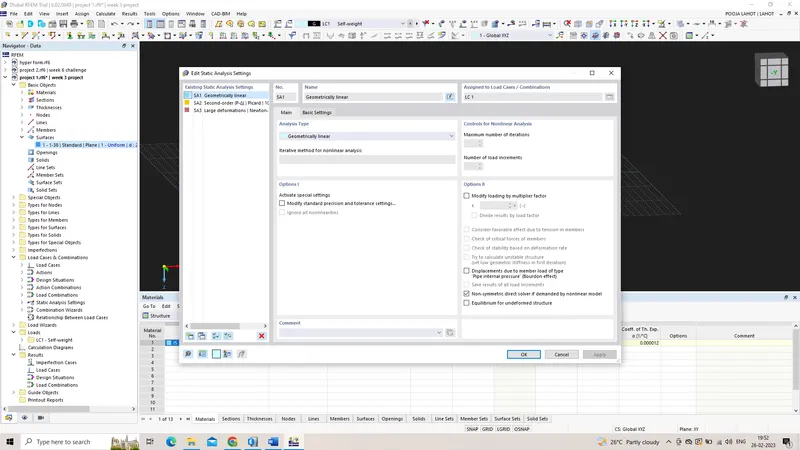
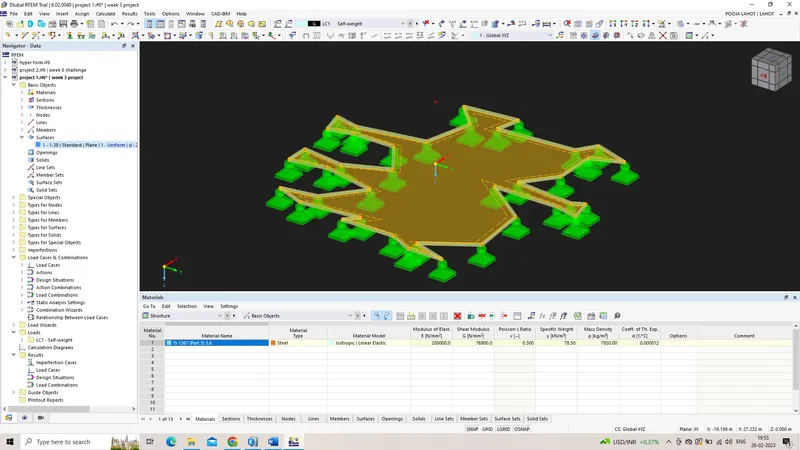
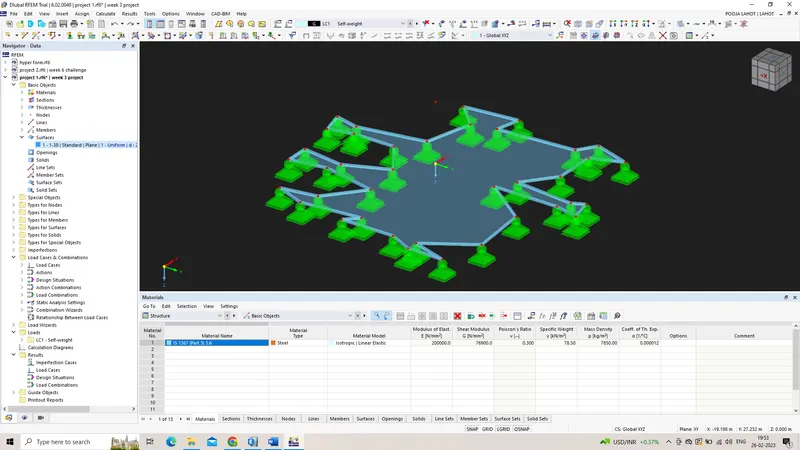
Refrence RFEM file is attached below
SOME OF THE FUNCTIONS CAN NOT BE PERFORMED DUE TO RFEM SOFTWARE TRIAL VERSION