Project 1
Introduction-
- Crutches are a sort of walking aid that serves to broaden a person's base of support. They transfer weight from the legs to the upper body and are frequently used by those who are unable to use their legs to maintain their weight (from short-term injuries to lifelong disabilities).
Types of crutches -
Crutches are classified into three types: axilla crutches, forearm crutches, and gutter crutches.
Axilla or underarm crutches: Place two fingers between the axilla and the axilla pad, with the elbow flexed between 20 and 30 degrees.
-
[1]Axilla crutches - The design consists of an axilla bar, a handpiece, and two uprights linked distally by a single leg. They are height adjustable; both the overall height and the handgrip height can be modified (about 48 to 60 inches / 12 to 153 cm).
-
[2] Forearm crutches: (or lofstrand, elbow or Canadian crutches). They have a single upright, a forearm cuff, and a handgrip. Forearm crutches are measured from the handgrip to the floor (adjustable from 29 to 35 inches / 74 to 89 cm).
- [3] Crutches for Guttering or adjustable arthritic crutches, forearm support crutches) Another form of crutch that consists of a padded forearm support made of metal, a strap, and an adjustable handpiece with a rubber ferrule. These crutches are utilised for patients who can only bear partial weight and are especially beneficial for customers with rheumatoid arthritis.
A sketch of forearm crutch-
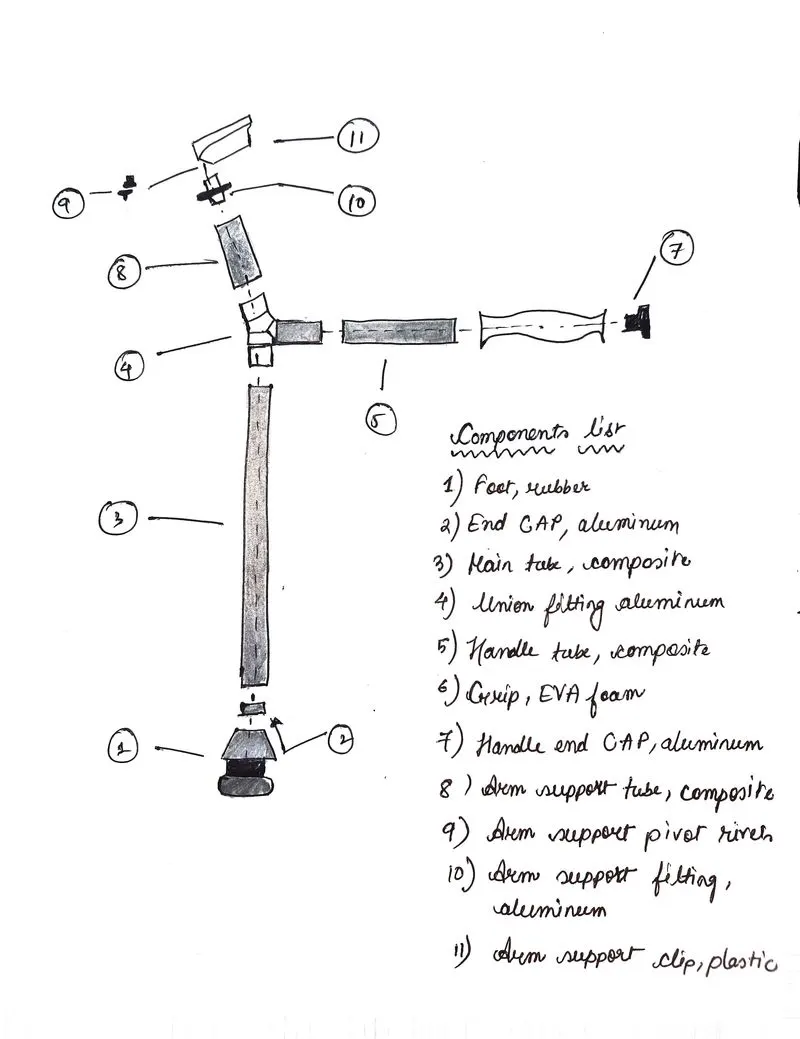
Main Parts of the crutch-
An elbow crutch or forearm crutch is made up of the following components: a frame, cuff, grip handle, tip, and height adjusters.
1. The frame is constructed of aluminium alloy. It is light in weight due to its great strength and low density.
2. The cuffs are constructed of Nylon, a plastic with great strength and stiffness that provides adequate support to the user.
3. The grip handles are either rubber or the same material as the cuffs. Rubber is more comfortable than plastic.
4. The rubber tip of the elbow crutch provides adequate grip and stability. It also keeps you from slipping while walking.
5. Height changes can be made using either pins or clamps. Both are composed of stainless steel and have a high abrasion resistance, making them both robust and strong.
Materials used for the main parts -
The forearm crutch is made up of a frame, grip handle, cuff, tip, and height adjustments. Each of these parts is produced from materials with mechanical qualities that best suit the needs of the respective part.
- The frame of a forearm crutch is typically constructed of an aluminium alloy. Aluminium has a low density and consequently a low weight, making it mobile and manoeuvrable. It is also quite strong, so the crutch can support a person's entire weight without bending or buckling. Aluminium is also easy to process and corrosion resistant, ensuring a long life.
- On the forearm crutch, plastic cuffs are used. It is typically constructed of plastic, such as Nylon-6/6. It has good abrasion and hydrocarbon resistance to withstand the repeated friction and skin contact while walking. It also features a high strength and rigidity to offer the user with adequate support.
- The forearm crutch grip handles can be made of the same plastic as the cuffs or of rubber. The plastic is more resistant to wear and tear, while the rubber is more pleasant and can absorb more stress.
- The forearm crutch's tip is constructed of rubber. The rubber provides a lot of traction and stability to keep you from slipping when walking.
- It also has strong shock absorption, which helps to reduce the impact of walking.
- Height adjustment devices come in a variety of shapes and sizes, including adjustment pins and clamps. Stainless steel is commonly used for these mechanisms. This creates a stable link between the various elements of the main frame by providing high strength and minimum deformation. It also has a strong abrasion resistance, making it long-lasting and suitable for outdoor use.
Manufacturing process of the forearm crutch -
The process begins with feeding the plastic polymer into the machine's heating unit to melt it. The molten material is then pressed through high pressure injection into the specific mould cavities to form either the arm cuff, hand grip, or rubber tip, and the material passes through an opening known as sprue. The cavities are then filled, and more material is injected into the machine than is required to fill the moulds, to compensate for shrinkage that will occur as the material begins to solidify. The moulds are then held together until the item has been fully shaped and cooled before being opened and the object discharged from the machine.
- This type of manufacturing is ideally suited for the production of plastic products.
- Because of its precision and accuracy in shaping parts, as well as the complexity of the forms it can manufacture, this unique manufacturing is ideally suited for making plastic materials like as arm cuffs and hand grips, as well as rubber.
Conclusions-
Suggestions for improving the crutch
- Customers complain that standard forearm crutches, which are constructed of aluminium, are too heavy, noisy, and weak. Customers assert that even a slight weight decrease for forearm crutches would greatly lessen user fatigue.
- However, there shouldn't be a loss of strength in addition to the weight loss. The majority of crutches on the market are made for short-term usage only and degrade soon. Users of crutches typically need to change them two to three times a year. This necessitates the redesign of forearm crutches to make them more durable, suitable for a variety of users—from lighter people to users up to 250 pounds—with strong upper bodies who may use them violently on a regular basis.
Suggestions-
- Utilizing a crutch made of lightweight composite material that performs well in terms of strength is one possibility. It is, however, comparatively pricey. It should be follow after a thorough market analysis, to outsource the aluminium union fitting component, use the suitable composite tube, and use Hysol adhesive to attach the tubes to the union fitting.
- Curving the crutches-
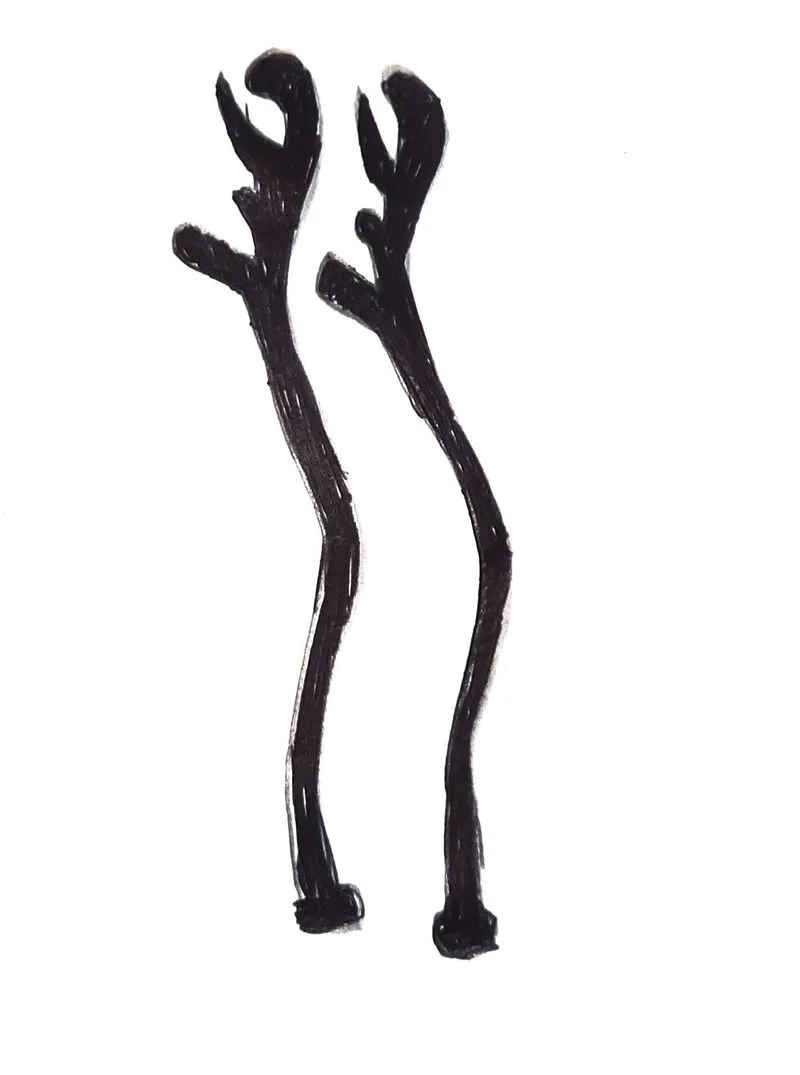
- Fig - Curving forearm scrutch
- By bending the crutches, they effectively transform into shock absorbers, greatly reducing the impact on the user's upper body. Additionally, it will enable the user to retain energy to go ahead after the crutch straightens, saving the user a great deal of work and reducing the discomfort and exhaustion of using crutches over longer distances.
Reference-
https://web.stanford.edu/group/rrd/Projects/2kprojects/crutch/crutch.html
https://www.researchgate.net/figure/Exploded-view-of-a-forearm-crutch